
 Login
Login
Troubling new details emerge on diabetes ouster controversy
Last month, we reported on a troubling incident at the annual meeting of the American Diabetes Association (ADA) in New Orleans. On June 5, five leading scientists were ousted for handing out copies of an editorial, published in the journal Diabetes Care (an ADA journal) in April, sharply criticizing the Trump administration’s ongoing attacks on scientific research. There was a public outcry and (eventually) a personal apology from the ADA's CEO for the heavy-handed response, but it seems the organization has not yet learned its lesson.
The deputy editors of Diabetes Care have posted an editorial and seven accompanying opinion articles to a preprint server—handily contained in a single PDF file—that they say the ADA has refused to publish. Several troubling new details are included in the articles, including an accusation that ADA leadership knew in advance that members would be handing out copies of the editorial and deliberately set up an ambush by venue security and local police. That decision, in turn, might be due to simmering tensions connected to a session organized the year before.
ADA leadership was provided with the articles in advance of publication with an invitation to simultaneously publish their response.


© Screenshot/MedPage Today
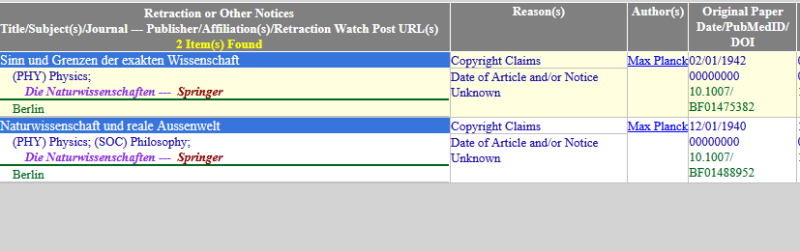
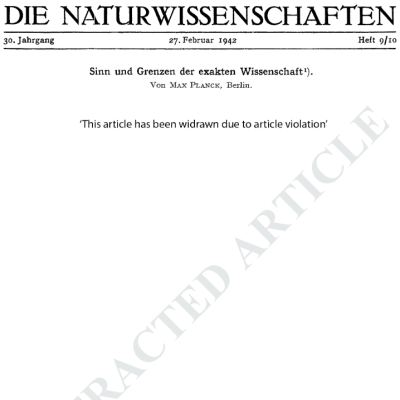 In the world of scientific publishing there are many reasons why a paper can be retracted, but generally there is an obvious and clearly communicated reason for doing so. Thus when [Yves Gingras] – a historian of physics – and [Mahdi Khelfaoui] – a colleague – noticed recently that two 1940s papers by [Max Planck] had been quite recently retracted, this resulted in an eyebrow-raising double-take, before naturally