Teledyne FLIR Defense has won a $48 million U.S. Army contract to fit Bulgaria’s new Stryker fleet with the same upgraded chemical, biological, radiological and nuclear reconnaissance sensor suite now going to U.S. Army units, the company announced on Oct. 26. U.S. Army Contracting Command at Aberdeen Proving Ground, Maryland, awarded the contract under a […]
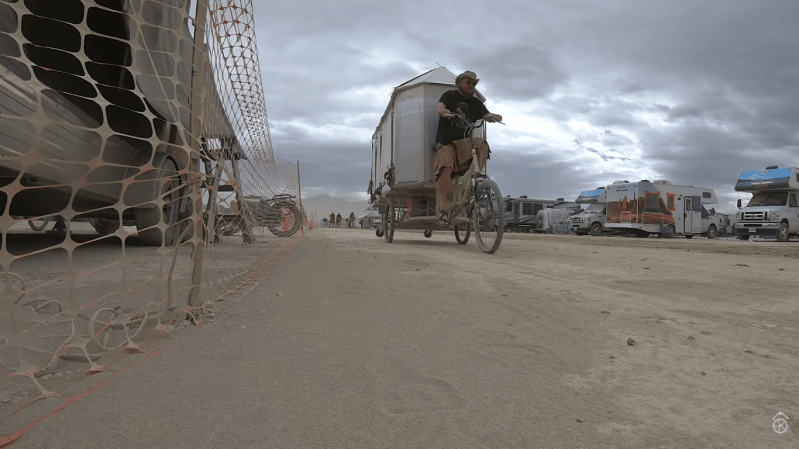
Bicycles are the ultimate form of transportation freedom. They’re easy to repair, parts are cheap, and they will travel almost anywhere for free, as long as the rider has enough calories. Their only real downside is dealing with car-dependent societies, but once a year there’s a place in the American desert that eschews all of this and [Attoparsec] decided to take this custom cargo bike modified into an RV out to Burning Man, a place and time that would be perfect for a build like this.
The build started out as a cargo bike, but not many of them have cargo areas long enough to support a sleeping human. To increase this storage capacity, the bed was extended towards the rear. Without moving the axle further back, though, this created a problem with tail-heaviness so two trailer jacks with wheels were added to the back to keep it from occasionally tipping up too far. The sleeping enclosure was built with rigid foam insulation and taped together, in a modified style common to the Burning Man event which helps keep out sun and playa dust. The bicycle recived one last upgrade to the chain to support the extra weight, and a solar-powered refrigerator, and then it was off to the desert.
The bike RV worked well in the end, and even handled a rain storm without the roof leaking. There were some problems with the customized drive train which were solved in the short term by pounding on one of the wheels occasionally with a hammer. [Attoparsec] left the event early for other reasons, though, and might not be back for a while. But vehicles like these are gaining in popularity, presuming there are safe places to ride them. [Paul Elkins] is often making ones like this gas-powered bicycle and trailer camper.
Fiserv’s digital-asset platform is live, with Bank of North Dakota’s Roughrider Coin as its first production use case.
Roughrider Coin transactions are processed on Solana, while VersaBank serves as issuer and Fireblocks supplies tokenization and security infrastructure.
The deployment gives Solana a live role inside a regulated interbank payment product rather than another retail crypto application.
Solana has picked up a very different kind of workload: moving a bank-backed stablecoin inside a US financial institution network.
Fiserv said on October 1 that its digital-asset platform is now live with financial-institution clients. The first production use case is Roughrider Coin, a dollar-backed stablecoin created for Bank of North Dakota and designed to make interbank money movement more efficient across the state.
Transactions run on Solana.
The stack combines banking, tokenization and a public blockchain
Roughrider Coin is not simply a token deployed by an anonymous smart-contract team.
VersaBank serves as issuer, Fireblocks provides digital-asset infrastructure and tokenization services, and Fiserv connects the product into financial-institution systems. Solana handles blockchain transaction processing underneath that structure.
That division of roles is what makes the deployment interesting.
Traditional banks are unlikely to replace their entire technology stack with a crypto wallet. They are much more likely to adopt blockchain settlement when it is embedded inside vendors, compliance systems and operational processes they already understand.
Solana is increasingly being used as payment infrastructure
The network’s reputation was built heavily around fast trading, memecoins and decentralized exchanges.
Stablecoins are changing the composition of activity. Bitcoinist reported this summer that Solana’s stablecoin market cap crossed $15 billion, giving payment and treasury applications a much deeper liquidity base.
A state-linked banking use case pushes the network another step in that direction.
It does not mean Bank of North Dakota is speculating on SOL. The blockchain is being used as settlement infrastructure beneath a dollar-denominated financial product.
The bigger question is whether Fiserv can repeat the model
One bank stablecoin is useful evidence, but Fiserv’s distribution is what could make the story much larger.
The company supplies technology to financial institutions at scale. If its digital-asset platform becomes something banks can adopt through an existing vendor relationship, blockchain settlement stops being a bespoke innovation project and starts looking more like another banking feature.
Roughrider Coin is the first live use case. The number of institutions that follow will tell us whether it becomes a template.
—
This article was written by the News Desk and edited by Samuel Rae.

 Login

 Teledyne FLIR Defense has won a $48 million U.S. Army contract to fit Bulgaria’s new Stryker fleet with the same upgraded chemical, biological, radiological and nuclear reconnaissance sensor suite now going to U.S. Army units, the company announced on Oct. 26. U.S. Army Contracting Command at Aberdeen Proving Ground, Maryland, awarded the contract under a […]