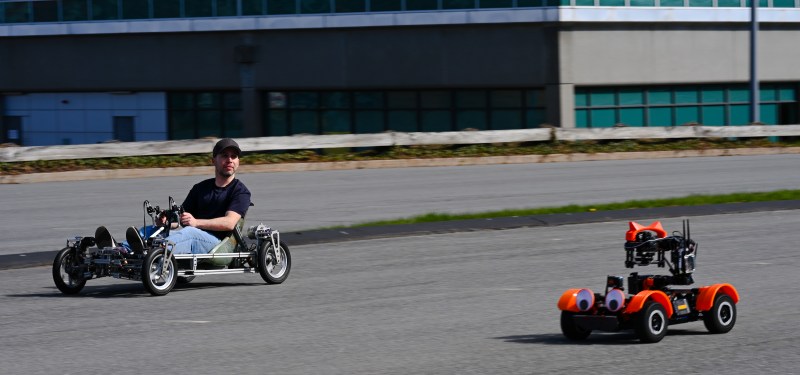
Modern cinema relies very heavily on quadrotor drones, because they make for very smooth, very easy to position platforms. From slow pans to chase shots, drones are great– if your shots can be taken at a high enough altitude. Close to the ground, things get a bit dodgier. That’s where [Transistor Man]’s camera chase vehicle comes in— it’s a rover, so it excels close to the ground. In fact, it can’t go anywhere else, except perhaps if provided with a jump. It’s got a hefty gimbal to hold the camera steady on any terrain, a decade-old surplus radio to provide full HD FPV to the remote driver, and a powerful 1/5th scale radio control rally chassis to make it all go. Plus googly eyes, because everything is better with googly eyes.
It looks like an enormous amount of fun to drive, but more importantly it provides smooth, cinematic shots from the professional Sony camera held in the gimbal. One big takeaway is that when 3D printing something that will bounce around this much, you can’t rely on pure strength– flexible filaments are your friend. Just about everything printed ended up remade in TPU if it didn’t start that way. The other takeaway is that we’ve reached enough of a technological plateau that if you scrounge around, you can build something to take a top-of-the-line footage with decade-old castoffs, like the gimbal and radio used in this project, which is a great thing for hobbyists and small studios.
If you can’t find surplus, you could always DIY a gimbal. We’re not filmmakers, but we find ourselves wondering how shots made with this rover would compare to a camera slider.
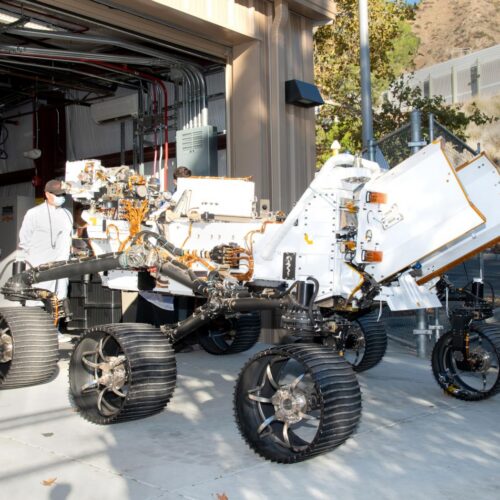
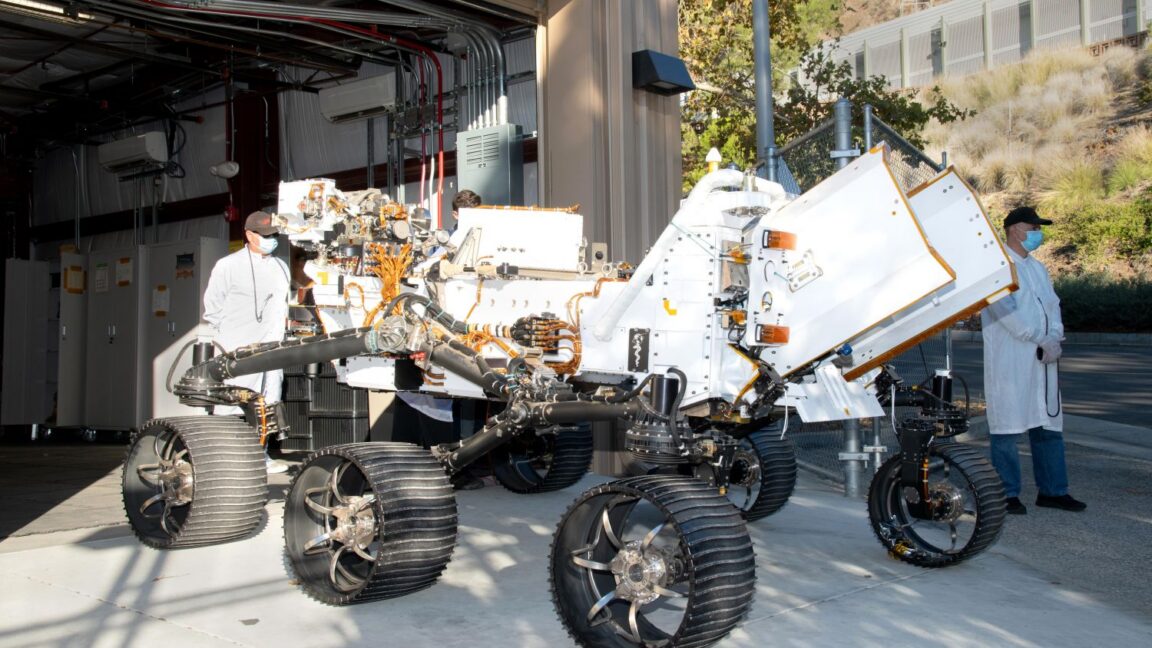
An engineering development version of the NASA rovers currently operating on Mars takes a spin at the Jet Propulsion Laboratory in California. (NASA via YouTube)
NASA is considering repurposing an engineering development version of the nuclear-powered Mars rovers for a different destination: the moon’s south polar region.
The plan calls for turning the test rover, which is currently sitting at NASA’s Jet Propulsion Laboratory, into a lunar explorer named PROMISE (“Polar Rover for Observation, Mapping and In-Situ Exploration”).
During an update on the space agency’s long-range plan to build a moon base, NASA Administrator Jared Isaacman stressed that the PROMISE mission was still being defined, but added that “there’s very little that would hold us back from making use of that hardware.”
NASA is already planning to send a rover called VIPER (“Volatiles Investigating Polar Exploration Rover”) to the moon by the end of next year. But Carlos García-Galán, NASA’s program manager for the Moon Base effort, said PROMISE would bring some capabilities that VIPER lacks. For example, PROMISE’s plutonium power source makes that rover more suited for exploring permanently shadowed lunar craters that are thought to contain valuable water ice.
“VIPER uses solar power, so we’re constrained to the terrain that we put it on, how much illumination that’s going to get, the time of year, where it can go,” García-Galán explained. “It could certainly not potentially go into some of these permanently shadowed regions and stay deep in there — and then, based on the lunar nights, it will have a lifespan that’s limited.”
In contrast, the nuclear-powered Curiosity rover is still going strong 14 years after landing on Mars, and the Perseverance rover is still persevering after five years of operation.
Today’s Moon Base update provided a status report on several aspects of NASA’s plans to build a permanent base on the moon in the 2030s. Among the highlights:
A robotic lunar lander that’s being built by Jeff Bezos’ Blue Origin space venture “looks like it’s almost done,” García-Galán said. The Blue Moon Mark 1 lander, dubbed Endurance, had been due for launch this year on Blue Origin’s New Glenn rocket, though a recent New Glenn explosion raised questions about the timeline. Isaacman said launching New Glenn was still “Plan A” for the Blue Moon mission. If the launch slips past mid-2027, NASA will look at other options, García-Galán said.
Two other missions for the first phase of the Moon Base program are also progressing. Astrobotic’s Griffin 1 lunar lander appears on track for launch this year, while Intuitive Machines’ Nova-C lander “is looking pretty good,” García-Galán said.
Isaacman pressed García-Galán to promise that one of the robotic landers would carry a soccer ball to the moon if the U.S. wins the World Cup. “We will absolutely find a space,” García-Galán replied. Isaacman said that would serve as “a little bit of motivation” for the U.S. team. “We’re going to one-up Alan Shepard and the golf game on the lunar surface,” the administrator told García-Galán. “We’re going to get the soccer ball there. I don’t know which lander it’ll wind up going on. I’ll leave that to you guys to handle the payloading.”
NASA officials said Tuesday that they are seriously considering sending the full-scale engineering model of the Perseverance rover, which is currently housed at the Jet Propulsion Laboratory in California, to the Moon to expedite their efforts to explore the south pole region.
The car-sized rover nicknamed "Promise," which serves as a testbed for Perseverance and was not otherwise planned for a launch, would land equipped with a multi-mission radioisotope thermoelectric generator (MMRTG) to power it across difficult terrain and through the lunar night. NASA's other rovers primarily operate on solar power.
"We are thinking very hard right now about sending Promise to the Moon," NASA Administrator Jared Isaacman said Tuesday during a monthly update on the agency's plans to build a Moon base.

 Login
Login