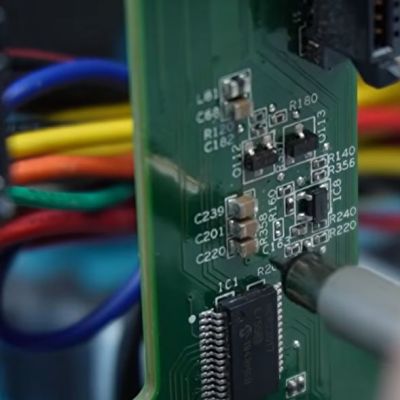
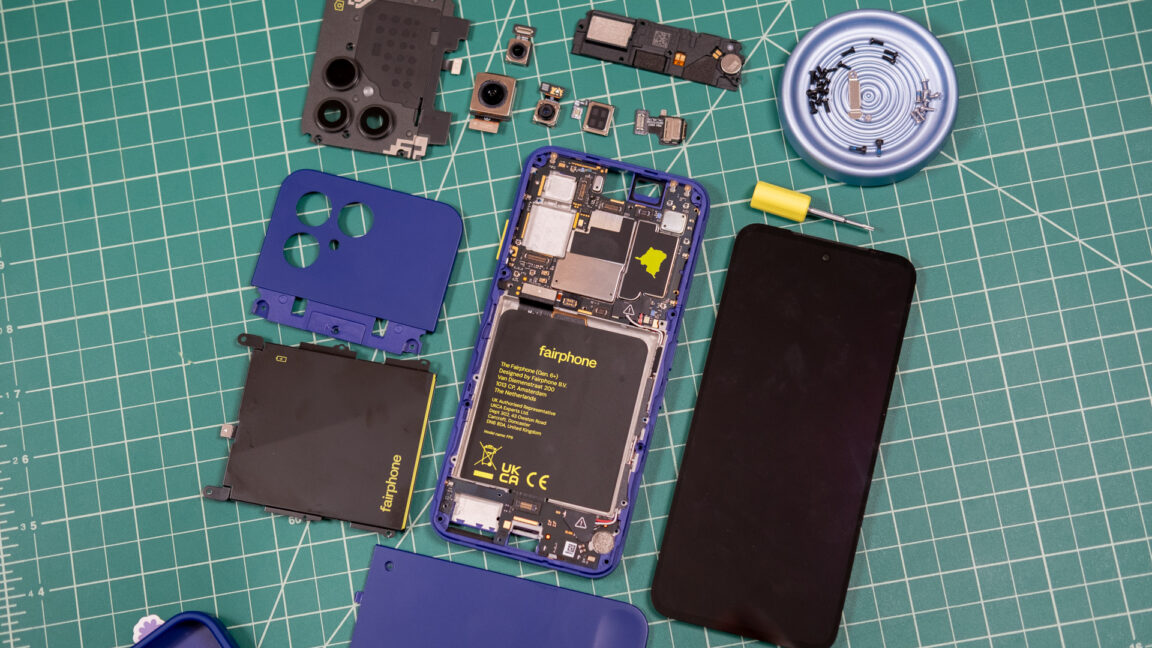
Would you buy a broken device, fix it, then return the repaired item? [Team Repair] hopes you will.
Many people would rather repair what they have than have to get a new device and deal with all the annoyances of shopping and getting used to a new item. The problem is, most people donβt have any experience fixing their broken electronics and are intimidated by the process. [Team Repair] has found that helping people through the process the first time is a big confidence boost, especially when they have a test piece to work with.
[Team Repair] started with workshops and now has a βFixers Clubβ subscription box for 8-14 year olds where they will send a broken device every three months to fix. After the device is repaired, it gets sent back into Team Repair, or iFixit in the US, to be broken again and sent to the next fixer. For grownups, there is a similar smartphone repair kit, but itβs currently waitlisted. If youβre in the UK, they even have a classroom program if you want to recruit larger groups into your fixer corps.
[ALT CINE] took a punt recently when purchasing a damaged RED Komodo camera online. In functional form, the 6K-capable camera sells for several thousand pounds (or dollars, or euros), whether used or brand new. However, [ALT CINE] was able to score the damaged unit for just Β£700. The question wasβcould it be repaired and turned back into a functional camera?
Things looked promising from the drop. The camera had just 3 hours of usage recorded in the firmware, and the casing seemed to suggest it had little use. However, the problem was soon revealed to be serious as the image sensor itself appeared to be damaged. Some research provided hope thoughβthat the damage could be limited to a glass layer in front of the sensor itself that had delaminated.
Thankfully, disassembling the camera was easy enough thanks to its modular design, and [ALT CINE] soon had the sensor block on the bench for further examination. The cause of the issue was apparentβoverzealous cleaning leading to fluid getting stuck to the rear of the filter in front of the sensor. Simply popping off the filter, cleaning and drying it properly, and reassembling, was enough to get the camera back to fully operational status.
REDβs repair service quoted $695 for a glass filter swap and $1,395 for a full sensor change. In contrast, [ALT CINE] was able to demonstrate that this repair was something easily within the realm of an intermediate camera tinkerer and it cost almost nothing to achieve. The video also covers an alternative potential repair route, wherein a DSMC2 filter can be subbed into a Komodo camera if the damage to the filter glass is otherwise unrecoverable.
A few years ago, France introduced a mandatory repairability score for consumer goods like laptops and tablets. It involves five criteria that range from documentation and availability of spare parts to ease of disassembly, with the manufacturer using a government-provided checklist to determine their score.
Recently Asus determined that their Asus ROG Flow Z13 β model GZ302EA β scored a 10 out of 10 using this system. This led [iFixit] to run the same tablet/laptop hybrid through their own rating system.
You can find the filled-out spreadsheet for this device here, with this Asus-provided site showing a list of devices that all score a 10/10 or a measly 9.9/10 according to this system. As a self-reported score it is hard to take it as the objective truth, as there is every incentive for the manufacturer to tweak the truth to their own benefit and gloss over inconveniences. This is where itβs interesting to compare it with [iFixit]βs 7/10 score.
On documentation, Asus gives itself a perfect score but [iFixit] finds it to be incomplete. Removal of one fan requires the disassembly of the cooler with its liquid metal thermal interface on the CPU. The wireless card, and most ports, are soldered to the mainboard. On the bright side, after you get the screen off, the insides are quite modular, which is a plus.
[iFixit] dings three points: for documentation, soldered-down components, and a fan accessibility glitch. Parts accessibility outside of France is also significantly harder, but one can hardly blame the French system for that. Overall the French self-reported rating would seem to be a fair start, but depending on which criteria you define as required you may find yourself disagreeing with the score.
In the case of LPDDR5 RAM one could argue for example that with LPCAMM2 modules soldering RAM onto the mainboard ought to be a thing of the past, and Wi-Fi modules should always be removable as well. You can take that up with the French regulators.
Although weβd rather bring you news of clever modifications and repairs down on the farm, more often than not, the name βJohn Deereβ has appeared on the pages of Hackaday because of their opposition to farmers actually being able to work on the machines their livelihoods depend on. But thanks to a settlement reached between the company and the Federal Trade Commission this week, farmers seem to have been handed a much-needed win in the Right to Repair battle.
When a lawsuit against a company ends in a settlement, it usually means spending money they would rather pay than go to court. Indeed, earlier cases against John Deere have resulted in plenty of checks being written. But this time around, the FTC agreement requires Deere to make its diagnostic and repair software available to owners and independent shops. It also has a clause that prevents them from retaliating against owners who want to handle their own repairs rather than going through the companyβs official service channels β hard to believe thatβs something that actually needs to be specified, but it does give you a hint as to just how bad the situation has been. Weβll definitely be keeping an eye on this story.
Sounds like the Feds were busy this week, as the Federal Communications Commission also gave the green light to Reflect Orbital to launch a prototype satellite for their controversial βsunlight as a serviceβ concept. The company plans to put the spacecraft into a roughly 600 km orbit around the planet, where it will deploy its 324-square-meter reflector and angle itself to illuminate a spot on the ground. It might sound like something a Bond villain would come up with, but Reflect Orbital says the capability will be used to beam sunlight directly onto solar panels at night and to provide light for search-and-rescue operations.
As you might expect, providing such a service on a global scale would require many such reflectors, which is where the concern really comes in. Critics note that a sky full of literal mirrors can cause all sorts of issues, ranging from the scientific to the scenic. The American Astronomical Society points out that each satellite in the constellation could appear to be four times as bright as the full Moon, and that itβs possible an amateur sky watcher could get an eyeball full of redirected sunlight should one of them unexpectedly zip past the aperture of their backyard telescope.
Moving from 600 km above to 400 meters below the surface of the ocean, the Royal Canadian Geographical Society and Woods Hole Oceanographic Institution have provided our first look at the wreck of Ernest Shackletonβs final ship, Quest. The schooner-rigged steamship was launched in 1917 and had a storied career that included not only a number of scientific expeditions but service during the Second World War. The ship ultimately met its fate in 1962 when it was damaged by ice and sank off the north coast of Labrador. The exact location of the wreck was unknown until its discovery in June of 2024.
Now, before you start questioning your knowledge of history, we should probably clarify that Shackleton was not exploring the Labrador Sea in 1962. He did, however, die aboard Quest in 1922 at the age of 47 as he was preparing to depart on another expedition to the Antarctic.
This next one isnβt new, but itβs the first time weβve come across this gallery of gorgeous Soviet-era control rooms. Hackaday isnβt the place to dive into the political and socioeconomic aspects of the USSR. All we know is that they were putting out some damn fine-looking control panels back then. Half of them look like they wouldnβt be out of place on a Moon base, and the white lab coats with the little hats really complete the retrofuturism vibe. Now we have to go watch Chernobyl again.
In software news, FreeCAD has received a new tool that we know many in the community will be excited about: Banana For Scale. Forget the confusion between Metric and Imperial measurements. Placing a 3D banana in the scene alongside your rendered part provides a globally recognized size reference. While the free and open-source CAD package has often been criticized for being behind its commercial counterparts in terms of user interface and overall feature set, we think this addition should go a long way toward evening the scales β no pun intended.
Finally, Phoronix reports that Linux 7.2-rc3 includes several vital updates to device drivers for the Sega Dreamcast. Users running Linux on the ill-fated PlayStation 2 competitor will benefit from improvements made to the keyboard, mouse, and joystick interfaces. These fixes join the improved code for the consoleβs GD-ROM optical drive that emerged back in April. The βYear of the Linux Desktopβ continues to be elusive, but it certainly looks like 2026 may finally be the Year of Linux on the Dreamcast.
See something interesting that you think would be a good fit for our weekly Links column? Drop us a line; weβd love to hear about it.