Eric Wu, who built and ran Opendoor before stepping away in 2022, has had his new company, NavigateAI, out of stealth since May — building AI copilots that give construction workers real-time, hands-free guidance through smartphones and Meta's AI glasses, backed by $25 million from Elad Gil, Khosla Ventures, and Lennar to tackle a labor shortage severe enough that data center projects alone now need 4,000 to 5,000 workers apiece.
An artist’s conception shows one of Cowboy Space’s data centers in Earth orbit. (Cowboy Space via LinkedIn)
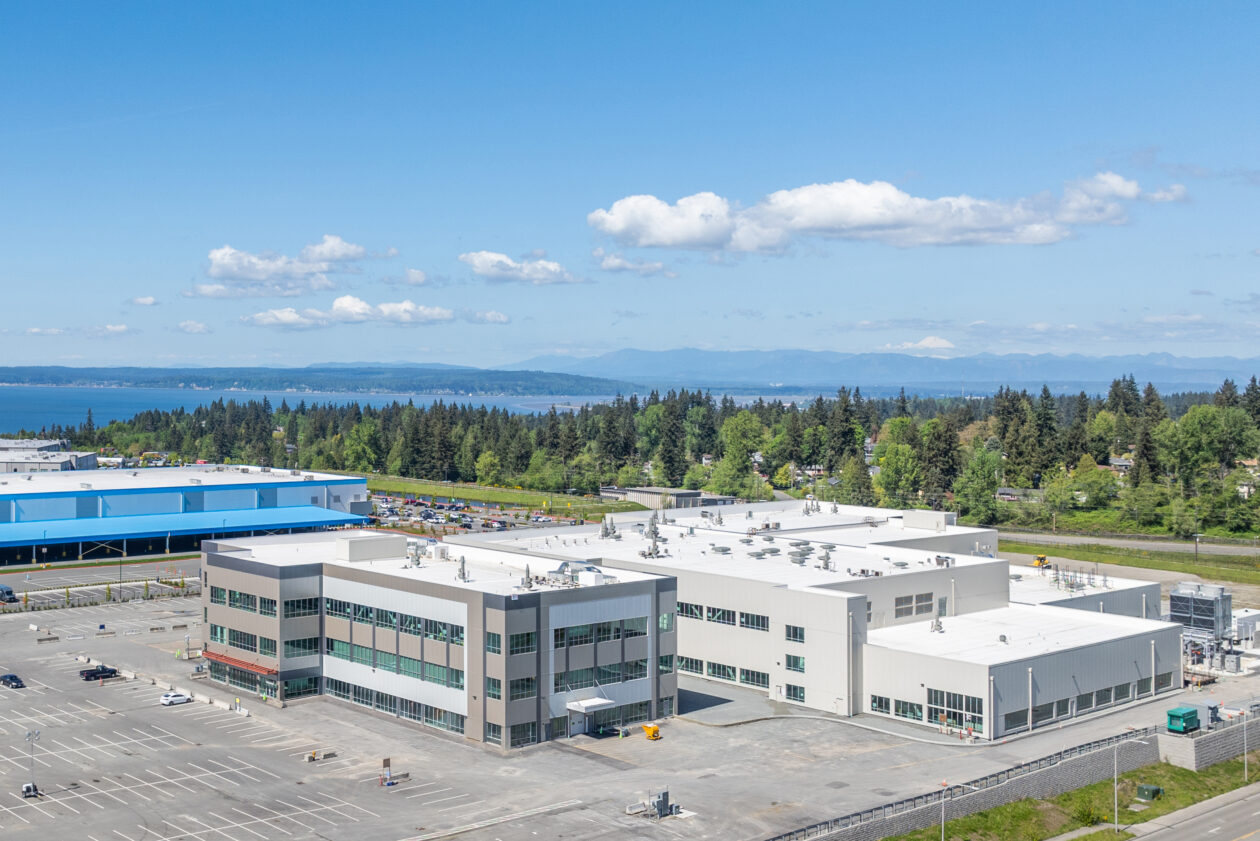
California-based Cowboy Space is leasing a 291,035-square-foot industrial facility in Kent, Wash., to support the production of hardware for its planned constellation of AI data center satellites, according to the company that arranged the lease.
“According to Newmark Research, the transaction is the largest industrial lease in the Puget Sound region year-to-date,” Newmark, the real estate broker for the deal, said in a news release. Newmark represented CenterPoint Properties, Cowboy’s new landlord.
The facility at 7650 S. 228th St. previously served as a Costco distribution and delivery center. “This building was originally designed for large-scale logistics users, but Cowboy Space recognized the opportunity to reimagine it as a highly specialized production facility,” said Taylor Hoff, a vice chairman at Newmark’s office in Bellevue, Wash.
Newmark said Cowboy Space plans to convert the facility into a manufacturing operation supporting space and rocket development. The operation is expected to add 300 jobs, Newmark said. Cowboy is currently listing 46 Kent-based positions in its careers database.
The city of Kent, which is about 20 miles south of Seattle, is one of the hotspots for space companies in the Pacific Northwest. Boeing’s Kent Space Center remains active more than 50 years after building NASA’s Apollo moon rovers. The city also hosts Jeff Bezos’ Blue Origin space venture and Stoke Space, which was founded by Blue Origin alumni.
Cowboy Space, previously known as Aetherflux, plans to send its own rockets into low Earth orbit starting as early as 2028, with the upper stages outfitted to serve as solar-powered orbital data centers. The Stampede constellation is one of several planned projects aimed at getting around the land, power and water constraints that have made ground-based AI data centers increasingly controversial.
“We are building what I call the last big clean-sheet launch vehicle in my lifetime, so it’s going to be a very big heavy-lift vehicle, and we’re working every day to bring it to reality,” Warren Lamont, Cowboy Space’s head of launch and propulsion, said this week in a LinkedIn video. Lamont, who previously worked for IonQ and Blue Origin, is one of the executives heading up Cowboy Space’s engineering hub in the Seattle area.
Update for 3:30 p.m. PT Sept. 13: Cowboy Space confirmed the opening of its Kent facility in a post to LinkedIn. “Kent will be our launch vehicle and satellite design hub, and we will be building our rocket engines and solar systems here too,” the company said:
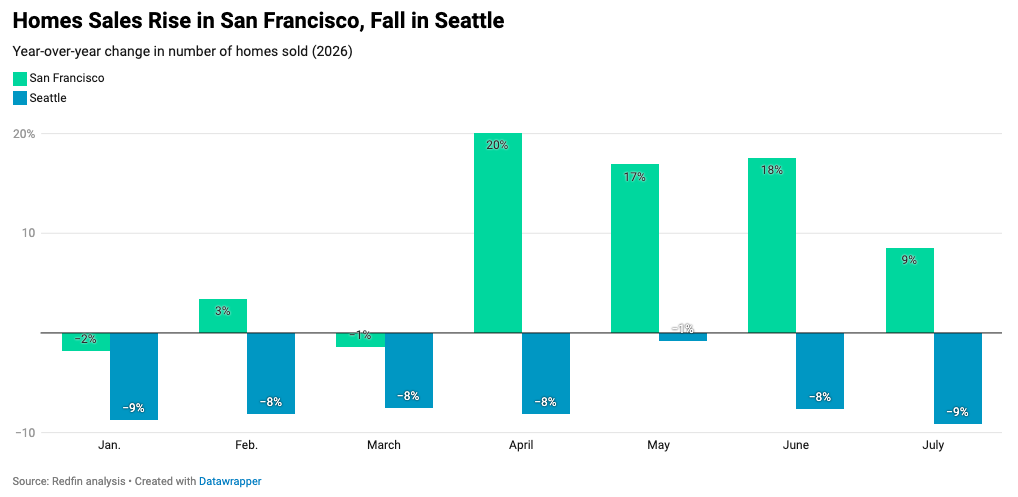
The housing markets in San Francisco, left, and Seattle have been diverging for the past year. Prices started falling in Seattle on an annual basis about a year ago, while prices in San Francisco have been rising since November. (BigStock, GeekWire File Photos)
While a fresh wave of AI-generated wealth is pouring fuel on San Francisco’s housing market, Seattle’s real estate scene is getting left out in the cold, stuck in a slump driven by ongoing local tech layoffs, soaring costs, and persistent worker anxiety.
A new report published Wednesday by Seattle-based Redfin illustrates just how dramatically the housing markets in the West Coast’s top two tech hubs have split.
In July, San Francisco’s median home-sale price jumped 6% year-over-year to $1.6 million as home sales rose 8.5%, fueled by an 18.4% drop in active listings—the largest inventory contraction in the country.
By contrast, Seattle’s median sale price dropped 3.6% to $809,479 as home sales fell 9.1% and active listings surged 16.7%, the nation’s steepest inventory increase, leaving local sellers outnumbering buyers by 65%. Redfin detailed the drop in pending sales in the city in an earlier report.
San Francisco’s resurgence is fueled by a concentrated wave of AI wealth. Driven by big salaries, six-figure signing bonuses, and anticipation of massive IPOs for Bay Area giants OpenAI and Anthropic, affluent buyers are aggressively bidding up homes, frequently paying hundreds of thousands over asking price.
The frenzy mirrors findings from The New York Times, which reported in May that cash-flush AI startup employees and secondary stock sales are fueling hyper-concentrated bidding wars across the Bay Area.
In Seattle, the dynamic is reversed. While local tech giants pour billions into AI infrastructure, corporate belt-tightening and lingering layoff fears at companies like Amazon and Microsoft have squelched buyer confidence, leaving prospective buyers cautious, job mobility low, and listings piling up.
Click to enlarge. (Redfin Graphic)
Ground-level real estate agents in the Seattle area are feeling that buyer hesitation firsthand.
“Layoffs in the tech world are dampening homebuying demand in the entire area,” said Sheryl Wingate, a Redfin Premier agent, noting that return-to-office policies are further squeezing demand in outlying suburbs as tech workers avoid long commutes amidst job uncertainty.
Seattle-area real estate isn’t just feeling the squeeze from the heavyweights. Job cuts have hit nearly every tier of the regional tech ecosystem this year, sweeping through engineering hubs for Meta, Google, and Salesforce, consumer brands like Zillow, T-Mobile, and Starbucks, corporate divisions at Expedia and TikTok, and startups including Qualtrics and Amperity.
The chill is hitting the region’s high-end neighborhoods hardest. According to Bloomberg, pending luxury home sales in the Seattle area plummeted 15%, driven by a double hit of tech-sector layoffs and Washington state’s higher taxes on top earners. Once-frenzied markets in Eastside suburbs like Bellevue and Sammamish have stalled, with homes priced over $2 million sitting for an average of 44 days as affluent tech buyers pull back.
By comparison, high-end buyers in San Francisco are doubling their budgets as AI confidence surges. Redfin noted that luxury pending sales in the Bay Area jumped 46% year-over-year, with local agents reporting tech clients doubling their price points — in some cases expanding from $2 million budgets to nearly $4 million — and placing offers as much as $900,000 over asking price.
The shift is also severing a key migration pipeline that long fueled Seattle’s housing boom. While high-earning Bay Area transplants historically moved north to stretch their tech compensation, Redfin migration data shows the net inflow of home shoppers moving from San Francisco to Seattle plummeted to just 369 people in the first quarter — down from over 5,100 five years ago.
Looking ahead, Redfin economists expect these diverging trends to play out across other tech hubs as artificial intelligence reshapes the labor market.
“AI is reorganizing the tech labor market, with San Francisco and Seattle representing two sides of that transition,” said Chen Zhao, Redfin’s head of economics research, adding that while AI creates rapid wealth in some markets, it drives corporate restructuring and caution in others.
Compass and the Washington state-based Northwest Multiple Listing Service (NWMLS) have settled their year-plus-long lawsuit, Compass announced on Monday.
A new marketing option
Compass and NWMLS have agreed to a settlement through the creation of a new listing status that will allow Compass agents to pre-market their properties without risk of being fined by the MLS. The new status, which will become effective Sept. 4, is called “First Look” and will be treated similarly to a coming-soon listing, according to a press release.
When requested by the seller, the status allows showings for brokers and their clients, open houses and offers to be made on a property without incurring public price changes or days on market for up to 21 days while preparing for an “Active” status launch.
NWMLS clarified that days in the “First Look” status and any pre-launch price adjustments will be available internally to members of the NWMLS database but will not be published publicly. The MLS also said sellers can choose whether a “First Look” is published on IDX websites “or choose to engage in more tailored public marketing.”
What Compass had to say
Compass International Holdings Chairman and CEO Robert Reffkin said the brokerage’s goal in launching its lawsuit against NWMLS “has been fully realized.”
“We brought this lawsuit on a fundamental principle: homeowners deserve the absolute right to control how their properties are marketed, and real estate brokers should never face fines from NWMLS simply for following their client’s lawful instructions which in Washington State is their Statutory Duty,” Reffkin said in a statement.
Compass “proudly invested millions” in the lawsuit, Reffkin added, “and it was worth it.”
“MLSs are a group of direct competitors that are telling their competitors how they can and can not compete, which is the textbook definition of an antitrust violation,” Reffkin continued. “MLSs exist to distribute listings, when the homeseller wants to use it, not to let brokerage competitors collectively dictate how other brokers compete in marketing services or how homesellers market their homes.”
What NWMLS had to say
In a news release, NWMLS said the “First Look” status was created in response to member feedback — specifically amid shifting consumer expectations.
“We are giving sellers the flexibility they desire when preparing a home for market, while steadfastly protecting buyers from private networks,” NWMLS President and CEO Justin Haag said in a statement. “Simply put, First Look modernizes the pre-launch preparation process, while ensuring an open marketplace and fair competition, in full compliance with Washington State’s open-market laws.”
The MLS’s announcement also noted that the new status enables NWMLS to resolve litigation with Compass “while reaffirming its commitment to an open and comprehensive marketplace, data integrity, and consumer protection across the Pacific Northwest.”
Redfin weighs in
In a blog post published on Monday, Redfin also praised NWMLS’s move to create the new listing status.
“This is exactly the kind of innovation sellers, agents and major industry players — including Redfin — have been calling for, and we salute NWMLS for pioneering a pro-consumer, pro-competition solution,” said the post authored by Joe Rath, head of industry relations at Redfin parent Rocket Companies.
Back in April, Rath authored a separate open letter published on the company’s website that implored NWMLS to change its pre-marketing policies, arguing in favor of “homeseller choice,” a phrase used often by Reffkin. Redfin and Compass partnered in February to allow the brokerage’s “Private Exclusive” and “Coming Soon” listings to be published on Redfin.
In his Monday post, Rath also reiterated an argument Redfin made earlier this year that providing sellers with more pre-marketing options could ultimately give for-sale inventory a boost.
How the lawsuit began
Compass sued NWMLS last April, alleging that the MLS engaged in anticompetitive business practices, obstruction of seller choice and retaliation through a temporary suspension of Compass’ IDX feed. At the time, Compass claimed that it spent months trying to negotiate rule changes with NWMLS to allow for the brokerage’s office exclusives, but NWMLS “simply refused.”
Then, in April of this year, NWMLS filed a counterclaim against Compass, alleging that the brokerage’s 3-phased marketing strategy violates the Washington Consumer Protection Act because it is a “deceptive scheme” designed to conceal data from the public at large. NWMLS also argued that its own MLS rules were reaffirmed through a new state law seeking to restrict private listings.
Other settlement details
In addition to the new listing status, several other terms were agreed to as part of the settlement.
By Oct. 15, NWMLS has agreed to require all portals and real estate websites that use the MLS’s data to clearly and prominently display the name and contact information of real estate brokers on a listing, and immediately next to any contact broker buttons so that buyers have clear and direct access to the listing broker.
By that same date, NWMLS must also stop placing its watermarks on listing photographs to “[ensure] that NWMLS does not take credit for the work of real estate professionals.”
NWMLS is further obligated to apply its rules across all brokerages in the state of Washington to ensure they receive equal treatment, and it will be prohibited from taking legal action against Compass or its real estate professionals “under the guise of ‘enforcing state law,'” Compass said. The point references the new Washington state law that took effect in mid-June, which seeks to limit the use of private marketing practices in real estate. The language of the law, however, is vague, and therefore how much it may curb private listings in practice is uncertain.
By Nov. 15, NWMLS must also “give broker platforms the data fields and supplements that are relevant for brokers to do their jobs (eg, Legal, Firpta, 22k, 22j, Prelim, Surveys/maps, Resale cert), unless legally prohibited,” Compass said, so that brokers don’t have to access multiple systems to complete their work functions.
Zillow and Redfin settled an antitrust case with the Federal Trade Commission and five states Monday, just as a trial was set to begin, agreeing to undo part of a $100 million partnership that the government said effectively paid Redfin to stop competing in apartment rental advertising.
The companies, both based in Seattle, have been rivals in online real estate and related services for the better part of two decades, expanding into rentals to build their businesses beyond the market for single-family homes. The FTC alleged the deal combined two of the three largest online apartment listing services against one main competitor, CoStar’s Apartments.com.
The proposed settlement requires Redfin, now owned by Rocket Cos., to relaunch its apartment advertising operation within six months — hiring a general manager, a sales force and a trained customer support team, while committing to spend millions of dollars to grow the business.
Redfin faces fines if it misses deadlines, and must report regularly to the FTC on its progress.
Zillow’s apartment listings will still appear on Redfin.com, Rent.com and ApartmentGuide, and Redfin will keep syndicating them, so Zillow is holding onto the audience it gained in the 2025 deal. The companies say the syndication will run through at least 2030.
What ends is the exclusive nature of the partnership: As part of the FTC settlement, Redfin is no longer barred from selling its own advertising alongside those listings, or from doing business on its own with the property managers shifted to Zillow under their original deal.
Zillow also must help Redfin rebuild. Under the order, which runs 10 years, Zillow is required to give Redfin employee information so it can recruit Zillow workers, waive any noncompete or anti-poaching agreements blocking those hires, and let apartment advertisers locked into Zillow contracts renegotiate without penalty for nine months after Redfin relaunches.
The companies will also pay the states $2 million in costs and fees, according to Washington Attorney General Nick Brown, who co-led the five-state coalition.
Zillow said the partnership “will continue unchanged,” and framed the standalone advertising products both companies plan to launch in 2027 as added flexibility for property managers.
“This resolution is a win for renters and multifamily housing providers,” said Michael Sherman, general manager and senior vice president of Zillow Rentals, in a statement. He said the partnership has brought “more leads and leases to property managers and more options to renters,” and that the standalone products will let Zillow “do even more to support the marketplace.”
The FTC offered its own take: “Today’s settlement unwinds an agreement under which Zillow paid Redfin $100 million to stop competing and hand off all its customers to Zillow,” said Daniel Guarnera, director of the FTC’s Bureau of Competition. “This kind of payment to a competitor to exit a market and stop competing violates the antitrust laws.”
FTC Chairman Andrew Ferguson called it “a complete victory for the American people” in a thread on X early Monday. He added, “This anticompetitive agreement is now history under our proposed settlement.”
Guarnera said the settlement “delivers better, quicker, more certain results” than the agency would have been able to achieve if it had gone to trial and prevailed.
“Today’s settlement will restore competition by paving the way for Redfin to re-enter the market as a stronger competitor,” Brown said in a statement. “Most importantly, consumers will have more choices and won’t be subjected to illegally manipulated prices.”
The FTC and state cases were consolidated last year. Zillow and Redfin moved to dismiss in January, and U.S. District Judge Anthony Trenga denied that motion in May, according to Real Estate News. However, the FTC’s case had met resistance in July, when Trenga denied its request to declare the deal presumptively unlawful, finding genuine disputes of material fact.
Redfin called the outcome “a significant win for Redfin and consumers across the country.”
“This agreement allows us to maintain our rental partnership with Zillow through at least 2030, while building and investing in a standalone rentals business of our own,” a spokesperson said, adding that renters “will continue to have access to the rental inventory they rely on today.”
The proposed settlement, announced Monday morning, requires court approval.
Updated with details from Washington AG Nick Brown.
According to plaintiffs, Peter Castaneda and Haley Gelfand, Compass has bought so many brokerage firms over the past decade-plus that it maintains a monopoly, controlling “over 80 percent of the rental unit listings available for renters in Manhattan based on 2025 data.”
With that monopoly, Compass can “literally dictate pricing for as much as 80 percent of Manhattan’s rental units,” renters argued. And now, Compass is allegedly trying to manipulate prices on other platforms, as well.
Seattle remains a beacon for tech talent, ranking No. 2 in CBRE’s annual report. (GeekWire File Photo / Kevin Lisota)
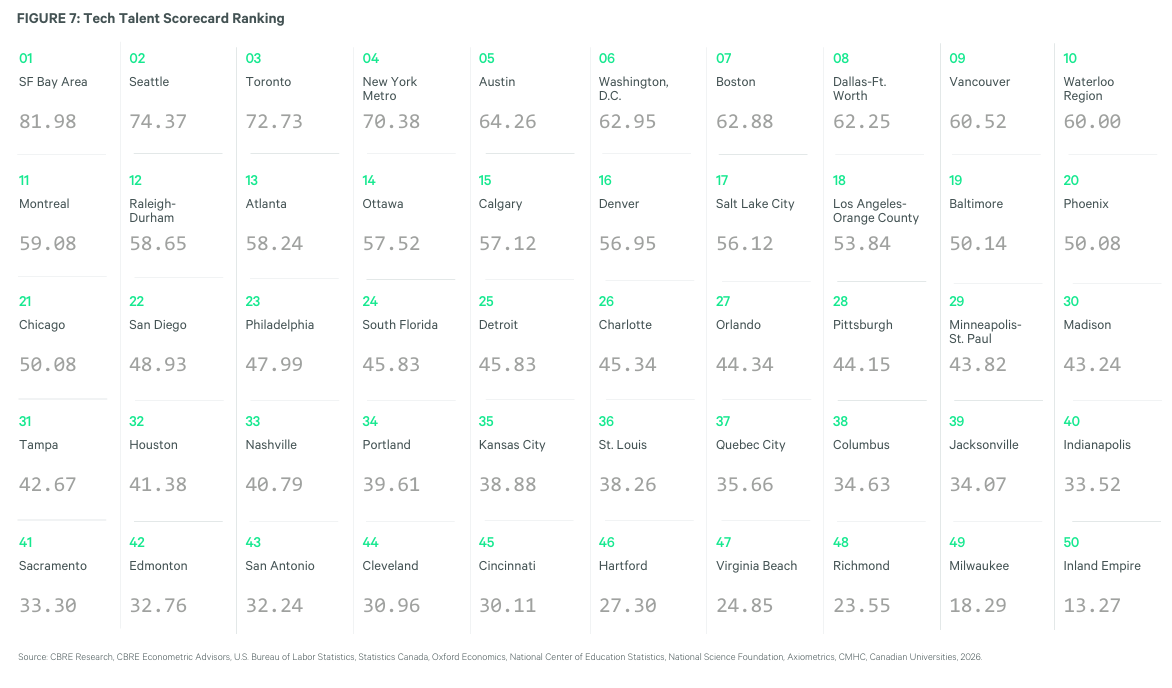
The Seattle region outranked New York, Austin, Boston and other tech hubs, trailing only the Bay Area, in an annual tech talent scorecard from commercial real estate firm CBRE that weighs factors such as tech worker concentration, wages, education levels and real estate costs.
You may have seen headlines this week that New York overtook the Bay Area for the first time in the CBRE rankings. That was based on a subset of the data: a straight head count in each market. New York’s 394,300 tech workers topped the Bay Area’s 375,730. Seattle ranks seventh on that specific list, with 213,010 tech workers across the region.
But in the broader scorecard, Seattle held onto the No. 2 spot (which it also occupied last year), thanks to the density of its tech workforce, one of the largest concentrations of AI talent in North America, and the second-highest tech wages on the continent.
CBRE’s 2026 Tech Talent Scorecard ranks 50 North American markets on 13 weighted metrics. Seattle placed second with a score of 74.37 behind the Bay Area at 81.9. (CBRE Graphic, Click to Enlarge, and see full report here.)
The market-by-market workforce figures in the report run through 2025, so this year’s layoffs aren’t reflected in the rankings. CBRE does flag the trend nationally: the tech industry accounted for a record 31% of all U.S. job cuts through June, up from 13% for all of last year.
Some of the Seattle region’s specific strengths:
The AI workforce is deep. Seattle is home to 41,591 workers with AI skills, third most in North America, behind the Bay Area and New York. One in five of the region’s tech workers now has AI skills — a higher share than anywhere except the Bay Area.
Tech is a bigger part of the economy here. Tech jobs make up 10.2% of all employment in the metro area, among the top five markets and nearly double the 5.5% average across the 50 markets studied in the CBRE report.
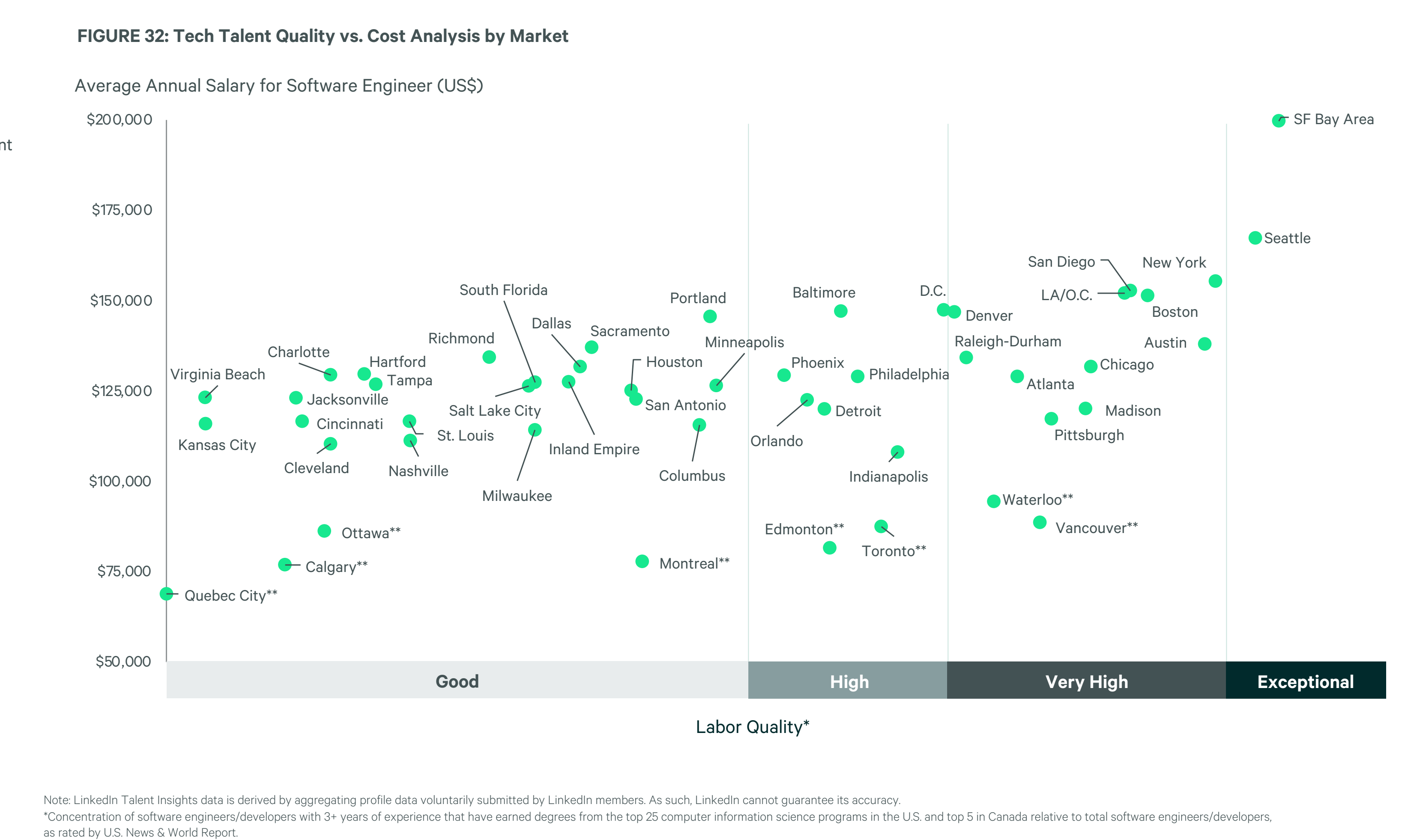
Wages are in a tier of their own. Seattle’s average wage for tech workers at tech companies was $190,050 in 2024, second to the Bay Area’s $211,048, and nearly $50,000 above third-place Boston.
The workforce grew while the Bay Area’s shrank. Seattle added 24,590 tech jobs from 2022 to 2025, a 13.1% increase and the fifth-largest gain of any market. The Bay Area lost 23,900 jobs over the same time period.
However, the report also points to warning signs:
Many offices are sitting empty. The Seattle metro area’s office vacancy rate hit 28.6% in the fourth quarter of 2025 — the highest of the 50 markets in the report. That’s despite 1.9 million square feet leased by AI companies across the region since 2023, according to CBRE.
Costs are near the top. Seattle is the third-most-expensive place to run a 500-person tech company, at $73.9 million a year in wages and office rent, behind the Bay Area at $90.6 million and slightly behind New York, which edged Seattle by about $24,000.
Seattle and the San Francisco Bay Area are the only two markets CBRE rates “exceptional” for software engineering talent. They’re also the two most expensive. (CBRE Graphic, Click to Enlarge, and see full report here.)
Young workers are going elsewhere. Seattle’s 20-something population fell between 2019 and 2024, even as its share of 30-somethings grew to the highest of any market in the report. The region is drawing mid-career but not entry-level talent, which risks creating a thinner pipeline over time.
One counterweight to the pipeline concern: the University of Washington ranks fifth among U.S. universities for its AI program, according to CBRE’s analysis of U.S. News & World Report rankings — the only school outside the Bay Area, Boston and Pittsburgh in the top five.
Access the full CBRE Scoring Tech Talent 2026 report here.
Members of the BuyWander team, including co-founders Brock Kowalchuk and Jordan Allen, celebrate with the company’s 10,000th customer in Spokane, Wash. in 2025. (BuyWander Photo)
BuyWander, the Spokane, Wash.-born startup building an auction marketplace for returned and overstocked retail goods, has moved its headquarters to the Seattle area and grown to 325 employees as it expands its warehouse network across the country.
The company said Tuesday that it has added four executives to its leadership team, including two former Amazon employees, as it pushes into new markets including Denver and Chicago.
BuyWander is now based in Kent, Wash., where it has 45 employees. The company said it moved its corporate headquarters from Spokane to the Seattle area this month, putting its leadership team closer to the region’s large retail and e-commerce ecosystem.
GeekWire last wrote about BuyWander in April 2025, when the startup employed 22 people and was on the verge of opening a 30,000-square-foot warehouse in Kent after raising $2 million in seed funding.
Founded in 2023 by Jordan Allen and Brock Kowalchuk, BuyWander’s marketplace sells returned and overstocked merchandise from retailers including Amazon, Target, Walmart and Home Depot. Products start at a $1 opening bid in seven-day online auctions, with buyers picking up purchases at local BuyWander warehouses rather than having them shipped.
Current items for sale on the marketplace include: window air conditioning units; steel gate fencing; carbon fiber rear trunk spoilers; Jeep Wrangler seat covers; countertop microwave ovens, pop-up canopy tents and dozens of other products.
The model is aimed at giving returned merchandise another route to consumers rather than leaving it in warehouses or sending it to landfills. BuyWander’s technology is designed to scan, sort and identify inventory before putting it up for auction.
The BuyWander warehouse in Kent, Washington. (BuyWander photo)
The sector is filled with rivals, including companies such as Mac.bid, B-Stock, Liquidation.com and ReturnPro, which focuses more on solutions for retailers.
Allen previously founded Stay Alfred, a Spokane-based short-term rental company that shut down in 2020, amid the pandemic, after expanding to more than 30 cities.
“Auction commerce is having a real moment, and it’s exciting to build the team to meet it,” Allen said in a statement Tuesday.
The four new executives are:
Laura Sasser, chief operating officer, who spent nearly 20 years at liquidation and inventory-management company Channel Control Merchants and most recently was senior vice president of operations at FullSpeed Automotive where she oversaw facilities, inventory management, and loss prevention.
Daniel Kiepfer, vice president of data and AI, who previously led data and analytics at Seattle online jewelry retailer Blue Nile and held roles at Microsoft, RealSelf and McKinsey.
Abu Marcose, senior director of warehouse technology, who spent 12 years at Amazon, most recently as a senior software development manager on Amazon’s Supply Chain Optimization Technologies team.
Roger Ling, director of marketing, who previously led integrated marketing at DoorDash and held go-to-market and product marketing roles at Amazon, including work on Prime Big Deal Days and Amazon Business.
Marcose’s hiring is particularly notable for BuyWander’s push to build technology around its warehouse operations. At Amazon, he worked on capacity planning, network optimization and generative and agentic AI systems used in fulfillment operations.
Ling’s experience also fits BuyWander’s retail focus, bringing experience in both Amazon’s e-commerce operation and DoorDash’s consumer marketplace.
Sasser’s experience will help the two-year-old startup expand into new markets, helping customers find deals in new geographies.
“My focus now is building the operational backbone that lets it scale across every new market we enter,” she said in a statement.
BuyWander said it currently operates eight warehouses, with Denver and Chicago among its newest locations, and plans to continue expanding nationally over the next year. The bulk of its employee base works in stocking, intake and customer service.
The company is backed by Triple Impact Capital, Animal Capital, Data Tech Fund, Vinay Menda, Quiet Capital, Maria Routimine, Eric Klein, James Dorman and Tom Simpson.
Bitcoin can be understood through an analogy with real estate.16 Michael Saylor, Executive Chairman and Co-Founder of Strategy (formerly MicroStrategy), has compared investing in bitcoin to buying real estate in downtown Manhattan during the early stages of its development. As population, commerce, and cultural activity concentrated in the city, demand for limited land surged, dramatically increasing property values. Many of the world’s wealthiest families built their fortunes by owning scarce real estate. When something limited is in high demand, its value rises. As the saying commonly attributed to Mark Twain goes, “Buy land—they’re not making it anymore.”
Scarcity plays a central role in determining value, which is why real estate in densely populated areas is more expensive than in sparsely populated ones. Real estate has utility value—it can be used for living or production—but its price is largely driven by the limited supply of land in prime locations. There are only so many properties that can be built in Manhattan, London, Shanghai, Mumbai, Paris, Beijing, Tokyo, or Venice. What ultimately makes these locations valuable is what occurs on top of them: the people, the capital, the creativity, the energy. As a city flourishes, whether through rising population, growing business activity, or cultural relevance, demand for that scarce land surges.
The value of land does not rise in a vacuum; it rises because it captures an expanding layer of economic activity that cannot be easily replicated or relocated. This dynamic is further amplified by fiat monetary expansion, which channels ever more liquidity into real estate, raising nominal prices well above what utility and income-generating capacity alone would support. Market mechanisms such as speculation and the widespread expectation of rising prices reinforce this scarcity and deepen that perception.
Bitcoin operates under a similar logic. Just like prime real estate, it gains value as more people, capital, economic activity, and trust accumulate around it. At the same time, the economic network built on top of it—financial infrastructure, global adoption, liquidity, and digital connectivity—can continue expanding globally through digital networks without corresponding expansion of the underlying monetary base. Adoption on the internet occurs globally and continuously—much faster than in the physical world, where economic expansion is constrained by geography.
But there is a crucial difference. In real estate, prices are shaped by development potential, location-specific utility, and relative scarcity, which is frequently intensified by regulations and policy decisions. Government interventions such as tax incentives for investors, zoning laws, and restricted building permits can artificially limit supply, pushing prices higher. These dynamics are further amplified by speculative behavior and the widespread expectation of continued price increases, making scarcity appear more absolute than it is. Bitcoin’s scarcity, by contrast, is absolute: its supply is fixed at twenty-one million, beyond the reach of policy decisions or political interference. Real estate’s manufactured constraints highlight the importance of distinguishing between natural and engineered scarcity in asset evaluation.
Owning bitcoin is comparable to owning a plot in a growing, borderless economy not tied to any government or geography. As more people and businesses adopt bitcoin, the value of that digital “plot” increases. The difference is mobility—this digital plot is not tied to any location and can be transferred globally within minutes. Unlike land, bitcoin enables the rapid, low-friction transfer of value anywhere in the world, subject only to network conditions and liquidity constraints.
Holding bitcoin provides a new way to participate in the global economy. While bitcoin operates on a global network, its effects are local. By enabling individuals to hold and transfer value without centralized permission, it allows participation in economic systems that are less dependent on institutions able to impose restrictions, exclude participants, or change rules unilaterally.
Bitcoin’s accounting model reinforces the real estate comparison. In a traditional bank account, value is recorded as a balance held by an institution. In Bitcoin, ownership is defined by direct control over individually defined units—unspent transaction outputs (UTXOs)—recorded on the network.
You can think of each bitcoin as a square of land that remains under your control until it is spent. Once spent, that square disappears, and new squares are created for the recipient. Each UTXO can be independently transferred or combined in future transactions. The result is a continuously evolving map of property claims secured by cryptography rather than institutional authority.
The analogy has limits. Bitcoin differs from real estate used to generate income. It generates no operating cash flow and is best understood as a scarce digital asset whose value lies in absolute scarcity and optionality rather than income. But like real estate, bitcoin functions as a long-term savings vehicle and increasingly as collateral, capable of supporting credit formation and broader economic activity while absorbing monetary demand. This makes real estate a useful framework for understanding bitcoin’s evolving role within capital markets and monetary systems.
An undisclosed pharma company signed a 21-year lease for the former Seagen property in Everett. Photo via Breakthrough Properties.
A bio-manufacturing facility in Everett, Wash., which was built by Seattle biotech giant Seagen but never opened under its Pfizer ownership, is getting a new lease on life.
Breakthrough Properties, a life sciences real estate company, said Friday that it has acquired the 270,000-square-foot facility at 215 Shuksan Way for $78 million and leased the entire campus for 21 years to an unnamed global biopharmaceutical company.
Seagen invested approximately $350 million to build out the facility, which was designed for drug manufacturing, quality-control labs, warehousing and distribution. But the company never moved in after drug maker Pfizer acquired Seagen for $43 billion in 2023.
“Pfizer regularly evaluates our manufacturing network to ensure capacity is effectively utilized based on projected product demands,” the company said in a statement to GeekWire in 2024. “After careful evaluation, we have made the difficult decision to wind down construction of the site.”
The facility sits about 25 miles north of Seattle along the I-5 corridor and is Breakthrough Properties’ first investment in the Puget Sound region.
The deal comes as pharmaceutical companies increase investment in U.S. manufacturing capacity. Breakthrough said major drugmakers have announced more than $600 billion in recent commitments to expand domestic production and strengthen supply chains.
The Everett facility was part of Seagen’s broader manufacturing expansion before the company was acquired by Pfizer for $43 billion. GeekWire previously reported on Seagen’s plans for the 270,000-square-foot Everett facility.
Breakthrough Properties is a joint venture between global real estate company Tishman Speyer and biotech investment firm Bellco Capital. A spokesperson for the company, which owns and develops life sciences properties in the U.S. and Europe, declined to provide details on the new tenant or the move-in date.
The Seattle metro area’s median home-sale price is $809,479, roughly double the national average. (GeekWire File Photo / Kurt Schlosser)
As prospective buyers face steep borrowing costs and a turbulent tech job market, home sales nationwide have fallen to their lowest point in nearly two years — and Seattle is feeling the brunt of the slowdown.
According to a new report by Redfin, pending home sales in the Seattle area plunged 15.6% year-over-year in July. It’s the sharpest drop among major U.S. metropolitan areas as prospective buyers grapple with steep prices and job insecurity driven by recent tech-sector layoffs.
Seattle’s drop in pending sales led all major U.S. metro areas in July, outpacing other slowing markets like Houston (-14.3%) and Phoenix (-13.3%). In closed home sales, Seattle’s 9.1% drop put it among the five steepest declines nationwide alongside Detroit (-9.3%) and major Texas metros.
Housing costs in the region remain a primary barrier for buyers. With a median sale price of $809,479, Seattle home prices sit at roughly double the national average of $408,795, making the local market particularly sensitive to elevated mortgage rates and tech-industry caution.
Real estate agents on the ground report that shifting dynamics at major tech employers are directly tempering local home-buying demand.
“Seattle is a tech-driven market, and right now a lot of buyers are feeling cautious about layoffs, AI and job security,” said Chase Costello, a Redfin Premier agent in the Seattle area. “Tech workers aren’t moving between companies — or moving into the area — as much as they used to, and that means fewer people are trading up into new homes.”
High-earning tech workers have long served as the primary engine for Puget Sound real estate growth. But ongoing staff cuts and corporate belt-tightening at major employers such as Amazon and Microsoft have created a chilling effect that extends beyond those directly affected. According to Redfin, even workers who remain comfortably employed are increasingly hesitant to stretch for expensive mortgages amidst broader economic uncertainty.
Layoffs have also impacted a variety of tech roles at companies big and small, including T-Mobile, Zillow, Starbucks, Meta, Google, Oracle, Epic Games, Bungie, Salesforce and others, as detailed in GeekWire’s layoff tracker.
While Seattle and major Texas markets saw the nation’s sharpest home-sales pullbacks, a handful of regions managed to buck the broader downturn. According to Redfin, home sales posted strong year-over-year growth in markets like West Palm Beach, Fla. (+17.1%), San Francisco (+8.5%), and Milwaukee (+7%).
In South Florida and the Bay Area, affluent buyers less sensitive to cost helped drive activity, with San Francisco getting an extra push from the ongoing AI boom, while Milwaukee benefited from relative affordability.
Pending sales also surged in West Palm Beach (+14.2%) and Milwaukee (+4.5%), illustrating a stark divergence between tech-heavy, high-cost markets in the West and resilient pockets elsewhere across the country.
Zillow Group’s revenue rose 18% to $772 million in the second quarter, beating its own forecast, but a $36 million restructuring charge from severance and other costs stemming from this week’s layoffs pushed it to a $4 million net loss.
The Seattle-based online real estate company, which on Tuesday laid off more than 500 people, or 7% of its workforce, expects the restructuring to cost $59 million to $64 million in total, with the rest recorded in the third quarter, according to the company’s 10-Q regulatory filing.
Zillow also announced a series of executive changes, including expanding CFO Jeremy Hofmann‘s role to include chief operating officer. Jun Choo, who became COO in 2024, is stepping down to focus on his health, serving as an advisor through the end of the year.
The company created a chief legal and policy officer role and hired Cassandra “Sandi” Knight, a Google vice president of litigation and discovery, who was previously PayPal chief litigation counsel. Knight starts next week.
Zillow and Redfin are set to go to trial Aug. 24 as defendants in an antitrust case brought by the FTC and five state attorneys general over the $100 million rental listings deal between the two companies. Zillow has spent $26 million on the case so far this year, including $10 million in the second quarter.
In addition, Zillow promoted Kathleen Berroth to senior vice president of strategy and operations, and Eric Wilson to senior vice president and GM of mortgages.
For the second quarter, Zillow said the residential real estate industry grew 6%, while industry-wide lending for home purchases was roughly flat compared with a year ago. The number of people visiting real estate sites and apps declined overall as mortgage rates rose, the company said, citing Comscore. Zillow’s own traffic fell 2%, to an average of 239 million monthly users.
Most of the revenue growth came from Zillow’s newer businesses. Mortgage revenue rose 75% to $84 million as Zillow directed buyers on its site to its own lending arm, and rentals revenue rose 31% to $209 million. Residential revenue, from advertising sold to real estate agents, grew 7% to $465 million.
Zillow Group’s headquarters at 1301 Second Ave. in downtown Seattle. (GeekWire File Photo)
Zillow Group’s layoffs will eliminate 91 jobs in Washington state, landing heavily on senior staff, according to a notice the company filed with the state Employment Security Department.
The filing under the federal Worker Adjustment and Retraining Notification (WARN) Act is the first detailed accounting of who was affected by the more than 500 layoffs the company announced Tuesday. The cuts hit about 7% of its global workforce, which stood at 7,058 as of March 31.
Zillow Group is officially headquartered in Seattle, but the relatively small share of the layoffs in its home state (18%) reflects how distributed it has become. The company adopted a remote-first model it calls “Cloud HQ” in 2020, at the height of the pandemic, and it has continued to bet on remote work as other tech companies pulled employees back to the office.
The list of affected job titles in Washington state is dominated by senior positions. It includes five directors and three senior directors, 14 principal-level roles, and a long list of senior managers and senior individual contributors. Relatively few junior positions appear on the list.
Product and engineering absorbed the most. Senior Product Manager is the single largest line at seven positions, followed by Senior Software Development Engineer, Software Development Engineer and Senior UX Researcher at four each. Together, product and engineering roles account for more than a third of the Washington cuts.
The list also includes AI and machine learning positions: a Senior Machine Learning Engineer, a Senior Manager of Machine Learning Engineering, a Senior Applied Scientist, a Senior Manager of Research Science, and an Annotation Lead, associated with labeling data to train AI models.
Zillow told GeekWire on Tuesday that AI did not drive the layoffs. “Today’s changes are about better positioning Zillow for the path ahead, which includes having the right people in the right roles and being able to move faster,” a company spokesperson said.
The WARN notice adds a detail Zillow did not mention publicly: “Some of these terminations are the result of, or are expected to result in, the relocation or contracting out of operations and/or employee positions.”
Affected employees were notified Aug. 4 and will be terminated effective Oct. 5, more than 60 days later as required under state and federal law. They will continue to receive pay and benefits until then, according to the filing. Employees who are offered and accept another role at the company before that date will not be terminated.
The cuts affect workers at Zillow Group’s headquarters at 1301 Second Ave. in downtown Seattle and employees working from home elsewhere in Washington. The company said in the filing that its headquarters will remain open. None of the affected employees are represented by a union.
Zillow Group reports second-quarter earnings Wednesday afternoon.
Seattle-based online real estate company Zillow Group laid off more than 500 employees Tuesday, about 7% of its global workforce, its second and largest round of cuts this year.
The layoffs are about “ensuring we have a disciplined cost structure and getting more efficient, with the right people in the right positions,” Zillow Group CEO Jeremy Wacksman said in a company blog post announcing the cuts. He said the decision reflects “both the strides we’re making in our strategy and the reality of what is required of us to grow at scale.”
He added, “Continuing to grow at scale requires us to work differently than we do today.”
Wacksman told real estate executives at the T3 Leadership Summit in April that Zillow employees were being retrained to use AI in their jobs, with gains that “are small, but they’re compounding,” as reported by Real Estate News.
Zillow told GeekWire the cuts were not driven by AI. “Today’s changes are about better positioning Zillow for the path ahead, which includes having the right people in the right roles and being able to move faster,” a company spokesperson said.
The company didn’t disclose which teams were affected, how many of the cuts will hit its Seattle headquarters, or what severance employees will receive.
Zillow Group will report second-quarter earnings Wednesday afternoon. The company’s business has been growing, defying a sluggish housing market. Its first-quarter revenue rose 18% year-over-year to $708 million, while the residential real estate industry grew 2%, according to NAR. Net income climbed to $46 million from $8 million a year earlier.
Wacksman indicated Tuesday that the company is still bucking the trend: “We continue to outperform the category, despite a housing market that has been essentially flat,” he wrote.
However, the company has been spending nearly as fast as it has been growing, on rental listings, loan officers for Zillow Home Loans, advertising and legal bills. Execs told investors in May that the spending would ease up in the second half of the year. Cutting payroll is one way to make that happen, and Zillow’s earnings guidance tomorrow could reflect that.
As for those legal bills: Zillow is headed to trial later this month in an FTC antitrust case over the $100 million deal the company struck in early 2025 to become the exclusive provider of multifamily rental listings on Redfin’s websites.
Zillow cut about 200 jobs in January, but characterized those as performance-related and part of its annual review cycle. It had 7,058 employees as of March 31, down just 10 positions from the end of 2025, meaning it had largely backfilled January’s cuts before Tuesday.
It’s part of a wave of cuts and consolidation in real estate portals and property tech. CoStar has cut its Homes.com inside-sales team by nearly 40% in recent months. Better founder Vishal Garg stepped down as CEO Monday as the mortgage company pushed to cut costs.
Along with its flagship Zillow portal, Zillow Group’s brands include Trulia, StreetEasy, HotPads and Out East, plus agent software products Follow Up Boss, ShowingTime and dotloop.
Updated after publication with additional details from Zillow.

 Login
Login