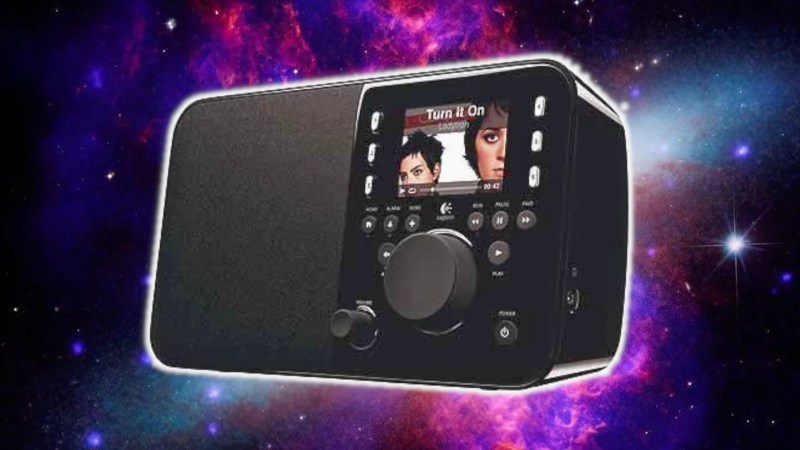
There are plenty of Wi-Fi radios out there that were built over the last two decades or so. However, many older models are now becoming less useful because many internet radio stations are switching to newer streaming formats that they don’t support. [Clifford Farrugia] has been working on a little project to save these appliances from the e-waste bin.
The HLS Radio Converter is the result of that work. It’s a small open-source tool that converts modern HTTP Live Streaming (HLS) protocol streams into regular old HTTP MP3 streams that older internet radio appliances are built to decode. You can run the tool on something as simple as an old Raspberry Pi. To make it work, you just give the tool the URL of the stream you’re looking to convert, and it then spits out a new URL to point your radio to which has the stream in the old-school format instead.
It’s a simple tool, but one that should prove very useful if you have a beloved old internet radio that can’t handle modern streams. We’ve featured lots of fun projects in this vein before, too, like this ultra-tiny internet radio build. If you’re working on your own projects in this space, be sure to let us know via the tipsline.
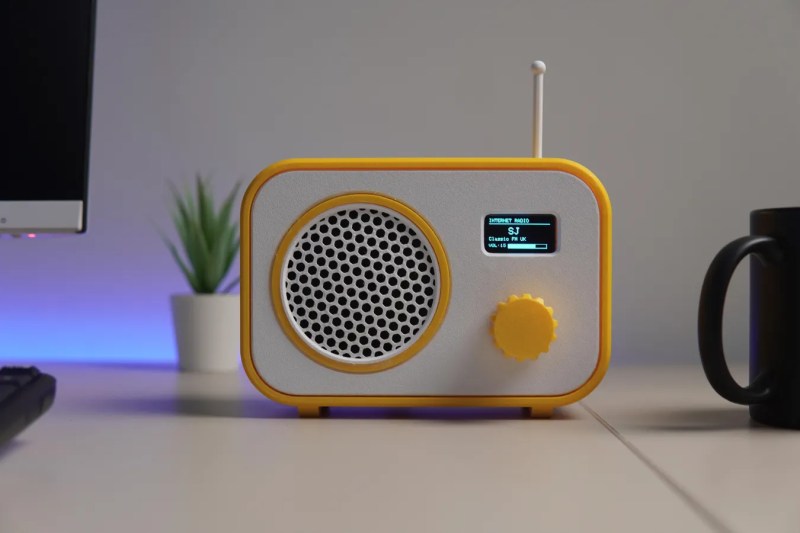
Broadcast radio isn’t as popular as it once was, its popularity suffering in turn due to technologies like MP3 players and music streaming services. If you don’t fancy either of those, you might like to listen to some internet radio stations, using a rig like the one [CodersCafeTech] built.
It’s a simple desktop radio set, but instead of tuning in to AM or FM broadcast bands, it has an antenna for 2.4 GHz instead. That’s because inside this radio is an ESP32-S3 development board, which is equipped with onboard WiFi hardware that lets it connect to the internet. It’s hooked up to a 1.3-inch OLED display over I2C, which acts as a user interface in concert with a rotary encoder. Sound is handled with a MAX98357 I2S audio amplifier, hooked up to a small 3 W speaker. Once programmed appropriately, all the unit needs is a WiFi SSID and password, and the URL for the internet radio station you’d like to listen to.
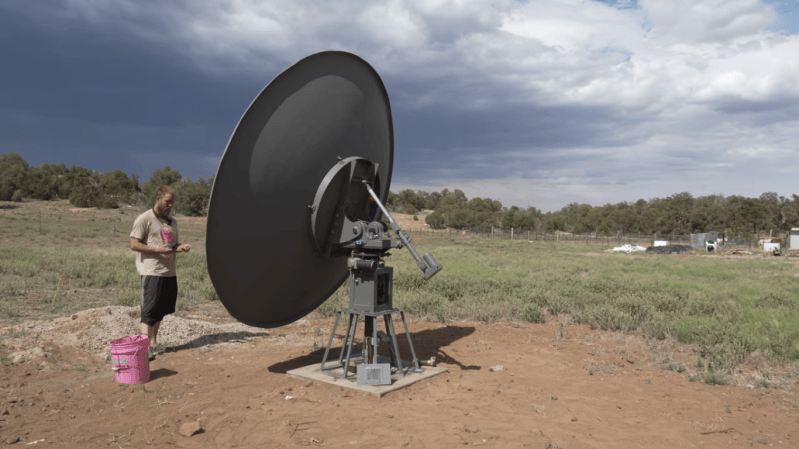
When most radio enthusiasts start trying to pick up signals from satellites, they might put together a quick-and-dirty Yagi antenna and try to catch a repeater as is passes overhead, or they might grab a small unused dish from a satellite TV service and point it up at a weather satellite by hand to try to decode some of the data coming down. But [Cranktown City] had a different approach. He found an eight-foot dish online and built a massive articulating base station out of it as his first exploration into the world of satellites.
The first problem that needs to be solved with a dish of this size is its mounting location. This installation uses a large post and concrete foundation with a custom-fabricated metal base at the bottom. The metal base houses all of the electronics not just for receiving signals from the dish, but also for orienting it properly. That includes a large metal gear driven by a wheelchair motor to control its azimuth and a linear actuator to take care of its elevation. Getting the large dish onto the frame was its own ordeal, complicated by the fact that it’s not uniform in its shape and has to be mounted in a specific orientation.
With everything assembled, the circularly-polarized antenna installed, and the computers up and running, the dish is able to track satellites across the sky and download data from things like GOES weather satellites. [Cranktown City] also built in a system that detects wind and points the dish vertically when it goes above a certain speed. This level of effort is impressive, and absolutely not required to listen in on plenty of sattelite activity out in the sky, but this installation will certainly give [Cranktown City] a lot of mileage and possibly even work for some radio astronomy.
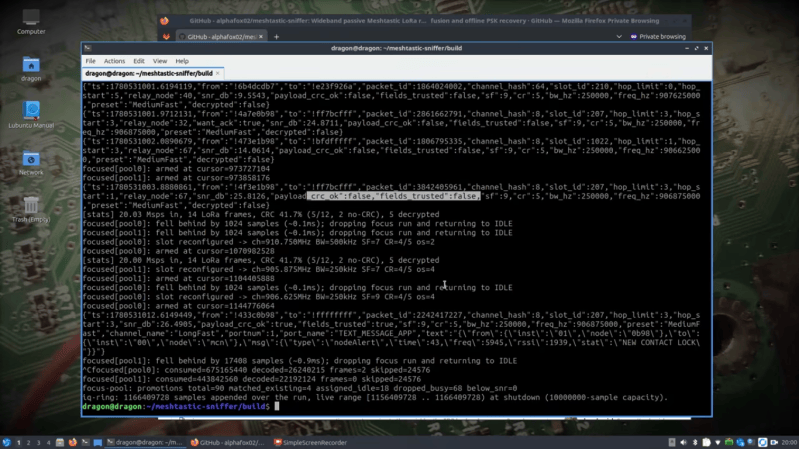
Meshtastic has gained a lot of popularity over the last few years thanks to its low barrier of entry. No licenses are needed and the hardware is dirt cheap, at least when compared to a lot of ham radio gear. But while that physical barrier is low, there is a bit of a learning curve. Part of that comes from the fact that there are a lot of channels and modes that people could be communicating on, and unless the user knows that information up front it can be hard to find where the conversations are happening. [cemaxecuter] noticed this problem and built a Meshtastic sniffer into his radio-forward Linux distribution, DragonOS.
The sniffing software is built in C and comes as a complete standalone binary and does not rely on GNU Radio. With DragonOS up and running and the software loaded, it can look at the entire bandwidth that Meshtastic operates on and detect any traffic and decode it (as long as the key is known). [cemaxecuter] is using a HackRF as a software-defined radio for this project, which he notes doesn’t quite have enough bandwidth to cover every Meshtastic operating frequency, but it can get most of them. After firing up his own node, the software quickly detects it and shows its details in the terminal.
Software like this opens up a lot of opportunities for things that would be tedious, difficult, or impossible to do with with a standard Meshtastic node. Besides finding places where conversations are happening more easily, [cemaxecuter] also suggests that it could be used for wardriving and for locating or finding other networks much more easily. For those who still haven’t tried it out, take a look at this 2023 treatise on the protocol and hardware and then dive right in.
To quote commenter [douyarou], “It’s like our little version of a Precambrian explosion”. A bunch of hackers have discovered, independently and building on each other’s work, software-defined radio (SDR) capabilities in more places than you can shake a stick at.
It all started with [Espargos] and [h0m3us3r] apparently independently discovering that the ESP32 family of chips had a “secret” debug mode that allowed direct access to the radio that’s normally used for WiFi. While the 2.4 GHz radio signal is almost always immediately converted into data by the MAC hardware, here they found a way to listen in upstream, to the raw IQ data.
Seeing this, folks were immediately inspired to find out if they could transmit as well. [marble] not only got transmit functionality working, but integrated the part in with the standard osmosdr data flow, which meant that a whole bunch of existing tools were ready to go. We didn’t know about it at the time, but apparently [jochenhammes] and [z1000biker] concurrently had their TX-capable hacks up and running: here and here.
At this point, folks have already started to use the capabilities for broadcasting digital TV signals, voice signals, FM Hell, and other hijinks. This reminds us of the early days of the RTL-SDR project, when a competent, if receive-only, SDR functionality was found in a bunch of USB TV-tuner dongles. Once the hardware capabilities were sussed out, people started writing all sorts of useful software, and it gave rise to all manner of radio projects, from simply poking at domestic wireless devices to tracking all the airplanes in the world as they fly by.
[Tom] and I were discussing this on the podcast, and he remarked that of course there are SDRs hidden everywhere there is a radio unit these days, and the question is just whether or not we could hack them into usability. And before the podcast was even finally edited, [Samson1te] told us about his find in the LR2021 LoRa chip. This is a radio that’s designed to be a radio, with 16-bit resolution, and covering lower frequencies from 150 MHz to 960 MHz.
Compared to the RTL-SDR revolution, this is all happening at incredible speed. Each of these hacks will enable us to use different slices of radio spectrum with different degrees of ease, but it’s clear that the cost of entry into playing around with digital radio has just dropped precipitously. We will see hundreds of new signals hacks in the next few months – the floodgates have been opened.
This article is part of the Hackaday.com newsletter, delivered every seven days for each of the last 200+ weeks. It also includes our favorite articles from the last seven days that you can see on the web version of the newsletter.
Want this type of article to hit your inbox every Friday morning? You should sign up!
The news of the past couple of weeks has seen the ESP32 turned into an software-defined radio (SDR) thanks to a hidden baseband mode, an exciting development by anyone’s standards. It seems unexpected SDRs are like busses in that you wait for ages and two turn up at once, because hot on the heels of the ESP32 story is [Samson1te], revealing the SDR functionality hidden within the LR2021 LoRa chip. This one is especially interesting because as well as a 2.4 GHz radio, the chip sports a radio that works from 150 to 960 MHz.
We’re indebted to them for posting this in a comment on our receive converter post, as a complimentary project to the ESP32 one. It gives a 16-bit SDR with receive and transmit, however as with the ESP32 it’s early days and we hope great things lie ahead. There are comprehensive docs available, should you wish to enter the fray. Currently the main demo is P25 digital voice.
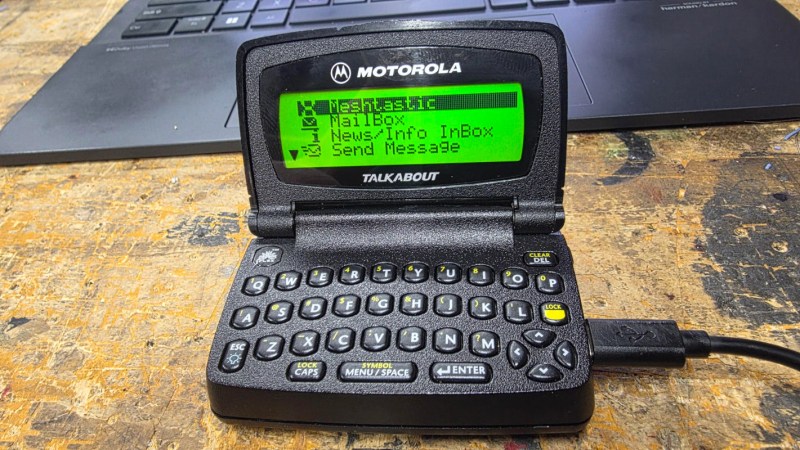
Text messaging has been around on cellular networks en masse for around three decades now. It’s so common that it’s difficult to remember a time without it. Its two-way quick messaging is incredibly useful, but for even simpler communications there’s a one-way system that predates it. Pagers are able to receive simple messages, but outside of hospitals are rarely used nowadays. Eventually some added in two-way communications like this Motorola T900, but they’re still mostly obsolete. That’s why [zindustries87] converted it to operate on the Meshtastic network instead.
To get this pager working, a lot of reverse engineering was needed. There is essentially no documentation on the chips in these devices, so the screen and keyboard both were reverse-engineered to work with other hardware. In this case, [zindustries87] found space for a Heltec V4 with an ESP32-S3, a popular Meshtastic node with a small form factor. Some programming was needed to get everything communicating together, but from the looks of things it seems to have basic functionality.
[zindustries87] points out that this is a prototype, and didn’t know going in if the keyboard and screen could be brought back to life, or if the other hardware would fit in the case. But with it working on this level, they plan to add a number of other features in and possibly build a drop-in PCB replacement for these devices. They were once fairly popular so there are plenty around, and they’re a good form factor for a dedicated Meshtastic device that doesn’t need a smartphone to work. The only other ways of bringing pagers back to life involve bootstrapping an entire pager network, and Meshtastic is a bit more useful than that now.
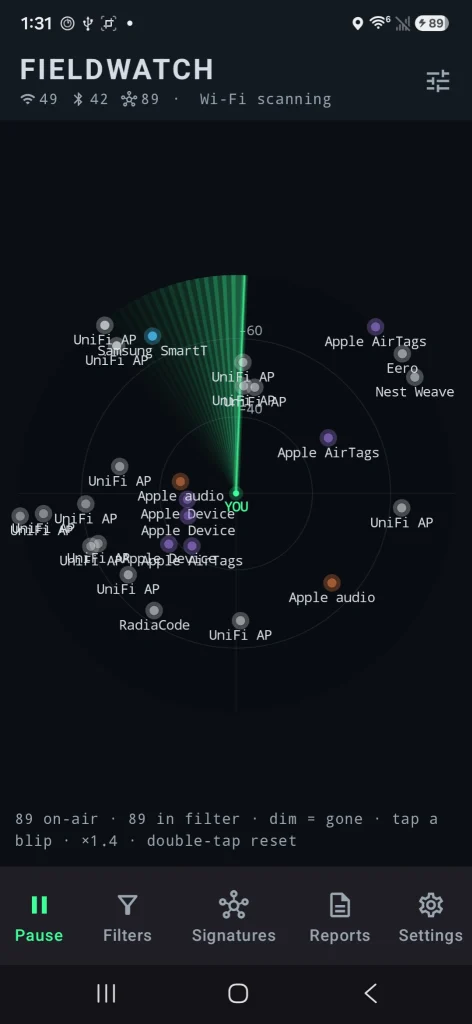
As you know, there are thousands of Bluetooth and WiFi signals we pass through daily, especially if we live an active life in a big city. That includes tags, smartphones, WiFi routers, drones, surveillance devices, vehicles, body cams and mesh radios. Clearly it doesn’t stop here and the list goes on.
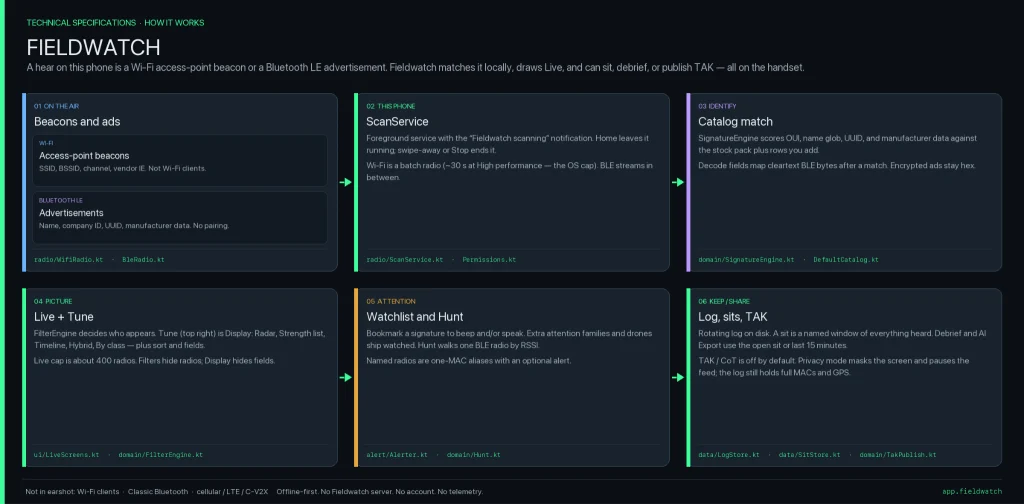
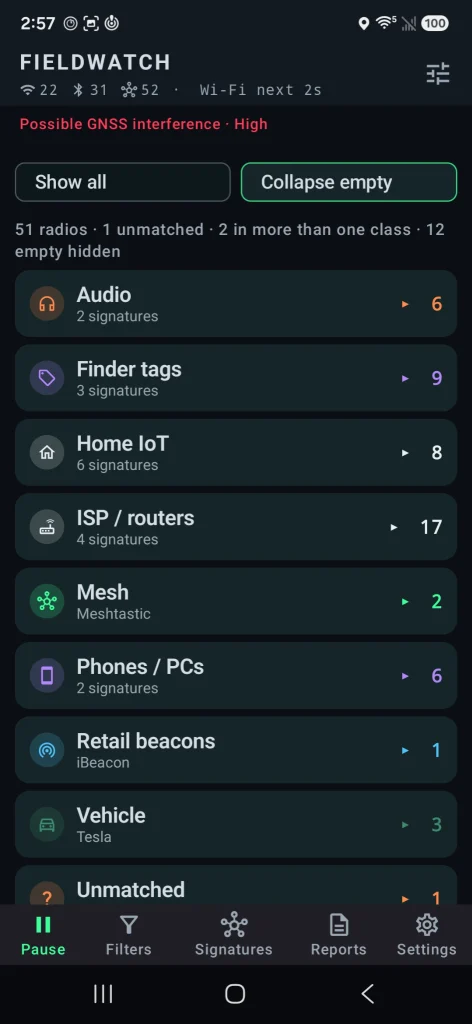
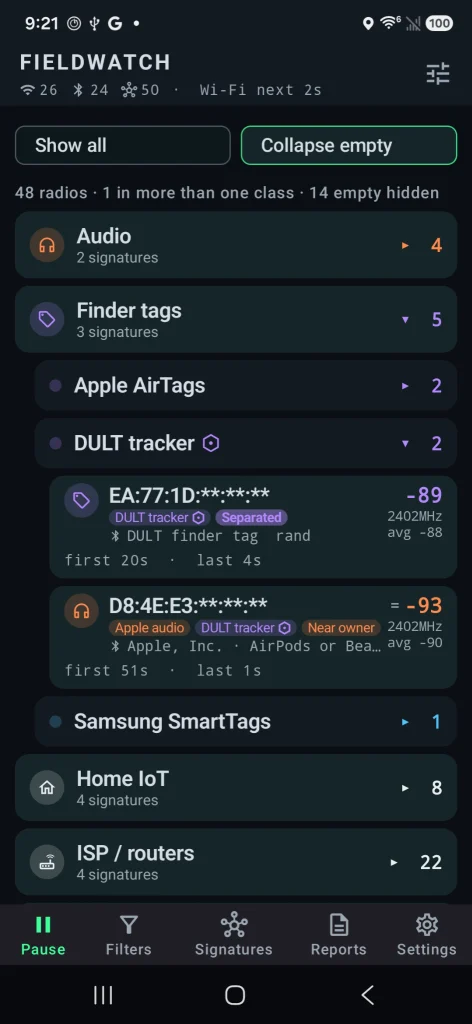
Many of you are privacy focused individuals and want to know what’s going on around you and whether you’re being tracked or watched by someone. That’s okay, protecting your privacy is a good thing. FieldWatch was made for this. It matches what it hears against an editable signature catalog of roughly 250 device types and shows the results in live views, recorded sessions, path maps and reports. Everything runs on the device and works fully offline.
FieldWatch
FieldWatch is a free, open-source Android app that listens to nearby Wi-Fi and Bluetooth signals using the radios already in your phone. It compares what it hears against a list of known device signatures and shows them. It only receives signals. It never transmits.
Source: OGridPeteSource: OGridPete
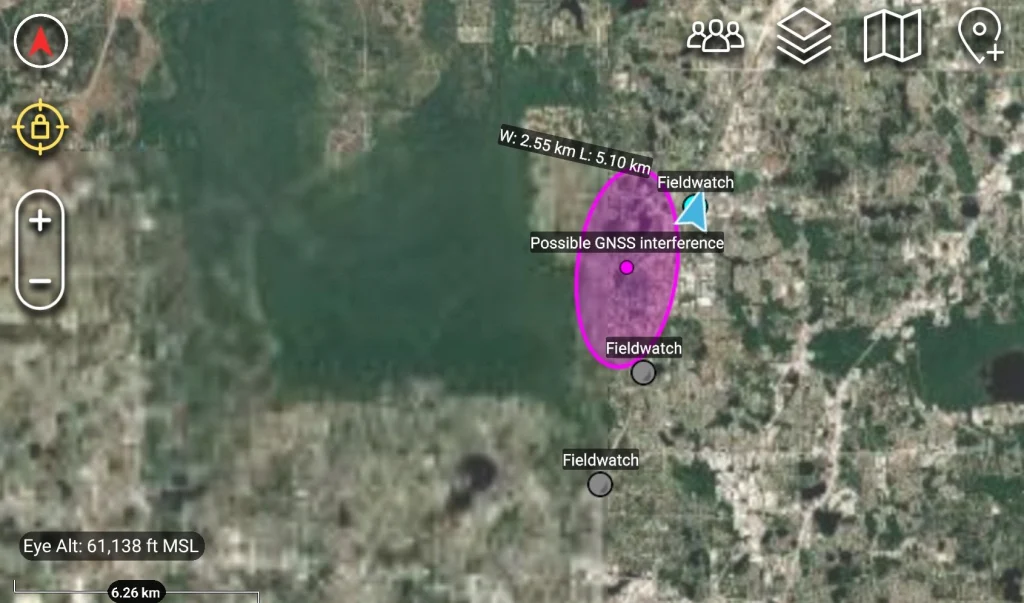
You can set alerts for specific devices, record what’s present during a walk or drive, and later compare sessions. All the findings are sorted under their category. It also has basic GNSS interference detection and can send results to mapping tools like TAK. Matches are based on patterns, not guaranteed identifications, and the app only sees what the phone’s radios and Android allow it to see.
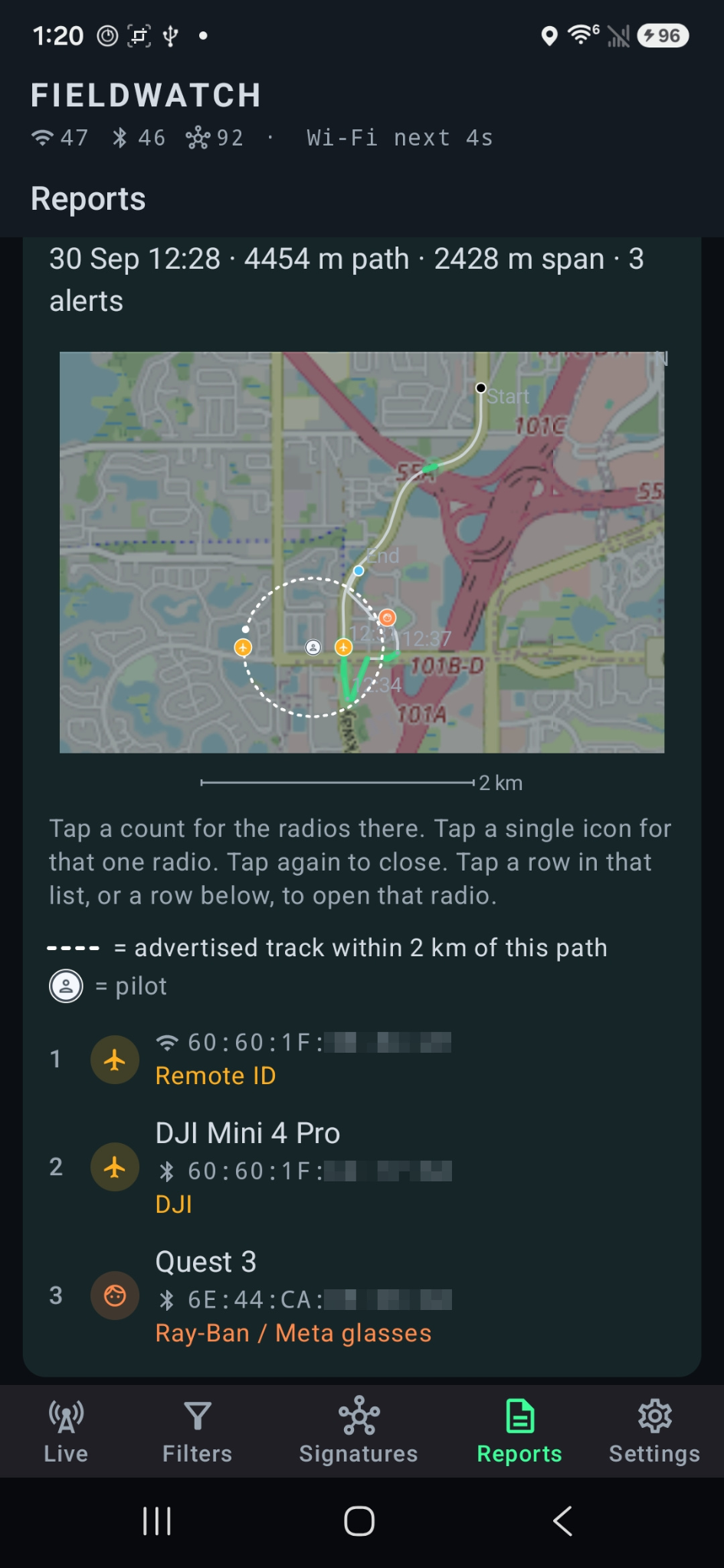
Depending on your preferences, you may want to see these devices on a radar or on a map. The app found the location of the drone operator as well as the drone itself.
Source: OGridPeteSource: OGridPete
TAK Support
TAK and ATAK are free mapping apps used by military, emergency responders and some civilians to share locations and information on a map in real time. FieldWatch can send what it detects straight to TAK over the local network.
When FieldWatch sees a drone that’s broadcasting Remote ID, it can place a moving marker on the TAK map for the drone and a second marker for the pilot if that location is available. Other devices it finds, plus any GNSS interference alerts, can also appear as markers. Several phones running FieldWatch can send data to the same map at the same time, so a team sees the same picture.
Source: OGridPete
GNSS Interference Detection
Newer versions check for signs of GPS interference or spoofing using the phone’s own receiver. After a short outdoor calibration, it can alert you and mark the spot on your path or on a TAK map. It shows where you were, not where the interference came from.
Source: OGridPete
Limits
Now let’s talk about its limits. It isn’t a direction finder. Also, it doesn’t scan Bluetooth Classic, cellular networks or full Wi-Fi traffic. Matches are based on patterns and those are not confirmed identities. Your results depend on the phone and what Android lets the app see. For better results use newer phones. Official versions only come from the GitHub repo.
Android App
Download the APK from the official GitHub page and sideload it. Android 10 or newer is required. Android 11 has more functions that can be used with this app. A short instruction file and manual are included. The repository has all the answers in terms of the app. It works on a cheap phone with no SIM card. OffGridPete recently posted that he used a Moto G for $30 for his test and it worked well. If you decide to use it, use it for your own privacy and security, and be respectful of other people’s privacy.
Summary
You can use your cheap phone as a scanner for devices nearby, and find jamming and tracking. There are different apps that do similar things, but they’re bound to Linux only, which is very inconvenient. FieldWatch works on an Android phone to find trackers, cameras, drones, body cams and more.
If you enjoy experimenting with frequencies and trying new things, we recommend signing up for our SDR for Hackers training. With Master OTW, you’ll learn how to use your computer and inexpensive SDR hardware to explore and hack a wide range of radio signals.
Perhaps the most famous of software-defined radios is the RTL-SDR, which is very cheap because it’s a digital TV receiver that’s been pressed into service delivering raw I and Q data streams. But the RTL-SDR is certainly not the only chipset that can do this, and today we have a new one.
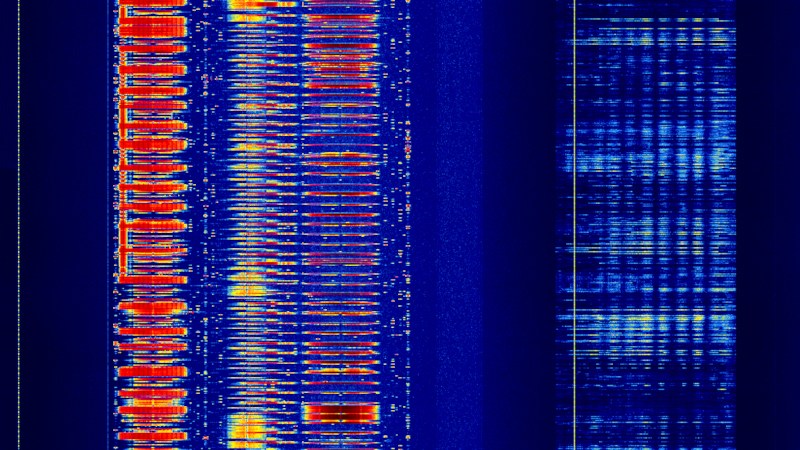
The radio works on the 2.4, 5, and 6 GHz bands, depending upon which version of the device — and thus which radio chip — you have. These may not be entirely useful to many who use lower bands, and given that a similar hack has been found for ESP32 radios on 2.4 GHz it’s likely a demand will arise for a receive up-converter. Until then, you can look at WiFi packets in a waterfall view to your heart’s content.
Since more and more devices now incorporate a radio, we hope that more such undocumented raw streaming modes will be found, and that we’ll see some other new SDRs. Something to look forward to.
As the legacy AM broadcast bands fade away, what happens to the millions of devices built to receive them? Many of them will go into e-waste, but with a century of radios to choose from, some of them are collector’s items. Vintage tube radios like the ones [GarethDaviesLondon] has would go silent, so he’s made a small AM transmitter to keep them alive.
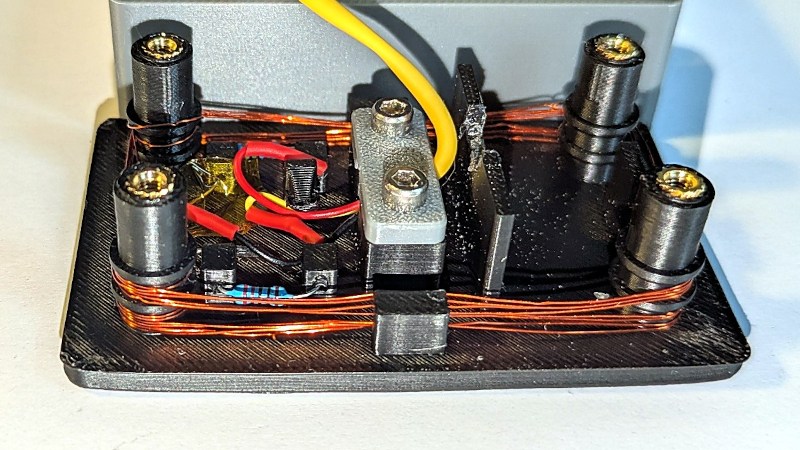
At its heart is an ESP32-S3, which takes an online radio stream and transmits it through RF generated with a pulse chain on a GPIO. Generating analogue signals from radio to video with a microcontroller is nothing new, but perhaps the more interesting part of this one comes in how he radiates enough from that pin. There’s a 3D printed box with stand-offs designed to take a widely spaced wire coil, which is enough for the vintage electronics to pick up. He makes the point that it may not be legal, but at that power we doubt anyone will notice.
The output on this one is 200kHz for the European long wave band, but we’re guessing a higher medium wave frequency could also be generated. Meanwhile if you are curious about AM, we’ve featured someone having a closer look at it.
The Doolan-Larson House and Storefronts in San Francisco, a potential future KEXP location. (SF Heritage Photo / Alvis E. Hendley)
Seattle independent radio station KEXP is exploring the possibility of building out a second physical home — far from its beloved base at Seattle Center — in San Francisco.
Three years after expanding its broadcast footprint to the Bay Area with the acquisition of 92.7 KREV FM, the non-profit music institution has set its sights on the city’s historic Haight-Ashbury neighborhood for a potential site.
The early-stage plan for the landmark property envisions radio broadcast facilities, a roof venue for live performances and community events, space for group and individual music lessons, and a public “third space” intended for year-round daily gathering.
The proposed hub adds another twist to the long-standing cross-pollination between the two tech capitals. While Silicon Valley giants have routinely set up major engineering outposts in Seattle, and founders and workers migrate between the regions, KEXP’s expansion represents a rare cultural export heading in the opposite direction.
San Francisco Mayor Daniel Lurie cheered the proposal as a win for both the neighborhood and the city’s broader economic recovery.
“Art and music have been part of what makes San Francisco special for generations,” Lurie said in a statement. “Innovative partnerships like this one help us reimagine what’s possible and find new ways to activate our neighborhoods. Our artists and cultural spaces make our city stronger, and this new home for music and culture at Haight and Ashbury will inspire generations to come.”
Located at the epicenter of the 1960s counterculture movement, the Colonial Revival-style Doolan-Larson House was originally constructed in 1903 and raised after the 1906 San Francisco earthquake to add ground-floor storefronts.
The property — designated San Francisco Landmark No. 253 and listed on the National Register of Historic Places — housed groundbreaking hippie-era boutiques during the Summer of Love. It was gifted to SF Heritage in 2017 by its long-time owner, the late Norman Larson, specifically to ensure the landmark would be preserved and activated for public and cultural use.
Bay Area band the Osees play a live show in the Gathering Space at KEXP in Seattle on Sept. 4. (KEXP Photo / Greg Chow)
Founded in 1972 as KCMU — a small, student-run station at the University of Washington — KEXP has spent over five decades building a global reputation for human-curated music discovery, famously becoming one of the first stations to champion the “Seattle sound” in the late 1980s.
The station’s Bay Area presence officially materialized in late 2023 when KEXP placed the winning $3.75 million bid at a bankruptcy auction to acquire commercial frequency 92.7 KREV FM (now KEXC). Funded by a portion of a $10 million bequest left by a anonymous long-time donor, the station began retransmitting its broadcast signal to Northern California in March 2024 as part of a strategy to ground its growing digital and streaming audience in key cultural markets.
In Seattle, KEXP’s physical hub at Seattle Center — itself a civic landmark — features a public Gathering Space that combines a coffee shop, record store, and live performance venue alongside its open-view DJ booth.
Translating a high-touch, human-centered physical experience into new markets is a core priority for the station: KEXP recently hired its first chief product and technology officer, former SiriusXM and Nordstrom executive Jyoti Shukla, to build digital products and physical spaces that intentionally prioritize human music curation over AI algorithms.
In a post on LinkedIn, KEXP CEO Ethan Raup said the response to the station’s arrival in the Bay Area “has been nothing short of remarkable” and that it gave KEXP “the confidence to start planning for our next big step.”
In its post on Thursday, KEXP stressed the plans are “not a done deal yet.” Over the coming months, SF Heritage, KEXP, and Blue Bear School of Music will focus on gathering community feedback, finalizing an adaptive reuse plan, and determining construction feasibility and project financing.
KEXP and Blue Bear representatives will make their first public outreach push at the Haight Ashbury Street Fair on Sunday to share more about the proposed project.

 Login