❌

Reading view

There are new articles available, click to refresh the page.

KiCad… In The Browser?

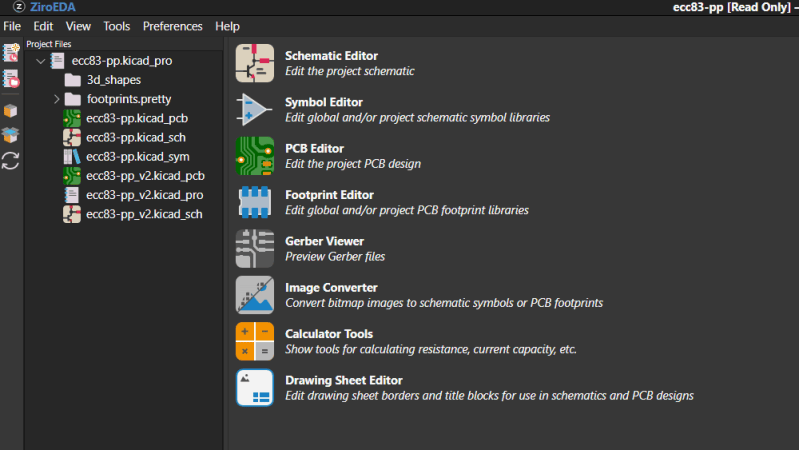
KiCad is a useful tool for designing printed circuit boards, but it’s of no use to you if you can’t install it on the computer you’re on. To get around that, [Akshay Rukade] has whipped up a browser-based alternative to help keep you working in less permissive environments. It’s called ZiroEDA.

Quite simply, ZiroEDA is a TypeScript port of KiCad 10.0.6’s C++ source code. You get the schematic editor, the PCB editor, the interactive router, and the electrical and design rule checkers all running in a browser. It can open .kicad_pro files as you’d expect, and you can edit and save them as you would if you were working in standard KiCad directly.

[Akshay] reports that KiCad’s own kicad-cli was used for compatibility testing, and that zone fills came out vertex-identical from ZiroEDA versus using KiCad itself. With that said, the project is still a work in progress, and some dialogs from the original software are still missing. Projects are said to be end-to-end encrypted, but you’ll hopefully lose your job quickly if you try and put anything important to national security through a tool like this. You can always try it, just to give your higher-ups a heart attack.

Source is available on GitHub if you want to see how it all ticks. We’ve featured other great KiCad hacks before, too, like this GPU-accelerated autorouter. If you’re working on PCB tools of your own, don’t hesitate to notify the tipsline.
Pager Converted to Meshtastic Node

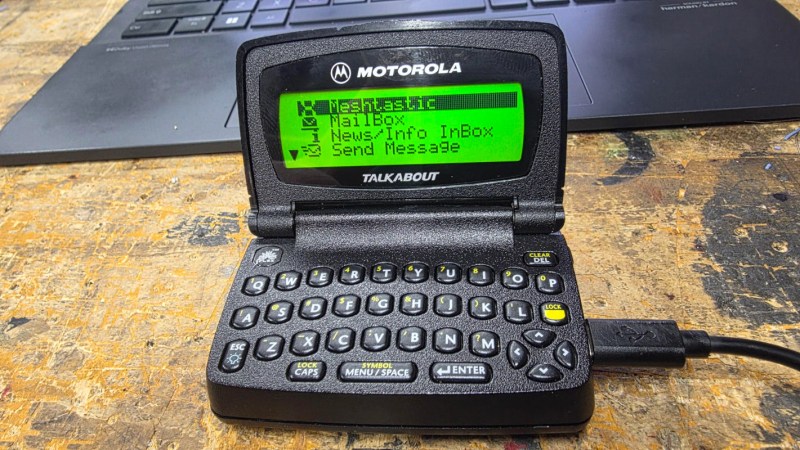
Text messaging has been around on cellular networks en masse for around three decades now. It’s so common that it’s difficult to remember a time without it. Its two-way quick messaging is incredibly useful, but for even simpler communications there’s a one-way system that predates it. Pagers are able to receive simple messages, but outside of hospitals are rarely used nowadays. Eventually some added in two-way communications like this Motorola T900, but they’re still mostly obsolete. That’s why [zindustries87] converted it to operate on the Meshtastic network instead.

To get this pager working, a lot of reverse engineering was needed. There is essentially no documentation on the chips in these devices, so the screen and keyboard both were reverse-engineered to work with other hardware. In this case, [zindustries87] found space for a Heltec V4 with an ESP32-S3, a popular Meshtastic node with a small form factor. Some programming was needed to get everything communicating together, but from the looks of things it seems to have basic functionality.

[zindustries87] points out that this is a prototype, and didn’t know going in if the keyboard and screen could be brought back to life, or if the other hardware would fit in the case. But with it working on this level, they plan to add a number of other features in and possibly build a drop-in PCB replacement for these devices. They were once fairly popular so there are plenty around, and they’re a good form factor for a dedicated Meshtastic device that doesn’t need a smartphone to work. The only other ways of bringing pagers back to life involve bootstrapping an entire pager network, and Meshtastic is a bit more useful than that now.

❌