
Reading view

There are new articles available, click to refresh the page.

University of Washington and Seattle biotech win $245M patent judgment against Guardant
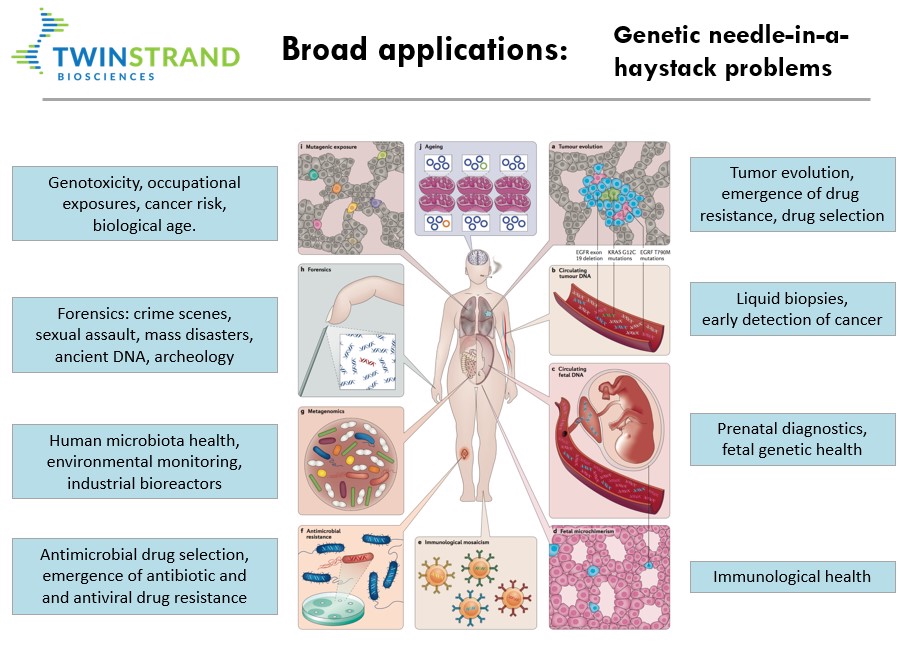
TwinStrand graphic

A federal judge has entered a final judgment requiring Guardant Health to pay more than $245 million to Seattle biotech TwinStrand Biosciences and the University of Washington over DNA sequencing technology developed at the university.

The judgment, entered Friday in U.S. District Court in Delaware, follows a 2023 jury verdict that found Guardant willfully infringed two patents covering TwinStrand’s Duplex Sequencing technology.

The case also establishes a continuing revenue stream for the university and TwinStrand from some of Guardant’s products.

Jesse Salk, co-founder of TwinStrand. (TwinStrand Photo)

The court’s final judgment includes $83.4 million in damages awarded by the jury for infringement through June 2023, plus $19.5 million in supplemental damages, $119.4 million in accrued royalties and $22.9 million in interest.

Going forward, Guardant is required under the judgment to pay a 6% royalty on covered sales through March 2033, when the patents expire.

The technology at the center of the case traces back to research at the University of Washington, where scientists, including co-founder Jesse Salk, developed Duplex Sequencing as a way to make DNA sequencing more accurate. Salk — who stepped down as CEO of TwinStrand in 2022 — now is the co-founder of cancer diagnostics startup CytoTerra.

The molecular biologist and clinical oncologist is the grandson of the late Jonas Salk, the scientist who discovered and developed the polio vaccine.

TwinStrand says its Duplex Sequencing technology can improve the accuracy of next-generation sequencing by more than 10,000-fold, allowing researchers to detect extremely rare genetic mutations that can be obscured by sequencing errors.

“Duplex Sequencing solved an accuracy problem the sequencing field had worked on for years, and this judgment affirms the jury’s finding that Guardant Health built products on that invention without a license,” said Chad Waite, chair of the TwinStrand board of directors, in a press release. “We remained steadfast in our conviction that the facts would prevail, and they have. We intend to see this through and stand firmly behind the intellectual property at the core of our technology.”

Salk and his colleagues from the University of Washington launched TwinStrand in 2015 to commercialize the technology. Based in Seattle, the startup raised funding from Madrona Venture Group, Soleus Capital, Janus Henderson Investors, Ridgeback Capital, Alexandria Venture Investments. Section 32 led a $50 million series B round in the company in 2021.

A jury found in November 2023 that Guardant willfully infringed the patents through 11 products and services. The products identified in the judgment include Guardant360, Guardant Reveal, Guardant Shield and other cancer-testing products.

The Delaware court subsequently rejected Guardant’s effort to overturn the verdict or obtain a new trial. In June, the court also awarded TwinStrand and UW ongoing royalties and supplemental damages. The final judgment now formalizes those awards.

Guardant is not accepting the ruling.

The California-based precision oncology company said Monday that it plans to appeal the judgment, arguing that the court’s order covers products that existed at the time of the 2023 trial and that many have since been discontinued or substantially upgraded. Guardant also said current versions of its Reveal and Shield products are excluded from the final district court order.

Guardant — founded in 2012 — said the judgment and collection of potential royalties will be stayed pending the appeal.

“We strongly disagree with this decision and will promptly be appealing for its overturn,” said John Saia, Guardant Health Chief Legal Officer, in a press release. “We have full faith in the strengths and merits of Guardant’s intellectual property and R&D and are confident we will ultimately prevail on appeal.”

Who First Made Software Installation Disappear?

By Tarik tali

Somewhere in the pile of old patent filings from the mid-2000s is a description of something you do without thinking about it: tap once on your phone, and an app just appears.

No license key. No installation folder to pick. No wizard asking questions you don’t have answers to. It’s easy to forget that this used to be complicated. Installing software in the early 2000s often meant a CD, a serial number written on a sleeve, and a setup program that walked you through half a dozen screens before anything worked. Somebody had to figure out how to make all of that disappear.

Behind even the simplest-looking app install today is a fair amount of machinery: a catalog of software, a way to deliver it over a network, authentication for the user and the device, the install itself, and a system for handling updates afterward. What makes a modern app store feel effortless is that all of this stays out of view. You never see the plumbing.

So who described that vision first?

One answer, worth a closer look: back in March 2006, an inventor named Tarik Tali filed a provisional patent application for a system he called “Method & System for Acquiring, Storing, & Managing Software Applications Via a Communications Network.” The provisional — №60/743,845 — was filed March 28, 2006. A full application followed a year later, on March 28, 2007, assigned to a company called SilentClick, Inc., and it published as US 2007/0233782 A1 that October. The filing described a system for viewing, managing, uploading, downloading, and installing software over a network, with what the document itself called “one button” upload and “one button” download and install — no manual license key, no additional prompts.

For context: that’s more than a year before the iPhone existed, and years before there was an App Store, a Play Store, or a Galaxy Store to put one in.

The vision, as Tali tells it, didn’t come from a lab or a whiteboard session. It came from a bad morning in Bangkok.

He was there in 2005, in Bangkok, for an MBA program, on-site for meetings with several companies across Asia. One morning, getting ready for a meeting, he noticed his laptop had slowed to a crawl and decided to uninstall a piece of Symantec antivirus software to free things up. Partway through, the uninstaller asked whether it should also remove a DLL file. He said yes. That single click turned out to break another program he needed for the trip — and every install disc and setup file that could have fixed it was sitting at home in Redwood City, thousands of miles away.

The problem stuck with him. On the flight home from Hong Kong to San Francisco, he ended up sitting next to Adam Barba, a teammate from his MBA program, and the two spent part of the flight talking through what software installation should feel like — something closer to a single action than a series of decisions any one of which could quietly break something else. That conversation became the seed of the filing that followed a few months later.

Worth saying plainly, since it would be misleading not to: the application never became a granted patent. It was eventually abandoned. That doesn’t erase it as a dated, public record of the vision — a patent application is still evidence of what someone described and when — but it does mean this is a story about who wrote something down first, not about anyone holding enforceable rights today.

The harder question is whether the vision was really new in 2006. Downloadable software wasn’t new. Installer programs weren’t new. Even automated network deployment of software was already common in corporate IT by then — an administrator could push an install out to a machine without touching the keyboard on the receiving end.

But most of those systems don’t quite match what’s described here. A typical enterprise deployment tool still required someone to log into a console, find the target machine, and choose what to install before anything happened — several decisions made by an administrator, not one tap made by an ordinary person. The specific combination worth checking for is narrower than “software over a network”: one simple action, taken by a regular consumer, with no license key and nothing further to configure once it’s started.

So far, nothing earlier than March 2006 has turned up that clearly matches all three of those pieces at once. That’s interesting, but it isn’t proof of anything. Patent and prior-art searches only find what got published, filed, or indexed somewhere searchable. Plenty of real systems from that era left no such trail — an old download portal, an internal prototype, a product demoed at a trade show and then forgotten. Any of those could still be out there, and any one of them would change this story.

Which is really the reason to write it up at all. This isn’t a claim that any company copied this filing — it’s entirely possible several teams landed on a similar vision around the same time, which happens often enough in technology that it’s barely worth remarking on. It’s more of an open question, aimed at anyone who might know of something earlier: a mobile software portal, a browser-based installer, some consumer product from the early 2000s that already did one-tap installation without a key or extra steps.

Until someone produces that, the March 2006 filing stands as an early description — currently the earliest one anyone’s found — of an innovation that eventually became how most people install software today. On the current record, Tarik Tali stands to be recognized as the person who first put that specific combination into writing — credit for an innovation, not a claim on anyone’s revenue.

If you know of something that predates it, I’d like to hear about it.


Who First Made Software Installation Disappear? was originally published in Coinmonks on Medium, where people are continuing the conversation by highlighting and responding to this story.

❌