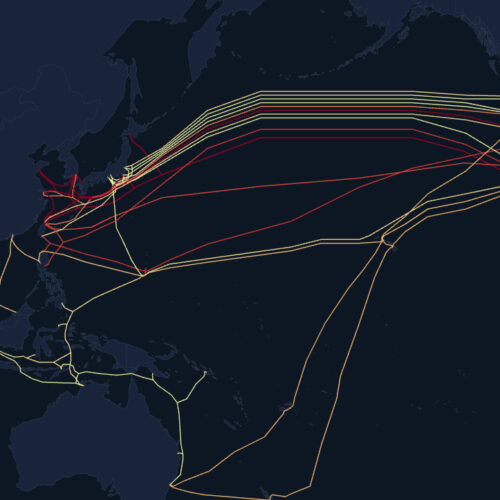
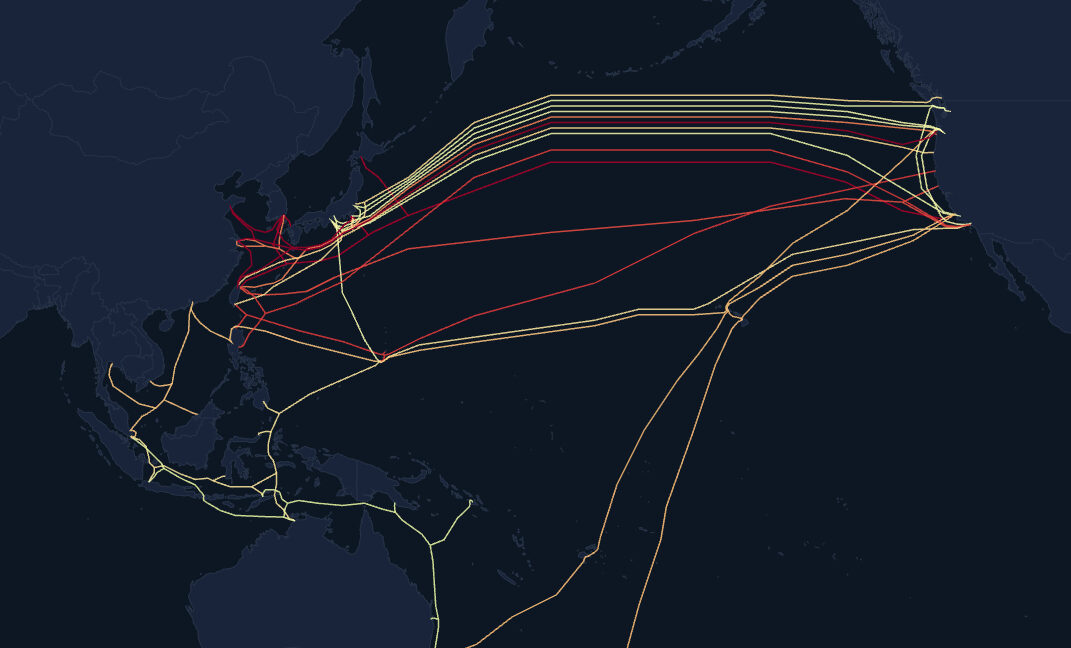
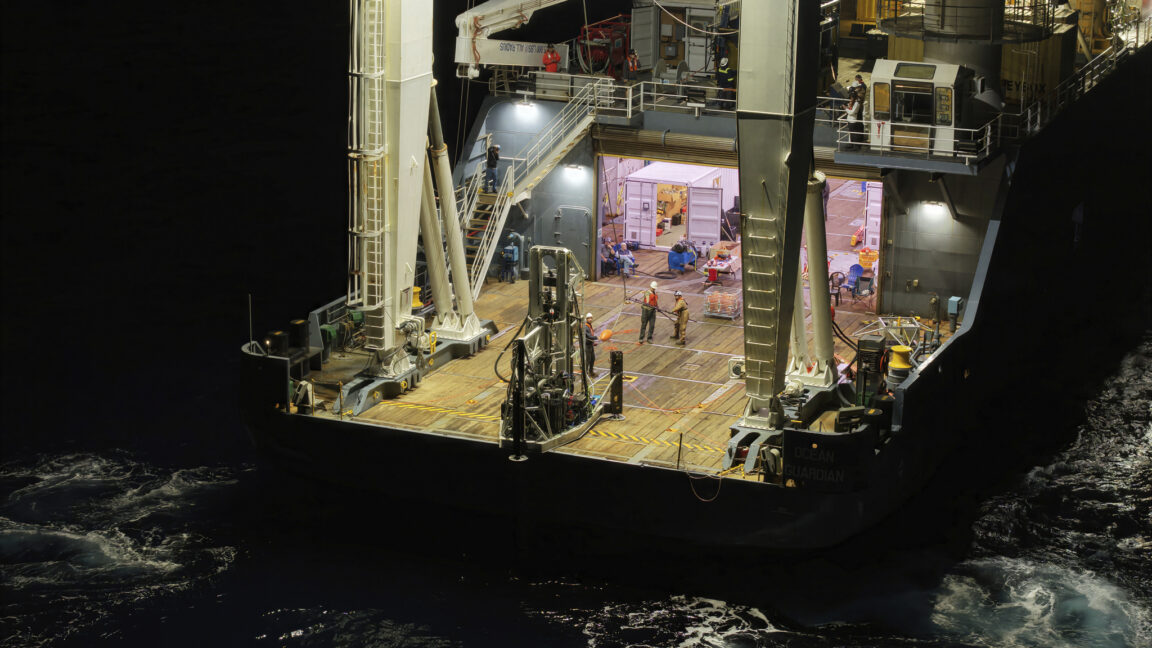
Subsea cable projects owned by US companies such as Google and Meta face some of the greatest risks from the threat of deep-sea sabotage in the Pacific Ocean, according to a new report. That coincides with Chinese research ships spending an extraordinary amount of time apparently surveying undersea cables—not to mention Chinese commercial ships being investigated for cutting cables in both European and Asian waters.
Most damage to the undersea cables that form the Internet’s backbone is the result of accidents involving bottom-trawling fishing nets and ship anchors dragging on the seabed, with storms and undersea landslides also factoring in. But the recent rise in international tensions and open conflicts have placed new scrutiny on more suspicious instances of cable-cutting damage, with analysts warning about Russia and China in particular engaging in cable sabotage or tampering as “gray zone” tactics that fall short of direct military confrontation.
One of the newest risk assessments of China’s gray zone tactics targeting the Internet’s undersea infrastructure comes from a research report published by the US-China Economic and Security Review Commission, an independent government commission that advises Congress. The report was contracted to the London-based think tank China Strategic Risks Institute and published in September 2026.
Coral bleaching is a major problem for ocean ecosystems as the ocean gets warmer. Researchers at Stanford have found a new method for regenerating bleached corals.
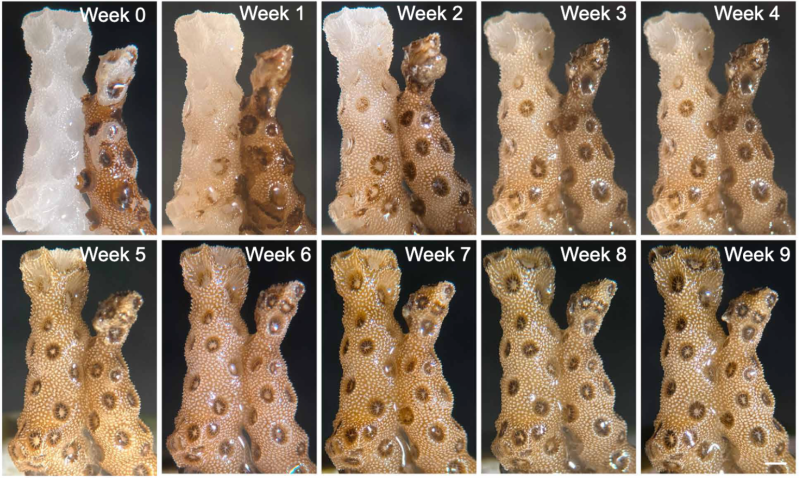
Scientists working on coral found that when they had a bleached and healthy example accidentally touching in the lab, the symbionts from the healthy coral that make its food were able to spread to the bleached coral, reviving it in a matter of weeks. Contact was only required for one week, although three days was sufficient in a few cases. The effect only seems to work with corals of the same genet as the healthy corals of other genets just take over the bleached coral antagonistically.
This is particularly exciting, as areas where not all coral has bleached may indicate the presence of symbionts that are more heat tolerant, and being able to spread these symbionts to their neighbors quickly can greatly speed up the process of coral regeneration and save the reef. Coral reefs are some of the most vibrant ecosystems in the ocean, so if you save the coral, you can save many other species as well that rely on them.
If you’d like to explore how the coral is doing near you, perhaps you should try an open ROV or a bionic jellyfish?
The world’s first demonstration of a subsea geothermal power plant has taken place near an active underwater volcano almost a mile below the ocean surface. It generated less than 10 seconds of net-positive electricity but showed the technical feasibility of tapping another form of renewable energy underwater.
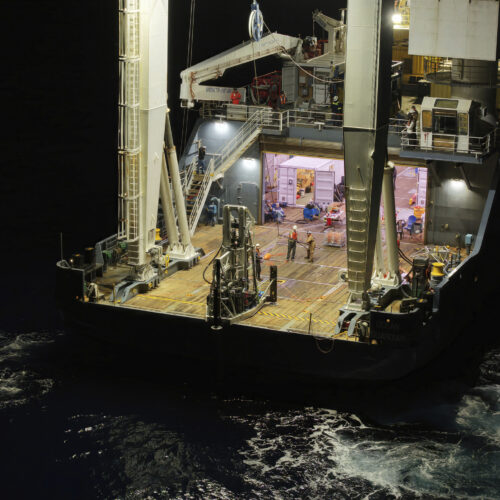
The three-week test deployment of the 3-ton prototype power plant took place at the Axial Seamount in the northeast Pacific Ocean in September. Endurance Energy, the Seattle-based startup behind the effort, aims to eventually commercialize subsea geothermal power for Pacific island nations and other customers looking for alternatives to importing expensive fossil fuels.
“The deep ocean gives us unlimited cold seawater for cooling, and its weight keeps the system and the well pressurized, so our plants can be compact,” said Andrew Redd, founder and CEO of Endurance Energy, in an email to Ars.
From left: Allison Arnold, co-director of the Opalene Climate Challenge; David Gory, co-founder and CEO of AirBuild; and Aina Abiodun, president and executive director of VertueLab. (Opalene Photo)
Some climate tech startups tied to the AI boom are still attracting investors, but deals are fewer overall and times are tougher for companies addressing sustainability issues that don’t align with data center needs.
Concerns about those trends inspired a one-time Washington state initiative called the Opalene Climate Challenge, which was led by the nonprofit VertueLab. The effort announced six investments from a pool of nearly 40 applicants.
The program planned to partner with the state to secure matching dollars, but organizers realized it would take too long to raise the needed capital. Instead, they relied solely on philanthropic donors.
“The imperative was to get the money out to these climate tech startups who are doing extraordinary work but are confronting that pinch in capital,” said Allison Arnold, co-director of the Opalene Climate Challenge.
Sustainability startups that develop hardware or physical products can face a more difficult path to scale than software companies because they typically require more capital, longer development cycles and time-consuming work to manufacture, test and deploy their technologies.
The challenge aimed to fill an early-stage funding gap with recoverable grants from donor-advised funds. Successful investments will return proceeds to the donor’s fund or another designated nonprofit.
Five of the six winners are commercializing technologies developed at the University of Washington or Washington State University. Many of the startups have participated in mentoring programs such as the Cascadia Clean Tech Accelerator or UW’s CoMotion Labs Climate Tech Incubator, or received investments from the E8 angel group.
“Those entrepreneurs who have actively sought out the resources in our ecosystem have had greater success. For most companies, it takes more than just the money,” Arnold said. At the same time, she added, “money is what has been missing in our corner of the country. We don’t have the type of risk capital that’s available in places like Silicon Valley, Boston or New York.”
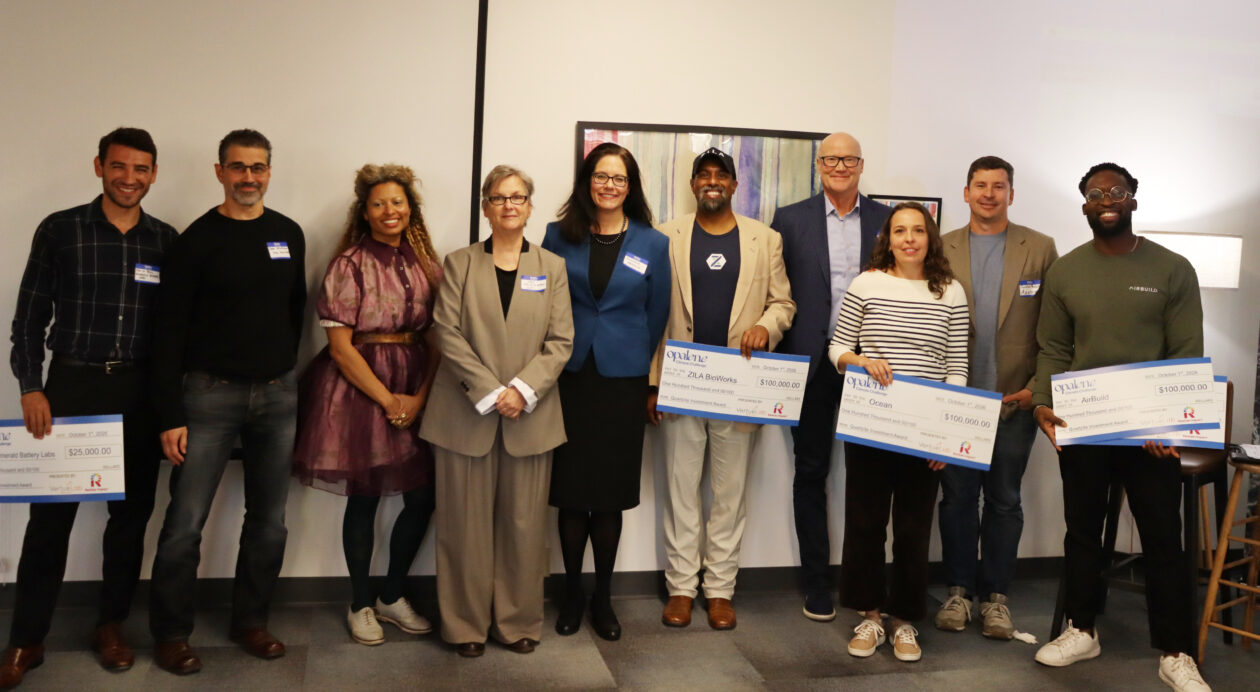
Opalene Climate Challenge awardees and leaders, from left: David Bell, Emerald Battery Labs; Steve Winkelman, Opalene selection committee; Aina Abiodun, VertueLab; Jan Whittington, Climate Solutions International; Allison Arnold, Opalene; Jason Puracal, ZILA BioWorks; Christopher Wood, Azotera; Alexa Bednarz, Ocean; Dustin McLarty, Azotera; and David Gory, AirBuild. (Opalene Photo)
The winners were featured at an event Thursday at the Seattle Climate Innovation Hub. Recipients of $100,000 awards:
Airbuild, also the winner of the $5,000 Audience Choice Award, uses microalgae to turn wastewater treatment plants into fertilizer factories
Ocean produces low-cost, low-carbon bamboo panels for roofing and other building applications
ZILA BioWorks offers plant-based resins and epoxies to replace high-carbon alternatives
Recipients of $25,000 awards:
Azotera produces low-cost ammonia for energy storage and farm applications
Climate Solutions International offers a software platform that helps government employees analyze factors such as climate resilience, cost and carbon emissions for proposed infrastructure projects
Emerald Battery Labs builds sodium-ion batteries to replace lead-acid batteries in commercial fleets and data centers

 Login