
 Login
Login
Newton’s Cradle Isn’t Really Perpetual
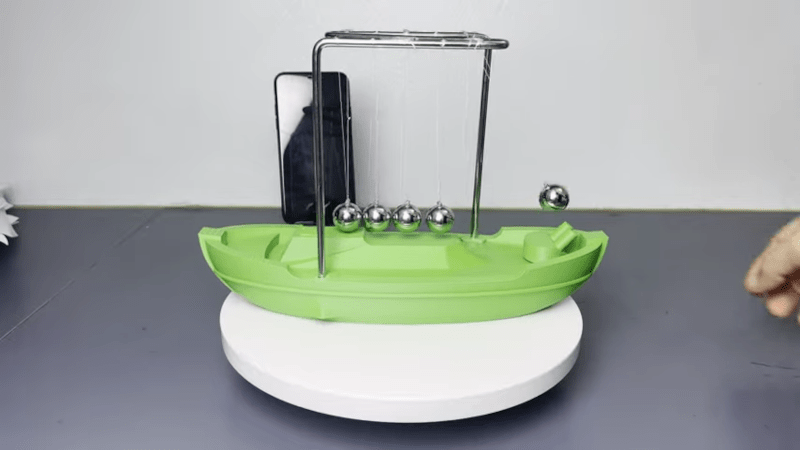
If any astute Hackaday reader saw [dongvua90]’s Newton’s cradle go on without human intervention all day long, they’d probably suspect the truth: there’s a battery and a magnet involved. But it is a nice desk piece, and you might be able to fool your less enlightened friends that you’ve discovered perpetual motion. Watch the resulting faux perpetual motion machine in action in the video below.
The trick is to sense the ball’s travel and inject a little electromagnetic pulse at just the right time. No problem for an ESP32 and a proximity sensor like the ones you find on some 3D printers. In fact, there’s very little custom circuitry. Everything is a module, and even the Newton’s cradle is cut out of a premade toy. A printed case and some software are really the heart of the design.
We can imagine this might be an interesting science demonstrator. Show the class the cradle with the electronics turned off, then subtly turn it on and ask the class what changed. You could even make the point by having students do it normally, while only you can get it to keep going forever, and challenge them to deduce what’s going on.
You might correctly imagine that this isn’t the first one of these we’ve seen. You can also build one that is sort of simulated.
