Two analog astronauts trudge toward the Mars Society’s Mars Desert Research Station in Utah. (Mars Society Photo)
The Mars Society is planning to build a Pacific Northwest research station suitable for simulating missions to the moon or Mars, in partnership with South Seattle College.
The nonprofit space advocacy group announced today that its executive director, James L. Burk, and the college’s president, Monica Brown, have signed a 10-year memorandum of agreement establishing the partnership.
The plan calls for the Mars Society to lease land on the college’s 87-acre West Seattle campus and build the research station, contingent on funding. Both parties will raise funds from aerospace companies and other donors to support construction, with the goal of opening the station at the start of the 2027-2028 academic year.
The agreement provides for the creation of a joint space studies curriculum and certificate program; a student capstone project and internship program tied to industry partners; and a regional workforce pipeline and community engagement effort.
Those two stations were built more than two decades ago to reflect the designs for Mars habitats. They provide opportunities for teams of researchers to test the tools and techniques that future astronauts might use for extraterrestrial exploration. During their missions, the researchers live and work under simulated Mars conditions. For example, they’re required to put on simulated spacesuits every time they venture outside their habitat.
Burk said the Seattle research station will reflect NASA’s growing emphasis on moon exploration as a precursor to crewed Mars missions, as well as South Seattle College’s traditional emphasis on workforce training. “For more than two decades, the Mars Society has operated analog research stations in the Utah desert and the Canadian Arctic that have shaped how humanity will live and work on other worlds. Bringing that capability to an urban community college campus is something new, and it is deliberate,” he said.
“The moon and Mars programs the federal government has now committed to are going to need a workforce we have not trained for in 50 years,” Burk said. “South Seattle College knows how to train people for the industries that actually build things. That approach is exactly what we need for preparing for planetary surface operations on the moon and Mars.”
South Seattle College’s main campus spans 87 acres in West Seattle. (South Seattle College Photo)
The analog research projects would build upon the college’s existing training programs. For example, students learning about electric vehicle maintenance and repair could work on projects involving battery-powered rovers and drones. Students in the college’s culinary arts program could contribute to research into growing vegetables in space environments.
“South Seattle College has a long tradition of meeting our region’s workforce needs in aerospace, applied science, and skilled trades,” Brown said. “This partnership extends that tradition, and this initiative reflects our commitment to exploring bold, future-oriented opportunities that expand access, inspire imagination, and ensure our students are prepared to lead in emerging industries.”
The Mars Society is headquartered in Colorado but has plenty of Pacific Northwest connections. The Seattle chapter was created in 1998, shortly after the national organization was founded. Burk, a former Microsoft project manager, lives and works in North Bend, Wash.
During a 2023 podcast interview, Mars Society President Robert Zubrin — who earned his Ph.D. in nuclear engineering from the University of Washington — said the Pacific Northwest was “perhaps at the top of the list” of potential sites for a Mars Technology Institute. Today’s announcement appears to be consistent with Zubrin’s assessment of the region.
In its news release, the Mars Society noted that the Pacific Northwest “hosts one of the largest concentrations of commercial space activity in the United States.” The society specifically cited Jeff Bezos’ Blue Origin space venture, SpaceX’s Starlink satellite factory and L3Harris Technologies’ Aerojet Rocketdyne facility in Redmond.
To raise public awareness of the Seattle project, the Mars Society said it plans to install an inflatable mockup of a research habitat in South Seattle College’s Aviation Maintenance Technology facilities this summer. The society also hinted at more to come, saying that there’s “a public event in the works.”
Human exploration of Mars will expose crews to a persistent, fine particulate environment whose physicochemical properties and health implications remain only partly understood. Because no samples of authentic Martian airborne dust have been returned to Earth, NASA must rely on lunar dust toxicology, Martian regolith simulants, and extensive rover/lander geochemical and mineralogical datasets to develop an initial, risk‑informed Permissible Exposure Limit (PEL). The Johnson Space Center (JSC) Lunar and Martian Dust Risk Custodian, the JSC Toxicology group, and the OCHMO Standards team worked together to draft a preliminary standard for incorporation into NASA-STD-3001 NASA Spaceflight Human-System Standard, Volume 2: Human Factors, Habitability, and Environmental Health.
The Martian Dust Limit Working Group was assembled to review this draft standard and associated evidence. Across two working sessions in February 2026, panel members reviewed mission architecture drivers, the current scientific understanding of Martian dust composition, and the toxicological evidence base supporting the establishment of a Mars dust PEL. Discussions emphasized the critical interplay between dust standards and Mars mission design elements including Extravehicular Activity (EVA) cadence, dust ingress characteristics, and the performance of habitat environmental control systems; these features highlight the need for a limit that is conservative, verifiable, and adaptable as the Mars architecture evolves. Panel members for the Working Group were David Damby, Claire Horwell, Brian Hynek, Shaunna Morrison, and Joyce Tsuji; NASA presenters were Katie Borremans, Elizabeth Rampe, and Torin McCoy; the OCHMO organizers/moderators were Douglas Ebert, David Francisco, and Kim Lowe. The Working Group meetings were also attended by members of Space Medicine and Operations group and JSC Toxicology.
The Martian Dust Limit Working Group Primary Goals
Evaluate NASA’s proposed derivation of this initial standard
The panel concluded that NASA’s approach to deriving a 30‑day continuous PEL of 0.1 mg/m³ is reasonable and appropriately conservative for early short‑stay missions. This value originates from the established lunar 30‑day PEL (0.4 mg/m³), reduced by a 3x database uncertainty factor to account for knowledge gaps in Martian dust toxicity, higher iron content, amorphous constituents, and differences between simulants and actual dust. Members supported this framework, noting that a continuous limit applied using measured time‑weighted averages is more practical than making assumptions tied to fixed dust clearance rates given the diversity of spacecraft designs. They also acknowledged that near‑term exposures will be peak‑driven (e.g., post‑EVA suit ingress) and therefore recommended that the standard explicitly address the need to manage short‑duration spikes.
Identify chemical constituents requiring further scrutiny
The panel affirmed that overall dust mass remains the primary near‑term engineering concern, but several chemical constituents warrant attention. Chromium 6+, manganese, and perchlorate were all considered low‑risk in the context of inhaled Martian dust, provided the overall dust PEL is applied (see below). However, perchlorate was recommended for broader agency‑level exposure management across multiple intake routes (e.g., ingestion due to in situ crop growth). Iron was discussed in detail due to its high abundance in Martian regolith and its potential to generate Reactive Oxygen Species (ROS), though current toxicology shows no clear link between iron‑driven ROS and pulmonary harm; still, knowledge gaps led the panel to prioritize iron for further study and potential Spacecraft Maximum Allowable Concentration (SMAC) development. Arsenic was judged unlikely to pose meaningful risk at present.
Weigh the merits of an overall dust limit versus separate SMACs
Chemical constituents embedded within Martian dust were evaluated with respect to whether independent SMACs are warranted. Based on rover observations indicating predominantly trivalent chromium, low airborne perchlorate, and manganese concentrations well below conservative SMAC thresholds at the proposed PEL, the group agreed that the overall dust limit is likely sufficiently protective for expected 30‑day missions. However, panel members advised that SMACs be maintained for select constituents such as perchlorate and manganese for mission‑planning crosschecks. From the requirement perspective, an overall Martian dust PEL approach was favored for practicality and clarity, with constituent-specific SMACs retained or developed only where they add tangible operational value.
Refine the standard’s technical language for operational use
The working group also refined the standard language to ensure clarity and consistency in implementation. Members recommended that the limit apply to a specified time‑weighted average measurement period but also making it explicit that the requirement is for protection during continuous exposure. They encouraged incorporation of peak‑exposure management within the rationale, and highlighted uncertainties related to iron content, nanophase iron, and oxidative potential so that future revisions can incorporate emerging scientific insight.
Martian Dust Contamination Limits
The new requirement established for NASA-STD-3001 is as follows:
[V2 6253] The system shall limit the concentrations of Martian dust particles less than 10 μm in size in the habitable atmosphere below a 24-hour time-weighted average of 0.1 mg/m3 during exposure scenarios lasting up to 30 days in duration.
Conclusions
Taken together, the working group’s deliberations reinforce that an initial Martian dust standard must balance conservatism with operational feasibility while accommodating architectural and scientific uncertainty. The proposed requirement provides a defensible, evidence‑informed foundation for design, verification, and risk communication. As additional Martian data and toxicological research become available, this standard should be periodically revisited to ensure continued protection of crew health during human exploration of Mars.
For more information on the results of the working group, see link to the special publication below:
Preparations for Next Moonwalk Simulations Underway (and Underwater)
NASA’s Perseverance took this selfie at “Witch Hazel Hill” on Jezero Crater’s rim on May 10, 2025. The small dark hole in the rock in front of the rover is the borehole made when the rover collected the “Bell Island” sample. The small puff of dust left of center and below the horizon line is a dust devil.
NASA/JPL-Caltech/MSSS
NASA’s Perseverance Mars rover has uncovered evidence that a 245-foot-thick (75-meter-thick) stack of ancient rock on the rim of Jezero Crater was built by repeated asteroid impacts. Referred to as the “Broom Point member” by the rover’s science team, this sequence of layered bedrock is likely more than 3.9 billion years old, making it among the oldest terrain ever examined by a Mars rover.
Released Wednesday in the Journal of Geophysical Research: Planets, the findings offer a window into one of the most tumultuous chapters in the history of the solar system.
“Since leaving Jezero, Perseverance has been exploring a brand-new frontier, both geographically and geologically — a chapter of Martian time that predates the crater itself,” said Ken Farley, Perseverance deputy project scientist at Caltech in Pasadena, California. “On Earth, our earliest geologic history has been fundamentally broken up, deformed, and erased by plate tectonics. Because Mars lacks plate tectonics to recycle its crust, this ancient record remains intact, giving us a rare glimpse into a geological time period that doesn’t exist on our own planet.”
Reading between layers
After ascending the western rim of Jezero Crater in late 2024, Perseverance began examining surrounding locations with its science instruments. Their data at Broom Point revealed six distinct rock types, including breccias — rocks composed of angular fragments — alternating with layers of fine-grained, pulverized rock dust. Rock fragments within the breccias are pocked with gas-bubble cavities, indicating they were once molten.
The presence of tiny, dark, glassy beads within the layers offered an important clue about how these rocks formed. While volcanoes can produce similar glassy droplets, they rarely occur in such high abundance, pointing to asteroid impacts, instead, as the primary architect. In fact, the largest beads rival those flung out by the dinosaur-killing Chicxulub asteroid’s impact on Earth.
NASA’s Perseverance rover captured its own tracks descending from the rim of Jezero Crater. The bright-colored rocks running from middle left to middle right of the image, a formation dubbed the “Broom Point member,” are likely more than 3.9 billion years old, making them among the oldest terrain ever examined by a Mars rover.
NASA/JPL-Caltech/ASU/MSSS
The repetition of these distinct rock types multiple times throughout this thick sequence of rock indicates that high-energy impact events happened again and again across this region of early Mars.
“The different rock layers are a record of variable-sized impacts occurring at different distances from where this rock sequence was accumulating,” said Alex Jones, a Ph.D. student in planetary geology at Imperial College London and lead author of the paper. “Some large impacts took place very far away, some small impacts nearby. Their debris all ended up landing here, constructing this thick section of rock.”
How these layers formed may suggest an interaction with water or ice. Several of the layers look like they may have been formed by fast, ground-hugging debris flows. On Earth, these powerful, fluidlike surges can occur when molten rock hits water or ice that instantly flashes into steam.
Cosmic one-two punch
Some of Broom Point’s layers tilt at angles exceeding 80 degrees — nearly vertical — which is far too steep to be caused by the impact that created Jezero Crater.
Instead, scientists suspect a cosmic “one-two punch” shaped this landscape long ago. First, a colossal asteroid impact created the 1,200-mile-wide (1,900-kilometer-wide) Isidis Basin, one of the largest impact basins on Mars, upending and tilting the once-flat rock layers. Later, a second asteroid likely struck, forming Jezero Crater, which measures 28 miles (45 kilometers) across. This second impact fractured and uplifted the already-tilted rocks into the dramatic formations the rover sees today.
To pin down exactly when these events took place, the Perseverance team collected two core samples, dubbed “Bell Island” and “Main River.” If a future mission were to return them to Earth, laboratory dating could determine when and how often impacts were occurring on early Mars — and, by extension, the infant Earth, whose own early impact record has been erased by billions of years of plate tectonics.
“During this violent era, it wasn’t rain or snow falling from the sky, but an almost constant barrage of molten rock droplets and pulverized dust kicked up by asteroid impacts,” said Jones. “If we can pin down the ages of these layers, it would be like reading a cosmic weather report from 4 billion years ago.”
This orbital map shows the path NASA’s Perseverance Mars rover took from its 2021 landing site in Jezero Crater to the “Broom Point” location in mid-2025.
NASA/JPL-Caltech/MRO/HIRISE/UA/ICL
More about Perseverance
NASA’s Jet Propulsion Laboratory in Southern California, which is managed for the agency by Caltech, built and manages operations of the Perseverance rover on behalf of the agency’s Science Mission Directorate in Washington, as part of NASA’s Mars Exploration Program portfolio. Arizona State University leads the operations of the rover’s Mastcam-Z instrument, working in collaboration with Malin Space Science Systems in San Diego, on the design, fabrication, testing, and operation of the cameras. SuperCam is led by Los Alamos National Laboratory in New Mexico, where the instrument’s Body Unit was developed. The rover’s SHERLOC (Scanning Habitable Environments with Raman and Luminescence for Organics and Chemicals) instrument was built at NASA JPL, and its WATSON (Wide Angle Topographic Sensor for Operations and eNgineering) camera was built at Malin Space Science Systems.

For more information on NASA’s Perseverance, visit:
Elon Musk takes a bow at NASA’s Kennedy Space Center in May 2020 after the launch of SpaceX’s Crew Dragon Demo-2 mission, which carried two astronauts to the International Space Station, about 250 miles up, and a world away from Mars. (GeekWire Photo / Kevin Lisota)
Ever since its founding, SpaceX has fixed upon a single idea: Elon Musk’s vision of colonizing Mars. Everything the company does is geared to that foundational goal.
Two years ago, Musk posted on X that there could be a city on Mars within 20 years, “but for sure in 30.”
“Civilization secured,” he added, implying that even if our troubled lives here on Earth come to some catastrophic end in the coming decades, don’t worry, humans will endure on Mars.
Yet the work of scientists studying Mars suggests that it’s far-fetched, perhaps delusional, to think a human colony could be established there. You don’t need to be a billionaire or a rocket scientist to realize Musk’s timeframe is certainly a fantasy; there won’t be a city on Mars in his lifetime or that of his children or his grandchildren. Think many, many decades at best. But more likely, never.
Retail investors rushed to buy SpaceX stock after the IPO in June. Though the share price has already fallen back below where it was that day, many see it as a long-term investment. The reality is that the improbability of the Mars project shadows SpaceX’s long-term future.
SpaceX’s Starship, the rocket Musk is counting on to reach Mars, lifts off in a test flight in Texas in 2024. (Steve Jurvetson / CC BY 2.0)
While humans will at some point likely overcome the massively daunting engineering and logistics challenges of getting to Mars and even staying for some time, there’s no technology available to form a permanent settlement there.
Musk may be excused as being playful with his time scale.
“Oh, Elon is famously bad at giving time estimates,” said Erika DeBenedictis, a biological engineer and Mars scientist, founder of Pioneer Labs, which is researching how to grow plants on Mars. “Things always take longer than he says, but they do tend to happen.”
Musk has been quite specific. Last year, he said SpaceX had a 50:50 chance of sending its first uncrewed Starships toward Mars in 2026, with crewed landings to follow “as soon as 2029, although 2031 is more likely,” he posted on X.
Then, this February, he said SpaceX would build a city on the moon first and start building a Mars city “in about 5 to 7 years.”
While his targets and timing keep moving, the problems go deeper than that. The question is not when humanity will expand beyond Earth, but whether it ever will.
Establishing a city on Mars depends crucially on a concept called “terraforming,” which means physically transforming the planet’s surface environment into something resembling that of Earth, at least partially hospitable for humans.
To DeBenedictis, the sterile science fiction notion of people confined inside glass domes, looking out upon a forbiddingly bleak landscape and living off protein shakes and dried food, is deeply unappealing. “I wouldn’t want it and I wouldn’t want it for my daughter,” she said. “It just seems terrible.”
“It doesn’t have to be that way,” she adds. “I want the planet to be green.”
DeBenedictis concedes at the outset of an interview that this is “probably impossible,” though in the tone of someone who lives to chase the impossible.
In contrast, Musk glibly mentions terraforming as if it were within reach. In truth, science has only highly conjectural ideas about how it might be done. The hypothetical options scientists are researching now, if they work at all, will take many decades if not centuries to make Mars habitable. And they may never work.
A titanic ambition
Despite this, investment bankers and those with pre-IPO access were primed to ride the coattails of Musk’s colossal wealth for a big payout on SpaceX’s Wall Street launch day. Musk supercharged the June IPO by absorbing his xAI project into SpaceX. The IPO filing positioned xAI as a $26.5 trillion market opportunity, dwarfing all the other business segments of SpaceX, which the filing pegged at a mere $2 trillion. What’s an IPO without a transcendent AI promise these days?
Wall Street weighed only Musk’s entrepreneurial success and his ability to conjure the future and spin financial dreams. The Economist in May called Musk’s risk-taking and mobilizing of resources “capitalism at its most remarkable.”
For Wall Street, that made the SpaceX IPO a surefire winner. The share price duly rocketed up and made Musk briefly a trillionaire. Though he lost that status when the share price subsequently slid, he’s still by far the richest man in the world with a net worth into the $900 billions.
That fortune is built upon the market perception that Musk can turn dreams into reality. Mass-producing all-electric, virtually self-driving cars was once a pipedream. Rockets landing on their tails graced the covers of 1950s science fiction novels. By force of will, Musk made both a reality. Whatever pipe he’s smoking now, shouldn’t we give his Mars dream some healthy respect?
That dream is specified precisely on the SpaceX website: “A permanent human colony on Mars with at least one million inhabitants.”
A SpaceX facility in Redmond, Wash., where the company designs and builds its Starlink internet satellites. (GeekWire Photo / Alan Boyle)
Musk designed the huge Starship rocket to go to Mars. And when Musk first unveiled his plan for the internet satellite venture that became Starlink in Seattle more than a decade ago — the satellites are made in Redmond — he told Bloomberg Businessweek he saw it as “a long-term revenue source for SpaceX to be able to fund a city on Mars.”
Nearer term, SpaceX is to provide the lunar lander for NASA’s Artemis project that should return humans to the moon within a few years and lay the groundwork for a permanent moonbase; Musk sees it as a stepping stone to the true goal.
The problem is, Mars is not even remotely habitable. It’s deathly cold. There’s nothing on the surface but dust and rocks, in places some deeply frozen CO2. Regular dust storms whip the surface. The planet has zero vegetation; not a tree, not a leaf, not a blade of grass. The oxygen-free Martian air is unbreathable.
Venture outside without a space suit and you’ll die within a minute in the poisonous, low-pressure atmosphere. During unpredictable solar flares, cosmic radiation is a separate threat to life.
Martian gravity, one-third of Earth’s, may deform the human body over time. Astronauts on the zero-gravity International Space Station must work out constantly to retain muscle strength. Even then, if they spend too long in space they must be carried from the space capsule after splashdown.
“I don’t see any prospect for there to be permanent settlements,” said senior NASA astrogeophysicist Chris McKay, who for more than 40 years has studied the possibility of supporting human life beyond Earth, and on Mars specifically. “Why would anybody want to live there?”
Bruce Jakosky, professor emeritus at the Laboratory for Atmospheric and Space Physics at the University of Colorado, Boulder, who has studied Mars his entire career since he worked on the Mars rover Viking mission in the mid-1970s, says he thinks it will happen someday, but adds, “I have no idea when or how.”
“It’s far enough into the future that, once you get beyond, say, 30 years, you can’t tell the difference between that and infinity into the future,” Jakosky said.
That’s scientific realism. Buzz Lightyear talks about getting to infinity and beyond, but he’s a toy.
What’s really achievable on Mars
Despite the cold facts, Musk has so successfully sold the notion that if he put out a call for volunteers for the first Starship mission to Mars, hundreds of space scientists, enthusiasts, adventurers and Musk fanbros would eagerly sign up.
Indeed, he already has a Mars mission volunteer. On the launch webcast of SpaceX’s latest and largest Starship rocket in late May, a presenter introduced cryptocurrency billionaire and civilian astronaut Chun Wang, revealing that he’s been tapped to lead the first crewed flyby mission to Mars at some unspecified future date — a round trip of about two years, going there and back without landing on the surface.
And yes, it’s inevitable humans will get to Mars one day. Crewed spacecraft may land on Mars within a couple of decades.
The first astronauts to land will plan to explore the surface and hopefully return in triumph two years later, the next occasion when the Mars solar orbit again aligns with Earth. DeBenedictis dismissively describes this as the “expensive camping trip” phase of exploration, “mostly for the photo opp.”
Decades from now, humans may take a much harder, more substantive step: establishing a scientific base on Mars; we have such bases in Antarctica today. Researchers could rotate in and out every couple of years.
Creating a permanent colony on Mars is something far different. It implies lifetime commitments and subsequent generations growing up and building their lives there. As Elton John sang, “Mars ain’t the kind of place to raise your kids. In fact, it’s cold as hell. And there’s no one there to raise them if you did.”
A child born on Mars — a Martian! — would likely adapt to the low gravity as it developed. We have zero data on the physical consequences. Such a child could grow up so different in muscular and skeletal strength that he or she would be unable to walk on Earth.
“The first mothers that give birth will be guinea pigs,” said NASA’s McKay.
And yet, Musk has laid out a plan he insists can establish a human colony on Mars within his lifetime. After Optimus humanoid robots designed by Tesla do some advance exploring on the Martian surface, eventually “a few thousand” Starship rockets will head off together from Earth orbit to Mars, loaded with people and more than a million tons of equipment, dried food and supplies.
A SpaceX illustration imagines life at a future Mars colony, with a family watching a Starship from inside a glass dome. (SpaceX Image)
The SpaceX website offers a few images envisioning life in the early days of a Mars colony. A mom and two kids look out from inside a glass dome as a Starship lands nearby. The accompanying text on the website glances over some of the most glaring problems.
The extreme temperature fluctuations, from 70°F to -225°F, with an average of about -85°F? “It is a little cold, but we can warm it up.”
The atmosphere of mostly unbreathable CO2? That’s good for plants; those don’t need oxygen. “We can grow plants on Mars just by compressing the atmosphere.”
That one-third gravity compared to Earth? “You would be able to lift heavy things and bound around.”
In a speech a year ago to employees at the Texas rocket site — the video is on the SpaceX website — Musk conceded that Mars is inhospitable but said terraforming will provide the solution.
“You can’t really walk around on the surface of Mars, at least as yet until Mars is terraformed to be like Earth,” Musk told the employees. “You need to walk around with a Mars suit and be initially in kind of like glass domes.”
“But it would work,” he added. “And eventually we can make Mars into an Earthlike planet.”
Yes. Terraforming. How exactly could that be achieved? And how long would it take?
The science on terraforming
SpaceX did not respond to requests to grant an interview or to offer comment on the feasibility of Musk’s vision. But Mars scientists have studied the question. Edwin Kite, associate professor of planetary science at the University of Chicago, resident at the Berkeley-Calif.-based Astera Institute that funds futuristic science, is a leading researcher on terraforming Mars. In a paper published in April in collaboration with two dozen other Mars scientists, including DeBenedictis, he assessed the feasibility of the potential pathways currently being studied.
His paper begins with a bracing caveat: “It is unknown whether human civilization can thrive off-Earth.”
But if we want to try living on Mars, the paper says, the first requirement will be to warm the freezing planet or at least regions of the planet. It lays out three possible ways to do so.
A SpaceX illustration imagines a future Mars base, with a central habitat dome, and pressurized greenhouses. (SpaceX Image)
Some local regions on Mars could hypothetically be warmed by spreading a translucent, high-tech blanket that would block harmful UV radiation but otherwise allow sunlight through to warm the Martian soil. The solar warmth trapped beneath the blanket, made from a plastic-like biomaterial, would melt ice under the ground. The heat and water would then potentially support primitive life forms, starting with microbes, bacteria and algae and, in time, plants.
However, even warmed, wet Martian soil is salty and laden with bleach-like chemicals hostile to life. No known micro-organism on Earth can survive in such conditions.
That’s where DeBenedictis’s research comes in. Her team — funded in large part by crypto billionaire and space entrepreneur Jed McCaleb, who founded the Astera Institute — is trying through selective breeding and genome modification to engineer new, hardier biological organisms that could get life started in the Martian soil. She is looking to microbes that could digest the bleach and others that could produce more of the bioplastic, allowing extension of the soil-heating blanket to a larger area.
The idea: as the soil improves with this microbial organic matter, more complex organisms could take hold. Eventually, she says, “you could actually do things like grow potatoes in the dirt.”
DeBenedictis is super optimistic about biology turning Mars green. It could have a cover of basic plants “in my lifetime,” she says.
Pioneer Labs has been going for just two years. Its early-stage research is developing lab-grown microbes inside enclosed, stirred, heated, radiation-shielded vessels, like high-tech Instant Pots. It’s a long way from growing potatoes.
DeBenedictis notes that although the lack of oxygen means humans still couldn’t breathe outside, plants grown under these bioplastic blankets would produce oxygen through photosynthesis. That might eventually build up a breathable atmosphere on Mars at some point in the far future. Kite said the timeframe for that would be centuries, at least — “much longer than your civilization-relevant time scales.”
The second warming method outlined in Kite’s paper: large reflecting mirrors in orbit around Mars, beaming down sunlight to warm a contained scientific base and the region immediately around it. The first reflectors would launch from Earth as solar sails, unfurling in space and flying themselves to Mars, propelled by sunlight.
Kite projects that doubling the sunlight reaching an area of less than half a square mile on Mars would require a large constellation of reflectors in sun-synchronous orbit, with a combined surface of nearly 300 square miles.
That’s a huge armada of solar sails heading off to Mars, all of which would have to be managed and maintained from Earth.
The third and most extravagant pathway being studied: warm the entire planet by forcing artificial global warming.
At one time, it was hoped that local warming on Mars would release frozen CO2 in the ground as a greenhouse gas that would thicken the atmosphere and gradually warm the whole planet, the same process now warming Earth. But a 2018 paper by Jakosky dashed that plan. Analysis of sensor data and imagery from the latest satellites orbiting Mars showed there’s not enough frozen CO2 on the surface to provide significant greenhouse warming.
That paper concluded that “terraforming Mars is not possible using present-day technology.”
To overcome that setback, scientists developed a new idea: pumping a few million tons of aerosol particles into the atmosphere, artificial dust manufactured on Mars from material in the soil. These clouds of dust, which would very slowly settle and have to be continuously spewed out, would warm Mars by trapping the solar heat.
But the time scale for this is the longest under consideration. NASA’s McKay, in a 1991 paper, analyzed the timeframe for a greenhouse effect on Mars, based on how much of the solar energy reaching its surface might be realistically trapped. He calculated that it would take 100 years to warm the surface to an Earth-like temperature, and “perhaps 100,000 years” to eventually produce an oxygen-rich atmosphere from plant photosynthesis.
Kite, in an interview, said it would take “decades, at least” just to build the robotically-operated factories on the Martian surface that would manufacture and disperse the aerosols across the planet. His paper projects the cost of the aerosol project at $1 trillion.
DeBenedictis said this enormous investment and the extended time scale of planetwide warming make the more local methods the only practical options.
Yet even if any of these planet-warming methods work, that still leaves the other major problems. While machines can extract oxygen from the CO2 in the atmosphere and pump it into sealed indoor living spaces, the air remains unbreathable outside. The extremely low pressure and potentially deadly cosmic rays remain unaddressed. Inside and out, the low gravity will still, over time, exert its unpredictable physical impact on human bodies.
In short, even if these wildly speculative, generations-long projects succeed somewhat in warming Mars, the result will fall disappointingly short of Earth-like. Dreams of colonizing Mars could still reach a dead end.
Concluding his summary of the various possible paths toward terraforming Mars, Kite notes that “no approach has been shown to be simultaneously affordable, safe, scalable, and to enable extending life beyond Earth.”
As one might expect from a group of Mars researchers, Kite’s paper urges that terraforming research continue, arguing that “a finding that no approach is viable” would at least curtail the vast expense and bring more realism to plans for large numbers of people to self-sustain anywhere beyond Earth.
SpaceX woos investors
SpaceX’s IPO prospectus relegated such downer conclusions to the “risk factors” section that offers legal cover in any such financial filing. The Mars mission and similar space endeavors, the filing said, “involve significant technical complexity, unproven technologies, or technologies that do not exist or may require significant advancement.”
Outside that CYA boilerplate, the prospectus offered investors a Musk-style sprinkling of high-flown stardust. The SpaceX “mission is to build the systems and technologies necessary to make life multiplanetary, to understand the true nature of the universe, and to extend the light of consciousness to the stars.”
In case that was insufficiently inspiring, the prospectus added a dash of fear, stating that humanity needs to spread beyond Earth to survive a potential planetary catastrophe. “We do not want humans to have the same fate as dinosaurs,” it stated.
When Musk addressed employees in Texas as the IPO opened trading on June 12, he gushed enthusiasm for his vision: “There have to be things that make you excited about the future, that make you glad to wake up in the morning because you can’t wait to see what happens next.”
The risk to future funding
For Musk, maintaining such enthusiasm will be essential. For beyond the scientific and engineering challenges of the Mars enterprise, politics and economics could be showstoppers.
After the inspiration of the first human moon landing in 1969, the public quickly lost interest in subsequent Apollo missions. However scientifically interesting, the moon seemed to offer little but dust and rocks.
SpaceX’s stunning rocket launches and the recent Artemis mission that swung astronauts around the moon have reignited space travel enthusiasm in a new generation.
But interest could collapse again.
Kite’s paper notes that “If in the future crew were lost and there were no obvious short-term financial benefits to exploration, society might cease to pay the high costs of sending people to space.”
Orbiting space satellites — chiefly communications, navigation, imagery, surveillance, and missile detection — will continue to rake in cash for SpaceX, much of it from the government. And Musk is well-placed to grab lucrative Pentagon contracts to deploy weapons to kill enemy satellites and defenses to protect ours.
But crewed space missions beyond Earth orbit produce no immediate applications. An investment sinkhole, they demand clear-eyed purpose, not delusion.
In an interview, Jakosky — who like McKay, Kite and DeBenedictis fervently wants humans to be interplanetary one day — said he doesn’t buy Musk’s idea that if, say, climate change makes Earth less habitable, Mars can be a “back-up planet.”
Terraforming Mars is just too far out, he believes.
“It’s an incredible amount of money and resources that would be better spent understanding our own climate here,” Jakosky said. “It’s always going to be easier to terraform the Earth, bring it back to the current conditions, than it is going to be to terraform Mars.”
The realistic future
If the Mars project fades in the years ahead, Musk may try pivoting entirely to AI as the new vision — and investment draw — for SpaceX.
In the meantime, the next big technical milestone, one needed just to reach the moon, never mind Mars, will be refueling rockets in space. If this and other hard-to-pull-off engineering challenges can be met, what’s realistically ahead for Mars exploration?
It would be much easier to build a city in Antarctica than on Mars but we haven’t done so. (Why? Oh yes, no one wants to live there.) Instead, we have scientific bases there, where researchers rotate in and out after a few months. Tourists visit Antarctica in the summer to see the penguins. At the largest U.S. base, McMurdo Station, there’s even a bar and a chapel.
NASA’s McKay foresees such a base as the future human footprint on Mars — at least for a century. Beyond that, who knows?
The low sun over the ice near McMurdo Station, Antarctica, in September 2020. Scientists see a research outpost like it — not a colony — as the realistic model for any human foothold on Mars. (Neil Crawn / U.S. Antarctic Program / NSF)
He has traveled to Antarctica for nearly 40 years, typically staying no more than two months, specifically to study the effects of the cold, dry environment for his Mars research.
But in the long, dark Antarctic winter, those scientific and military research bases largely empty out. There are no nurseries, no elementary schools, and no full-time residents.
“I go there for a season and contribute to the research and then come home,” McKay said. “I don’t want to take my family there.”
McKay, who grew up watching Star Trek, still hopes that the “long, long, long-term vision” of humans on other planets will one day materialize.
“The problem with some of the current thinking is that it jumps from zero, right now, from one or two robotic missions to, OK, let’s set up a million people on Mars, with nurseries and kids and everything,” he said. “That’s crazy.”
“Humans moving into space, I think that is inevitable,” McKay said. “But it might be that it takes thousands of years.”
This close-up view shows fragments of sulfur crystals — the first ever seen on the Red Planet. The crystals were found after NASA’s Curiosity Mars rover happened to drive over a rock and crush it on May 30, 2024. Several days later, Curiosity used a camera on the end of its robotic arm to take this image.
A recent paper in Science suggests that the sulfur formed when magma deep below the surface released fluids or gases that deposited sulfur on the Red Planet’s surface about 3 billion years ago.
NASA’s Perseverance rover has spent five years traversing Jezero Crater looking for the chemical leftovers of whatever processes were at work on Mars billions of years ago. The rover has found organic carbon, but it has mostly been inside rocks that had to be drilled or abraded to expose it. But now, at an outcrop on the edge of an ancient river channel named Neretva Vallis, Perseverance detected complex macromolecular carbon sitting right on the rock’s surface.
“To our knowledge, that’s the shallowest detection of organic matter on Martian surface to date,” said Ashley E. Murphy, a researcher at the Planetary Institute in Tucson, Arizona, and lead author of the study of the rock, which was found at a site called Bright Angel. On Earth, this much macromolecular carbon usually suggests a biological origin. But to learn what this Bright Angel carbon is and where it came from, we might need to bring samples back to Earth.
Carbon on the rocks
The detection of Bright Angel carbon came from SHERLOC (Scanning Habitable Environments with Raman and Luminescence for Organics and Chemicals), a UV Raman spectrometer fitted on Perseverance’s robotic arm. SHERLOC fires a deep-ultraviolet laser at a target and reads the light that bounces back at shifted energies, a signal that enables scientists to identify specific molecular bonds.
A predawn Moon-and-planets meetup, a returning comet, a great chance to see the Milky Way, and Saturn’s rings at a new angle.
Skywatching Highlights
July 7: Last Quarter Moon
July 11 + 12: Dawn alignment of the Moon, Mars, Saturn, and Uranus
July 14: New Moon; best dark-sky window for Comet 10P/Tempel 2 and the Milky Way
Later in July: Saturn’s unusually thin rings are a rewarding telescope target
July 21: First Quarter Moon
July 29: Full Moon
Transcript
An early morning hangout with the Moon and planets, a comet swings by, prime time for the Milky Way, and Saturn’s rings shine at a new angle. That’s What’s Up for July.
Before sunrise on July 11 and 12, look toward the eastern sky for a lineup of the Moon and planets. On these mornings, the waning crescent Moon helps point the way to Mars, with Saturn shining nearby in the morning sky.
Uranus is in the same general part of the sky, too, but it is much fainter, so you will need binoculars or a telescope to see it.
Mars will look like a small reddish point of light, Saturn is brighter and easier to spot, and the Moon makes the whole scene easy to locate.
Before sunrise on July 11 and 12, the Moon, Mars, Saturn, and Uranus will parade in the eastern sky.
NASA/JPL-Caltech
Around the New Moon on July 14, Comet 10P/Tempel 2 swings by.
This is a short-period comet, meaning it returns to the inner solar system on a regular orbit. In this case, it comes back about every 5½ years. It is not a dramatic comet that you see just by looking up at the sky, though.
Through binoculars or a telescope, find the constellation Capricornus and look for a small fuzzy glow nearby, possibly with a brighter central knot and a short, broad, fan-shaped tail.
For the best chance to view the comet, head somewhere dark, away from city lights. Start looking once the sky is fully dark, ideally about 45 to 60 minutes after sunset.
NASA/JPL-Caltech
Those same dark nights around the July 14 New Moon are also the best time this month to look for the Milky Way.
From a dark location, away from city lights, the Milky Way appears as a pale, cloudy band across the summer sky. The bright, cloudy region of the Milky Way marks the direction of the galactic center. It looks so dense because we’re looking toward one of the most crowded parts of our galaxy, where countless stars glow behind dark clouds of cosmic dust.
Late in the evening, look low in the southern sky for a group of stars shaped like a big hook or scorpion tail. That’s Scorpius. The bright, cloudy part of the Milky Way is nearby, close to another group of stars called Sagittarius.
For the best chance to see the Milky Way, go somewhere dark, give your eyes time to adjust, and try not to look at your phone.
NASA/JPL-Caltech
Later in July, Saturn is a rewarding target for telescope users.
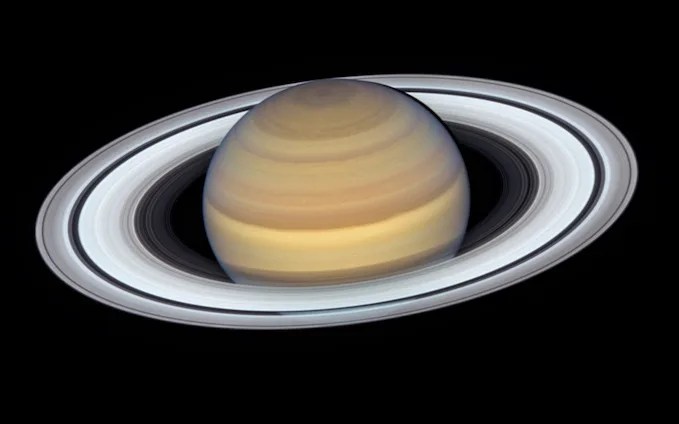
Saturn’s rings are still tilted at a very shallow angle from our point of view, making them look unusually thin. The rings aren’t disappearing, but how they appear from Earth is changing. It’s a great reminder that our view of the solar system is always in motion.
Saturn is famous for the intriguing rings that encircle it. As Saturn orbits the Sun, though, our view of its rings changes. Roughly every 15 years (halfway through Saturn’s almost-30-year orbit), Saturn’s rings appear edge-on, sometimes seeming to disappear altogether. On Feb. 24, 2009, when Saturn’s rings were nearly edge-on, Hubble tracked four of Saturn’s moons as they passed across the face of the giant ringed planet.
NASA, ESA, and the Hubble Heritage Team (STScI/AURA)
Here are the phases of the Moon for July.
NASA/JPL-Caltech
You can stay up to date on all of NASA’s missions exploring the solar system and beyond at science.nasa.gov. I’m Raquel Villanueva from NASA’s Jet Propulsion Laboratory, and that’s What’s Up for this month.
The Apollo 11 astronaut had already beaten the original schedule for the opening of the National Air and Space Museum by three days, but no one would remember that if these final 36 minutes didn't go perfectly.
President Gerald Ford and Vice President Nelson Rockefeller took 35 seconds to find their seats on the red, white, and blue bunting-lined outdoor stage. The flyover by the Thunderbirds was quick enough. At any other event, it would have been the only time-dependent concern of the day.
An engineering development version of the NASA rovers currently operating on Mars takes a spin at the Jet Propulsion Laboratory in California. (NASA via YouTube)
NASA is considering repurposing an engineering development version of the nuclear-powered Mars rovers for a different destination: the moon’s south polar region.
The plan calls for turning the test rover, which is currently sitting at NASA’s Jet Propulsion Laboratory, into a lunar explorer named PROMISE (“Polar Rover for Observation, Mapping and In-Situ Exploration”).
During an update on the space agency’s long-range plan to build a moon base, NASA Administrator Jared Isaacman stressed that the PROMISE mission was still being defined, but added that “there’s very little that would hold us back from making use of that hardware.”
NASA is already planning to send a rover called VIPER (“Volatiles Investigating Polar Exploration Rover”) to the moon by the end of next year. But Carlos García-Galán, NASA’s program manager for the Moon Base effort, said PROMISE would bring some capabilities that VIPER lacks. For example, PROMISE’s plutonium power source makes that rover more suited for exploring permanently shadowed lunar craters that are thought to contain valuable water ice.
“VIPER uses solar power, so we’re constrained to the terrain that we put it on, how much illumination that’s going to get, the time of year, where it can go,” García-Galán explained. “It could certainly not potentially go into some of these permanently shadowed regions and stay deep in there — and then, based on the lunar nights, it will have a lifespan that’s limited.”
In contrast, the nuclear-powered Curiosity rover is still going strong 14 years after landing on Mars, and the Perseverance rover is still persevering after five years of operation.
Today’s Moon Base update provided a status report on several aspects of NASA’s plans to build a permanent base on the moon in the 2030s. Among the highlights:
A robotic lunar lander that’s being built by Jeff Bezos’ Blue Origin space venture “looks like it’s almost done,” García-Galán said. The Blue Moon Mark 1 lander, dubbed Endurance, had been due for launch this year on Blue Origin’s New Glenn rocket, though a recent New Glenn explosion raised questions about the timeline. Isaacman said launching New Glenn was still “Plan A” for the Blue Moon mission. If the launch slips past mid-2027, NASA will look at other options, García-Galán said.
Two other missions for the first phase of the Moon Base program are also progressing. Astrobotic’s Griffin 1 lunar lander appears on track for launch this year, while Intuitive Machines’ Nova-C lander “is looking pretty good,” García-Galán said.
Isaacman pressed García-Galán to promise that one of the robotic landers would carry a soccer ball to the moon if the U.S. wins the World Cup. “We will absolutely find a space,” García-Galán replied. Isaacman said that would serve as “a little bit of motivation” for the U.S. team. “We’re going to one-up Alan Shepard and the golf game on the lunar surface,” the administrator told García-Galán. “We’re going to get the soccer ball there. I don’t know which lander it’ll wind up going on. I’ll leave that to you guys to handle the payloading.”