Reading view

There are new articles available, click to refresh the page.

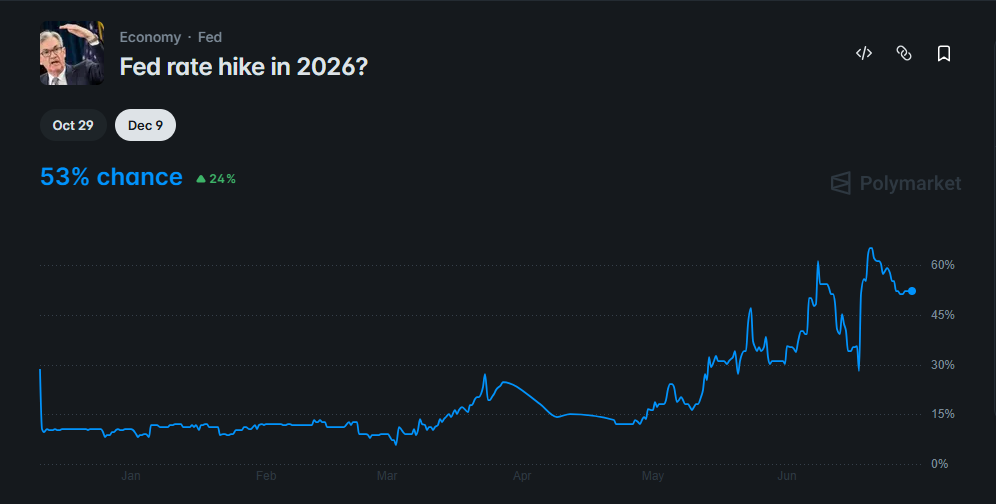
Quarter-Point Hike Leads Polymarket’s September Fed Pricing at 62%

Polymarket’s Fed rates dashboard shows a 62% probability that the Federal Reserve raises rates by 25 basis points at the Wednesday, September 16, 2026 FOMC meeting. The dashboard lists a 39% probability for no change. A 50-basis-point-or-larger hike, a 25-basis-point cut and a 50-basis-point-or-larger cut are each listed below 1%, according to Polymarket.

The pricing presents a narrower set of leading outcomes for the September meeting. A quarter-point hike is the dashboard’s expected decision, while no change remains the other outcome with a substantial listed probability. The cut outcomes are listed at below 1%, placing them well behind the two leading scenarios in this snapshot.

(Source – Polymarket)

How Likely is a Fed Rate Cut Next Week?

Polymarket lists a 25-basis-point hike at 62% and no change at 39%. Those figures put a hike ahead of a hold, but the hold outcome remains material in the displayed pricing. The other listed outcomes are all below 1%.

The dashboard provides probabilities for the listed meeting outcomes, but it does not explain the reasoning behind those prices or forecast how financial markets may respond to the decision. The figures show event pricing for the September meeting rather than explaining the economic developments that may influence policymakers.

Earlier readings reported by Yahoo Finance illustrate how pricing differed across venues. On September 8, Polymarket traders indicated 49% odds of a 25-basis-point hike, Kalshi traders assigned 48%, and CME FedWatch showed nearly 56%, according to Yahoo Finance.

Make Your Prediction Count With $25 For Free on Kalshi

Those figures were reported before the current 62% Polymarket reading and come from separate market-based measures, so they provide context rather than a direct comparison of identical prices at the same time.

What happens at the September Fed Rate Meeting?

If the Fed raises rates by 25 basis points on September 16, that result would align with Polymarket’s leading listed outcome. If the Fed leaves rates unchanged, it would align with the dashboard’s second-largest listed outcome. The dashboard lists the alternatives of a larger hike or a cut of below 1%.

Other interest-rate market measures have also shown elevated odds of a hike. CNBC reported on September 10 that CME Group’s FedWatch gauge put the chance of a rate increase at 70% in morning trading.

The move followed an August wholesale-price report and a rise in U.S. crude oil prices above $100 a barrel. The report also said that market pricing put the chance of another increase in December close to 60%.

The CNBC reading is higher than Polymarket’s current 62% figure, and it was reported on a different date using CME FedWatch. The difference underscores that market-based gauges can show different probabilities as pricing changes and as venues reflect their own markets.

Polymarket’s current dashboard places the immediate focus on whether the September meeting produces a quarter-point hike or no change. Its below-1% listings for both cut outcomes indicate that cuts were not among the leading outcomes displayed for this meeting.

For readers following the decision, the relevant distinction is between the dashboard’s 62% hike probability and its 39% no-change probability, alongside the separate readings reported by other market-based gauges.

Make Your FOMC Prediction Count With $25 For Free on Kalshi

Don’t Miss: The Hottest Meme Coin Opportunities Silently Climbing the Crypto Ranks in September

The post Quarter-Point Hike Leads Polymarket’s September Fed Pricing at 62% appeared first on Cryptonews.

Ripple Supercharges Treasury With New GSmart AI Tools

Ripple has expanded GSmart, its AI tools built into Ripple Treasury, with new features for forecasting, managing liquidity, assessing risk, reconciliation, and reporting.

Ripple’s enterprise customers already use GSmart. The new features help finance teams use AI while still following company policies, approval processes, and audit requirements.

AI Works Within Treasury Rules

Ripple said GSmart helps solve a growing problem: companies are using more AI agents, but many lack strong rules to manage them.

Gartner expects the average Fortune 500 company could use more than 150,000 AI agents by 2028. Yet only 13% of organizations say they currently have enough governance for AI agents.

For treasury teams managing financial operations, Ripple says AI should provide useful recommendations without taking control away from people.

GSmart separates calculations from AI. Financial calculations are handled by fixed, reliable systems, while AI reviews company policies, spots patterns, and explains its recommendations.

Treasury teams still have the final say and must approve financial actions.

Renaat Ver Eecke, SVP of Ripple Treasury, said CFOs need to adopt AI while making sure financial decisions remain clear, controlled, and compliant. He added that GSmart follows each company’s treasury policies and provides transparent recommendations while keeping humans in control.

GSmart Adds AI Agents and Analytics

The expanded GSmart platform includes AI agents for forecasting, liquidity, risk, reconciliation, and reporting. Each AI agent monitors a specific task, recommends an action, explains which company policy supports it, and waits for human approval before taking action.

Ripple is also adding Knowledge Studio, which lets treasury teams set the policies and controls that guide how the AI works. Analytics Studio helps teams analyze treasury data and create AI-powered reports. Its Ask GSmart assistant lets users ask questions and get insights from their treasury data.

Existing Customers Are Already Using GSmart

Ripple said many of its enterprise customers are already using GSmart. About 60% of eligible customers use Risk Insights, which helps find unusual risks and policy violations.

Another 44% use Forecast Insights, which compares expected cash flow with actual cash flow to spot possible cash shortages. Ripple said GSmart is part of its plan to create one treasury platform for both traditional money and digital assets.

The new AI features add tools that help finance teams predict and manage their money. Ripple Treasury aims to let teams view, predict, move, and earn on cash and digital assets from one platform.

XRPL Foundation Is Bringing Traditional Finance Directly to the XRP Ledger, CTO Says

The XRP Ledger Foundation is working to add more traditional financial features to the XRP Ledger, according to CTO Denis Angell.

At Rare Evo, Angell spoke with Ray Fuentes about the foundation’s work, including the upcoming Lending Protocol, Single Asset Vaults, agentic payments, and other infrastructure projects.

“We are writing TradFi primitives into the XRP Ledger,” Angell said, highlighting the foundation’s direction for the network.

XRPL Adds More Traditional Finance Features

Angell said the XRP Ledger is a decentralized network where developers can build features for different needs. While it does not currently support general-purpose smart contracts, developers can propose changes that validators can vote on.

One major development is the Lending Protocol, which is already on the network and can be voted in. Angell said it will allow users to earn yield on their assets, something he believes the XRP Ledger has been missing.

Another key development is the Single Asset Vault, which Angell called his favorite project. He compared it to a traditional mutual fund. Users will be able to deposit their assets into a pool, which would then be invested. 

If the investments earn money, the returns would go back into the pool. Users can later withdraw their funds.

Angell said these developments show that the XRP Ledger is adding more traditional financial tools directly into the network, instead of relying only on smart contracts.

Token Payment Channels to Help AI Agents

The CTO also highlighted agentic payments as another area being developed on the XRP Ledger. The network is working on payment channels for tokens, not just XRP. This will allow for new ways to approve and complete payments.

Angell compared some of these features to how credit card payments are authorized. He said token payment channels will also be useful for AI agents, allowing them to make and complete payments on their own.

XRP Ledger Foundation Expands Infrastructure

Angell also talked about changes happening at the XRP Ledger Foundation. The foundation plans to distribute the xrpld software and host related files as it takes on more responsibility for the network’s infrastructure.

It is also improving its monitoring systems. These systems could collect validator logs when problems occur, such as a ledger halt. This would help the foundation understand what went wrong and respond faster.

The foundation is also reviewing how the network’s infrastructure is managed and considering whether it should run more of the infrastructure itself, including its own servers and data centers.

Vet Highlights “Deep Alpha”

After the interview, XRPL validator Vet described Angell’s comments as “deep deep Alpha” about the XRP Ledger and fintech. Vet also mentioned plans to create committees within the XRPL Foundation to help with more technical and ecosystem-related work.

Deep deep Alpha by Denis from the XRP Ledger Foundation regarding the XRPL and Fintech ✅

Aside from that, XRPL Foundation Committees are coming, lots of technical and ecosystem work.

I didn't know he liked the Single Asset Vault so much btw and he's not Mickey B Fresh. https://t.co/QeBy3UEZzF

— Vet (@Vet_X0) September 11, 2026

The comments show that the foundation wants to expand the XRP Ledger beyond simple payments and add more financial features directly to the network. With lending, vaults, token payments, and AI-powered payments being developed, the XRPL will eventually support a much wider range of financial applications.

Trump Crypto: Kevin Hassett Coinbase Stake Raises Conflict of Interest Concerns

In Trump crypto news, National Economic Council Director Kevin Hassett disclosed holding between $1M and $5M in vested Coinbase shares at the end of 2025, according to a previously unreported annual financial filing.

The stake sat on his books while the Trump administration rapidly rewrote federal crypto regulation, and the filing does not establish whether he still holds the shares in 2026.

That timing is the story. Hassett ran the council that housed Trump’s digital-assets working group even as his Coinbase position sat unresolved on paper, and Coinbase itself has been central to the regulatory rewrite now moving through Congress.

Hassett kept up to $5 million Coinbase stake as Trump reshaped crypto policy https://t.co/Am7fM82W77

— CNBC (@CNBC) September 11, 2026

Trump Crypto News: What the Hassett Disclosure Shows

Hassett’s 2025 annual disclosure lists vested Coinbase Global Class A shares valued between $1,000,001 and $5,000,000. He served on Coinbase Asset Management’s advisory council from March 2021 until January 2025, when he joined the White House. The filing does not confirm whether he sold the shares afterward.

Three days after Trump’s second inauguration, an executive order established the President’s Working Group on Digital Asset Markets, with Hassett’s office named as a member. The group proposed significant changes to digital asset regulations and reversed Biden-era crypto policies, aligning with Coinbase’s lobbying efforts.

Hassett said he recused himself from crypto matters while ethics officials reviewed his holdings, and he chose not to sell the shares to avoid the appearance of timing. The White House confirmed his recusal remains in effect, declining to comment on whether he still owns the shares or whether it affected his economic-policy work.

Make Your Prediction Count With $25 For Free on Kalshi

The Conflict-of-Interest Question

Virginia Canter, a former SEC ethics lawyer now at Democracy Defenders Fund, described the holding as a major conflict of interest or the appearance of one, according to the disclosure’s reporting.

She questioned whether a recusal broad enough to cover all crypto matters could have sidelined one of Trump’s top economic advisors from a defining priority of the administration – one that touched Treasury, Commerce, the SEC and the CFTC, all represented on the same working group Hassett’s council hosted.

What remains unclear is the practical scope of that recusal: which meetings Hassett skipped, which decisions he stepped back from, and how much of his NEC portfolio it touched.

The working group’s final report lists NEC deputy Robin Colwell as its representative rather than Hassett himself, suggesting at least some formal distance, but it doesn’t explain how crypto policy discussions were handled within a council he still directs.

🚨HASSETT: TRUMP IS SERIOUS ABOUT $5,000 CHECKS!

White House senior adviser Kevin Hassett said President Trump is committed to the $5,000 payment plan floated this week.

Hassett said budget reconciliation could be used to send the checks in a way he called fiscally responsible. pic.twitter.com/enzvV3QQt1

— Crypto Banter (@crypto_banter) September 11, 2026

Coinbase’s Stake in the Outcome of the CLARITY Act

Coinbase has more than a passive interest in how this policy fight resolves. The SEC dismissed its enforcement case against the exchange with prejudice just over a month into Trump’s term, a move regulators framed as part of a broader overhaul rather than a ruling on the case’s merits.

Coinbase was also a major backer of the Fairshake super PAC during the 2024 cycle, and CEO Brian Armstrong has met repeatedly with Trump and senior officials, including at the March 2025 White House crypto summit, context that shapes how Armstrong has talked about the regulatory environment under this administration.

Earn $50 and Enter $300K Prize Draw on EdgeX

The post Trump Crypto: Kevin Hassett Coinbase Stake Raises Conflict of Interest Concerns appeared first on Cryptonews.

Blockstream Rejects Liquid Hackers’ 10% Bounty Demand as 598 BTC Remains Unreturned

Blockstream has rejected a 10% bounty request from the group behind the Liquid Network breach, with 598 BTC from the incident still unreturned.

Blockstream said withholding assets obtained without authorization in exchange for payment does not constitute legitimate security research, distinguishing responsible disclosure from taking funds without permission.

The company had been in contact with the actors as it sought to recover user funds. Blockstream is now asking them to return what remains without attaching any financial conditions.

Hackers Seek 10% Bounty

The group outlined its terms in an on-chain message that Samson Mow, JAN3 CEO and former Blockstream chief strategy officer, shared on Wednesday. The proposal called for Blockstream to fund a 10% bounty and claimed Liquid holders could face a 15% loss without an agreement.

The demand came after the Sept. 6 breach of Liquid, when about 4,000 BTC was taken from the network’s federation wallet. The Bitcoin involved was valued at roughly $320 million at the time.

Of that amount, 3,400 BTC was subsequently sent back after fixes were applied to the affected bridge nodes, leaving 598 BTC unrecovered.

If those coins are withheld, Blockstream plans to involve law enforcement and seek assistance from exchanges, service providers and blockchain investigators. Such cooperation could help track where the Bitcoin moves and determine who controls it.

Liquid Moves Toward Restoring Operations

Meanwhile, Liquid took an initial step toward restoring the network on Thursday after implementing software fixes introduced in response to the breach.

Blocks began being created again, but without regular user transactions. Transfers between Bitcoin and Liquid also remained unavailable as the network continued to recover.

XRP Sees Largest 2026 RWA Inflow Across All Blockchains with $3.6B

The XRP ecosystem has recorded the largest real-world asset (RWA) inflow of any blockchain network in 2026.

Data from RWA.xyz, a leading provider of tokenized RWA data, shows that the XRP Ledger (XRPL) has received $3.6 billion in RWA inflows since the start of the year.

XRP Leads Global Ranking for RWA Inflows in 2026

The impressive growth comes despite XRP’s continued price weakness. The cryptocurrency has fallen 27.19% year-to-date despite the August rebound as the broader market remains in a bear phase. 

Interestingly, amid the struggles, capital entering the XRPL’s RWA ecosystem has grown, showing that activity around tokenized real-world assets has continued even as XRP’s market performance remains weak.

For context, the $3.6 billion inflow puts the XRP Ledger at the top of the global ranking for 2026. BNB Chain follows in second place with $2.6 billion, putting XRP about $1 billion ahead. Stellar ranks third with $2.5 billion, while Solana takes fourth place with $2.2 billion in RWA inflows this year.

XRP 2026 RWA Inflows Excluding Stablecoins

Ethereum ranks fifth with $1.2 billion in capital flows. This gives the XRP Ledger a $2.4 billion lead over Ethereum in 2026 RWA inflows. 

XRPL RWA Growth Jumps From 2025 Levels

The network has also already surpassed its 2025 RWA inflow record by more than 16 times, with three months left before the end of 2026.

The difference from last year is particularly large. For context, the XRP ecosystem’s RWA market stood at $5 million at the start of 2025 and reached $226.8 million by the end of that year. 

This represented an increase of $221 million during 2025. By comparison, the $3.6 billion added in 2026 already amounts to 16.2 times the $221 million increase recorded in 2025. 

Interestingly, the $3.6 billion figure does not include the XRPL’s stablecoin market. That market has grown by more than $1 billion this year, with RLUSD’s growth providing a major boost. As a result, the network’s overall tokenized-asset growth is even larger when considering stablecoins.

JMWH and CRX Drive Most of the Growth

Excluding stablecoins, commodities and asset-backed credit account for most of the $3.6 billion RWA growth recorded on the XRP Ledger in 2026. Within the commodities sector, Justoken’s JMWH alone has added $2.229 billion to the XRP ecosystem this year.

Asset-backed credit has also made up a large share of the XRPL’s RWA expansion. The various CRX Digital Assets have added about $1 billion to the XRP Ledger in 2026.

Together, Justoken’s JMWH and CRX Digital Assets have contributed around $3.229 billion to the XRP Ledger this year. JMWH accounts for $2.229 billion, while CRX Digital Assets account for about $1 billion. Combined, these two asset classes make up 89% of the total $3.6 billion added to the network.

The figures show that the XRPL’s RWA growth has not come only from stablecoins. Tokenized commodities and asset-backed credit have provided most of the network’s non-stablecoin growth, giving the XRP Ledger a wider base of RWA activity.

Stablecoins Lift Total XRPL Flows to $4.4B

When stablecoins enter the calculation, the total amount added to the XRP Ledger this year rises from $3.6 billion to $4.4 billion. The increase considers nearly $1 billion in stablecoin growth during 2026, with RLUSD making the biggest contribution.

XRP 2026 RWA Inflows Including Stablecoins

However, including stablecoins changes the network ranking. At $4.4 billion, the XRP Ledger ranks third in terms of total year-to-date flows for 2026. TRON leads with $11.9 billion, followed by HyperEVM with $6 billion.

Three-Year Dormant Shiba Inu Whale Moves Final 192B SHIB After $1.63M Loss

A Shiba Inu whale that remained dormant for more than three years has finally liquidated its entire SHIB holdings, realizing an estimated loss of $1.63 million in the process.

The whale initially received 600 billion Shiba Inu tokens on July 16, 2023. At the time, the tokens were worth $4.86 million, based on a SHIB price of around $0.0000081.

The wallet then remained inactive for more than three years. However, that long period of dormancy ended this month when the whale began transferring its holdings to BitGo, suggesting an intention to sell.

Whale Moves Final 192 Billion SHIB to BitGo

The whale made its first major transfer on September 6, 2026, sending approximately 408 billion SHIB to a BitGo-affiliated address. The tokens were worth about $2.23 million at the time.

The whale has now transferred its remaining 192 billion SHIB to BitGo. The latest batch was worth $999,050, effectively moving the entire 600 billion SHIB holding to the platform.

Overall, the whale transferred the tokens for $3.23 million, compared with the $4.86 million value when it initially acquired them. As a result, the whale incurred an estimated loss of $1.63 million. 

Shiba Inu Whale Liquidates SHIB Holdings

SHIB Remains Under Market Pressure

The whale’s liquidation comes as Shiba Inu continues to trade significantly below its all-time high. SHIB reached a record $0.00008845 in October 2021 but has since suffered a prolonged decline. At press time, SHIB was trading at $0.000005102, leaving the token about 94.23% below its all-time high. Shiba Inu’s volume has plunged 13.31% over the past 24 hours to $64 million. 

Meanwhile, SHIB faces growing pressure in the cryptocurrency rankings. The token currently ranks No. 30 globally, with a market cap of roughly $3 billion. PayPal USD ranks 31st with a market cap of $2.8 billion, leaving SHIB with a relatively narrow lead.

Therefore, the whale’s latest transfer adds another notable sell-side development to the pressure surrounding SHIB. However, transferring tokens to an exchange does not confirm that the whale has already sold them.

India Launches $107 Million Tokenised Bond Pilot Linked to RBI Wholesale CBDC

India has put 10.25 billion rupees ($107 million) of corporate debt onto its new tokenisation infrastructure, with three companies completing issuances as securities regulators and the central bank test a model that pairs distributed-ledger bonds with wholesale central bank digital currency.

The pilot, called Demat 2.0, is being run by the Securities and Exchange Board of India and the Reserve Bank of India. SEBI disclosed details of the initiative on Thursday.

REC, a state-owned lender, was the first to use the framework, raising 5 billion rupees from 18 investors in a Monday transaction. Two additional deals followed on Wednesday: Larsen & Toubro, the engineering group, raised 5 billion rupees from four investors, while IIFL, a non-bank financial company, sold 250 million rupees of bonds to one investor.

Three-Issuer Launch Goes Beyond Earlier REC Proposal

The scale of the first phase exceeds what had been reported in August. Reuters had said at the time that the planned test would involve selected investors and an REC offering valued at under 5 billion rupees. With L&T and IIFL also participating, the combined issuance is more than double the amount initially anticipated for REC.

More primary issuances are still being conducted under this opening stage, according to SEBI. Plans for subsequent phases include bringing the securities onto existing request-for-quote venues for secondary transactions and eventually allowing retail participation. SEBI said lessons from the trial would help determine how broadly to deploy the framework.

Notably, participation does not require investors to establish another securities account or repeat the Know-Your-Customer process. Tokenised bonds can be accommodated within an investor’s current Demat account. For transactions under the pilot, however, Demat 2.0 requires activation with the relevant depository, while the cash side requires a wholesale CBDC wallet maintained with a participating bank.

Distributed Ledger Links Bond Ownership With RBI Digital Currency

Demat 2.0 changes how the securities are represented and settled. Corporate bonds are generated as digital tokens on a distributed ledger operated by India’s statutory depositories. The payment side is connected to the RBI’s wholesale CBDC through the central bank’s Unified Market Interface.

That setup supports atomic settlement, which removes the time lag between money and securities transfers, SEBI said. It also shortens the funding timetable for issuers: proceeds can arrive on the bidding day instead of two to three days afterward. Smart contracts can automate interest distributions and bond redemptions.

The move to tokenisation does not modify the bonds’ legal standing, repayment responsibilities or protections available to investors, according to the regulator.

SEBI said the arrangement makes India the first country where corporate bonds originate natively on a distributed ledger, statutory depositories retain the ownership records, and CBDCs handle settlement, all within the existing regulated market infrastructure.

XRP Records Over $5B in Stablecoin Transfer Volume

The XRP ecosystem has recorded more than $5 billion in 30-day stablecoin transfer volume, a clear increase from the level recorded a month earlier.

This is according to data provided by RWA.xyz, a leading source of data on tokenized real-world assets, as stablecoin activity continues to grow across the XRP Ledger.

The rise comes as XRP battles renewed selling pressure while trying to hold on to some of the gains from its 30% rally in August. Despite the broader market pullback, XRP remains above $1.35, showing some resilience as the crypto market struggles.

Stablecoin Transfer Volume Surpassed $5B

Specifically, data from RWA.xyz shows that stablecoin transfer volume reached $5.25 billion over the past 30 days. This represents an 18.21% increase from the figure recorded 30 days ago. The growth has come alongside the rising presence of RLUSD, Ripple’s stablecoin, on the XRP Ledger.

In addition, the number of stablecoin holders on the XRP Ledger has also increased. Over the past 30 days, stablecoin holders grew 10.13% to 80,740. This indicates that the network is now witnessing growing participation in the stablecoin market amid increasing adoption.

XRP Stablecoin Transfer Volume Spikes

The stablecoin market itself has also expanded during the same period. Its market capitalization rose 26.04% over the past month to $1.10 billion, after crossing the $1 billion mark just last month. 

XRPL RWA Market Sees Mixed Trends

However, the broader tokenized asset market on the XRP Ledger has shown a less consistent trend. Notably, RWA holders rose 19.63% in the past 30 days to 256, but distributed asset value fell 5.51% during the same period to $458.39 million. Represented asset value also declined 2.01% to $3.97 billion.

In addition, RWA 30-day transfer volume dropped 87.15% over the last month to $31.14 million. However, the decline does not automatically indicate weaker demand. Investors may simply be keeping their tokenized assets on the XRP Ledger instead of moving them between wallets.

RLUSD Contributes to Stablecoin Market Value

Regarding the growth of the XRP ecosystem’s stablecoin market, RLUSD has made the largest contribution. Ripple launched the stablecoin in December 2024, and its market presence has continued to expand since then.

Earlier this month, The Crypto Basic confirmed that RLUSD had crossed a $2 billion market cap, with about $1 billion issued on the XRP Ledger. At press time, RLUSD’s market value on the XRP Ledger stood at exactly $1,033,001,741. This represents a 26.86% increase in its XRPL-based valuation over the past 30 days.

RLUSD has also strengthened its position within the XRP Ledger’s distributed RWA market. Its share increased 10% over the past month to 66.32% at press time. This confirms that while some areas of the tokenized asset market have slowed, stablecoin activity, led by RLUSD, continues to grow across the XRP ecosystem.

Shiba Inu On Verge of Breaking Down Below 87 Trillion SHIB Threshold

Shiba Inu’s exchange reserve is approaching the key 87 trillion SHIB threshold as more tokens leave crypto trading platforms. 

Shiba Inu recorded a significant decline in its exchange reserve over the past 24 hours. Data from CryptoQuant shows that 213.88 billion SHIB flowed into crypto exchanges, while users withdrew around 458.87 billion SHIB within the timeframe.

As a result, SHIB recorded a negative exchange netflow of 244.99 billion tokens. In other words, nearly 245 billion more SHIB left exchanges than entered them during the period.

Consequently, the amount of Shiba Inu held on exchanges fell to approximately 87.0059 trillion SHIB. At this level, the reserve sits just 5.9 billion SHIB above the 87 trillion threshold. Therefore, continued outflows could soon push exchange-held supply below this level.

A declining exchange balance could potentially ease immediate selling pressure because fewer tokens would remain readily available on trading platforms for investors looking to sell. However, exchange outflows do not guarantee a price increase, as investors can move tokens back to exchanges when market conditions change. 

Shiba Inu Exchange Reserves
Shiba Inu Exchange Reserve

SHIB Exchange Supply Has Struggled to Stay Below 87 Trillion

Notably, this is not the first time Shiba Inu’s exchange reserve has fallen below the 87 trillion SHIB mark. On previous occasions, the balance briefly dipped below the threshold before recovering as investors transferred more tokens back to exchanges.

Therefore, while another move below 87 trillion SHIB could attract attention, maintaining the level could prove more significant than briefly crossing it.

If withdrawals continue to outpace deposits, the declining reserve could offer stronger evidence that investors are keeping their SHIB away from trading platforms rather than preparing to sell.

SHIB Price Remains Under Pressure

Despite the reduction in exchange-held SHIB, the development has yet to produce a positive market reaction.

At press time, SHIB was trading at $0.000005094, down 2.52% over the past 24 hours and 4.35% over the past seven days. At this price, Shiba Inu had a market cap of roughly $3 billion, ranking it as the 30th-largest crypto asset by market value.

Thus, the continued price decline shows that shrinking exchange supply has so far failed to offset broader selling pressure.

SHIB Liquidations Reach $76,000

Meanwhile, the recent weakness has affected traders holding leveraged SHIB positions. Around $76,000 worth of SHIB futures positions were liquidated over the past 24 hours.

Long traders betting on a price increase suffered most of the losses, accounting for $70,090 in liquidations, equivalent to around 13.75 billion SHIB at the current price.

By comparison, short positions accounted for roughly $5,890 in liquidations, representing approximately 1.15 billion SHIB. The dominance of long liquidations suggests that the recent decline caught some bullish traders on the wrong side of the market. 

Shiba Inu Liquidation

Here’s What Will Happen Before XRP Journey to $2.30 Begins

XRP may be approaching a technical confirmation that determines whether its recent consolidation develops into a larger rally toward $2.30.

Analyst Celal Kucuker has identified $1.38 as the level XRP needs to reclaim and hold to confirm what he describes as a “fake breakout.”

XRP Price Needs to Close Above $1.38

In a recent post on X, Kucuker said XRP must close above $1.38 today or tomorrow to confirm the setup. His chart shows XRP trading inside a large contracting triangle. The price is currently near the point where the descending resistance line and rising support line converge.

The chart places the key confirmation level around $1.37896, making the $1.38 area the immediate level to watch.

XRP is currently trading around $1.35, according to CoinMarketCap data. It is down about 2.2% over the past 24 hours and 6.5% over the last seven days.

The decline has come alongside weakness across the crypto market. Bitcoin fell below $77,000 yesterday and is down roughly 4.3% over the past week.

However, XRP’s monthly performance remains positive. The token is still up about 32% over the past month, compared with Bitcoin’s 21% gain. Much of those gains came during the explosive rally in late August, after which XRP has struggled to push through resistance.

XRP chart by Celal Kucuker

The Way to $2.30

Kucuker’s setup suggests that reclaiming $1.38 would provide the confirmation XRP needs to move out of its current consolidation structure.

The $2.30 target would represent a 70% move from XRP’s current price near $1.35. However, the chart does not suggest that XRP would necessarily reach that level immediately.

In particular, the chart shows resistance at $1.513 and $1.70, which, if reclaimed, will set the foundation for higher targets in the $2 range.

Meanwhile, a failure to reclaim $1.38 could leave XRP inside the triangle and expose the token to another test of its lower trendline.

ChartNerd Sees Higher XRP Targets

In another post, ChartNerd told investors to “zoom out” when they start doubting whether XRP can reach higher prices. The analyst shared a chart showing that XRP’s current price pattern looks similar to patterns from previous market cycles.

ChartNerd described it as: “Same Structure: Different Cycles.”

The chart shows a large triangle that started forming after XRP’s 2018 peak and is now nearing its end. ChartNerd believes XRP will eventually break out of this long-term pattern.

Based on Fibonacci levels, the analyst sees possible targets around $8.33, $13.50, and $27. These levels roughly match the 1.272, 1.414, and 1.618 Fibonacci extensions.

Image

ChartNerd also compared the current pattern to XRP’s price movement from 2014 to early 2017. During that period, XRP traded sideways for a long time before breaking higher and eventually reaching its previous all-time high.

Because of this, ChartNerd believes XRP’s current setup is part of a long-term market cycle, rather than just a short-term price move.

Lark Davis Calls Cardano a “Ghost Town” After Eight Years, Compares It to Solana

Popular market commentator Lark Davis has questioned Cardano’s progress after eight years, arguing that the network has yet to achieve the level of adoption expected of a blockchain of its age.

Davis made the remarks while responding to Cardano SPO Sssebi, who expressed continued confidence in Cardano founder Charles Hoskinson and the project’s long-term vision.

Davis Questions Cardano’s Adoption

In response, Davis challenged whether that confidence is supported by Cardano’s current network activity. He described the blockchain as a “ghost town” and argued that its on-chain metrics remain weak.

Moreover, Davis questioned whether Cardano’s technology and development efforts have translated into meaningful adoption. In his view, eight years should have given the network enough time to demonstrate stronger user activity.

He also compared Cardano’s progress with that of other major blockchain networks, particularly Solana. Specifically, Davis questioned why Cardano had not become the “Solana equivalent in terms of use,” pointing to the significant difference in adoption and network activity between the two ecosystems.

Davis further urged those still waiting for Cardano’s anticipated growth to reconsider their expectations. He questioned whether investors want to wait another eight years for the network to achieve greater adoption.

Cardano and Solana Take Different Approaches

Critics have frequently compared Cardano with Solana to highlight the difference in their network activity and adoption. However, the two blockchains have fundamentally different development philosophies.

Cardano has pursued a slower, research-driven approach that emphasizes academic research and formal development processes. Solana, meanwhile, has focused on high performance, speed, and rapid ecosystem growth.

Nonetheless, their differences become more apparent when comparing network activity. According to Chainspect data, Solana has processed more than 126 billion transactions since launching in March 2020. Cardano, which launched three years earlier, has processed about 124 million transactions.

Solana also leads Cardano significantly in DeFi activity. The network has $5.8 billion in Total Value Locked (TVL) and $2.90 billion in DEX volume over the past 24 hours.

By comparison, Cardano’s TVL stands at about $59.83 million, while its DEX volume is $1.19 million.

Sssebi Highlights Cardano’s Development Strategy

The exchange continued as Sssebi attributed Cardano’s relatively low adoption to the network’s decision to prioritize governance and infrastructure development.

According to Sssebi, Cardano has already established much of the foundation required for its next phase of growth. He noted that the network is now focused on improving its scalability and DeFi activity through initiatives such as AlphaGrowth PRIME.

However, Davis remained unconvinced by the argument. He maintained that technological upgrades will have limited significance if they fail to attract more users and generate greater activity on the network.

The exchange highlights a broader debate surrounding Cardano, which revolves around whether its research-driven development strategy will eventually translate into the user adoption and economic activity critics have long expected.

Riot Games holds sponsorship talks with Polymarket, Kalshi

Riot Games has discussed potential esports sponsorship agreements with prediction market operators Kalshi and Polymarket as the League of Legends World Championship approaches in October. Bloomberg reported on Sept. 11, citing people familiar with the private talks, that the Tencent-owned…

❌