Dara Khosrowshahi, now CEO of Uber, speaks at the 2016 GeekWire Summit. (GeekWire File Photo)
Uber is laying off 93 Washington state-based employees as part of a sweeping global restructuring that will eliminate roughly 10% of the company’s workforce.
The cuts heavily impact the transportation giant’s Seattle hub, targeting those assigned to the downtown engineering center as well as regional remote workers.
The job losses are detailed in a new Worker Adjustment and Retraining Notification (WARN) notice filed by the company with the state’s Employment Security Department, which lists impacted positions ranging from software engineers to senior managers.
Affected staff were notified Wednesday and will receive full pay and benefits through a 60-day notice period ending Nov. 2. The cuts hit technical roles particularly hard, with position titles including software engineers, product managers, data scientists, and a Seattle-based director of engineering.
Nationally, the cuts eliminate about 3,300 corporate jobs — roughly 10% of Uber’s global workforce — in the company’s largest round of layoffs since 2020. In a memo to staff, CEO Dara Khosrowshahi framed the restructuring as a move to eliminate middle-management bureaucracy, flattening reporting structures by reducing management layers and cutting “micro-teams” by nearly half.
As part of the overhaul, Uber is also clamping down on remote work, capping fully remote positions at less than 1% of its total workforce and requiring most employees to move near core office hubs like San Francisco and New York. Khosrowshahi noted that savings from the cuts will help free up capital to invest in core operations, including autonomous vehicle partnerships.
Uber first established its engineering outpost in Seattle in March 2015 to tap into the region’s pool of tech talent. The company expanded significantly in 2018 when it signed a 10-year lease for 115,000 square feet at downtown’s Second & Seneca building at 1191 Second Ave.
Qualtrics Tower in downtown Seattle. (GeekWire File Photo)
Qualtrics is cutting 117 jobs connected to its Seattle headquarters, according to a state filing that provides new details of the layoffs that the experience management technology company made two weeks ago.
Engineering and product teams were hit hard. The filing lists software roles from entry-level through principal engineers, plus testing, machine learning, network and information security positions; engineering managers and directors; and product and product marketing managers.
The employees work at or report into Qualtrics Tower at 1201 Second Ave., the filing says.
The company, which has dual headquarters in Seattle and Provo, Utah, made cuts globally on Aug. 19, so the Seattle number reflects only a portion of the overall positions impacted. The company has not disclosed the total. We followed up again Wednesday to ask for an overall number.
Qualtrics employed about 900 people in Seattle as of 2023 and has not disclosed a figure since.
It’s part of a steady stream of tech layoffs in the Seattle region. Amazon disclosed 121 job cuts in Washington state on Aug. 31, T-Mobile 77 on Aug. 26, and TikTok 75 in Bellevue on Aug. 19. Zillow cut more than 500 Seattle jobs in early August.
Earlier this year, Meta cut nearly 1,400 jobs in the state, about 20% of its local workforce; Microsoft cut 605; and Oracle 491.
Qualtrics makes software that companies use to collect and analyze feedback from customers, employees, partners and others — a category that Qualtrics calls experience management. It was founded in Provo in 2002 and later added a Seattle headquarters.
The layoffs followed the company’s $6.75 billion acquisition of Press Ganey Forsta, an Indiana-based healthcare data company, which closed in May.
In a memo to employees on Aug. 19, CEO Jason Maynard said the deal brought together “two organizations, two sets of teams, two structures built independently,” and that the company had gone “function by function, team by team, to understand where we have overlap.”
Qualtrics has been owned by Silver Lake and Canada Pension Plan Investment Board since they took it private for $12.5 billion in 2023. The company cut about 780 jobs, roughly 14% of its workforce, in October 2023, and about 270 earlier the same year.
Uber is laying off about 3,300 people, or about 10% of its global headcount, in a bid to reduce management layers and invest more in its ridesharing, delivery, and robotaxi divisions.
Two of Amazon’s Seattle headquarters towers rise above the Spheres. (GeekWire File Photo / Kurt Schlosser)
Amazon is cutting 121 jobs in Washington state, according to a new state regulatory filing on Monday, hitting corporate tech teams in Bellevue and Seattle as well as fulfillment operations in Sumner.
The largest single concentration of cuts is at the SEA106 building in Bellevue, where 49 employees — ranging from entry-level software development engineers and applied scientists to a vice president of legal and senior software managers — were notified.
In Seattle, impacted positions span multiple downtown office buildings and include roles such as a director of human resources, product managers, and technical writers.
Beyond corporate offices, 32 positions were cut at the BFI1 fulfillment center in Sumner, affecting warehouse associates, service technicians, and safety specialists.
“Teams across the company regularly review their structures to ensure they’re best set up to deliver on their goals,” Brad Glasser, an Amazon spokesperson, told GeekWire via email. “As part of these reviews, teams sometimes determine that certain roles are no longer necessary. We don’t take these decisions lightly, and we’re always committed to supporting employees whose roles are impacted by them.”
The Worker Adjustment and Retraining Notification (WARN) filed with the state’s Employment Security Department says impacted employees were notified between July 1 and July 29 and terminations will be effective between Oct. 1 and Oct. 27.
Amazon says it provided 90 days of advance notice, during which affected workers can apply for open internal transfer positions before separations become final.
Amazon employs roughly 50,000 corporate and tech workers in the Puget Sound region, divided between its primary headquarters in Seattle and its growing operational footprint in Bellevue. Across Washington state, the company employs more than 80,000 total workers across corporate offices, data centers, and fulfillment hubs.
The previous larger cuts were part of an effort to “reduce layers, increase ownership, and remove bureaucracy,” according to a memo sent to employees.
A number of layoffs across the tech sector have impacted Washington employees in recent months, including at Microsoft, Zillow, Meta, Google, T-Mobile, Salesforce, Starbucks, TikTok, Qualtrics and elsewhere.
T-Mobile is cutting 77 jobs across Washington state, trimming staff across its Bellevue headquarters, regional retail stores, and remote roles, according to a new state filing.
The workforce reductions span frontline, regional, and corporate roles, eliminating positions ranging from retail mobile experts and account care specialists to principal systems architects and senior directors at the wireless carrier.
In addition to 63 newly disclosed job cuts, the filing includes 14 workers whose previously announced departures were deferred to this fall.
Beyond corporate offices, the cuts will result in permanent store closures across Washington. Locations expected to close include retail sites in Seattle (45th & Stone Way), Bothell, Kennewick, Tacoma, Vancouver, and Yakima.
“Like all businesses, we’re constantly looking at where we allocate our resources so we can invest in the areas that matter the most to our customers,” a T-Mobile spokesperson said in an emailed statement. “That means making adjustments where needed while continuing to hire in areas that support our priorities, strengthen our momentum and help us keep changing the industry through innovation.”
The spokesperson pointed to a broader retail pivot aimed at concentrating its store footprint toward company-operated locations integrated with digital tools like its T-Life app, rather than third-party dealer operations.
“Changes to third-party dealer-operated locations do not affect T-Mobile employees,” the spokesperson added. “In most cases, T-Mobile retail employees can apply for positions in other locations or relocate if there is a change to their current store.”
A subset of the latest cuts stems from facility relocations, where some employees were offered transfer opportunities, according to the filing.
The company previously cut 393 workers in Washington in February.
Editor’s note:A previous version of this story incorrectly stated that a T-Mobile store in Bellingham would be closing. That information came from an error in the WARN filing.
A former Starbucks cafe in Seattle. (GeekWire Photo / Kurt Schlosser)
Starbucks is laying off 224 more workers tied to its Seattle headquarters, according to a new state filing. The coffee giant says the layoffs don’t represent a new round of cutbacks, but rather the lingering effect of restructuring work announced earlier this year.
About 120 of the 224 are employees who were offered roles in Starbucks’ new Nashville office and declined to relocate, according to the filing. Those roles are expected to be filled in Tennessee.
The remaining 104 in the notice filed Thursday stem from the restructuring that Starbucks announced in May, and fall largely within the group that designs, sites and builds its coffeehouses.
Not all 224 are based in Seattle. The filing covers employees who work at or report to Starbucks’ headquarters at 2401 Utah Ave. S., so some are located elsewhere in the country while reporting to managers at the Seattle campus. Starbucks did not say how many are based in Washington state.
The reductions are part of the “Back to Starbucks” turnaround CEO Brian Niccol launched after taking over in September 2024 — an effort that has paired store-level technology upgrades and a simplified menu with a restructuring of the company’s corporate ranks.
Starbucks has now laid off 537 corporate workers tied to its Seattle headquarters this year, across three state filings: 61 in a tech reorganization in May, 252 at the support center later that month, and the 224 disclosed this week.
Starbucks is targeting $2 billion in cost reductions over two years under Niccol, and has shed more than 2,300 corporate jobs companywide since last year, according to Bloomberg.
At the same time, Starbucks is building out its Nashville office, a $100 million investment expected to house 2,000 support jobs within five years. The company has said the majority of its corporate teams will remain in Seattle.
The design and development cuts come later than the rest of the May restructuring because the executive who leads the group, Stephen Piacentini, joined Starbucks from Chipotle in April, and the organizational changes in his group weren’t finalized when the May restructuring was announced.
Editor’s note: This story has been updated to clarify that the 224 workers covered by the filing report to Starbucks’ Seattle headquarters but not all are based in Seattle.
Three months after closing its $6.75 billion purchase of Press Ganey Forsta, Qualtrics is cutting jobs across the combined company — a reduction that the experience-management technology company says reflects duplication between two organizations that were built independently.
The cuts are global, including the company’s dual headquarters in Seattle and Provo, Utah, and its international offices. Qualtrics is not publicly disclosing how many jobs were cut, and did not break out numbers by office, region, or job function.
One clue: Qualtrics sent impacted Seattle employees layoff notices under the Worker Adjustment and Retraining Notification Act, or WARN, according to one copy reviewed by GeekWire. The notice covers workers at Qualtrics Tower, 1201 Second Ave., its Seattle headquarters.
The Washington law applies only to layoffs of 50 or more at one site — so at least that many jobs were cut at the Seattle HQ. As of publication time, Qualtrics had not appeared in the Washington or Utah state WARN databases, which can sometimes lag the notices to employees by a day or more.
Qualtrics CEO Jason Maynard
Individual employees learned their status by email Wednesday morning.
In a memo to employees, obtained by GeekWire, Qualtrics CEO Jason Maynard called the acquisition a “defining milestone” for the company but said it “meant making hard decisions about what the organization needed to operate and function as a single uniform team.”
“Since the acquisition closed, we’ve gone function by function, team by team, to understand where we have overlap and determine what we needed to do to move forward as one company,” he wrote, noting that the decisions were “made based on the structure of our combined organization: the roles we need, the capabilities we are building toward, and where we have duplication.”
Qualtrics makes software that companies use to collect, analyze, and adapt to feedback from customers and employees, a category of technology that it branded “experience management.”
Current and former employees posting publicly Wednesday on LinkedIn and other forums described cuts spanning departments and offices, including Seattle, Provo and international locations, and hitting both the legacy Qualtrics and Press Ganey Forsta sides of the business.
The Press Ganey Forsta acquisition, announced in October and completed in May, added what Qualtrics called the largest healthcare experience dataset in the industry. Press Ganey Forsta, based in Indiana, was itself the product of earlier mergers, and its Forsta products competed directly with Qualtrics.
The cuts follow a leadership shakeup in April, when Maynard removed five senior executives and outlined a broader reorganization spanning marketing, customer operations, IT and corporate development. Maynard, who joined from Oracle, became CEO in February.
It’s not the first round of cuts under private equity ownership. Qualtrics cut about 780 jobs, roughly 14% of its workforce, in October 2023 under then-CEO Zig Serafin, who cited complexity from years of rapid hiring. It had cut about 270 jobs earlier that year.
Qualtrics has been owned by private equity firm Silver Lake and Canada Pension Plan Investment Board since 2023, when they acquired it for $12.5 billion. It was the second time the company changed hands in under five years, following SAP’s $8 billion acquisition in 2019 and a 2021 IPO.
The Expedia Group logo at the company’s headquarters campus on the Seattle waterfront. (GeekWire Photo / Todd Bishop)
Expedia Group is parting ways with at least eight vice presidents and senior vice presidents in a major reorganization designed to reorient its product and technology groups around AI.
In an internal memo Tuesday, obtained by GeekWire, the Seattle-based online travel giant’s top product and technology leaders said “AI has radically changed what’s possible” over the past year, and that “work that once took weeks increasingly happens in hours.”
The company must “fundamentally change how we work, how we’re organized, and the technology we build,” wrote Chief Product Officer Shilpa Ranganathan and Chief Technology Officer Ramana Thumu in the memo (full text below).
They said the company is moving to “small end-to-end squads with clear ownership” and making AI and machine learning “part of every mission.”
This comes amid the online travel industry’s broader reckoning with the implications of artificial intelligence. AI agents are emerging as a new interface for travel, with the potential to relegate booking platforms to inventory sources behind the scenes unless they keep pace.
Expedia confirmed the departures in response to an inquiry from GeekWire.
“We’re evolving our Product and Technology organization to better align engineering and product teams with the brands and businesses they support,” an Expedia Group spokesperson said via email. “By bringing teams closer to the work and decisions, we can move faster and deliver more impactful experiences for travelers and partners.”
The spokesperson described the impact as “limited,” not saying how many roles were cut. “The majority of the changes involved employees moving to different teams or changes in reporting lines to better align talent and resources with business priorities,” the spokesperson said.
Most of the changes are to leadership scope and reporting lines, according to the memo, but “in a small number of cases, we made the tough decision to eliminate some roles.”
Reorg details: The most senior departure is Sachin Singh, SVP of book-to-trip technology, a former Amazon exec who joined Expedia in 2022 and served on the CTO leadership team. The memo credits him with advancing priorities “across checkout, payments, fraud prevention, servicing, and AI.”
Singh’s portfolio is being broken up. According to his LinkedIn profile, he led checkout, payments, fraud and risk, and post-booking self-service. The memo moves fraud and risk under Chief Information Security Officer Hilik Kotler, self-service under Ryan O’Neill, and payments product, technology and operations under Reena Patil and Debashis Saha.
The memo also lists promotions. Saha was elevated to senior vice president of travel foundations. Four leaders were promoted to vice president: Rajat Arora, Ryan Hillman, Ashwita Kaur and Ambrish Srivastava. All four were senior directors, according to their LinkedIn profiles.
Rick Fast, senior vice president of platform engineering, becomes chief architect.
A third disruption for travel: In a May interview marking the company’s 30th anniversary, Expedia Group CEO Ariane Gorin described artificial intelligence as the third major technology disruption in Expedia’s history, after the internet and mobile. She said the AI era was “only starting to unfold.”
The online travel industry is facing the prospect that AI assistants could do to Expedia and Booking.com what those companies once did to traditional travel agents — inserting themselves between travelers and suppliers, and pushing the incumbents into the background. Marriott’s CEO has said AI booking agents will hurt online travel agencies more than they will hotels.
Expedia has been embedding itself in the new platforms as a hedge. It was a launch partner when OpenAI opened ChatGPT to outside apps, and began buying ads inside ChatGPT this year.
So far the disruption has moved slower than feared. When OpenAI pulled its Instant Checkout button from ChatGPT’s main interface in March and stepped back from processing travel transactions directly, shares of Expedia and Booking Holdings jumped significantly.
Expedia Group’s brands include Expedia, Hotels.com and Vrbo, along with Orbitz, Travelocity, ebookers and Wotif, plus its majority-owned hotel metasearch subsidiary, trivago.
The company ended 2025 with about 16,000 employees across nearly 50 countries, according to its most recent annual report, and said “approximately one half of our people work in technology roles” — putting the organization at the center of Tuesday’s memo at roughly 8,000 people.
Employment peaked above 25,000 in 2019, fell to 14,800 during the pandemic, and rebounded to 17,100 by the end of 2023, before a series of restructurings and layoffs in recent years.
Here’s the full text of the memo:
Hi Product and Technology teams,
We’re making some organizational changes to bring our teams closer together.
Our mission is to grow our business and build a platform that propels both our consumer and B2B businesses forward. To do this, we need to move a lot faster, and, over the past year, AI has radically changed what’s possible. Work that once took weeks increasingly happens in hours. To fully realize that opportunity, we must fundamentally change how we work, how we’re organized, and the technology we build. As we work differently, we will move faster from idea to outcome, organize into small end-to-end squads with clear ownership, make AI and Machine Learning part of every mission, and build products that scale.
Several teams have been piloting a different way of working that removes the usual constraints and provides squads and smaller cross-functional teams clear ownership. Our new structure considers what these teams have learned, that:
A lot of speed blockers are structural.
Decisions and accountability work best when teams are close to the work and have greater autonomy.
When used well, AI bridges gaps and scales knowledge in real-time.
Going forward, you should expect less time coordinating and waiting, and more time working together to build great experiences for travelers and partners.
What this means for you
Most changes are to leadership scope and reporting lines, bringing teams closer and simplifying our organization. In a small number of cases, we made the tough decision to eliminate some roles. Anyone experiencing a change directly has been informed.
Detailed placemats are posted on Basecamp, but some of the key changes are:
Dedicated Technology teams will be moved under each Brand Product leader: CJ Allen, Ritcha Ranjan and Eric Moore.
The Product & Technology team for Supply will be consolidated under Jonathan Holland.
The Product & Technology team for Fraud & Risk will be consolidated under Hilik Kotler.
Rick Fast is becoming Chief Architect.
Data, AI, and Agentic platforms are consolidated under Xavi Amatriain.
Product & Technology team for Self Service will be consolidated under Ryan O’Neill.
CRM (Customer Relationship Management) is moving from Marketing into Product & Technology under Reena Patil and Debashis Saha, respectively.
Payments Product, Tech & Ops will also be moving under Reena Patil and Debashis Saha, respectively.
Strategic Payment Partnerships is moving to Finance.
Experience Design under Rachel Been has made some adjustments to enable tighter alignment with our Product and Technology teams.
With this, Sachin Singh will be leaving Expedia Group. During his time on the CTO Leadership Team, we advanced key priorities across checkout, payments, fraud prevention, servicing, and AI that have had a real impact for travelers and the business.
We also want to recognize Sara Beckmann, Ian Butcher, Matt Esler, Amitabh Ghosh, Emil Riccardi, Fiona Stevenson, and Shao Xie, who will be leaving Expedia Group, and thank them for their leadership and contributions.
Additionally, Debashis Saha has been promoted to SVP, Travel Foundations and the following leaders have been promoted to Vice President: Rajat Arora, Ryan Hillman, Ashwita Kaur and Ambrish Srivastava.
Next Steps
Your leaders will be reaching out and hosting team meetings soon to walk through more context, org charts, and questions. In the meantime, head to Basecamp for more, including domain placemats, team charters, and more details.
This new structure is one step. The real work is in how we operate within it. It’s a new chapter for our teams as we deepen the partnership between Product and Technology and go after our big bets with speed and focus. We’re excited about what’s ahead, and we hope you will be too as you learn more about what this means for your day-to-day,
TikTok is laying off 75 workers in the Seattle region, focused largely on the company’s e-commerce business, according to a notice filed Tuesday with Washington state.
Job titles listed in the notice are almost entirely TikTok Shop and Global E-Commerce roles in Bellevue, Wash., including anti-fraud and governance program managers, seller and creator operations staff, campaign managers, data scientists, and backend and frontend engineers.
The notice Tuesday was filed by TT Commerce & Global Services LLC on TikTok letterhead, and lists two ByteDance employees as contacts. It gives the affected facility as Lincoln Square North at 700 Bellevue Way NE, with a separation date of Oct. 19.
TikTok Shop is the company’s in-app shopping business, which lets brands and creators sell products directly in TikTok videos and livestreams. The company has used the Seattle region as a base for the e-commerce push, expanding its Bellevue offices as it built out the business.
GeekWire has contacted TikTok representatives for comment, and asked for details on the size of the company’s remaining workforce in Bellevue and the Seattle region.
The cuts follow TikTok’s announcement on Aug. 6 that it will close its Nashville office and lay off all 250 workers there, most of them on content moderation teams.
The Seattle metro area’s median home-sale price is $809,479, roughly double the national average. (GeekWire File Photo / Kurt Schlosser)
As prospective buyers face steep borrowing costs and a turbulent tech job market, home sales nationwide have fallen to their lowest point in nearly two years — and Seattle is feeling the brunt of the slowdown.
According to a new report by Redfin, pending home sales in the Seattle area plunged 15.6% year-over-year in July. It’s the sharpest drop among major U.S. metropolitan areas as prospective buyers grapple with steep prices and job insecurity driven by recent tech-sector layoffs.
Seattle’s drop in pending sales led all major U.S. metro areas in July, outpacing other slowing markets like Houston (-14.3%) and Phoenix (-13.3%). In closed home sales, Seattle’s 9.1% drop put it among the five steepest declines nationwide alongside Detroit (-9.3%) and major Texas metros.
Housing costs in the region remain a primary barrier for buyers. With a median sale price of $809,479, Seattle home prices sit at roughly double the national average of $408,795, making the local market particularly sensitive to elevated mortgage rates and tech-industry caution.
Real estate agents on the ground report that shifting dynamics at major tech employers are directly tempering local home-buying demand.
“Seattle is a tech-driven market, and right now a lot of buyers are feeling cautious about layoffs, AI and job security,” said Chase Costello, a Redfin Premier agent in the Seattle area. “Tech workers aren’t moving between companies — or moving into the area — as much as they used to, and that means fewer people are trading up into new homes.”
High-earning tech workers have long served as the primary engine for Puget Sound real estate growth. But ongoing staff cuts and corporate belt-tightening at major employers such as Amazon and Microsoft have created a chilling effect that extends beyond those directly affected. According to Redfin, even workers who remain comfortably employed are increasingly hesitant to stretch for expensive mortgages amidst broader economic uncertainty.
Layoffs have also impacted a variety of tech roles at companies big and small, including T-Mobile, Zillow, Starbucks, Meta, Google, Oracle, Epic Games, Bungie, Salesforce and others, as detailed in GeekWire’s layoff tracker.
While Seattle and major Texas markets saw the nation’s sharpest home-sales pullbacks, a handful of regions managed to buck the broader downturn. According to Redfin, home sales posted strong year-over-year growth in markets like West Palm Beach, Fla. (+17.1%), San Francisco (+8.5%), and Milwaukee (+7%).
In South Florida and the Bay Area, affluent buyers less sensitive to cost helped drive activity, with San Francisco getting an extra push from the ongoing AI boom, while Milwaukee benefited from relative affordability.
Pending sales also surged in West Palm Beach (+14.2%) and Milwaukee (+4.5%), illustrating a stark divergence between tech-heavy, high-cost markets in the West and resilient pockets elsewhere across the country.
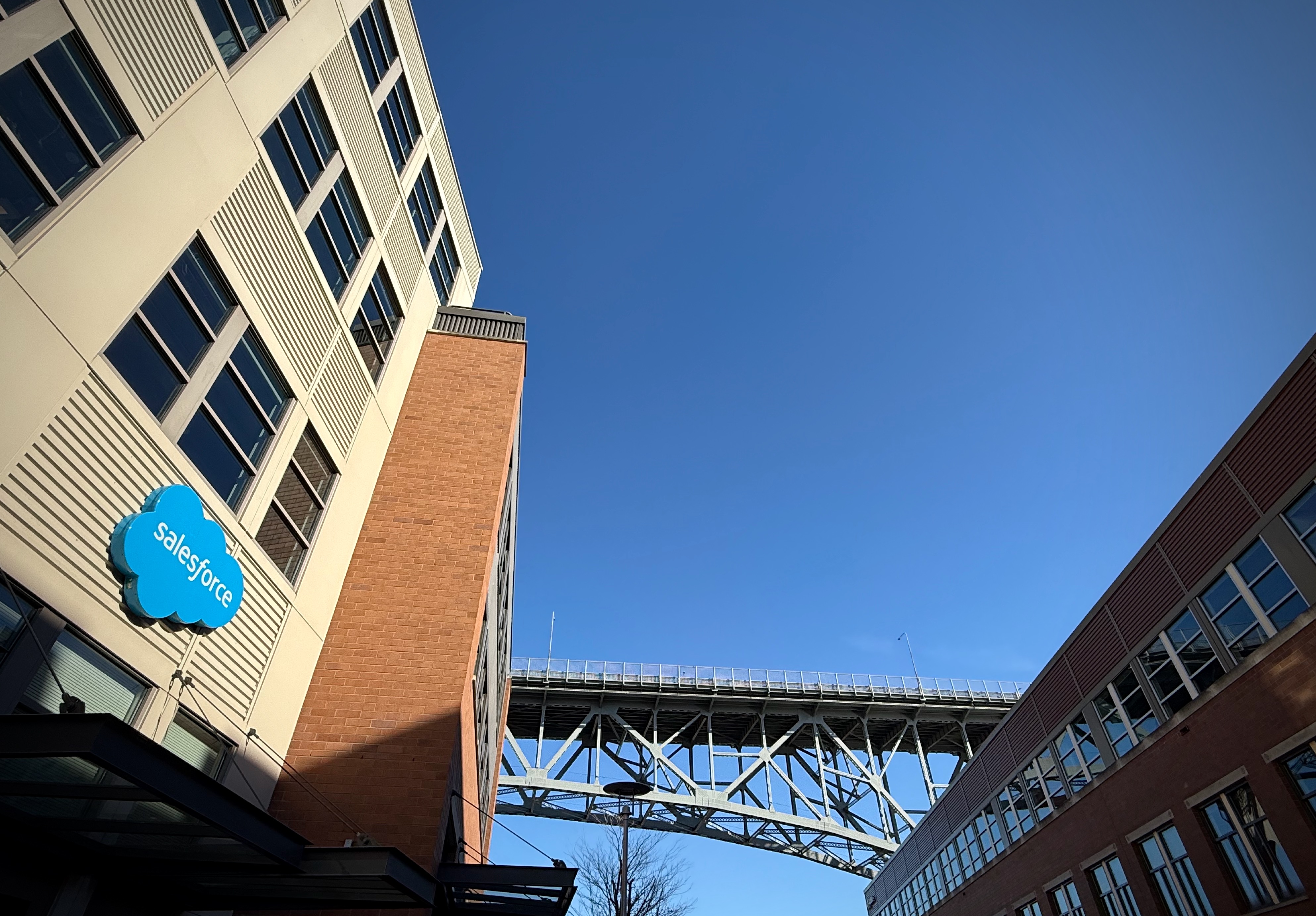
Salesforce offices in Seattle’s Fremont neighborhood. (GeekWire Photo / Kurt Schlosser)
Salesforce is cutting 59 jobs in Washington state, impacting a wide variety of tech roles at offices in Seattle and Bellevue, according to a new state filing.
The layoffs at the San Francisco-based enterprise software giant, as well as data visualization company Tableau, are effective Oct. 5 according to a Worker Adjustment and Retraining Notification from the state’s Employment Security Department.
Affected positions include software engineers, product management directors, incident commanders, technical support engineers, and leadership roles across marketing and sustainability.
GeekWire reached out to Salesforce for comment on the reason behind the layoffs and for updated workforce numbers in the Seattle area. We’ll update this story when we hear back.
Last September, 93 employees in Washington state were laid off by Salesforce. At the same time, CEO Marc Benioff was touting efficiency gains at the company achieved through the use of AI tools.
The latest reductions come amid a broader restructuring at Salesforce, marking its third round of job cuts this year. The San Francisco Business Times reported that 74 employees are being laid off at the company’s headquarters, accompanied by a reshuffle in the C-suite that promoted Miguel Milano to COO.
Amid the restructuring, the company continues to pull in top regional leadership. Longtime Microsoft cybersecurity executive Krishna Kumar Parthasarathy announced last week that he’s joining Salesforce as executive vice president of engineering.
Salesforce acquired Seattle-based Tableau in 2019 for $15.7 billion. Despite the recurring job reductions, the company recently renewed its lease for roughly 114,000 square feet at the Data 1 office building in Seattle’s Fremont neighborhood, signaling an ongoing commitment to its long-term home in the city.
In other tech industry layoffs this week, Google announced it was eliminating 52 jobs in Washington and Zillow is cutting 91 jobs.
Zillow Group’s revenue rose 18% to $772 million in the second quarter, beating its own forecast, but a $36 million restructuring charge from severance and other costs stemming from this week’s layoffs pushed it to a $4 million net loss.
The Seattle-based online real estate company, which on Tuesday laid off more than 500 people, or 7% of its workforce, expects the restructuring to cost $59 million to $64 million in total, with the rest recorded in the third quarter, according to the company’s 10-Q regulatory filing.
Zillow also announced a series of executive changes, including expanding CFO Jeremy Hofmann‘s role to include chief operating officer. Jun Choo, who became COO in 2024, is stepping down to focus on his health, serving as an advisor through the end of the year.
The company created a chief legal and policy officer role and hired Cassandra “Sandi” Knight, a Google vice president of litigation and discovery, who was previously PayPal chief litigation counsel. Knight starts next week.
Zillow and Redfin are set to go to trial Aug. 24 as defendants in an antitrust case brought by the FTC and five state attorneys general over the $100 million rental listings deal between the two companies. Zillow has spent $26 million on the case so far this year, including $10 million in the second quarter.
In addition, Zillow promoted Kathleen Berroth to senior vice president of strategy and operations, and Eric Wilson to senior vice president and GM of mortgages.
For the second quarter, Zillow said the residential real estate industry grew 6%, while industry-wide lending for home purchases was roughly flat compared with a year ago. The number of people visiting real estate sites and apps declined overall as mortgage rates rose, the company said, citing Comscore. Zillow’s own traffic fell 2%, to an average of 239 million monthly users.
Most of the revenue growth came from Zillow’s newer businesses. Mortgage revenue rose 75% to $84 million as Zillow directed buyers on its site to its own lending arm, and rentals revenue rose 31% to $209 million. Residential revenue, from advertising sold to real estate agents, grew 7% to $465 million.
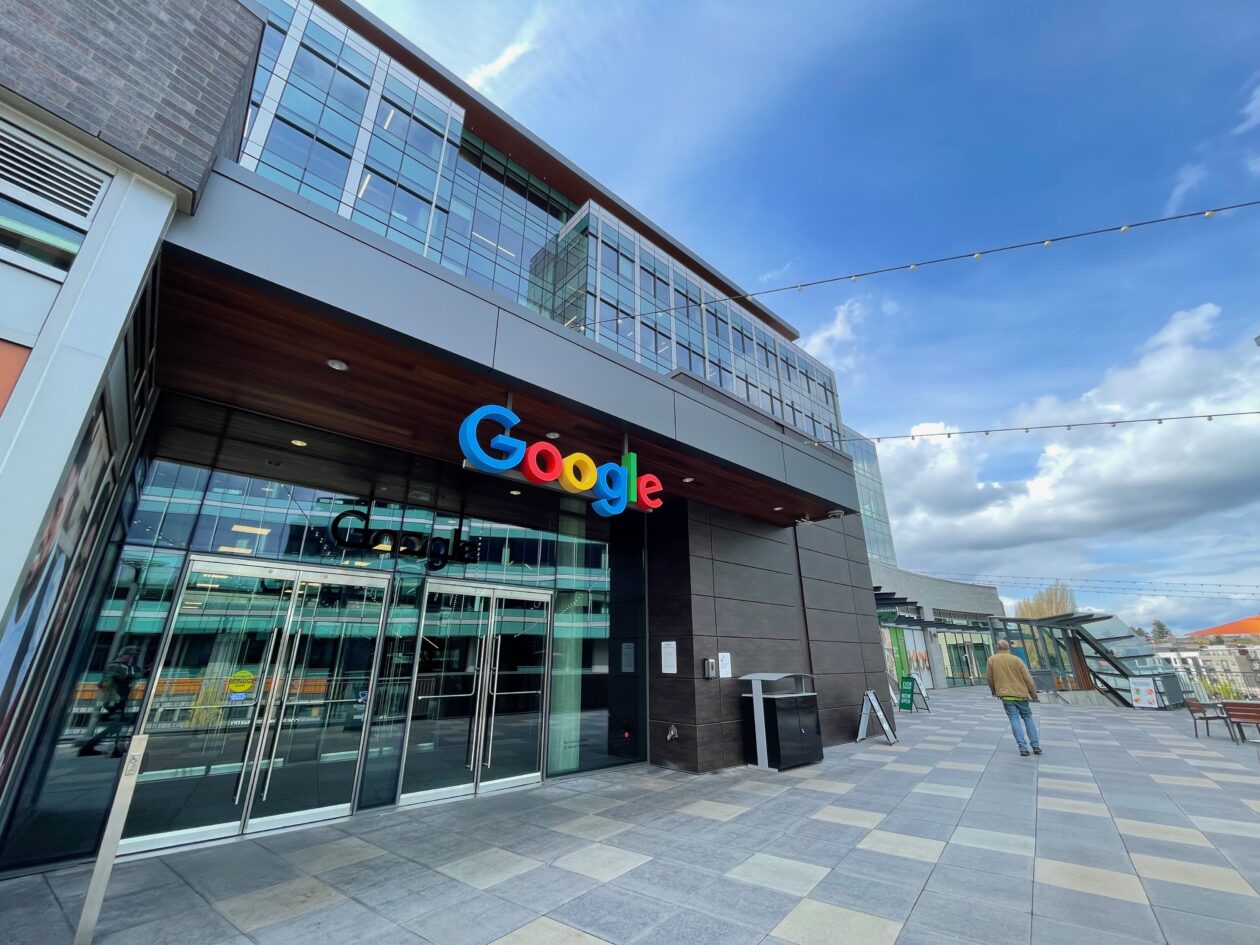
Google’s Kirkland Urban campus in Kirkland, Wash. (GeekWire File Photo / Kurt Schlosser)
Google is laying off 52 employees in Washington state, according to a state filing released Wednesday.
The job cuts include software engineers, engineering and product managers, mechatronics engineers, UX designers and recruiters located in Kirkland, Redmond and Seattle offices as well as remote employees.
The layoffs are scheduled to take effect in September and early October. The notice from Google filed with the state’s Employment Security Department did not provide an explanation for the cuts.
GeekWire has reached out to Google for comment and will update if one is forthcoming.
Business Insider reported layoffs in the Google Cloud division earlier this summer, but did not say how many jobs were impacted.
While Microsoft, Amazon and other tech companies have cut Washington employees in multiple rounds over the past year, this is Google’s the first significant reduction in the state since 2023. In January of that year, Google parent Alphabet shed 12,000 workers globally or 6% of its workforce. It did not indicate how many jobs were lost in Washington.
Washington is one of Google’s largest engineering hubs outside of its Bay Area headquarters. It opened offices in the state more than 20 years ago, with a focus on Android, Chrome, Cloud, Maps, Ads and other projects.
Zillow Group this week disclosed it is eliminating 91 jobs in Washington state, landing heavily on senior staff.
Zillow Group’s headquarters at 1301 Second Ave. in downtown Seattle. (GeekWire File Photo)
Zillow Group’s layoffs will eliminate 91 jobs in Washington state, landing heavily on senior staff, according to a notice the company filed with the state Employment Security Department.
The filing under the federal Worker Adjustment and Retraining Notification (WARN) Act is the first detailed accounting of who was affected by the more than 500 layoffs the company announced Tuesday. The cuts hit about 7% of its global workforce, which stood at 7,058 as of March 31.
Zillow Group is officially headquartered in Seattle, but the relatively small share of the layoffs in its home state (18%) reflects how distributed it has become. The company adopted a remote-first model it calls “Cloud HQ” in 2020, at the height of the pandemic, and it has continued to bet on remote work as other tech companies pulled employees back to the office.
The list of affected job titles in Washington state is dominated by senior positions. It includes five directors and three senior directors, 14 principal-level roles, and a long list of senior managers and senior individual contributors. Relatively few junior positions appear on the list.
Product and engineering absorbed the most. Senior Product Manager is the single largest line at seven positions, followed by Senior Software Development Engineer, Software Development Engineer and Senior UX Researcher at four each. Together, product and engineering roles account for more than a third of the Washington cuts.
The list also includes AI and machine learning positions: a Senior Machine Learning Engineer, a Senior Manager of Machine Learning Engineering, a Senior Applied Scientist, a Senior Manager of Research Science, and an Annotation Lead, associated with labeling data to train AI models.
Zillow told GeekWire on Tuesday that AI did not drive the layoffs. “Today’s changes are about better positioning Zillow for the path ahead, which includes having the right people in the right roles and being able to move faster,” a company spokesperson said.
The WARN notice adds a detail Zillow did not mention publicly: “Some of these terminations are the result of, or are expected to result in, the relocation or contracting out of operations and/or employee positions.”
Affected employees were notified Aug. 4 and will be terminated effective Oct. 5, more than 60 days later as required under state and federal law. They will continue to receive pay and benefits until then, according to the filing. Employees who are offered and accept another role at the company before that date will not be terminated.
The cuts affect workers at Zillow Group’s headquarters at 1301 Second Ave. in downtown Seattle and employees working from home elsewhere in Washington. The company said in the filing that its headquarters will remain open. None of the affected employees are represented by a union.
Zillow Group reports second-quarter earnings Wednesday afternoon.
Seattle-based online real estate company Zillow Group laid off more than 500 employees Tuesday, about 7% of its global workforce, its second and largest round of cuts this year.
The layoffs are about “ensuring we have a disciplined cost structure and getting more efficient, with the right people in the right positions,” Zillow Group CEO Jeremy Wacksman said in a company blog post announcing the cuts. He said the decision reflects “both the strides we’re making in our strategy and the reality of what is required of us to grow at scale.”
He added, “Continuing to grow at scale requires us to work differently than we do today.”
Wacksman told real estate executives at the T3 Leadership Summit in April that Zillow employees were being retrained to use AI in their jobs, with gains that “are small, but they’re compounding,” as reported by Real Estate News.
Zillow told GeekWire the cuts were not driven by AI. “Today’s changes are about better positioning Zillow for the path ahead, which includes having the right people in the right roles and being able to move faster,” a company spokesperson said.
The company didn’t disclose which teams were affected, how many of the cuts will hit its Seattle headquarters, or what severance employees will receive.
Zillow Group will report second-quarter earnings Wednesday afternoon. The company’s business has been growing, defying a sluggish housing market. Its first-quarter revenue rose 18% year-over-year to $708 million, while the residential real estate industry grew 2%, according to NAR. Net income climbed to $46 million from $8 million a year earlier.
Wacksman indicated Tuesday that the company is still bucking the trend: “We continue to outperform the category, despite a housing market that has been essentially flat,” he wrote.
However, the company has been spending nearly as fast as it has been growing, on rental listings, loan officers for Zillow Home Loans, advertising and legal bills. Execs told investors in May that the spending would ease up in the second half of the year. Cutting payroll is one way to make that happen, and Zillow’s earnings guidance tomorrow could reflect that.
As for those legal bills: Zillow is headed to trial later this month in an FTC antitrust case over the $100 million deal the company struck in early 2025 to become the exclusive provider of multifamily rental listings on Redfin’s websites.
Zillow cut about 200 jobs in January, but characterized those as performance-related and part of its annual review cycle. It had 7,058 employees as of March 31, down just 10 positions from the end of 2025, meaning it had largely backfilled January’s cuts before Tuesday.
It’s part of a wave of cuts and consolidation in real estate portals and property tech. CoStar has cut its Homes.com inside-sales team by nearly 40% in recent months. Better founder Vishal Garg stepped down as CEO Monday as the mortgage company pushed to cut costs.
Along with its flagship Zillow portal, Zillow Group’s brands include Trulia, StreetEasy, HotPads and Out East, plus agent software products Follow Up Boss, ShowingTime and dotloop.
Updated after publication with additional details from Zillow.
Microsoft and Amazon both saw their stocks surge again Monday, riding a post-earnings tech wave across the stock market that pushed Amazon past $3 trillion in value for the first time.
The gains follow earnings reports last week in which both companies’ cloud platforms exceeded expectations. Microsoft said Azure grew 43%, passing $100 billion in annual revenue for the first time. Amazon said AWS grew 37%, its fastest pace in 18 quarters.
Microsoft and Amazon are now the world’s fourth and fifth most valuable companies, respectively. The three ahead of them (Nvidia, Alphabet and Apple) are all headquartered in the Bay Area, although each has sizeable engineering centers in the Seattle region.
Amazon rose 4.6% in intraday trading to $284.15 as of publication time, after touching an all-time high of $287.20 earlier in the session, giving it a market value of $3.06 trillion.
Microsoft climbed 5.2% to $488.97, worth $3.63 trillion. Its rally began Thursday, when it added nearly $450 billion in market value, the largest one-day gain by any company on record.
The rallies came despite AI spending plans that have unsettled investors for much of the year. Microsoft went into earnings near a one-year low, after a $357 billion wipeout to start the year.
It’s all still coming at a huge cost. Microsoft spent a record $41 billion on capital projects last quarter and told investors to expect more than $50 billion in the current quarter. Amazon raised its 2026 forecast to about $220 billion from $200 billion, citing rising memory chip prices.
In one sign of the impact of the spending, Microsoft’s free cash flow fell 23% last quarter. Amazon’s free cash flow turned negative for the first time since 2023.
But cloud growth and other signs of demand for AI seem to have appeased investors for now.
Amazon CEO Andy Jassy told investors the spending reflects unmet demand: “Even at that amount, we will still not have enough capacity to meet all the demand we have in 2026, and I believe this dynamic will also be true in 2027 too. In fact, the demand we already have for 2028 is striking.”
The number of product research and development roles at Microsoft declined for the second straight year, according to the company’s annual regulatory filing, offering a new indication of how the tech giant is reshaping its workforce in the AI era.
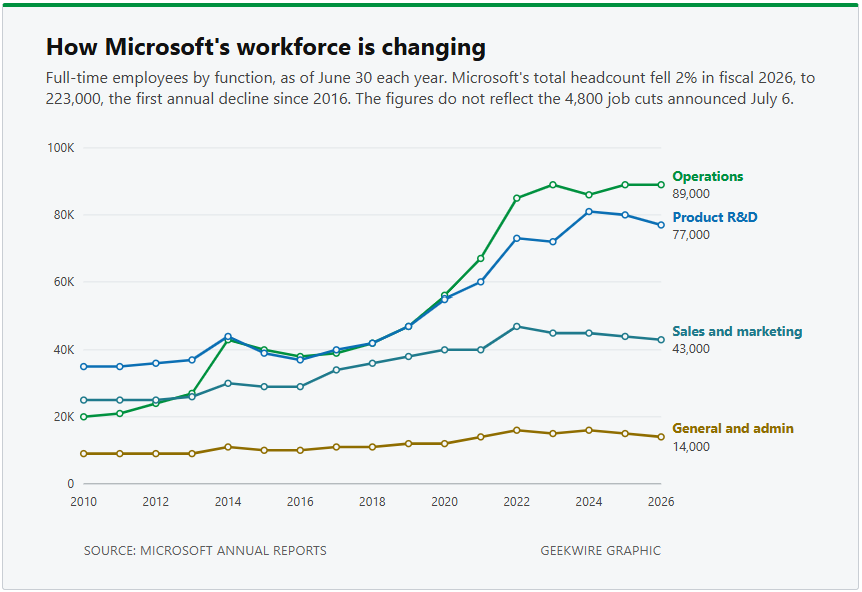
Microsoft’s total headcount declined by 5,000 people to 223,000 as of June 30, according to its Form 10-K, filed with the SEC this week. It’s the first annual employment decline for Microsoft since 2016, when the company was writing off and winding down its Nokia smartphone business.
The trend is notable in part because, over the same time period, Microsoft’s revenue rose 18%, or $50.1 billion, to $331.8 billion — the largest one-year increase in the company’s history.
Here’s how the employment trends break down:
Product R&D roles represented the majority of the net decline, falling by 3,000, to 77,000 — down from a peak of 81,000 in 2024.
Operations roles, now Microsoft’s largest employment category, held steady at 89,000 after growing by 3,000 the year before. It includes datacenter operations, product support, consulting, and manufacturing and distribution.
Sales and marketing roles declined by 1,000, to 43,000, and general and administration by 1,000, to 14,000.
The reductions fell disproportionately on Microsoft’s U.S. workforce, which declined by 4,000, to 121,000. International employment declined by 1,000, to 102,000.
The numbers reflect the roughly 9,000 jobs Microsoft cut on July 2, 2025, two days into its fiscal year. They do not reflect the 4,800 cuts announced July 6 of this year — spanning sales, consulting and Xbox — or the thousands of U.S. employees who left in early July under the company’s first voluntary retirement program.
On the earnings call Wednesday, CFO Amy Hood confirmed that “total company headcount declined 2% year over year.” She linked a 10% increase in operating expenses to “continued investment in R&D compute capacity, talent, and data to support product development across the portfolio.”
AI coding tools — including Microsoft’s own GitHub Copilot — have become a standard part of how software is built at Microsoft and across the industry, reducing the number of people and the amount of time it takes to ship products, while often expanding the total scope of the work.
Microsoft has repeatedly declined to link its job cuts to AI. Chief People Officer Amy Coleman said in a memo earlier this month that the roles being eliminated were not being directly replaced by AI, while acknowledging that “AI is changing how work gets done.”
Tech companies have been keeping a tighter rein on operating expenses, primarily through job cuts, in part to offset soaring capital expenses to support their AI infrastructure buildouts. Microsoft’s capex reached $41 billion in the June quarter alone.
Microsoft is also moving engineers out of product development and into customer-facing roles. The Microsoft Frontier Company, a $2.5 billion initiative announced July 2, brings together more than 6,000 people to embed engineers inside customers building AI systems — a group drawn “primarily from Microsoft’s existing engineering and forward-deployed teams,” according to the company.

 Login
Login