❌

Reading view

There are new articles available, click to refresh the page.

Taking A Nokia 3310 Game Jam To The N’th Degree

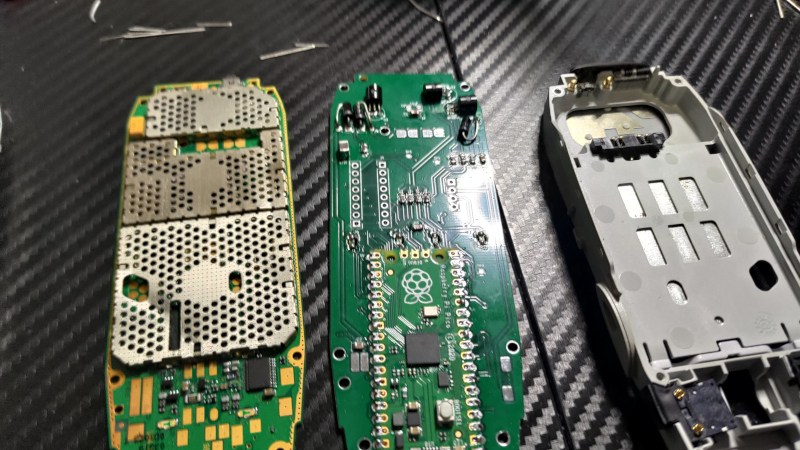
Game jams are a fun competition in which the aim is to write a game under a particular theme while under a time constraint, usually a weekend.Β  [Hoani] entered one where the aim was to write a game within the constraints of the Nokia 3310’s user interface: a 94 by 48 pixel grey LCD, a buzzer, and a keypad. His entry was Trick Shot II, a ball-bouncing game running on his game engine, which is cool enough, but making a custom PCB for a Nokia 3310 case to run it on? Next level.

Look away if you don’t like restomods, for a real Nokia 3310 is gutted to take this board. On it is a Pi Pico, the Nokia LCD, which has outlasted the original phone as a part by decades, and a Nokia keypad layout. The first prototype was not a perfect fit because it had a 1.6mm board rather than 1mm.

The engine meanwhile is written in Go, and has both graphics and sound APIs. Considering that the Pico’s power exceeds whatever CPU the phone had by many orders of magnitude, we’d imagine it has no problems with such a tiny screen.

We like the attention to detail of this project, and that such a limited interface can still deliver gaming fun. Meanwhile, if you would prefer to use a 3310 as a phone, you can charge it the 21st-century way.

Hack The Box: Devhub Machine Walkthrough – Medium Difficulty

Completed another Hack The Box machine: Devhub (Medium).

Devhub was a great exercise in exploring modern development tooling, service misconfigurations, and Linux privilege escalation. The journey began with web enumeration and identifying an exposed MCP Inspector service. Further investigation revealed a command injection vulnerability that provided initial access to the machine.

From there, internal service enumeration uncovered a localhost-only Jupyter instance. Accessing it through SSH port forwarding and investigating its authentication mechanism opened the path to another user. The final stage involved examining an internal operations service, understanding its exposed functionality, and identifying a weakness that ultimately led to root access.

Devhub highlights how development tools, internal services, and poorly secured administrative functionality can create unexpected attack paths when combined. Another valuable machine for practising enumeration, lateral movement between local users, and privilege escalation.

#HackTheBox #HTB #CyberSecurity #PenetrationTesting #RedTeam #OffensiveSecurity #Linux #PrivilegeEscalation #WebSecurity #MCP #InfoSec …

Learn MoreHack The Box: Devhub Machine Walkthrough – Medium Difficulty

The post Hack The Box: Devhub Machine Walkthrough – Medium Difficulty appeared first on Threatninja.net.

Hack The Box: Kobold Machine Walkthrough – Easy Difficulty

Completed the Hack The Box "Kobold" machine, an easy-difficulty Linux challenge focused on web exploitation and container-based privilege escalation.

The assessment involved identifying and exploiting an unauthenticated Remote Code Execution vulnerability (CVE-2026-23744) in MCPJam Inspector to gain initial access as the ben user. During the privilege escalation phase, I explored Docker security weaknesses by leveraging excessive group permissions to escape the container environment and obtain root access. Additionally, I analyzed an alternative attack path involving CVE-2025-64714 in PrivateBin, which allowed sensitive configuration data exposure and access to the Arcane container management interface. This machine provided practical experience in vulnerability exploitation, container security assessment, and identifying risks associated with exposed internal services.

#HackTheBox #HTB #CyberSecurity #PenetrationTesting #OffensiveSecurity #RedTeam #Linux #Docker #VulnerabilityManagement #CVE #EthicalHacking #CybersecurityLearning …

Learn MoreHack The Box: Kobold Machine Walkthrough – Easy Difficulty

The post Hack The Box: Kobold Machine Walkthrough – Easy Difficulty appeared first on Threatninja.net.

❌