
❌

Reading view

There are new articles available, click to refresh the page.

This Circuit Sculpture is an ESP32-Powered Console

Expressif might not have intended the ESP32-S3 to become an emulation powerhouse, but that’s certainly what has happened. The little microcontroller seems perfect for recreating the Game Boys or Game Gears of years past, and there are a lot of software options to that end. Having grabbed firmware off a github repo, you still need a physical build to hold, and that’s where this one by [HVT Lab and Huy Vector] stands out.

As you can see, they’re letting everything hang out β€” not even in a 90s-inspired clear case, but with an open frame of soldered brass, with just a small strip of 2 mm clear acrylic to help stabilize the buttons. That appears to be held with cyanoacrylate glue, but it’s brass and solder doing the majority of the structural work here. We might be a little more confident tossing this lovely device in a bag or pocket if the whole device was boxed in with that acrylic β€” shorting the exposed power bus on your keys sounds like a bummer β€” but we can’t argue with the aesthetic vision here. It’s a lovely build on the physical end.

From the video it looks like the software is based on Retro-Go, which we’ve seen in use before. In any case, there are plenty of open source projects you could load onto the ESP32-S3 powering this circuit sculpture, though, from NES to IBM PC.
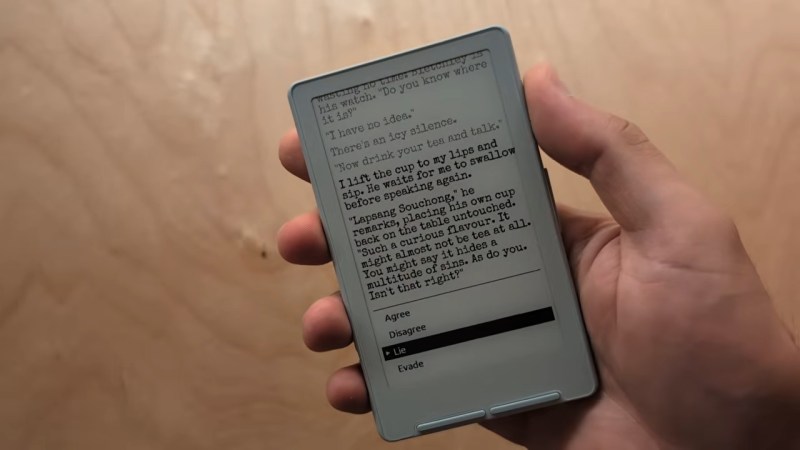
eenk Provides eInk, ESP32 Powered Text Adventures

There’s a niche genre of text adventure that’s halfway between a traditional novel and a videogame. Think Zork if it had an extra few novels worth of words of well-crafted story to go with the action. [t0mg] is a fan of such adventures, and also quite enjoys carrying around his palm-sized ESP32 powered Xteink e-ink reader, so decided to create a project to merge the two interests, called eeink.

The Xteink readers have gotten popular lately because their modest internals and size make them very affordable. Not to mention hackable, since they’re basically an ESP32-C3 e-ink dev board that comes with a nice case and battery. The X4 Pro notably comes with an ESP32-S3 which means a lot more RAM, but this project targets both that and the X3/X4 that use the C3 version. Using the C3 means working within some rather stringent limits, as Xteink didn’t spring for any PSRAM, so [t0mg] had less memory to work with than folks did in the 80s.

This project is specifically focused on adventures using the scripting language ink, and comes with its own IDE called eenky to roll your own choose your own adventure book. It’s all on GitHub under an MIT license, and if you want to see it in action there’s a demo video embedded below.

Speaking of Zork, it wasn’t just the first commercial text adventure; it brought some important technological innovations, too.

Β 

Miniaturizing the Atari 2600 Console

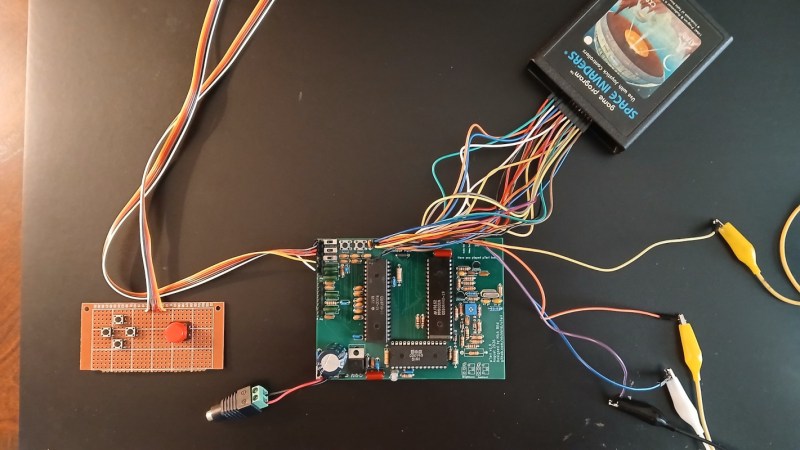
For as popular as Atari was in their heyday, it wasn’t until well after they were on their famous decline that they released their first handheld, the Atari Lynx. In retrospect, competing with the Game Boy was not going to be a recipe for success even without considering their other problems as a company, and as a result was their penultimate console before exiting the market completely. But [Nick]’s most recent project asks what the world would have been like with an Atari handheld from their golden era, and has been working on this miniaturized version of the 2600.

Unlike any modern emulators which can easily handle Atari 2600 games in almost any form factor today, this console is doing it all with as much original hardware as possible. It uses much smaller switches and buttons compared to the original, and omits some other unnecessary hardware for today’s world like the RF modulator. [Nick] has also designed a custom PCB that reduces the overall footprint considerably as well, and has relocated the cartridge port in preparation for its eventual handheld shape. The result is a console using original hardware that’s less than half the footprint of the original.

Although there were around 30 million Atari 2600 consoles sold and the system is unlikely to be a real collector’s item anytime soon, [Nick] makes sure to note that no real 2600 hardware was harmed in this build. And, as far as its handheld nature, this is a stepping stone on the path to that eventual goal. We’ll look forward to an eventual system that integrates a screen and controller as well as a port for the original cartridges. In the meantime, here’s another handheld 2600 that fits completely inside one of those cartridges.

❌