A union representing Uber and Lyft drivers was just certified by California's Public Employment Relations Board, officially recognizing them as the drivers' bargaining organization.
The Sacramento Bee reports that this new bargaining structure :
The move will allow the California Gig Workers Union to help drivers negotiate issues affecting working conditions and benefits. It comes as at least 30% of active drivers expressed support of the union... [California] Assembly Bill 1340 helped bring the union to fruition by allowing the independent contractor drivers to engage in collective bargaining.
"The next step for the union is to negotiate a contract with Uber and Lyft that meets drivers' demands," reports the Los Angeles Times, "including health insurance, support for high gas prices and more transparency around pay:
California is the third state to allow ride-hailing drivers to unionize, following Washington in 2022 and Massachusetts in 2024...
The California Gig Workers Union was formed with the support of the Service Employees International Union... "Gig drivers shouldn't have to face the future alone," said SEIU 521 official Riko Mendez in a statement. "As autonomous vehicles rapidly expand, having a union gives the drivers the power to negotiate for fair pay and meaningful say in how new technology shapes their work and our communities' futures."
An anonymous reader quotes a report from the Associated Press: California Gov. Gavin Newsom signed a sweeping package of laws Thursday aimed at protecting children from the risks of technology, including social media and AI chatbots. The laws will penalize large social media companies up to $1 million per child if they are found negligent of harming children through their platforms, ban tech businesses from offering addictive feeds to anyone under 16, require operators of AI chatbots to perform risk assessments before rolling them out and allow families to opt out of receiving school-issued laptops.
Newsom joined his wife and state lawmakers at a children's museum near San Francisco to stress the importance of protecting kids at a time when they have such easy access to social media and AI chatbots. "We have designed cribs to be safe, chairs to be safe, car seats," Assemblymember Rebecca Bauer-Kahan said. "Yet we've allowed technology to be handed to our children and never asked or expected it to be safe." [...]
Newsom also signed laws Wednesday, which are supported by Anthropic, that are aimed at improving oversight of AI companies. One of the measures requires the state to create rules for independent organizations to evaluate the safety risks of AI models, and the other requires the state to create a registry of AI auditors, who'd have to be financially independent from the businesses they are auditing.
Chris Arroyo, a regional director at Datadog, said agencies need to start small, build confidence in AI models before moving them into the mission areas.
Spain’s largest cryptocurrency exchange Bit2Me has launched a separate company to help courts, police and financial institutions trace, seize, store and liquidate cryptocurrency linked to investigations. According to a statement from Bit2Me, the new unit, Bit2Shield, has been legally registered…
Thursday 404 Media reported that Flock taught America's cops "how they could surveil the No Kings protests" against President Trump (as well as "small parades") in a webinar last year that described "using a mix of Flock's technology and law enforcement's own databases."
In the webinar, Flock's director of market management Caity Peak explains how real time crime centers — which are police surveillance centers that utilize Flock cameras and other surveillance cameras — can be used for emergency response, but can also be used to surveil "established events" like 4th of July fireworks displays, parades, bike races, Mardi Gras, and protests. The webinar shows just how routine the idea of always-on surveillance has become, and how casually it is used during extremely innocuous events. Peak explains that police can use FlockOS, a software platform that combines Flock's automatic license plate readers (ALPR), drones, gunshot detectors, 911 data, and other surveillance cameras (including ones Flock does not own) into a "single pane of glass" or single piece of software to look at various types of surveillance in one place during both emergencies and relatively mundane events in a city or town.
"Imagine that you're an incident commander, and you're working this No Kings Protest," Peak explains while a dashboard shows a series of surveillance tools overlaying the city of Denver. "If I'm somebody assigned a traffic post that's working this No Kings Protest, I really don't have time to go in [...] and look at all these places [for different intelligence]. This is an example of viewing all of that in one place...." The dashboard Peak shows includes traffic information, a "response plan" for the protest, the floor plans of nearby buildings, as well as a series of video feeds of both outdoor-mounted cameras and cameras inside businesses and government buildings.
404 Media and the Electronic Frontier Foundation previously showed that police have specifically used Flock cameras to monitor the No Kings protests and other First Amendment-protected activity... This webinar shows this type of surveillance is not anomalous, and is specifically taught by Flock. The webinar also shows that Flock's latest public stance — that its ALPR cameras are noninvasive technology, that they take only static images at a single place and time, and that they are primarily used to solve the worst crimes — is wildly misleading. Flock has time and time again pitched itself to police as a sort of operating system to solve crime and do real-time surveillance and predictive policing. ALPRs are just one part of this broader surveillance apparatus that Flock has created, markets to police, and teaches them how to use.
The United Nations has an announcement. "The UN General Assembly has voted overwhelmingly to encourage governments, schools and tech companies worldwide to stop using maps that make Africa look far smaller than it really is."
By 164 votes to one, Member States on Friday endorsed a resolution promoting map projections that more accurately reflect the true size of continents — the culmination of an African-led campaign against the 16th-century Mercator projection, still the most widely used map in the world. The United States cast the sole vote against, dismissing the initiative as part of a "radical ideological project." Six countries — Estonia, Georgia, Lithuania, Moldova, Serbia and Ukraine — abstained.
The resolution does not ban the Mercator projection or impose a replacement. Instead, it encourages governments, schools, international organizations and technology companies to use the Equal Earth projection and other so-called equal-area maps when relative size matters, and to teach the limitations of any flat map in representing a spherical planet.
Behind that seemingly technical debate lies a larger argument about history and power: whether a map designed for European sailors in the 16th century has, over generations, distorted not only geography but perceptions of a whole, vast and complex continent... [With Mercator maps] landmasses appear increasingly enlarged the farther they are from the Equator. Greenland, for instance, can look roughly comparable in size to Africa, even though Africa is about 14 times larger. Northern Europe and North America are similarly magnified, relative to equatorial regions. Despite its original navigational purpose, Mercator remains common in educational, media, digital and official materials. The resolution says those distortions have contributed to the "symbolic minimization" of Africa and perpetuated an unbalanced view of the world...
Equal-area maps do not make Africa larger; they remove the exaggeration Mercator gives landmasses closer to the poles.
The UN notes that hours before the vote, France's foreign minister announced the country was planning to abandon Mercator for its maps of the world.
Rockstar Games and the mayor of Miami-Dade county are discussing a joint marketing campaign transforming parts of the county to look like areas from Grand Theft Auto 6, reports the blog Rock Paper Shotgun:
The proposed publicity event would include "an immersive arrival experience" at Miami International Airport. with signs for Vice City and planes coated in GTA 6 livery, together with branded Metromover skytrains and specially designed manhole covers... [I]t proposes a dockyard visual installation inspired by GTA 6's Port Gellhorn, incorporating cargo containers, cranes, and cruise ships. There's also talk of a "Vice City Motor Fest", which might feature "classic cars, customized vehicles, lowriders, motorcycles, tropical graphics, and local entertainment within a controlled, family-appropriate setting." Attendees would presumably be discouraged from nicking the cars...
As it happens, Rockstar have embedded a team in Miami to sponge up the ambience, research Miami culture, and study the habits of residents — including "ex-criminals", in the careful phrasing of senior vice president of narrative Rupert Humphries.
The pitch suggested murals, "wrapping" buses (with special signs at transit stops), and even a Vice City-inspired baggage-claim installation at the airport. The pitch also suggested the library offer recording equipment for "Vice City Radio" to capture music (as well as podcasting, oral histories, neighborhood storytelling) — along with " limited-edition GTA VI-inspired library cards, collectible bookmarks, Miami-themed reading and music lists, and demonstrations of the new recording and production equipment."
Though nothing has been formally agreed to or approved, the mayor's office confirmed the discussions, reports Axios.
The sheriff of Miami-Dade county "has publicly opposed plans to transform the city into a real version of Grand Theft Auto 6's "Vice City", reports Kotaku. The sheriff's reason? The videogame city "includes murder, robbery, drug trafficking, carjacking, violence against law enforcement," as well as "other conduct" that the police department works "every single day to prevent."
Late amendments to the Cyber Security and Resilience Bill would give ministers new powers to restrict risky technology providers as supply chain attacks intensify.
An anonymous reader quotes a report from Ars Technica: President Trump yesterday demanded that the Federal Communications Commission punish or rebuke an NBC journalist for saying he has "mixed results" in his election endorsements. In the latest example of how Trump is using the FCC to harass reporters and news organizations that he dislikes, he said Meet the Press host Kristen Welker "will be reported to the FCC for rebuke or punishment" for what he claimed was a "purposeful inaccuracy." "Kristen Welker, the Unpopular 'Hostess' of the once great Meet the Press, now considered Meet the Fake Press, just stated that Donald Trump has 'mixed results' on his Endorsements of Candidates, when the recent WINS of Darline Graham and Mike Mazzei, stand at 100% for the U.S. Senate, and 98% for the U.S. House, recently and over the longterm. How can anyone be allowed to say this, working for freely given Public Airwaves? Results are attached. Because of this purposeful inaccuracy, she will be reported to the FCC for rebuke or punishment," Trump wrote in a Truth Social post.
A separate post from Trump yesterday said, "THE FAKE POLLS USED BY OUR CROOKED MEDIA ARE OUT OF CONTROL, AND SOMETHING MUST BE DONE ABOUT IT. FCC TO THE RESCUE! President DJT." Trump also posted a rant on Friday about New York Times journalist Maggie Haberman, calling her "an unattractive person both inside and out" who "should be forced to turn over any and all money that she's made through her fake reporting on me." Trump referred to Haberman throughout his post as "Maggot Haberman." Trump's post about Welker included an image purporting to show he has near-perfect results in his endorsements this year. "The Press is a Disgrace to our Nation, and I hope that Chairman Brendan Carr, and the fine people of his Commission, will take this Threat to our Country very seriously," Trump wrote. Perhaps indicating that he will refer additional journalists for FCC punishment, Trump wrote that Welker "is not the only one. The Radical Left News is going out of their way to harass, demean, and libel anything 'TRUMP.'" The FCC website says the commission "cannot prevent the broadcast of any particular point of view," and that it "generally will not intervene" in complaints about "one-sided news reports" because "it would be inconsistent with the First Amendment to replace the journalistic judgment of licensees with our own."
As noted by Ars, FCC Chairman Brendan Carr has "made it clear he takes orders from Trump, abandoning his previous position -- which he held under Democratic presidents -- that the FCC must operate independently of White House interference."
Carr could use the commission's regulatory authority over licensed broadcasters to open an investigation into Welker, potentially creating pressure on NBC and its affiliated stations through licensing proceedings or other FCC actions. The most likely vehicle would be the FCC's rarely enforced news distortion policy, which Carr has repeatedly revived to target coverage he considers misleading; historically, however, the policy required an unusually high evidentiary bar and was seldom enforced.
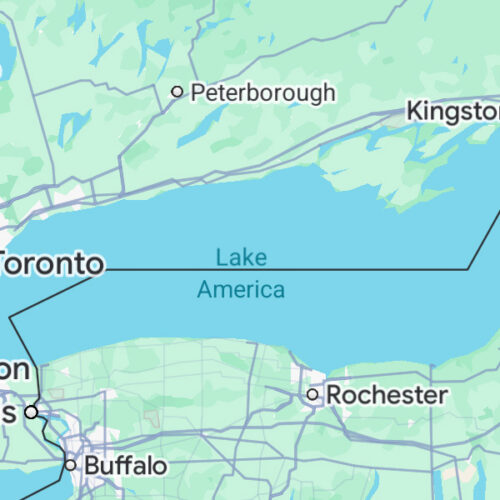
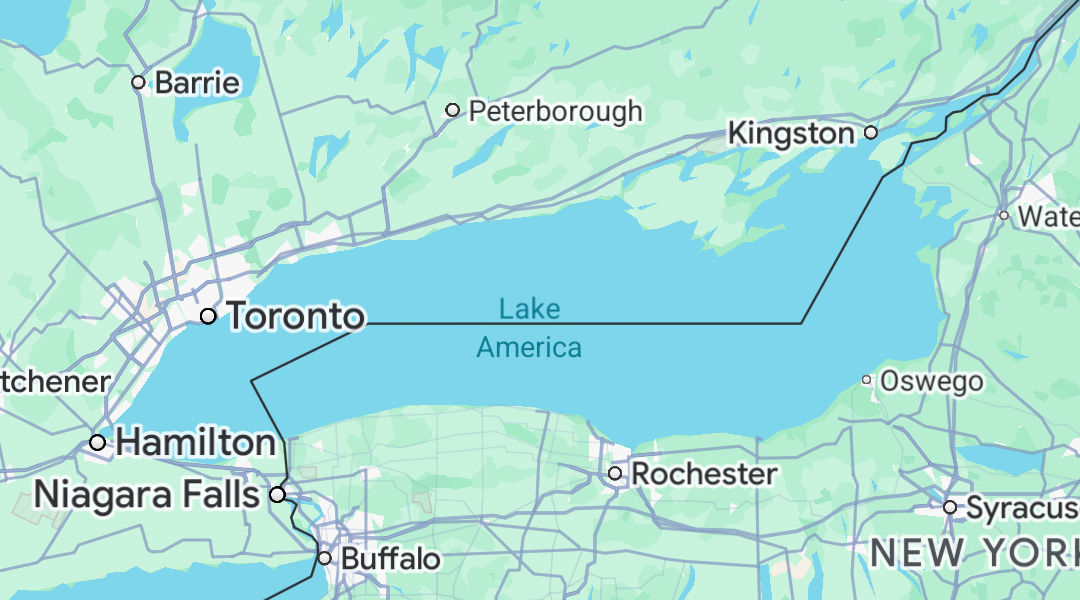
Trade talks between the US and Canada broke down last week, leading to a wave of tariffs and retaliatory tariffs. US President Donald Trump also fell back on an old favorite to needle his opponents, signing an executive order on Thursday to rename Lake Ontario to "Lake America."
The body of water, which straddles the US-Canada border, gave its name to the Canadian province rather than the other way around. Regardless, the US government now refers to this great lake as Lake America—or it will soon. Official US government maps have yet to be updated, but Google wasted no time adopting the new, Trumpian name.
Google began rolling out this change for US users on Saturday. The company posted a brief update on its Google Maps blog, noting that it follows the US Geographic Names Information System (GNIS) for its maps, so the company implies it had no choice but to rename Lake Ontario in Google Maps, which is the most popular mapping platform in the US by a wide margin.
"It's easier if there's a little bit of distance between you and the vote, or if you're not running for re-election or not on the ballot," said Loren Duggan.
The U.S. Capitol, center, is seen with the Supreme Court of the United States, left, and the Library of Congress, right, Thursday, April 9, 2026, in Washington. (AP Photo/Rod Lamkey, Jr.)
AI is proving effective at finding and exploiting vulnerabilities. Some say this will make it harder for governments to use hacking tools and spyware and could reignite calls to backdoor devices.
California's age-verification bill has passed in its legislature — but with its open-source carve-out intact, reports the blog Linuxiac:
Back in May, we reported that California lawmakers amended Assembly Bill 1856 to carve open-source operating systems out of the state's upcoming age verification requirements. Three months later, that exemption survived the legislative process intact, and the bill has cleared both chambers of the California Legislature... sending the measure to Engrossing and Enrolling, the final legislative preparation stage before it can be presented to Governor Gavin Newsom...
For operating systems that are covered, AB 1856 builds on California's Digital Age Assurance Act, which is scheduled to take effect on January 1, 2027. Under the current text, when an operating system runs on a device and includes an account setup feature, its provider must offer an interface that asks the account holder for the birth date, age, or both, of the device's primary user during account setup. The operating system must then be capable of providing a digital age signal to covered application stores and application developers through a reasonably consistent real-time API. Instead of exposing a precise birth date, the signal identifies one of four age ranges: under 13, 13 through 15, 16 through 17, or 18 and older... Covered application stores must request the signal from the operating system and make it available to developers.
A new survey on police license plate cameras found that "more Americans oppose these surveillance cameras than support them," reports TechCrunch:
According to a new YouGov survey of 20,000 people across the U.S. that was shared exclusively with The Washington Post, 46% of respondents opposed the company's surveillance cameras in their communities, while 38% supported them. This is a reversal from last year, when the majority of survey respondents said they were in favor... The survey also reported that more respondents said the surveillance would not make them feel any safer.
TechCrunch reports that Flock CEO Garrett "faces a growing public outcry around concerns that Flock's surveillance cameras, drones, and license plate recognition technology could be misused." Responding to reports of police abusing Flock's system, Langley told CBS News " I don't think that Flock created police abuse. I think we're the first company to ever shine a light on it and build the tools to find it."
But Futurism notes that "a grand jury in Ohio declined to bring felony charges against a man accused of destroying a Flock camera earlier this month — perhaps the clearest sign yet of the country's overwhelming hatred for the surveillance gadgets." And Newsweek documents more of the backlash:
Flock Chief Executive Garrett Langley recently became the subject of a doxxing campaign after his home address was circulated online by opponents of the company's technology, underscoring how deeply divisive the issue has become.
TechCrunch reports Flock's CEO is now calling for new laws — at the state level — regulating not Flock's cameras but the police officers who use them:
Langley has said that state regulators should "pass bills that make [the illegal use of Flock data] a criminal offense." And during his Fox News interview, he pointed to the changes the company has already made, while also saying, "Today, it is too often that in Flock and in other technologies, there's no regulation. There's no accountability, and we think that's wrong."
But Flock has its supporters. One local police department used a 3D printer to create a fake "decoy" camera, then monitored it for five days until they arrested a Florida man for knocking it down.
404 Media suggests that because the man told officers he believed it was a camera worth between $1,000 and $5,000, he was charged with three felonies including "grand theft" and criminal mischief of property damage worth over $1,000, plus property crimes against computer equipment supplies.
Ironically, days earlier the City Council was already considering a resolution to end their city's use of Flock cameras altogether...
An anonymous reader quotes a report from CNBC: U.S. President Donald Trump's administration is reportedly considering new tariffs on semiconductors used in the U.S., as tech giants race to beat China in the artificial intelligence infrastructure build-out. The duties will be imposed on an expanded range of tech products made alongside chips, including laptops, data center servers and gaming hardware, eight people familiar with the matter told Politico in a report published Thursday.
The measures, which are still in the early phases and subject to significant changes over the next few months, will be introduced via a staggered rollout period, according to the report. The White House did not immediately respond to a request for comment from CNBC, but told Politico: "Reshoring semiconductor manufacturing is a top priority for President Trump, whose policies have already secured hundreds of billions of dollars of investments in this key sector." The tech industry is pushing back on the tariffs, warning they could raise chip costs, slow data-center construction, and undermine the very AI expansion the administration wants to promote. "This may be the single dumbest way imaginable to pursue American dominance in AI," said one tech official from a major industry group that also served in the first Trump administration. "It's like kneecapping yourself at the starting line."
Lobbyists say they have repeatedly urged officials to "tread carefully" because U.S. demand is surging while domestic chip capacity remains far too limited. The industry argues that factories take years to build and current domestic production cannot come close to satisfying demand.
One tech representative said "the math literally just does not work," noting that proposed duty-free allowances "wouldn't cover the hyperscalers alone." Meanwhile, the Computer and Communications Industry Association warned that higher costs and uncertainty could put the massive data-center buildout "in jeopardy."
Pakistan has launched its virtual asset regulatory regime in less than six months while using just 8% of the budget allocated to build it, according to Bilal Bin Saqib, the country’s Minister of State and Chairman of the Pakistan Virtual Assets Regulatory Authority (PVARA).
Speaking at Bitcoin Asia in Hong Kong on August 28, Saqib said approximately $200,000 was used to build and operationalize the new regulatory framework, leaving roughly 92% of the approved budget unspent.
“We used only 8% of our approved budget to get this done,” Saqib announced. “Government should not measure success by how much money it spends. It should measure success by how much it delivers.”
Pakistan moved from primary legislation to notified regulations and a live licensing regime in under six months, establishing a formal pathway for companies operating in the digital asset sector.
The framework covers activities including exchanges, custody, brokerage, asset management, lending and settlement, while introducing requirements around governance, anti-money laundering and counter-terrorism financing, customer asset safeguarding, cybersecurity and market conduct.
For Pakistan, the regulatory rollout represents a significant shift toward bringing Bitcoin and digital asset activity into the formal financial system and providing companies with a defined framework for operating in the country.
Rethinking How Governments Build
Saqib framed the PVARA rollout as more than a regulatory achievement, arguing that it demonstrates how governments can operate differently in an environment where technology is developing rapidly.
Rather than building a large bureaucracy, the authority focused on smaller teams, technology-driven workflows and delivering a functioning regulatory framework.
“Technology is moving at machine speed. Government has to learn how to move much faster without compromising structure, accountability or consumer protection,” Saqib stated.
Saqib argued that governments need to balance speed with institutional credibility as emerging technologies continue to develop.
“Speed without structure can be dangerous. But structure without speed can become irrelevant.”
The approach reflects a broader vision for how Pakistan intends to compete in financial technology. Rather than simply adopting technologies developed elsewhere, the country is positioning itself to participate in the development of new financial infrastructure.
Beyond Crypto: The Agentic Economy
Saqib said Pakistan’s regulatory ambitions extend beyond today’s digital asset market.
The country is looking toward an economy increasingly shaped by tokenized markets, programmable payments, stablecoins, machine-to-machine commerce and artificial intelligence agents.
AI agents could eventually transact on behalf of individuals, companies and other machines, creating new questions around financial authority, identity, compliance and consumer protection.
Among the questions governments may need to address are who is responsible when an AI agent executes a financial transaction, how delegated authority should work and how anti-money laundering controls can function when machines transact directly with one another.
“Today we are regulating virtual asset service providers,” Saqib stated. “Tomorrow we will need regulation around agentic payments and the agentic economy.”
Saqib described the country’s virtual asset framework as an initial building block for this broader financial system.
Pakistan Wants to Build at the Frontier
The strategy represents an attempt to compress the traditional timeline for emerging markets, which often adopt financial and technological innovations after they have already matured in larger economies.
“Emerging markets do not have to spend the next decade catching up. We can build at the frontier,” Saqib said.
With a population of more than 240 million, Pakistan represents a potentially significant market for emerging financial technologies.
For PVARA, the immediate test will be whether the new regulatory regime can attract legitimate digital asset businesses while maintaining the consumer protections and oversight built into the framework.
But Saqib’s vision extends beyond regulation itself.
Pakistan’s rapid transition from legislation to live licensing — accomplished with only 8% of its approved budget — is being presented as a model for how governments can approach the next generation of financial infrastructure.
The country now wants to apply that same philosophy to an economy where digital assets, artificial intelligence and programmable finance increasingly converge.
You can watch Saqib’s full appearance at Bitcoin Asia 2026 below.
China has imposed new restrictions on AI companion services over concerns they can foster "emotional dependence or addiction" and replace real-world social interaction. Officials are also worried that increasingly satisfying AI relationships could deepen loneliness and further discourage marriage and parenthood. The Guardian reports: No country has rolled out AI as comprehensively and as enthusiastically as China; the country's demographic challenges are forcing the government to turn to technology to solve future labour shortages. Elderly people use chatbots to answer medical questions, while young children have AI education in schools. But the authorities are increasingly worried that AI might exacerbate existing social problems including loneliness, unemployment and -- in the eyes of Beijing -- singledom.
New rules introduced on July 15 ban AI companions for minors and mandate certain restrictions for chatbots marketed to adults. Some major providers including Doubao removed the companion function entirely to ensure compliance. The government says it is worried about chatbots fostering "emotional dependence or addiction" in users. It has warned companies against offering services that "replace social interaction." While many countries are grappling with how to limit the potential harm of AI chatbots, particularly for young people, China's rules are the most sweeping to be implemented on a national scale.
[...] But talking to AI is now so commonplace that it would be hard for the government to end the practice entirely, and the new rules include large loopholes for AI services that are deemed educational or "which do not involve continuous emotional interaction." The government "has already recognized that AI companions or AI-related applications are a vital part in the citizens' everyday life," says Liang Ge, a lecturer in digital sociology at the University of Manchester. In many sectors, the government is still pushing the use of AI as a way of easing looming demographic pressures.
Cybercriminals used to hacking home routers and security cameras have found another Internet-connected device to add to their botnets: your car, according to research published by Kaspersky Lab.

 Login
Login