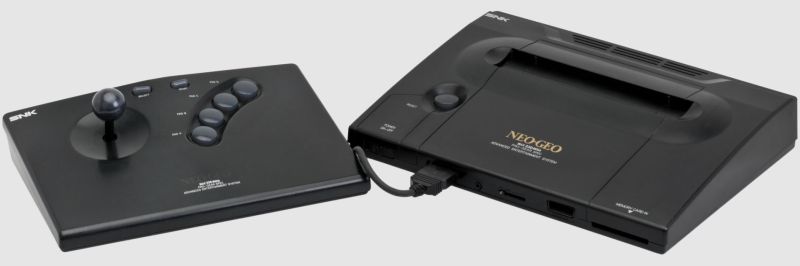
Demonstration of the DoomGeo port of Doom to the Neo Geo. (Credit: Sabino, GitHub)
Perhaps the most ridiculous statement that anyone can make is that a computer system with clearly enough processing power ‘cannot run DOOM‘. This is why we accept the premise that a PDP-11 cannot run this game, but something on the order of a Neo Geo gaming console with its 68000 processor and for the time impressive GPU definitely ought to be able to.
The stated problem here is a lack of RAM for a framebuffer, with the CPU only having 64 kB to play with. This limitation now has seen two different approaches to try and circumvent it, as covered by [Modern Vintage Gamer].
The first project here is Doom64kB, which as the name suggests tries to somehow work with this system RAM limitation. It uses the Doom8088 port for the original IBM PC and similar Intel 8088-based systems. This had to massively reduce the feature list, including the lack of texture mapping for floors and ceiling, no saving or loading, and no music.
The other project is DoomGeo, which doesn’t try to bend the Neo Geo hardware to its will, but accepts the Neo Geo way of doing things: involving sprite strips, pre-baked graphics, fix-layer UI, and a minimum of runtime data. This of course drastically changes how the Doom game engine normally works, with its framebuffer-based rendering.
From this we can thus conclude that it’s not so much the processing power that limits where DOOM can run, but more of how framebuffer-friendly the system architecture is, yet with some ingenuity and a complete rewrite of the game engine even that is no major obstacle.
Last month, we passed along Modern Vintage Gamer's (MVG) confident assertion that Doom is functionally impossible to run on the Neo Geo, owing to the console's sprite-based display hardware and lack of a frame buffer. We all should have known better than to tell a dedicated group of hackers that something is "impossible," though, as two recent projects have made great progress toward functional Doom ports on stock Neo Geo hardware.
Both of these projects have significant graphical compromises that limit how viable they would have been for a marketable, '90s-era console port, as MVG lays out in a new video. Still, they stand as a testament to the surprising results that clever, determined coders can coax out of legacy hardware.
It looks like Doom if you squint
To create the Doom64KB project for the Neo Geo, coder FrenkelS adapted an earlier Doom port they designed to run on 16-bit PC processors like the 8088 and 286. Using that engine, the Neo Geo code then makes a kind of proto frame buffer out of the console's fix layer, an area of display memory that's usually used to display menus and HUD information on top of gameplay.
This week the US Space Force brought two more companies into the pool of bidders eligible to compete for its launch contracts—Impulse Space and Relativity Space. For a rocket company, cracking into the lucrative US military launch market is both a sign of maturity, as well as an important source of revenue.
The inclusion of Relativity Space, which is making credible progress toward the launch of its heavy-lift Terran R rocket, is perhaps not a huge surprise. Under the leadership of former Google chief executive Eric Schmidt, the company has continued to work toward bringing the partly reusable rocket to the launch pad.
The addition of Impulse Space, however, was something of a surprise. The company specializes in building spacecraft for in-space operations, rather than launching from Earth.
Optimly founder and CEO Apurva Luty pitches at the Tech Alliance’s Seattle Investor Summit + Showcase in Redmond. (GeekWire Photo / Todd Bishop)
Seattle startup Optimly, which helps brands manage what AI understands and says about them, went into the Flywheel Investment Conference in Wenatchee, Wash., in May as a last-minute entrant, and walked out with a triple crown.
The company won a $150,000 investment, a $50,000 relocation offer contingent on moving to the region, and a $5,000 fan-favorite prize. Founder and CEO Apurva Luty, who’d strolled to the event from her hotel, expecting nothing, ended up with too many giant ceremonial checks to carry back on her own.
This unexpected sweep came from a solution to a problem that’s suddenly becoming urgent for many brands. Optimly builds a public index where brands can claim and correct the information that AI chatbots use to describe them — then measures whether it actually works.
The $150,000 investment from Flywheel Angel Network became part of a broader $800,000 pre-seed round that Optimly closed just recently. Also participating in the round were Mighty Capital and AI House, the Seattle startup incubator formerly known as AI2 Incubator.
Apurva Luty with her three ceremonial checks at the Flywheel Investment Conference in Wenatchee. (Photo courtesy of Flywheel Investment Conference)
“The funny thing about winning at Flywheel is that it got us noticed by Seattle investors,” Luty explained. So even though she has decided to work out of AI House on Seattle’s Pier 70, passing up the relocation prize, the Wenatchee group gets a stake and an assist.
The problem: Optimly addresses a phenomenon that increasingly unsettles marketers: AI models generally don’t learn about a brand from its own website. They read everything else — Wikipedia, Reddit, online reviews, analyst write-ups — and synthesize it into the response each chatbot gives shoppers when they ask about a company, or its product or service.
“Shoppers used to Google — now they ask AI,” Luty said during her presentation at a separate event in June, the Technology Alliance’s Seattle Investor Summit + Showcase in Redmond, where GeekWire first heard the Optimly pitch.
The solution: Optimly has two connected products:
The AI Brand Index is the free, public layer: a directory that AI agents can pull from, offering a short, structured description of a company generated automatically from across the web. The company says it has scored about 60,000 brands, with more than 24,000 now live and searchable.
BrandVault is the paid layer. A brand verifies that it owns the name, then rewrites its entry in the plain, factual language an agent can parse, instead of the marketing copy on its website. Optimly then monitors how AI describes the brand and flags what to fix.
Background: Luty founded Optimly in October 2025. A researcher by training, she had studied public policy and economics at the University of Oregon, before a decade in consumer insights and product strategy in tech, studying how people decide which brands to trust.
At Microsoft, she worked on the launch of the Surface line as a consumer research manager. At Meta, she led product marketing insights for the Quest and metaverse products and worked on the rebrand from Facebook to Meta. At Discord, she headed UX research and product strategy during the pivot back to gaming.
Each job, she said, came down to explaining a product to a new group of customers during a big shift in technology. She came to see AI as the next shift, with one difference: this time the initial consumers of the information are the AI systems themselves.
How it caught on: The idea started as an experiment. Optimly put up a small index of about 200 brands, just to see if anyone would notice, and AI agents swarmed it, asking for the data.
OpenAI sent three kinds of bots, Luty said: one crawling for training data, one building its own index, and one pulling live answers for users. The AI giants are each building their own private brand indexes that don’t talk to one another. Optimly wants to be the public, verified version.
Anthropic’s Claude recently started pulling from the index as well.
The brand index now gets about 11,000 agent requests a week, up from 4,000 a few weeks earlier, the company says, and more than 100 brands have claimed their profiles since the index launched this spring. Many found it on their own, through Google or ChatGPT.
Landscape: Other startups already promise to track and improve how brands show up in AI. The category goes by AEO or GEO — answer-engine or generative-engine optimization. Most stop at telling a brand to publish more content, Luty said.
Optimly’s pitch is different. Give a brand a page it can correct, then measure whether the fix changes what the AI says. AI chatbots have already started citing Optimly’s data in live answers, Luty said. The near-term goal is making that repeatable — proving a specific fix leads to a specific change.
Funding: Prior to the $800,000 pre-seed round, Optimly raised an initial $100,000 in late 2025 from Right Side Capital Management and Forum Ventures as part of their accelerator program. It also participated in a WTIA startup accelerator.
Business model: Brands pay monthly subscriptions, with tiers ranging from $100 to $799 a month. Luty said the long-term goal is to charge for results, not reports.
The team: Optimly’s original technical co-founder has stepped back from his role in California into an advisory position. Luty is now hiring in Seattle, with openings for a technical co-founder and a senior founding engineer, and recently brought on a data engineering intern.
She also works with contractors and, yes, makes significant use of AI agents.
What’s next: The focus now is making the early results repeatable — running A/B tests to prove a specific profile fix leads to a specific change in how AI describes a brand.

 Login
Login