
 Login
Login
Building an Analog Geiger Counter
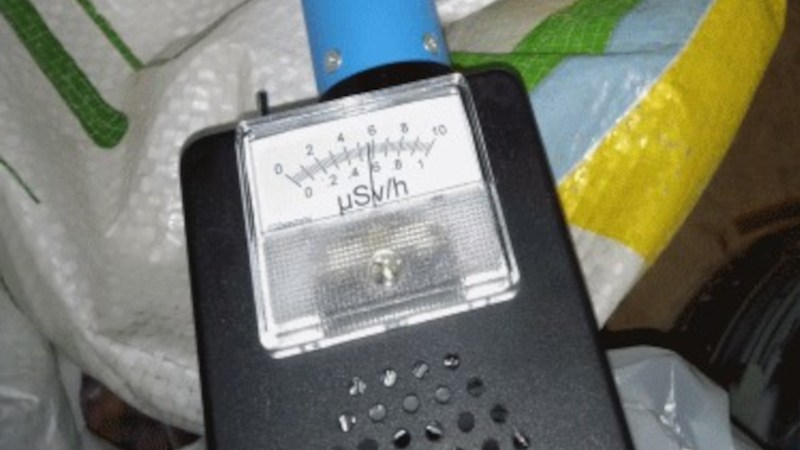
These days, it’s plenty easy to build a Geiger counter with a microcontroller that has a nice fancy display and a simple digital readout for how many radiations you’re likely sucking up into your delicate fleshy body. But you can still do things the old fashioned way, as [ludens] demonstrates with this analog Geiger counter project.
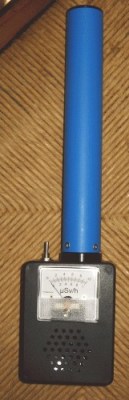
With a goal of measuring low-level radiation sources and the normal background levels on Earth, [ludens] selected a large Geiger tube for its sensitivity—a Chinese J306β in particular. It’s rated to output 88 counts per minute at the average background level, or 8 counts per second when exposed to 1µSv/h. It’s quite a large device, measuring 200 mm long and 18 mm in diameter, and it sticks out on top of the device like a big fat antenna.
Since the large tube puts out plenty of counts at even low levels, [ludens] decided it would be easy to average the output with a simple analog low-pass circuit. Everything runs off a single AA battery, with a power supply built to step that up to 5 V for the ICs and 400 V for the tube itself. CMOS Schmitt triggers are responsible for running the show, with an old-school analog dial showing the reading.
There are two ranges to use, depending on the magnitude of the radiation source—1 uSv/h, and 10 uSv/h. The high range isn’t particularly high, but as [ludens] notes—”If anything I find pegs that scale, I prefer to run, instead of measuring exactly how much radiation there is! So I don’t need a higher scale than 10µSv/h.”
If you’ve ever wanted to build a Geiger counter that has that classic Cold War feel, this is a great way to go about it. Alternatively, you can always go the more modern route and build something digital and networkable for logging purposes.
