
❌

Reading view

There are new articles available, click to refresh the page.

This Circuit Sculpture is an ESP32-Powered Console

Expressif might not have intended the ESP32-S3 to become an emulation powerhouse, but that’s certainly what has happened. The little microcontroller seems perfect for recreating the Game Boys or Game Gears of years past, and there are a lot of software options to that end. Having grabbed firmware off a github repo, you still need a physical build to hold, and that’s where this one by [HVT Lab and Huy Vector] stands out.

As you can see, they’re letting everything hang out β€” not even in a 90s-inspired clear case, but with an open frame of soldered brass, with just a small strip of 2 mm clear acrylic to help stabilize the buttons. That appears to be held with cyanoacrylate glue, but it’s brass and solder doing the majority of the structural work here. We might be a little more confident tossing this lovely device in a bag or pocket if the whole device was boxed in with that acrylic β€” shorting the exposed power bus on your keys sounds like a bummer β€” but we can’t argue with the aesthetic vision here. It’s a lovely build on the physical end.

From the video it looks like the software is based on Retro-Go, which we’ve seen in use before. In any case, there are plenty of open source projects you could load onto the ESP32-S3 powering this circuit sculpture, though, from NES to IBM PC.
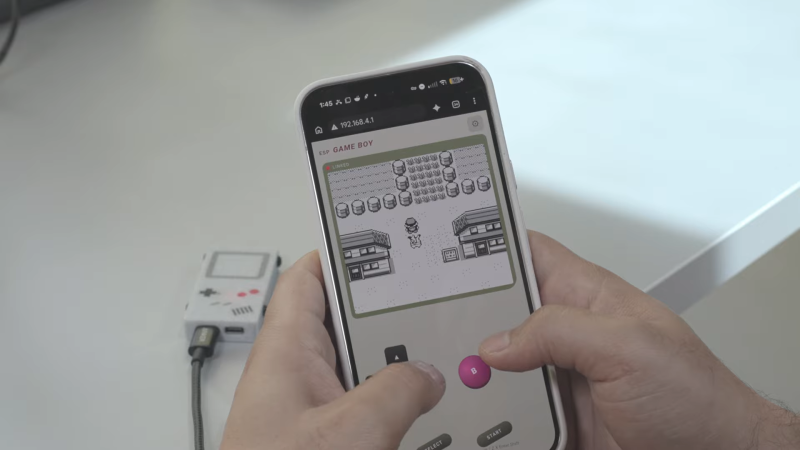
Building a Headless Game Boy Emulator

[Artificial-Age] has built a rather unique way to play old Game Boy games. It’s an emulator, but it doesn’t work in quite the way you might think!

Since the Game Boy is a relatively simple 8-bit machine that runs at a leisurely 4 MHz or so, it is well within the capabilities of an ESP32 microcontroller to emulate. [Artificial-Age] got an ESP32-S3 and programmed it to do just that. However, there’s a twistβ€”there is no screen hooked up to the microcontroller, nor any buttons. Instead, the board is accessed over a WiFi access point that it hosts itself.

One then opens a web browser, which streams the emulated video and audio from the console, while accepting button inputs from your keyboard or touchscreen, depending on the platform you’re viewing the web interface on. ROMs are stored on the ESP32’s flash storage, and can be uploaded via the web interface.

It’s an interesting setup, and one that perhaps doesn’t make obvious sense at first. After all, any modern smartphone can easily emulate a Game Boy, too. However, this setup makes it easy to share the emulator with other people, who can simply check out the WiFi AP and web interface without having to download or or install anything on their own device. We’ve featured some other fun emulation projects lately, too.

❌