The Trump administration is trying to stop Utah from enforcing its gambling ban against Kalshi, making Utah the 10th state sued by the US government agency that regulates prediction markets.
Utah, which prohibits gambling, sued Kalshi in a state court last week. Utah's lawsuit seeks an order prohibiting Kalshi from offering bets on sports, elections, politics, and other events.
“Kalshi runs an online casino in Utah and calls it a prediction market. That violates Utah law,” Utah Attorney General Derek Brown, a Republican, said last week. “Not only do our state laws ban gambling but Utah is one of only two states where gambling is also prohibited under the state constitution. For 130 years, Utah has been clear: gambling has no place here, and we will enforce our laws.”
Polymarket has faced renewed CFTC scrutiny over whether it honored the U.S. access restrictions tied to its $1.4 million settlement in 2022, according to Reuters. Reuters reported on Oct. 27, citing two people familiar with the matter, that the review…
The Commodity Futures Trading Commission and the U.S. government have sued Utah over its enforcement against prediction markets, bringing the agency’s state jurisdiction challenges to 10. The CFTC’s Oct. 27 announcement said the lawsuit seeks to stop Utah from using…
The Commodity Futures Trading Commission is investigating whether Polymarket broke a 2022 enforcement settlement, according to Reutersreporting earlier today. The probe revives an inquiry the agency closed in 2025 without filing charges. For a platform that has tried to fit prediction markets inside US law, the question strikes at its core.
Polymarket settled with the CFTC in January 2022 and paid a $1.4 million penalty for offering event-based binary options without registration. The company agreed to block American users from its offshore exchange. Geofencing tools followed, but regulators and critics pointed to traders who reached the site through VPNs. The platform has also courted crypto natives, adding bitcoin deposits in October 2025 as part of a broader push to fund accounts with digital assets.
According to the sources, investigators are examining three areas: the adequacy of Polymarket’s location controls, its advertising inside the United States, and the onboarding and customer protections on its US platform, which launched late last year.
The company is headquartered in New York and runs its offshore exchange through a Panama-registered entity. A probe is an inquiry, not a finding, and many investigations end without enforcement.
Polymarket’s mounting regulatory scrutiny
The inquiry sits inside a wider effort. In June, the Wall Street Journal reported that Polymarket paid individuals to produce videos of fictitious winning bets, and senators Adam Schiff and John Curtis urged the agency to open a probe. Bloomberg reported that investigators were examining the company’s social media activity.
CFTC Chairman Michael Selig has framed prediction markets as tools for hedging and information discovery, and he has argued that federal regulators, not states, should oversee them. Enforcement director David Miller has pledged tough policing of the sector.
Enforcement pressure has a test case. In April, prosecutors charged a US soldier, Gannon Ken Van Dyke, with making $400,000 from insider bets on the offshore platform. The indictment says he used a VPN and an “exit mode” that appeared to sit in a foreign country. Van Dyke has denied the charges, and Polymarket says it referred the matter to authorities.
Scale raises the stakes. Intercontinental Exchange, the parent of the NYSE, agreed in October 2025 to invest roughly $2 billion, and Bloomberg counted founder Shayne Coplan, 27, among the youngest self-made billionaires. The bigger the platform, the more its geographic walls matter.
Earlier this year, Polymarket’s five-minute Bitcoin up/down contract was exploited by a small group of traders who pushed Binance’s price in the final seconds before each close, according to a study. Just 821 wallets, about one in 300 traders, took $8.2 million in the pushed cycles, and 93% of the losses fell on retail bettors.
The authors of the study found no manipulation in the fifteen-minute contract, since a longer window dilutes a fixed push, a lesson that matters now that Nasdaq and Cboe have filed to list similar binary contracts on equity indices.
Samsung faces a $15.1 million fine over gaming claims tied to the Galaxy S21 and S22, reviving a four-year throttling controversy that lawsuits had seemingly put to rest without consumer damages.
The U.S. Commodity Futures Trading Commission has advanced a voluntary federal registration pathway for crypto exchanges, Chairman Mike Selig has said, as Congress has yet to enact a crypto market-structure law. In an Oct. 26 X post, Mike Selig said…
CFTC Chairman Michael Selig has said the agency is monitoring prediction markets for possible manipulation ahead of the 2026 U.S. midterm elections, according to reporting on his latest television interview. Bloomberg’s Oct. 23 interview with Selig covered election-market surveillance alongside…
The FTC has subpoenaed OpenAI and Anthropic over potential consumer protection violations. An AI security expert explains the risks of enterprise AI agents.
The FTC has subpoenaed OpenAI and Anthropic over potential consumer protection violations. An AI security expert explains the risks of enterprise AI agents.
Following a string of incidents where AI models hacked websites and breached government systems during testing phases, the Federal Trade Commission is officially probing Anthropic and OpenAI over consumer harms, an insider told Axios.
On Wednesday, the FTC sent out civil investigative demands seeking a wide range of information from the AI firms on recent safety incidents.
The FTC did not respond to Ars’ request to review the subpoena demands. However, Axios’ source said the requests spanned more than 50 pages of questions and sought documents related to the incidents, internal security measures taken, and marketing materials that may suggest consumers were misled.
Pro-crypto regulator Mike Selig has said that pushing ahead with new rules will stop another collapse like FTX.
Speaking on Fox Business Network’s Varney & Co. show Wednesday, the Commodity Futures Trading Commission Chair said that crypto exchanges will have the chance to register with the regulator in order to safeguard digital asset spot markets.
Once one of the most popular crypto exchanges, FTX quickly and abruptly went bankrupt in 2022 due to mismanagement. Its founder, Sam Bankman-Fried, is now serving 25 years in prison for fraud and other crimes after $8 billion in customer funds was stolen.
The CFTC and other regulators are pushing ahead with rulemaking for the crypto space, despite lawmakers last month blocking the long-awaited Clarity Act.
“Four years ago, we saw the collapse of Sam Bankman-Fried’s FTX, where he stole over $8 billion in customer funds. That can’t happen under our regime,” Selig said.
“Actually, Sam Bankman-Fried’s subsidiary that was CFTC registered, all the funds were safe and secure because they were segregated, and we have some of the most stringent requirements of any federal agency when it comes to markets — we want to bring that to the crypto world,” he added.
Selig added that some exchanges may choose to remain under the state regimes, while others will register federally.
The CFTC is relying on powers it already has to regulate crypto markets. The watchdog this week sought public comment on a framework that would create a new federal registration category, called a “crypto asset market,” for exchanges offering leveraged, margined or financed crypto trades to retail customers.
Exchanges that don’t offer leverage could stay under state licenses. But the agency reads “leverage” broadly, which could bring even fully paid trades under its oversight unless customers take delivery of their crypto.
CFTC Chair Selig, formerly chief counsel at the SEC’s Crypto Task Force, last month said that the regulator was preparing for the transition of markets moving “24-7, on-chain.”
Both the CFTC and Securities and Exchange Commission have taken a more friendly approach to regulating the crypto industry since U.S. President Donald Trump took power.
The SEC’s proposed custody rules could make it easier for investment advisors to help clients own Bitcoin directly. Coinbase’s Ryan VanGrack explains why institutional capital tends to flow where there are clearer rules, and why he sees direct ownership and ETFs as “both and, not either or.” He also shares why traditional finance is accelerating its push into Bitcoin and digital assets.
Chapters: 00:00 Coinbase Wins CFTC Approval for Its Own Clearinghouse 01:29 Can SEC Guidance Last Without the Clarity Act? 02:40 SEC Custody Proposal: Helping Advisors Hold Bitcoin Directly 04:14 Tokenization: The Biggest Upgrade Since Electronic Trading 05:41 How Tokenization Cuts Out Wall Street’s Middlemen 07:34 What Washington Still Needs to Fix for Bitcoin Holders 08:56 Institutional Adoption Accelerates After the Clarity Act Vote 11:07 How Coinbase Is Bringing Digital Asset Infrastructure to Community Banks 12:01 Sponsor: Square 12:34 Is Crypto Really a Tool for Illicit Finance?
DISCLAIMER: The views and opinions expressed in this show are those of the participants and do not necessarily reflect the official policy or position of BTC Inc., Bitcoin Magazine, or any affiliated entities. This content is provided for informational and educational purposes only and should not be construed as investment, legal, tax, or accounting advice. Nothing contained in this show constitutes a solicitation, recommendation, endorsement, or offer to buy or sell any securities or financial instruments. Viewers should consult their own advisors before making financial or business decisions.
The U.S. Commodity Futures Trading Commission has proposed new rules to regulate digital asset transactions and markets.
In a Monday release, the agency said that the proposed rules would allow U.S. crypto exchanges to opt into a federal regulatory regime.
Despite lawmakers blocking the Clarity Act last month, the CFTC and Securities and Exchange Commission have pressed ahead with proposing rules to regulate the digital asset industry.
“Today’s action is a critical step in the CFTC’s ongoing efforts to ensure America remains the crypto capital of the world,” Chairman Mike Selig said.
JUST IN: CFTC proposes rules to regulate U.S. crypto markets.
"Today’s action is just the beginning…America can lead the next generation of financial technology without repeating the mistakes of the last one." pic.twitter.com/jTL52Aqhbi
He added: “The Commission’s announcement begins our process of new rulemakings grounded in the CEA’s purpose and President Trump’s directive to propose a federal crypto asset regulatory market structure using the CFTC’s existing statutory authorities.”
If approved, the new rules would allow crypto exchanges offering the leveraged trades to register with the regulator.
The Clarity Act wants to formally divide oversight between regulators, distinguishing which digital assets are securities, commodities or stablecoins.
But the bill stalled and stumbled this year as the banking lobby had issues with crypto companies paying customers stablecoin rewards and some lawmakers — mostly Democrats — were concerned about the ethics side of the legislation.
Regulators are drafting rules that the crypto industry has long called for regardless.
CFTC Chair Selig, formerly chief counsel at the SEC’s Crypto Task Force, last month said that the regulator was preparing for the transition of markets moving “24-7, on-chain.”
The SEC — also run by a pro-crypto regulator — went ahead and in September approved tokenized stocks trading.
That came after it also proposed its own framework for crypto asset offerings in August, pressing ahead while the landmark legislation stalled.
U.S. President Donald Trump campaigned on a ticket to help the digital asset industry and since taking office has signed pro-crypto legislation and executive orders.
Trump in August urged lawmakers to get the Clarity Act over the line, calling the proposed legislation “very powerful.”
The CFTC’s preliminary rulemaking notice is open for public comment for 60 days after it’s published in the Federal Register. After that, the agency will review the feedback and decide whether to issue a formal proposed rule, which would go through another comment period before any final rule is adopted.
CFTC records show Bitnomial’s “Ondo US Dollar Spot” futures product was certified on October 1.
The filing classifies the contract as a futures product under the financial-instrument category.
Certification is a regulatory product filing status; it should not be described as a broad CFTC endorsement of ONDO or the underlying protocol.
Bitnomial has added another crypto-linked contract to its regulated US derivatives pipeline, this time tied to Ondo.
The Commodity Futures Trading Commission’s designated contract market product database shows “Ondo US Dollar Spot” under Bitnomial, with a futures classification and a certified status dated October 1.
That puts Ondo alongside a growing list of digital assets being wrapped into products on regulated US derivatives venues.
Bitnomial is becoming more important to US crypto market structure
Bitnomial’s role has expanded significantly since Kraken parent Payward acquired the platform and began using its regulated stack for US derivatives products.
The exchange structure matters because US traders historically had far fewer domestic routes into crypto-native derivatives than users on offshore venues.
An Ondo-linked futures contract widens that regulated menu beyond the largest assets.
“Certified” has a specific meaning
The CFTC database lists the contract as certified on October 1.
That should not be turned into a claim that the regulator has evaluated ONDO as a good investment or endorsed the Ondo project. Futures exchanges can self-certify products under the Commodity Exchange Act by representing that the contract complies with applicable rules.
The regulatory status is about the listed derivatives product.
That precision matters in crypto because product approval, asset classification and project legitimacy are often collapsed into one headline even though they are legally different questions.
Bitcoinist has also tracked the increasing overlap between crypto and regulated financial infrastructure through Kraken’s Bitnomial acquisition and other domestic derivatives launches.
More altcoin exposure is moving into regulated wrappers
Bitcoin and Ethereum built the first deep US regulated derivatives markets. The next stage is broadening the asset set.
Every additional contract gives professional traders another way to hedge, express a directional view or arbitrage differences between spot and derivatives markets without leaving a regulated venue.
Whether the Ondo contract attracts meaningful liquidity remains to be seen. Certification opens the door; market makers and traders still have to decide whether the product is worth using.
For now, the important fact is straightforward: Bitnomial has a certified Ondo US dollar futures product on the CFTC’s October 1 list.
—
This article was written by the News Desk and edited by Samuel Rae.
Coinbase has already launched gold and silver perpetual futures for eligible non-US traders.
The company is also moving its regulated US gold and silver futures toward 24/7 availability through Coinbase Derivatives.
The products provide derivatives exposure rather than physical bullion ownership.
Coinbase is extending its “everything exchange” strategy into precious metals, using crypto-style derivatives infrastructure to make gold and silver increasingly available outside traditional market hours.
The company already offers GOLD-PERP and SILVER-PERP contracts to eligible non-US traders and has been working to move its US-regulated commodity futures toward 24/7 trading.
Metals Are Getting Crypto Market Hours
Traditional commodities markets are highly liquid, but they still operate around established exchange schedules.
Crypto traders are used to something different.
Bitcoin and other digital assets trade continuously, including weekends and overnight periods when many conventional markets are closed.
Coinbase’s metals push is an attempt to bring that always-on model to gold and silver price exposure.
For non-US users, perpetual contracts provide continuous leveraged exposure settled in USDC.
For eligible US users, the regulated route runs through Coinbase Derivatives, a CFTC-regulated designated contract market and its participating intermediaries.
Derivatives Are Not Bullion
The product structure needs to stay clear.
Traders are not taking delivery of gold bars or silver coins simply because they trade these contracts.
The instruments provide financial exposure to metal prices.
That means users still face derivatives-specific risks including leverage, margin requirements and liquidation.
Coinbase is also using hybrid index mechanisms to keep commodity perpetual prices aligned during periods when underlying traditional markets are closed.
That is a technical challenge crypto exchanges increasingly need to solve as they move into traditional assets.
The bigger trend is straightforward.
Crypto venues no longer want to be places where users trade only cryptocurrencies.
They want the same account and collateral base to provide exposure to equities, commodities, prediction markets and other assets.
Gold and silver are becoming another test of how far that model can stretch.
Precious metals are also a useful test case for the wider strategy because their reference markets are deep and globally understood. If crypto exchanges can offer reliable around-the-clock derivatives on gold and silver, the same infrastructure can potentially be extended to more commodities and equity-linked products. The challenge is maintaining credible pricing when traditional venues are closed. Coinbase’s use of external and internal reference mechanisms is designed to bridge that gap, but traders still need to understand that weekend liquidity and price discovery can behave differently from the primary futures market.
This article was written by the News Desk and edited by Samuel Rae.
Mary Beth Westmoreland, Amazon’s VP of Worldwide Selling Partner Experience, speaks Tuesday morning at Amazon Accelerate at the Seattle Convention Center. (GeekWire Photo / Todd Bishop)
Amazon is introducing tools to let independent sellers manage their sales on four of its biggest rivals — eBay, Shopify, TikTok and, yes, even Walmart — from Seller Central, the same dashboard they use to run their Amazon businesses.
The multichannel selling tools, announced Thursday at Amazon’s Accelerate seller conference in Seattle, are rolling out gradually to U.S. sellers over the coming months at no extra cost. At first, sellers can connect their accounts on the other platforms, import and link listings, see all their orders in one place, and fulfill orders across channels.
The data question: The move raises natural questions about Amazon’s motives, including what the company might do with data from sellers’ businesses on rival platforms. In an interview, Mary Beth Westmoreland, Amazon’s VP of Worldwide Selling Partner Experience, brought the issue up unprompted.
“A seller’s multichannel data that might surface in Seller Central, it’s never used for anything other than surfacing it to that specific seller. Period,” she said. “We never use that data for any other purpose.”
Pressed on whether the data could affect a seller’s standing on Amazon, such as by pushing their products lower in search results for charging less elsewhere, she was more emphatic. “We never, ever, will touch this data or use it for any other reason other than to show it to you,” she said.
Questions about how Amazon could use seller data for other purposes are not hypothetical. In 2020, The Wall Street Journal reported that Amazon employees had used data about independent sellers to develop competing house-brand products, and in 2022 Amazon agreed with European regulators not to use sellers’ non-public data in its own retail business.
Amazon said at the time that it prohibits employees from using non-public, seller-specific data to decide which house-brand products to launch. When it settled with European regulators, the company said it still disagreed with “several of the preliminary conclusions” in the case.
The Federal Trade Commission’s pending antitrust case also accuses Amazon of punishing sellers who offer lower prices on other sites, an allegation Amazon denies. The case is set for trial in March 2027.
Why, then, is Amazon doing this? Westmoreland said sellers told Amazon that managing sales across so many platforms takes too much time. “They said we would love it if we could use some of the cool tools in Seller Central everywhere we sell, and so that’s what we did,” she said.
In addition, she said, the company believes sellers who succeed on other platforms will bring a wider range of products to Amazon, which makes its store more appealing to shoppers, so helping sellers elsewhere ultimately benefits Amazon, too. More than 95% of Amazon’s independent sellers already sell through multiple channels, according to the company.
What Amazon already offers: The new multichannel tools in the Seller Central dashboard add to a collection of services Amazon already offers to merchants who sell elsewhere, potentially boosting its other services.
Buy with Prime lets merchants offer Prime delivery on their own websites, with Amazon handling customer service and returns.
Amazon also announced Thursday that merchants using Multi-Channel Fulfillment in the U.S. can now offer Prime delivery on their own websites at no additional cost. It launched a separate pricing program that it says can cut their fulfillment fees by 15% to 25% for the first six months.
Selling services to merchants is a big business for Amazon. Independent sellers account for more than 60% of units sold on Amazon worldwide, and the fees Amazon charges them brought in $46.8 billion in the second quarter, more revenue than AWS.
How it works: Sellers connect their other accounts through a multichannel settings page in Seller Central. The Manage Orders page then shows unshipped orders from every connected channel on one screen. A seller can select a Shopify order, for example, and send it to Amazon for fulfillment, with tracking updates flowing back to Shopify automatically, according to Amazon.
Westmoreland said the connections to other platforms mostly use their standard APIs, along with existing agreements through Veeqo, the multichannel shipping software company Amazon acquired in 2021 and now offers free to sellers. Sellers don’t have to use Amazon’s fulfillment services to use the new tools, she said.
Amazon says more features are coming, including the ability to edit a product description once and have it update on every channel, AI-generated listings for other platforms, and a dashboard showing how much sellers earn on each product across channels, including ad spend and traffic data from the other platforms.
The competition: The new tools also put Amazon in competition with companies that already sell multichannel software, including Rithum, formed from the combination of ChannelAdvisor, CommerceHub and Dsco, and Linnworks.
Shopify offers its own version, Marketplace Connect, which lets merchants manage their Amazon, Walmart, eBay and Target Plus sales from inside Shopify — essentially the reverse of what Amazon is now offering.
Westmoreland called Amazon’s tools “one more option” for sellers. She also said sellers had told the company they were already paying for this kind of software: “Hey, I’m paying for it, and it’s hard to do. Can you do this for me?”
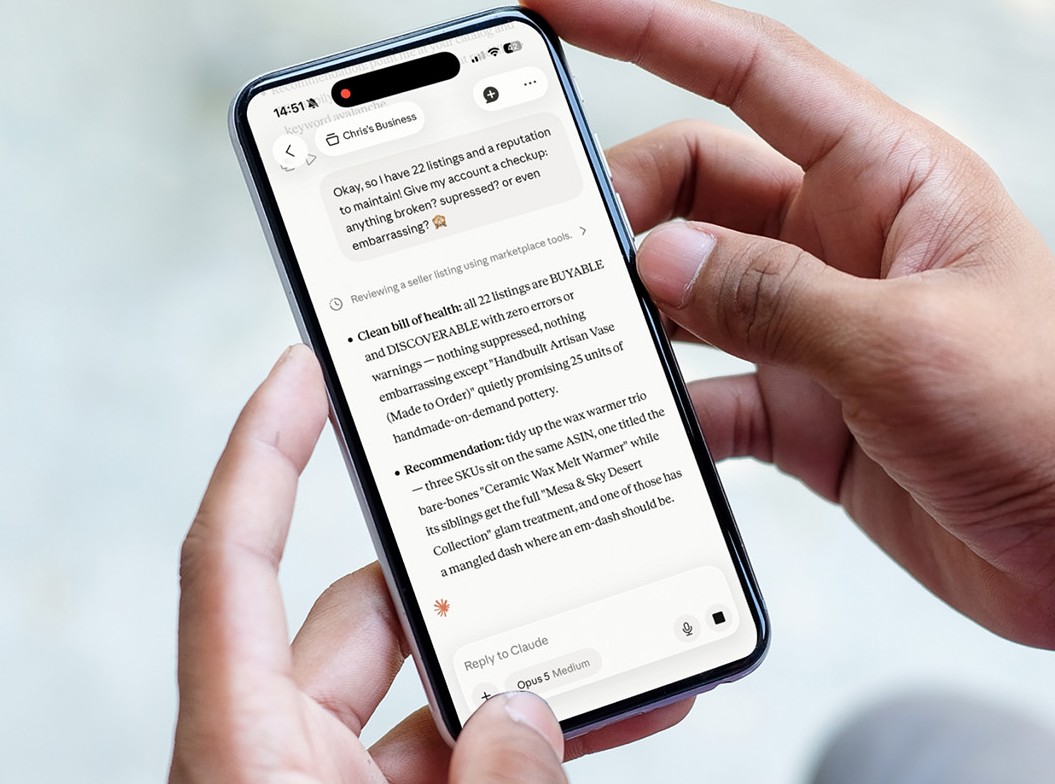
A seller’s account checkup in Anthropic’s Claude app, using Amazon’s new selling partner plugin. (Amazon Image)
Amazon announced new AI tools for its independent sellers Wednesday, led by a plugin that lets them run their Amazon businesses from Anthropic’s Claude or Amazon’s own Quick assistant.
The idea is to let sellers check inventory, adjust prices and update listings without opening Seller Central, which merchants have used for years to manage their Amazon businesses. Amazon says about 90% of sellers already use some form of outside AI to run parts of their operations.
“Our vision was that they would never have to log into Seller Central,” said Mary Beth Westmoreland, Amazon’s vice president of Worldwide Selling Partner Experience, in an interview. “We would just bring it to them where they work.”
The company is making the announcement at Accelerate, its annual seller conference, taking place in Seattle this week. It’s also releasing automations that monitor a seller’s business in the background and can act on it with the seller’s approval, and an upgraded Seller Assistant that remembers a seller’s pricing patterns, inventory cycles and growth goals from one session to the next.
The stakes: Independent sellers account for more than 60% of units sold on Amazon worldwide, and the fees Amazon charges them brought in $46.8 billion in the second quarter, more revenue than AWS.
Those fees are one of the issues in the Federal Trade Commission’s antitrust case against Amazon, which accuses the company of overcharging sellers and punishing them for offering lower prices elsewhere. Amazon has denied the allegations and called the suit “wrong on the facts and the law.”
The case is set for trial in March 2027 in federal court in Seattle.
Amazon’s advertising business, which includes the sponsored listings sellers buy to promote their products, brought in $19.8 billion in the quarter, up 26% from a year earlier. When it filed the case, the FTC said advertising had become “virtually necessary for sellers to do business,” and that Amazon’s combined fees take close to half of many sellers’ revenue.
Sellers are a tough and pragmatic crowd. The loudest ovation at last year’s Accelerate went to a housekeeping fix rather than a new tool, when Amazon ended commingling, the practice of mixing identical inventory from different sellers in its warehouses.
Which agents get in: By starting to officially connect its seller tools to outside AI platforms, Amazon is loosening its grip on the technology sellers use to manage their presence in the company’s e-commerce store, although it still decides which platforms to support.
The announcement comes days after Amazon blocked Meta’s Muse, a new AI agent that can shop on behalf of consumers, from its store. Amazon says outside agents need to identify themselves and follow the rules of the sites they use.
Amazon is a major investor in Anthropic, and the AI company’s Claude models already power Seller Assistant, the AI technology built into the Seller Central portal that answers sellers’ questions and, with their approval, updates listings and prices.
The company says more integrations will follow Claude and Quick. “We’ve built this in a way that should be modular enough for us to continue to publish plugins,” Westmoreland said.
How it works: Amazon says connecting Claude takes about 60 seconds and no coding. The plugin pulls a seller’s listings, inventory levels, sales analytics and performance metrics into the outside assistant, which can then act on the account the way Seller Assistant does inside Seller Central.
Sellers choose which types of data the plugin can reach and approve each action before it’s carried out. The company says it doesn’t see the other business data in a seller’s assistant.
The plugin is in beta in Amazon’s U.S. stores, with international expansion to follow.
Among other announcements, Seller Assistant is getting a new canvas feature, a visual workspace generated on the fly from a seller’s live data. Sellers can use it to compare pricing strategies or diagnose ad campaigns, and it redraws as they ask follow-up questions.
In addition, Amazon says it’s giving every primary selling account holder worldwide a free 12-month subscription to Amazon Quick Plus, available through Dec. 31, 2026, with two additional co-workers covered at no cost.
This year’s event comes amid a leadership change in the seller organization. Amit Agarwal, a 27-year Amazon veteran who launched its India marketplace, took over selling partner services in February as Dharmesh Mehta moved to become CEO Andy Jassy’s technical advisor.
 Login














CFTC proposes rules to regulate U.S. crypto markets.
pic.twitter.com/jTL52Aqhbi