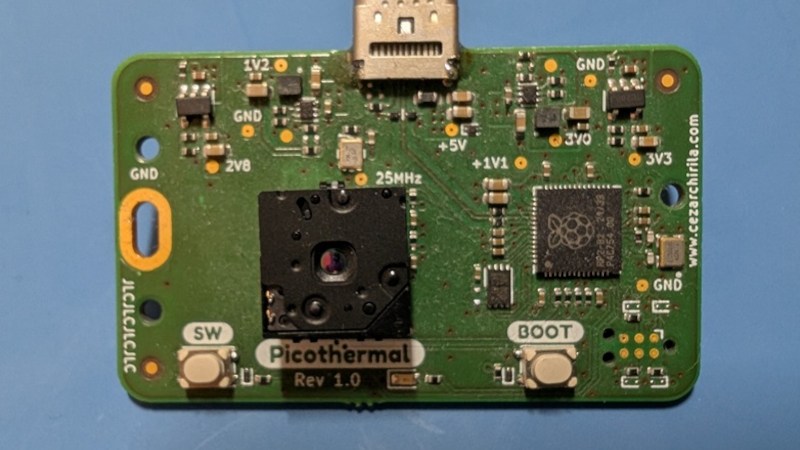
When creating a peripheral for a mobile phone, an obvious path is to create a companion app with which to talk to it. But as we all know today’s app is tomorrow’s non-functional abandonware, so to give his infrared camera a long life, [Cezar Chirila] made it talk WebUSB to a browser instead.
The hardware is conventional enough, a FLIR sensor talking to an RP2040. There’s very little in the way of supporting circuitry save for a power supply regulator, as so much that might be on a standalone project is already present in the USB host device. Running the thing is as simple as going to a landing page in a browser that supports WebUSB, and using the camera. The whole lot is in a GitHub repository, if you’re interested.
We’re big fans of WebUSB, for exactly the reason it’s been used here. While there are a few browser features which have been deprecated over the years — who remembers the BLINK and MARQUEE HTML tags — it’s likely WebUSB won’t be one of them. This could only be topped by having the microcontroller share a small USB disk with the landing page as an HTML file.
Meanwhile if you’re strapped for cash, there are cheaper thermal cameras out there.

 Login

 Teledyne FLIR Defense has won a $48 million U.S. Army contract to fit Bulgaria’s new Stryker fleet with the same upgraded chemical, biological, radiological and nuclear reconnaissance sensor suite now going to U.S. Army units, the company announced on Oct. 26. U.S. Army Contracting Command at Aberdeen Proving Ground, Maryland, awarded the contract under a […]