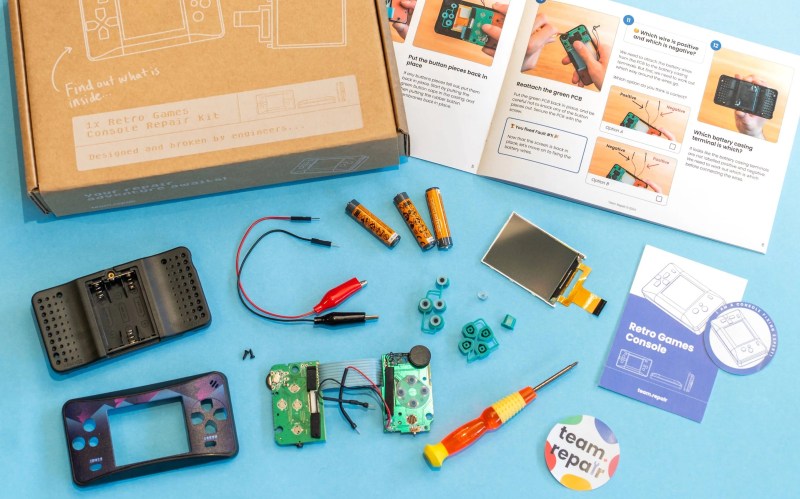
Would you buy a broken device, fix it, then return the repaired item? [Team Repair] hopes you will.
Many people would rather repair what they have than have to get a new device and deal with all the annoyances of shopping and getting used to a new item. The problem is, most people don’t have any experience fixing their broken electronics and are intimidated by the process. [Team Repair] has found that helping people through the process the first time is a big confidence boost, especially when they have a test piece to work with.
[Team Repair] started with workshops and now has a “Fixers Club” subscription box for 8-14 year olds where they will send a broken device every three months to fix. After the device is repaired, it gets sent back into Team Repair, or iFixit in the US, to be broken again and sent to the next fixer. For grownups, there is a similar smartphone repair kit, but it’s currently waitlisted. If you’re in the UK, they even have a classroom program if you want to recruit larger groups into your fixer corps.
One of the Russian government’s most elite hacking groups has adopted an attack, known as Clickfix, to compromise devices belonging to sensitive organizations in Ukraine, the latter country’s CERT center is warning.
Clickfix has emerged as an effective attack technique that attackers, primarily financially motivated criminals, began using in the last year or so. Websites under the control of the attackers display a CAPTCHA that requires the visitor to copy a jumble of text and paste it into the terminal. The text contains scripts that, once entered, perform malicious actions, typically by installing malware or exfiltrating sensitive data. Ukraine’s CERT said Wednesday that Sandworm, an advanced hacking unit inside the GRU, Russia’s military intelligence arm, is now using the technique.
"GhettoVibe," "ScoutCurl," and many more
The Clickfix attacks began in the spring and have continued through the summer. The campaign has resulted in the network compromise of at least one organization when a connected device was found to be infected by FreakyPoll, the name of one of Sandworm’s custom malware packages. Ukrainian authorities discovered 10 compromised websites that displayed a PowerShell command as part of a fake CAPTCHA that said it had to be passed to ensure a real human was behind the visiting device’s keyboard.
Cardano’s road to the Chang hard fork is now deep in the practical maintenance stage. The release of Node 9.0.2 is not the kind of update that generates glossy marketing, but it is exactly the kind of technical cleanup that matters before a major governance transition.
For Cardano, these last-mile releases are important because Chang is not just another routine upgrade. It is tied to the network’s move toward more formal decentralized governance, which means validator readiness and script reliability carry real weight.
For more details, visit the official GitHub platform.
TL;DR
Cardano developers released node version 9.0.2.
The hotfix addresses governance and script-related issues ahead of the Chang hard fork.
The update is recommended for mainnet staking pool operators.
Why A Hotfix Is Worth Covering
The release notes point to fixes around script verification and governance-related stability. That makes the update relevant to staking pool operators, developers, and anyone watching whether Cardano can move into the next phase without unnecessary technical friction.
Crypto markets often prefer big milestones, but networks usually get there through smaller patches. A hotfix can be the difference between a smooth hard fork path and one cluttered with avoidable issues.
The Chang Context
Chang has become a central part of Cardano’s current narrative because it is meant to push the network further into on-chain governance. That sounds abstract until the software has to support it under real-world conditions.
Node 9.0.2 sits inside that preparation window. It signals that developers are still tightening the implementation before the network asks operators to coordinate around the upgrade.
What ADA Holders Should Take From It
This is not a guaranteed price catalyst. A bugfix release rarely is. But it is a sign that Cardano’s technical process is still active and focused on getting the governance transition right.
For a project often criticized for moving slowly, the more important question is whether it keeps moving carefully. This release suggests the final hard fork preparation remains in motion.
Why The Timing Matters
The useful way to read this story is not as a standalone headline about Cardano, but as part of the wider pressure building around Cardano coverage this week. Markets have been jumping quickly from one catalyst to the next, so the cleaner value for readers is in separating the actual development from the instant reaction around it. In this case, the source material gives us a concrete event to work from, rather than a loose rumour or a recycled social-media talking point.
That distinction matters because crypto readers are being asked to process a lot at once: ETF flows, regulatory actions, exchange listings, protocol upgrades, wallet movements, and political signals. A story like this is most useful when it helps them understand where Node 9.0.2 fits into that broader map. It does not need to be inflated into a guaranteed price call to be worth covering. It simply needs to explain what changed, who is affected, and why the market is paying attention today.
The caveat is also important. Even clean source-backed developments can be overinterpreted when traders are hunting for a fast narrative. A listing does not automatically create lasting demand, a regulatory update does not immediately settle every legal question, and an on-chain movement does not always translate into a finished sale. The better read is to treat the development as a fresh data point and then watch whether follow-up activity confirms the direction of travel.
For NewsBTC readers, that means keeping the focus on what can actually be verified from the source and avoiding the temptation to turn every update into a sweeping market verdict. The story is strong enough on its own terms: it gives investors and traders another piece of context around Cardano, while leaving room for the next filing, dashboard update, wallet movement, governance vote, or exchange notice to decide whether the angle grows into something bigger.
This report is based on the Cardano node release notes.
This article was written by the News Desk and edited by Samuel Rae.

 Login
Login