❌

Reading view

There are new articles available, click to refresh the page.

AI Risk Management in DeFi: What It Can and Can’t Do

AI already runs the monitoring, the simulations, and a lot of the automation behind on-chain risk. Here is what it still can’t do on its own, and why your yield still rests on human judgment.

A glowing network of AI nodes on the left feeds arrows into a colored risk gauge dial on the right, needle resting near the green-to-amber boundary, on a deep navy background.
AI now runs much of the monitoring and automation behind on-chain risk. People still hold the dial.

Here is the short answer. AI already manages real parts of on-chain risk today.

It runs simulations, watches markets every second of every day, and adjusts protocol settings inside limits that people approve.

What it does not do yet is run the whole risk desk on its own. So the honest take on AI risk management in DeFi is this: yes for the hard, repetitive parts, and not yet as a manager you leave alone.

That gap matters more than the hype suggests, so let me walk through what AI does, where it hits a wall, and what measured on-chain risk really looks like.

The quick version

  • AI already runs simulation, monitoring, and bounded automation across DeFi.
  • Firms like Gauntlet and Chaos Labs provide much of that risk plumbing.
  • Automated systems act only within human-set, governance-approved limits.
  • The real limits stay: stale data, models that get gamed, and crises no model has seen.
  • Over-automation can spread risk, not contain it. AI augments risk management; it does not replace it.

What “managing on-chain risk” actually means

Managing on-chain risk means keeping a protocol solvent and liquid while markets move.

In plain terms, that is four jobs. Set the rules: collateral ratios, borrow caps, interest curves. Watch everything: positions, liquidity, oracle prices, concentration.

Stress-test: model crashes and attacks before they happen. Act fast: change settings the moment conditions change.

It is constant, data-heavy work, and the cost of getting it wrong is bad debt. No wonder teams want to automate it. It is also why a careless version is dangerous.

Where AI already runs the risk desk

AI already handles the simulation, monitoring, and bounded automation behind DeFi risk, and it is now core infrastructure. A few concrete examples, as of late 2026.

Gauntlet builds simulation-driven risk models and has acted as the economic risk brain for major lending markets, tuning parameters like collateral ratios and caps. It now runs some of the largest curated vaults too.

Chaos Labs runs AI-powered economic and security stress tests. Its risk oracles watch indicators in real time and push parameter changes within governance-approved bounds.

Aave’s renewal with the firm described more than 1,100 parameter updates.

AI-curated vaults from firms like Chaos Labs, Gauntlet, and Sentora now sit behind consumer products, rebalancing capital across Aave, Morpho, and Sky inside set risk targets.

Two-column chart. Left, in blue, THE MACHINE: monitors 24/7, runs simulations, flags anomalies, adjusts within bounds. Right, in purple, THE HUMAN: picks scenarios, approves limits, owns the brake, decides responses.
AI does the speed. Humans still own the judgment and the brake.

The division of labor is simple. The machine does the speed: monitoring, simulation, anomaly detection, bounded adjustments.

The human keeps the judgment: which scenarios to run, which thresholds matter, which bounds to allow. This is real automated risk management in crypto, not a demo.

The part AI still can’t do

AI cannot be trusted to manage on-chain risk unsupervised, and 2026 showed why.

Start with the limits that never go away. It works inside human bounds, so that judgment stays human.

Models depend on data and oracles, and a stale price turns a smart system into a confident fool.

Models can be gamed by adversaries who know which inputs break them. And tail events escape training, because the crisis that matters most is usually the one the model has never seen.

Bar chart comparing a collateral token priced at $1.13 on-chain versus $0.63 on the open market, with an amber arrow marking the roughly 44% gap the automated system could not see.
A 2026 lending failure. The system acted on a price that was simply wrong.

The year drove this home. A string of lending blowups traced back to hardcoded or stale oracles.

In one case a collateral token was marked on-chain near $1.13 while it traded around $0.63 on the open market.

That is not a model being clever. That is automation acting fast on a wrong number.

The uncomfortable twist: automation can add risk. Fast, automated allocation paired with slow or sloppy controls, or a risk curator that itself fails, can spread a problem instead of containing it. Speed cuts both ways.

Governance-safe automation: humans still set the bounds

The norm today is not autonomous AI. It is governance-safe automation: people set the strategy and the limits, and AI acts inside them.

People decide the risk appetite and approve the guardrails. AI monitors, simulates, and makes bounded changes, often with a validation step before anything goes on-chain. And a human brake always exists.

You keep automation’s speed and keep accountability. Handing a model the power to act, with real money and real adversaries on the other side, should not be done blind.

What measured on-chain risk looks like: a Sky case study

The real answer to on-chain risk is not add AI. It is make the risk measurable. Sky is one of the clearer examples of that in stablecoins.

A quick primer, since the names trip people up. USDS is Sky’s fully backed stablecoin and the way into the system. It is the unit of account, not the yield.

sUSDS is what you hold to earn: you supply USDS, receive sUSDS, and it accrues the Sky Savings Rate over time. It is currently the largest rate-bearing stablecoin by supply.

The Sky Savings Rate is the governance-set yield behind sUSDS, funded by revenue from the Sky Agent Network, an independent set of capital allocators who put USDS to work across strategies like onchain loans, Treasury bills, and lending liquidity.

Five-step flow: USDS liquidity, Sky Agent Network, protocol revenue, governance sets the Sky Savings Rate, sUSDS holders earn. A note explains the rate is governance-set, diversified, and variable.
The Sky Savings Rate is produced, not promised. Revenue feeds a governance-set rate.

What makes it measured rather than trust me? USDS is over-collateralized and backed by diversified collateral, so the backing is not a single bet.

The yield is risk-adjusted and governance-set, not whatever the market will pay this week.

Sky is the only stablecoin protocol with credit ratings from both S&P Global and Moody’s.

Both are sub-investment grade, S&P at B- and Moody’s at B3, which is the honest part: independent agencies see real credit and concentration risk, and they publish it.

The infrastructure also carries a decade-long track record with no smart-contract exploit, and governance is building a $150 million solvency reserve.

Adoption is following. In September 2026, Galaxy Digital, a Nasdaq-listed firm, put $100 million of sUSDS on its balance sheet and approved it as institutional collateral.

And yes, this ties back to AI. Sky’s own 2026 roadmap names AI-driven automation as a growth theme, alongside Sky Agents and tokenized credit.

The through-line is the same: use quantitative, verifiable risk work, not guesswork.

If you want to go beyond the savings rate, Sky Vaults and stUSDS sit further out on the risk curve, and Sky Ecosystem Rewards layers in token incentives.

One honest caveat for savers: the Sky Savings Rate is variable. It has moved from roughly 8.75% in early 2025 to around 3.6% in late September 2026, and governance can change it. Read the live number before you decide anything.

The agent frontier, and why it’s still risky

The next step is AI agents that do not just advise but act, holding permissions and moving funds on-chain, including around tokenized real-world assets. Promising, and early.

Every limit above gets sharper when the model can pull the trigger. An agent that can act can also be manipulated or prompt-injected. A misbehaving agent causes harm directly, not as a suggestion.

Safety research keeps landing on the same answer: strict, often deterministic guardrails and clear permissions, not unsupervised control.

Full autonomy, with your money, is not here, and it is not obviously what you want.

A four-rung ladder of machine autonomy: advise, monitor, act within bounds (marked where we are), and full autonomy (marked not here yet), with an amber guardrail bar running alongside.
Four rungs of machine autonomy. Most serious protocols sit on the third, on purpose.

So, can AI actually manage on-chain risk?

Yes for the parts that need speed and scale. Not yet as a manager you can leave alone.

AI already simulates, monitors, and adjusts risk faster than any human team, and it is now core plumbing for major protocols.

But it works inside human-set bounds, it can be wrong or gamed, it struggles with the crises that matter most, and letting it act unsupervised introduces fresh risk.

The grown-up version of on-chain risk is not a black box making the calls. It is measurable risk, verifiable backing, and humans who own the guardrails, with AI doing the heavy lifting in between.

AI can manage parts of on-chain risk as augmentation inside human guardrails. It is not yet a risk manager you can walk away from.

Frequently asked questions

Q. Can AI manage DeFi risk?

A. It already manages important parts, like simulation, monitoring, and bounded parameter changes, but inside human-set guardrails, not as a fully autonomous manager.

Q. What does AI actually do in DeFi risk management?

A. It stress-tests parameters, watches markets in real time, auto-adjusts limits within approved bounds, rebalances curated vaults, and flags anomalies faster than people can.

Q. What are the limits of AI risk management in DeFi?

A. It only acts within human bounds, depends on data and oracles, can be gamed, struggles with novel tail events, and over-automation can itself spread risk.

Q. How does Sky approach risk?

A. Like other protocols, Sky relies on quantitative, increasingly AI-assisted risk modeling to set the parameters behind USDS and the Sky Savings Rate, and its risk is also measured externally with credit ratings from both S&P and Moody’s. That does not make it risk-free.

• • •

On-chain risk is getting more measurable every year. That is the real story, bigger than any single model. If you want to see what governance-set, verifiable yield looks like up close, you can put your stablecoins to work on sky.money and read the live numbers on the dashboard.


AI Risk Management in DeFi: What It Can and Can’t Do was originally published in Coinmonks on Medium, where people are continuing the conversation by highlighting and responding to this story.
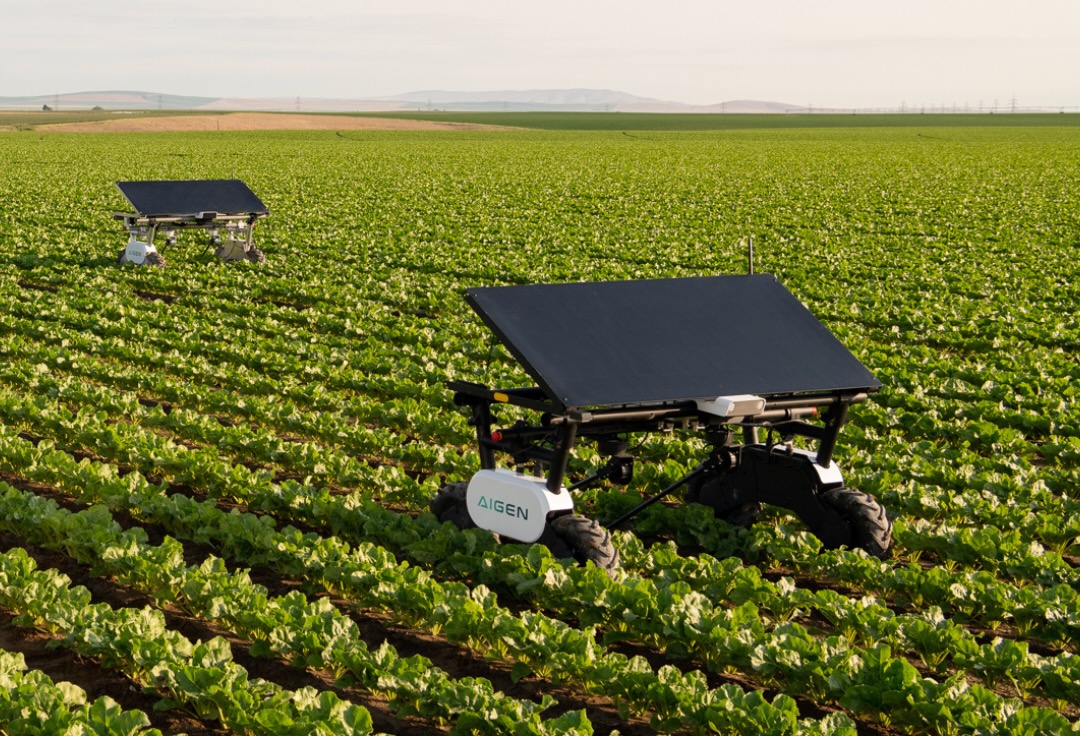

Data farmers: Ag-tech startup Aigen grows AI-generated weeds to train its solar-powered farm robots

Aigen’s autonomous, solar-powered robot Element. (Aigen Photo)

For years, Aigen has been building and tweaking solar-powered robots designed to pull weeds on farms. But the Redmond, Wash., startup is also raising a crop of its own: a growing, AI-generated collection of digital weeds and plants that teaches those robots what to pull.

That synthetic data, which Aigen calls Alchemy, is changing what the company can sell. Training its robots on a new crop used to require three to four years of collecting and labeling real-world images, co-founder and CTO Richard Wurden said. Now it takes about a week, helping Aigen attract growers of asparagus, hops, flowers, lettuce and more.

Wurden spoke with GeekWire by phone from FIRA USA, a three-day agricultural robotics expo at Yakima’s State Fair Park that wrapped up Thursday. He said Aigen made several sales at the show, including to growers it previously couldn’t serve.

“Now we’re saying yes to a bunch of crops, where previously we were locked into just doing a few,” he said.

Aigen is nearly sold out of robots for the 2027 season following the show, according to the company.

Aigen’s solar design is also getting more attention as fuel costs climb. U.S. diesel prices are up roughly 70% from a year ago, according to EIA data, and averaged nearly $6.30 a gallon this month, according to AAA. Many rival weed-control machines are pulled by diesel tractors, Wurden said, while Aigen’s robots run entirely on solar panels with a battery backup.

“It just so happens running a solar-powered robot without pesticides is the best possible timing right now,” he said.

Aigen co-founders Kenny Lee and Richard Wurden. (Aigen Photo)

Wurden and CEO Kenny Lee founded Aigen in 2020 after meeting in a climate-focused Slack group and discovering they lived about five minutes apart. Wurden, a mechanical engineer, previously worked on battery systems at Tesla and at Seattle electric boat maker Pure Watercraft. Lee is a cybersecurity veteran who co-founded Weblife.io, which Proofpoint acquired in 2017.

The mission is personal for both founders. Lee had non-Hodgkin’s lymphoma and Wurden has type 1 diabetes — diseases Wurden said have been linked to herbicide use.

The startup raised a $4 million seed round in 2022 and a $12 million round in 2023 led by ReGen Ventures, with participation from NEA and others. Wurden said the company has raised about $26 million in total. The startup now has about 15 employees.

Aigen’s Element robots are about 6 feet wide and topped with a roughly 400-watt solar panel. Cameras and AI distinguish weeds from crops, and mechanical arms pull the weeds out at the root. The robots cost $50,000 to $70,000 each depending on configuration, and Aigen typically sells them in packs of five, Wurden said.

Aigen has built more than 100 robots, all assembled in Redmond, and logged more than 15,000 hours in fields in California, Minnesota and North Dakota. Customers include organic soybean growers in North Dakota and tomato growers in California, Wurden said, and the company is expanding a recent pilot with an unnamed Fortune 500 company.

Alchemy has also become a product in its own right.

Large agribusinesses are using Aigen’s synthetic data, Wurden said. Because the plants are generated in simulation, each one comes perfectly labeled. That matters when weeds and crops overlap in ways that are hard to sort out from real photos, especially under shifting daylight. Aigen’s robots don’t use artificial lights. Wurden said the startup built the system out of necessity, because it couldn’t afford to pay people to label images by hand.

“Our AI now labels the data for us,” he said.

The company is choosy about who gets that data. Wurden said the company would work with precision-spraying companies that use less herbicide, but not with operations that broadcast-spray fields.

Next up: robots on Washington farms early next year, the company says. It’s also developing an orchard version with arms that reach out to weed between trees. And a next-generation robot is in the works.

Aigen is one of several Washington startups using AI to fight weeds. Issaquah-based TerraClear maps individual weeds so farmers’ existing sprayers hit only those spots. Seattle-based Carbon Robotics zaps weeds with lasers and trained its AI on 150 million labeled images of real plants. Aigen is betting synthetic data can teach its robots new crops faster.

Wurden said it’s refreshing to see technologists working on these problems rather than focusing on ad clicks or another gadget or service that may not be good for society.

“I support every company working on ag technology and things that help farmers, because farmers have felt like they’re left behind for a long time,” he said. “It’s a good way to cross the aisle in politics, too. Everybody needs food.”

Seattle ag-tech startup Carbon Robotics reduces workforce, citing economic conditions

The LaserWeeder G2 from Carbon Robotics is pulled behind a tractor to detect and zap weeds on a farm. (Carbon Robotics Photo)

Carbon Robotics, the Seattle-based agricultural technology startup known for its AI-powered, laser-weeding farm implements, has trimmed its workforce.

The company did not disclose the total number of layoffs, but confirmed to GeekWire on Monday that the cuts affected employees across multiple departments both in the U.S. and internationally.

Carbon Robotics currently employs 275 people worldwide, according to Brett Goodwin, vice president of marketing, who attributed the decision to a need to “realign costs due to broader economic conditions.”

The cuts come after a period of rapid momentum for the startup. The company raised $20 million last year to support the development of an undisclosed AI-powered farm robot. Carbon also unveiled an autonomous tractor kit in 2025.

The company’s signature product is its LaserWeeder, a machine which can be pulled behind a tractor and uses AI to detect and map plants in fields and then target and eliminate weeds with lasers. The most recent iteration is the LaserWeeder G2.

Founded in 2018 and led by CEO Paul Mikesell, Carbon Robotics has raised about $177 million to date from investors including BOND, NVentures, and Anthos Capital.

In a recent interview with AgFunder, Mikesell noted that the startup crossed the $100 million revenue threshold, stating, “We intend to keep scaling from there — it’s our intention to get to the point that we’re an independently publicly traded company, so that would involve going through an IPO.”

Robert F. Kennedy Jr., the U.S. secretary of health and human services, earlier this year touted Carbon Robotics’ machines on an episode of “The Joe Rogan Experience” as a possible solution in cutting pesticide use.

Carbon Robotics was named Next Tech Titan at the 2026 GeekWire Awards earlier this year. The company is currently ranked No. 8 on the GeekWire 200 index of the Pacific Northwest’s top startups.

What Is Yield Chasing (and Why It Ends Badly)?

In early 2022, one number pulled in more than fourteen billion dollars.

The highest APY is a warning: yield chasing in crypto, and why it ends badly.

A protocol called Anchor promised around 20% APY on a stablecoin. Most stablecoin yields at the time sat below 2%. So money flooded in. At its peak, Anchor held about three-quarters of all the UST in circulation.

Then the math showed up. A 20% payout on more than ten billion dollars needs over two billion a year to fund it. The borrowers on the other side never came close. The reserve drained.

In May 2022, the whole system unwound in a matter of days, and roughly forty-five billion dollars in value evaporated in a single week.

Real people lost real money. Some had moved everything they had into it, pulled in by a rate that felt safe precisely because it was everywhere you looked.

That is yield chasing. And it tends to end the same way every time.

This piece is about why. Not to scare you off yield, but to help you tell a durable yield from a trap, before your money is the one funding someone else’s exit.

What is yield chasing in crypto?

Line chart comparing a subsidized 20% APY that spikes and crashes against a steady revenue-funded yield near 4 to 5%, with a marker labeled “reserve runs dry, the rate collapses.”
Anatomy of a yield trap: a subsidized ~20% APY line collapses while a modest revenue-funded line stays steady. Illustrative, based on the 2022 Anchor / UST collapse.

Yield chasing is simple. You move your money to whatever protocol advertises the highest yield, and you keep moving it as bigger numbers appear.

The headline APY becomes the entire decision. Where the yield comes from, and whether it can last, barely get a glance.

It feels rational. A bigger number looks like a better deal. In crypto, though, the number on the banner is often the least reliable thing about the whole offer.

You can watch the cycle happen in real time. A new yield farm launches, the APY spikes, money rushes in over a weekend, and within weeks the same wallets have moved on to the next banner. The yield was never the point. The exit was.

Here is the rule sitting underneath all of it: markets price risk. If one option pays far more than everything around it, that extra yield is usually paying you for extra risk you cannot see yet.

Why does the highest APY almost always end badly?

Bar chart of crypto stolen by year: $3.8B in 2022, $1.1B in 2023, $2.2B in 2024, $3.4B in 2025, with a note that 89% of 2025 DeFi protocol losses came from protocol-logic flaws.
The cost of not asking where the yield comes from: crypto stolen by year, with 2025 topping $3.4B. Sources: Chainalysis 2026 Crypto Crime Report; Immunefi.

Because the biggest advertised yields are usually the least sustainable.

A yield that looks too good to be true tends to break in one of a few predictable ways.

  • It is printed, not earned. Many flashy rates are paid in a protocol’s own token. New tokens get minted to fund the reward. Supply dilutes, the token price slides, and the “real” yield quietly drifts toward zero.
  • It attracts money that leaves. Big incentives pull in fast, mercenary capital. When the rewards fade, that money exits just as fast. The rate collapses, and whoever showed up last is left holding a falling token.
  • It hides a fragile design. Sometimes the high number is buying you thin liquidity, an untested contract, or a straight-up scam.
There is a line that gets repeated in DeFi for good reason: if you don’t know where the yield comes from, you are the yield.

The risk backdrop is not hypothetical. Crypto hacks drained more than 3.4 billion dollars in 2025.

Inside DeFi, 89% of protocol losses that year traced back to flaws in the protocol logic itself.

Regulators logged over eleven billion dollars in crypto-related fraud complaints in the US alone.

Chasing the highest number often means walking straight into that risk with your eyes locked on the banner.

Printed or earned: where does crypto yield actually come from?

Two-column card contrasting printed yield funded by token emissions with earned yield funded by real protocol revenue such as collateralized lending, US Treasury bill exposure and lending markets.
Two sources of stablecoin yield, side by side: printed (token emissions) versus earned (real protocol revenue). One lasts.

This is the question that separates a real yield from a trap.

Broadly, stablecoin yield comes from one of two places.

Printed yield is funded by token emissions. The protocol creates new tokens and hands them out to attract deposits. It can post huge numbers for a while. It cannot post them forever, because the funding is inflation, not income.

Earned yield is funded by real revenue. The protocol actually makes money, from things like over-collateralized lending, exposure to short-term US Treasury bills, and providing liquidity to lending markets. That revenue pays the yield. It is usually more modest. It is also far more durable.

Modest and durable beats spectacular and temporary. Every time.

This is not a fringe idea anymore. Yield-bearing stablecoins have grown into a category worth more than 300 billion dollars, and they now drive a large share of all stablecoin growth. The market is slowly learning to ask the right question.

How do you spot sustainable stablecoin yield?

Bar chart of Sky Protocol gross protocol revenue, $338M in 2025 rising to a $429M annualized run-rate in 2026, with callouts for $250M-plus cumulative Sky Savings Rate paid, zero protocol exploits since 2017, and five consecutive quarters of surplus.
What earned yield looks like: Sky Protocol gross protocol revenue of $338M in 2025 versus a ~$429M annualized run-rate in 2026, with $250M+ paid via the Sky Savings Rate and zero exploits since 2017. Sources: Sky Frontier Foundation; sky.money, Oct 2026.

Stop reading the yield as a score. Start reading it as a claim that has to be backed up.

Before you supply a single dollar, ask five things.

  • Where does the yield come from? Real revenue, or freshly minted tokens? If nobody can explain the source in one plain sentence, that is your answer.
  • Is it paid in dollars or in a reward token? A rate paid in a volatile token is not the rate you think it is.
  • What is the track record? How long has the system run, and has it survived stress without an exploit?
  • How is it governed and verified? Can you check the numbers onchain, or are you trusting a screenshot?
  • What happens if I need my money tomorrow? Liquidity you cannot access is not really yours.

Run any offer through those five questions and most traps fall apart on the first one.

Notice that none of these is “what is the APY.” The number comes last, after the source has earned your trust.

That is the whole difference between chasing yield and choosing it.

A revenue-funded example: the Sky Savings Rate

Here is what earned yield looks like in practice, using one system I know well.

On Sky.money, you can put your stablecoins to work through sUSDS, the largest yield-bearing stablecoin.

sUSDS gives you access to the Sky Savings Rate. USDS itself pays no yield. It is the entry point. sUSDS is where the yield accrues.

The important part is the source. The Sky Savings Rate is funded by real protocol revenue, not by minting tokens.

That revenue comes from things like collateralized lending, US Treasury bill exposure, and lending markets. The rate is set by Sky governance and can be verified onchain.

The numbers behind it are not small. Sky Protocol booked more than 107 million dollars in gross protocol revenue in a single quarter of 2026, its fifth straight quarter in surplus, on an annualized run-rate near 429 million dollars.

Cumulative Sky Savings Rate paid to holders has crossed 250 million dollars since inception.

USDS is backed by more than 16 billion dollars in collateral against roughly 9.9 billion in supply. And the protocol behind it has operated since 2017 without a single exploit.

Zoom out and the pattern holds. Across all of 2025, Sky Protocol generated more than 338 million dollars in gross protocol revenue, while USDS supply grew by roughly 74% over the year.

This is a system that earns and shares real revenue, not one that prints tokens to look busy.

The demand is real, too. In early 2026, sUSDS drew more new capital than the next several yield-bearing stablecoins combined.

Instead of a single variable rate, you can also lock a fixed rate to a maturity date, or spread across curated, diversified vaults, depending on your risk tolerance. The point is not the specific product. It is that you can see the machinery.

None of this makes it a sure thing. The Sky Savings Rate is variable and can change. sUSDS carries risk, like anything onchain, and it is not a way to earn a high, guaranteed return.

But it is the sustainable style of yield, the earned kind, and every claim is one you can check yourself. That is what matters. You are not chasing a number on a banner. You know where it comes from.

Stablecoins are moving into a more serious, institutional phase, and the projects that last will be the ones whose yield can survive daylight.

• • •

The takeaway

Yield chasing ends badly because it optimizes the one thing built to mislead you: the headline rate.

Judge the source, not the size. Favor revenue over emissions. Favor dollars over reward tokens. Favor verifiable over “trust me.”

A durable, moderate yield you actually understand will almost always beat a spectacular one you don’t.

The best question in DeFi was never “what is the highest yield?” It is “where does this yield come from, and can it last?” Ask that first, every time, and you stop being the exit liquidity for someone else’s number.

This is educational content, not financial advice. All yields mentioned are variable and carry risk. Do your own research before supplying any funds.


What Is Yield Chasing (and Why It Ends Badly)? was originally published in Coinmonks on Medium, where people are continuing the conversation by highlighting and responding to this story.

The Fintech Front End and the Protocol Back End: How Onchain Yield Reaches Ordinary Users

A plain explanation of stablecoin yield distribution, and why the app showing you a rate is almost never the thing producing it.

Dark editorial graphic split by a horizontal line. Above the line, a single clean app card shows a rate of 7.00% APY with a ‘Start earning’ button, surrounded by empty space and labelled ‘what you see’. Below the line, a dense violet network of connected nodes grows heavier with depth, resting on a jagged strip of blocks. The layers are labelled down the right edge: allocators, strategies, settlement, governance, collateral. Three arrows rise from deep in the network and stop at the line beneath

On 1 July 2026, Robinhood put an estimated 7% rate in front of roughly 28 million customers.

Robinhood did not generate that yield. The dollar token sitting in the app did not generate it either. Under US law, it is not allowed to.

The number came from a back end almost none of those users will ever open, name, or think about.

That gap, between the app you tap and the machinery that actually pays, is the quietest big story in stablecoins right now. It has a name: stablecoin yield distribution.

Stablecoin yield distribution is the process of routing a return produced by onchain capital allocation out to an end user through a consumer front end that did not produce it.

The front end owns the customer. The back end owns the collateral. In 2026 those are increasingly two different companies.

The prize is enormous and mostly untouched. The stablecoin market sits above $312B, and the overwhelming majority of it earns its holder nothing at all between transactions. Every fintech with a dollar balance in it has now noticed.

Why Did Stablecoin Yield Split Into a Front End and a Back End?

Short answer: the law split it.

Section 4(a)(11) of the GENIUS Act prohibits permitted payment stablecoin issuers from paying holders any form of interest or yield solely for holding the coin. Not in cash. Not in tokens. Not in anything.

The OCC has since proposed extending that prohibition to affiliates and related third parties, which would close the gap platforms use to label payouts as rewards rather than issuer yield. More than 40 banking associations lobbied for exactly that.

So the dollar became a payment instrument, full stop. The return had to be produced somewhere else and routed in.

That is the entire origin of the split. Everything after it is plumbing.

Three-panel diagram titled ‘Who is allowed to pay you for holding a dollar token?’. Panel one, marked blocked, is the issuer of the payment stablecoin, prohibited from paying interest or yield for simply holding. Panel two, marked proposed, is affiliates and related third parties covered by the OCC’s proposed extension. Panel three, marked the route, is a separate protocol back end that generates a return from capital allocation and then distributes it.
Three layers, three different answers to the same question about who may pay a holder.

Who Actually Generates the Yield Behind a Fintech Earn Button?

An allocation network does. Not the app.

Sky Ecosystem is one of the clearest working examples, because every layer of it is published. Sky Protocol is the onchain infrastructure.

The Sky Agent Network is a set of independent capital allocators that access USDS liquidity from it under risk parameters set in public.

The sequence is deliberately boring:

  • Sky Protocol issues USDS, a fully backed stablecoin, as the base unit of capital
  • Independent Sky Agents borrow USDS at a governance-set wholesale rate
  • Agents deploy it across credit, tokenised treasuries, lending markets and institutional strategies
  • Agent fees settle back each monthly settlement cycle, pooling with vault fees, real-world asset yield and peg module fees
  • Sky Governance then sets the Sky Savings Rate as a separate parameter, and sUSDS holders accrue it continuously

One detail matters more than the rest. The Sky Savings Rate is not a slice of any single allocator’s return. It is a governance-set output of the aggregate. No single counterparty, strategy or market decides it.

Five-step flow diagram titled ‘How the Sky Savings Rate is produced and distributed’. Step one, Sky Protocol issues USDS as the base unit of capital. Step two, independent Sky Agents borrow USDS at a governance-set rate. Step three, capital is deployed across credit, tokenised treasuries, lending markets and institutions. Step four, agent fees settle back each monthly settlement cycle and pool with other revenue. Step five, governance sets the rate and sUSDS accrues it continuously.
Five steps from borrowed liquidity to a rate inside somebody else’s app.

How Does the Sky Savings Rate Reach Someone Who Has Never Heard of It?

Through other people’s products. That is the whole distribution model.

  • Sky.money is the non-custodial gateway to Sky Protocol. In August 2026 it reported $7.1B across its product suite, with $4.92B of that in the Sky Savings Rate
  • Spark, an independent Sky Agent, runs savings vaults whose USD versions are backed by USDS, including a USDG vault live on Robinhood Chain
  • Osero launched its consumer app on 18 August 2026, routing supplied USDC or USDT into sUSDS through vault infrastructure, with leverage and borrowing costs monitored by Gauntlet
  • Mantle moved a $200M vault product onchain with a strategy coordinated by Sky Agent Grove, carrying sUSDS exposure
  • Five Sky vaults now run on Morpho, each accepting a specific stablecoin under a defined strategy and risk profile

Here is the part most people miss. The protocol budgets for this. A documented portion of the spread between the wholesale rate agents pay and the Sky Savings Rate users receive is a distribution reward, paid to agents and third parties for driving USDS adoption.

Distribution is a line item, not a favour.
Horizontal bar chart titled ‘Where the rate actually surfaces for a user’. Sky.money product suite total 7.1 billion dollars, of which the Sky Savings Rate is 4.92 billion. SKY Staking 995 million. Ecosystem Rewards 739 million. Mantle Vault moved onchain with Grove 200 million. stUSDS 202 million. Galaxy sUSDS treasury position 100 million.
Different front doors, one back end. Reported figures, August to September 2026.

Why Are Fintechs Renting Yield Infrastructure Instead of Building It?

Because the thing they would have to build is a balance sheet, not a feature.

To produce a durable onchain rate yourself, you need:

  • Overcollateralised backing and a published collateral policy
  • Risk parameters, exposure limits, and someone accountable for setting them
  • Automated settlement that works at 3am on a public holiday
  • Liquidity deep enough that users can exit without slippage
  • Audit history long enough that a compliance team signs off

Spark’s lead contributor framed the Robinhood integration as letting fintechs launch stablecoin earn products “without building liquidity infrastructure from scratch.” That one line is the business case for the entire back end.

Compare the two models by mechanism rather than by rate. An app that builds its own yield owns the credit risk.

An app that routes to a protocol owns the interface, and discloses whose risk it is passing through. Both are valid.

Only one is honest about where the money comes from, and only if the app says so.

What Do the Numbers Say About Where the Yield Actually Comes From?

Public ledgers, mostly. That is unusual, and worth sitting with for a second.

Sky Frontier Foundation reported Gross Protocol Revenue of $107.35M for Q2 2026, Net Protocol Revenue of $40.09M, and Net Protocol Surplus of $33.29M.

That was the fifth consecutive positive quarter. The first half of 2026 came to $231.66M gross.

Grouped bar chart titled ‘The back end files quarterly results’. Q1 2026 shows Gross Protocol Revenue of 123.79 million dollars and Net Protocol Surplus of 46.04 million. Q2 2026 shows Gross Protocol Revenue of 107.35 million and Net Protocol Surplus of 33.29 million. A footnote records 231.66 million in Gross Protocol Revenue for the first half of 2026.
Two quarters of published results from the layer that actually funds the rate.

At the time of writing, skyeco.com shows a Sky Savings Rate of 3.52% APY, $14.15B in Total Protocol Collateral and $11.48B in stablecoin supply.

The allocation detail is published too. As of 1 September 2026, Sky Agents held roughly $1.23B with Janus Henderson, $618.32M with BlackRock, $304M with Galaxy, $239.60M in PayPal USD and $220M with Anchorage.

Token Terminal data from 21 August placed Sky Protocol at $4.6B in the tokenised funds category, the largest single share of a $34.4B market.

The institutional side is moving in the same direction. In September 2026, Galaxy added $100 million of sUSDS to its corporate balance sheet and approved it as eligible collateral across its institutional trading business.

The same instrument that sits behind a consumer earn button is being posted as collateral by a Nasdaq-listed firm.

That is not a coincidence. It is what happens when the back end is legible enough to underwrite.

A fintech earn tab gives you one number. Behind this one, the ledger is open.

Is Embedded Stablecoin Yield Actually Safe for Ordinary Users?

It depends on what sits underneath, and most users are never shown that.

What is true of sUSDS specifically:

  • The rate is variable and governance-set. It moves when governance decides it should
  • Users retain non-custodial control at all times. No account, no custodian, no lockup
  • It is not a bank product and carries no insurance of any kind
  • Smart contract risk, market risk and collateral risk are all real and all documented

And one risk the distribution model creates by itself: every extra wrapper adds another party setting the parameters, and another counterparty.

A user three apps deep can end up holding leverage they never knowingly agreed to.

The front end that onboarded them rarely explains this well, because explaining it well makes the product sound harder than the marketing says it is.

Q2 2026 made the point better than any argument could. One yield-bearing stablecoin lost roughly 54% of its supply while another gained over 63%, at broadly similar rates.

The difference was not the number. It was where the number came from, and whether holders believed it would last.
Horizontal bar chart titled ‘What the yield is actually standing on’, showing selected positions held across the Sky Agent Network as of 1 September 2026. Janus Henderson 1.23 billion dollars, BlackRock 618.32 million, Galaxy 304 million, PayPal USD 239.60 million, Anchorage 220 million, Securitize 103.11 million.
The positions behind the rate are published at token level and updated continuously.

What Happens Next in Stablecoin Yield Distribution?

More of it, with better labelling.

Yield-bearing stablecoins peaked near $22.7B in March 2026, around 7.4% of a $320B stablecoin market. Small share. Fastest growth in the category.

In Q1 2026 they drove more than half of all net stablecoin supply growth. sUSDS alone added over $2.5B, more new capital than the next four yield-bearing tokens combined.

If the OCC rule lands as proposed, front ends will get more careful about what they call the payout. They will not get less interested in offering it. Distribution is where the customers are, and customers want a rate.

So, a question, and I want your actual answer in the comments.

When an app shows you a yield, should it be required to name who generated it and what backs it? Or is the interface allowed to be a black box, as long as the number clears?

I have a view. I am honestly not certain it is the right one.


The Fintech Front End and the Protocol Back End: How Onchain Yield Reaches Ordinary Users was originally published in Coinmonks on Medium, where people are continuing the conversation by highlighting and responding to this story.

Do Stablecoins Go Up in Value? The Honest Answer Every Beginner Needs

A plain stablecoin is built to sit at one dollar. A yield-bearing one is built to grow. Here is the difference, in plain English.

A dark editorial cover reading “Do Stablecoins Go Up in Value?” with a flat dashed line marking a $1.00 peg and a rising green line marking value that accrues.

Let me save you the suspense. No, a stablecoin is not supposed to go up in value. That is the whole point of it.

A stablecoin is designed to track one dollar and stay there. If it swings around like Bitcoin, it has failed at its one job.

But there is a twist that trips up almost every beginner. Some stablecoins are quietly built to grow while still staying pegged to a dollar.

They are called yield-bearing stablecoins, and they behave very differently from the plain kind.

So the real question is not “do stablecoins go up in value.” It is this: which kind of stablecoin am I actually holding, and is mine working or just sitting there?

Let me walk you through it in plain English.

Do stablecoins go up in value? The short answer

No. A well-built stablecoin holds its peg near one dollar, on purpose.

  • Price appreciation is not the goal. Stability is.
  • If you buy USDC or USDT at a dollar, you should still have roughly a dollar a year later.
  • Neutral sources agree. Elliptic puts it plainly: stablecoins are designed to hold a steady value and do not appreciate.

Here is the nuance most guides skip. A stablecoin that stays flat is not the same as a stablecoin that does nothing. The dollar behind it is almost always earning yield somewhere.

The only real question is who keeps that yield. Usually it is the issuer. Sometimes, if you pick the right token, it can be you.

A stablecoin that stays flat is not the same as a stablecoin that does nothing.

Why is a stablecoin designed to stay flat?

Because its job is to be boring money. Reliable, liquid, and worth a dollar the moment you need it.

Stablecoins hold their peg through a few mechanisms:

  • Reserves. Each token is backed by dollars, treasuries, or other collateral held in reserve.
  • Arbitrage. If the price drifts below a dollar, traders buy it cheap and redeem it for a dollar, which pushes it back up.
  • Over-collateralization. Some are backed by more value than they issue, so the peg keeps a cushion.

This “boring by design” quality is exactly why the category exploded. The total stablecoin market sits above 300 billion dollars, after peaking near 322 billion in May 2026.

More than 99 percent of that supply is pegged to the US dollar. In fact, the whole category has grown nearly twelvefold since 2020. The entire appeal is that it does not move.

A line chart of a healthy stablecoin peg over twelve months, hovering inside a shaded band around $1.00 with small wiggles and no upward trend.
A healthy stablecoin peg. The goal is a flat line, not an upward one.

Think of it this way. Bitcoin is a bet. A stablecoin is a ruler. You do not want your ruler changing length while you measure with it. So a stablecoin going “up” would actually be a bug, not a feature.

If they don’t go up, how does anyone make money on stablecoins?

Good question, and this is where it gets interesting.

When you hold a plain stablecoin, your dollar does not vanish. It sits in a reserve that quietly earns yield, often from short-term US Treasury bills. For the biggest issuers, that adds up to billions in revenue every year.

Here is the catch. With a traditional stablecoin, that yield goes to the issuer, not to you. You hold the token. They keep the interest. You are basically handing someone an interest-free loan and thanking them for it.

That gap is the whole opportunity. And it is exactly why a new category showed up to close it.

What is a yield-bearing stablecoin, and does it go up in value?

This is the part beginners actually need.

A yield-bearing stablecoin still targets one dollar. But instead of the issuer keeping all the yield, it passes the yield back to holders.

There are two common designs:

  • Rebasing. Your balance grows. You simply wake up holding more tokens.
  • Value-accruing. Your balance stays the same, but each token is worth a little more in dollars over time.

The value-accruing model is where it finally clicks. The token count does not change, yet its redemption value climbs day after day.

In that specific sense, yes, a yield-bearing stablecoin can go up in value while the dollar it tracks stays perfectly flat.

Two lines over twelve months. A plain stablecoin stays flat at $1.00 while an illustrative sUSDS redemption value climbs steadily above it, with a note that the rate is variable and not guaranteed.
Same dollar peg, very different outcome. Illustrative only; the Sky Savings Rate is variable and governance-set.
A value-accruing token can go up in value while the dollar it tracks stays perfectly flat.

There is a timely reason these tokens are built this way. In the US, the 2025 GENIUS Act bars stablecoin issuers from paying yield directly to holders. So the market routed around it.

A separate, value-accruing token can do what the base stablecoin legally cannot.

That single rule helped turn a workaround into the fastest growing corner of the whole sector.

And this is not a fringe experiment. Yield-bearing stablecoins grew roughly 300 percent in 2025, and drove more than half of the sector’s net supply growth in early 2026. The plumbing of digital dollars is changing under our feet.

How does sUSDS accrue value through the Sky Savings Rate?

Let me make this concrete with the leading example.

sUSDS is currently the world’s largest yield-bearing stablecoin. It is a value-accruing token.

Your balance stays fixed while each sUSDS grows in what it can be redeemed for.

That growth comes from the Sky Savings Rate, a governance-set rate you can access through Sky.money.

Here is the simple flow:

  • You start with USDS, a fully backed stablecoin and the entry point to Sky Protocol.
  • You convert USDS to sUSDS through Sky.money, with instant liquidity and zero fees.
  • Your sUSDS then accrues value automatically. No active management, and you can redeem any time.

Where does the yield come from? Not from thin air, which is the first thing a beginner should ask.

Sky Protocol makes USDS liquidity available to a network of capital allocators who deploy it across diversified strategies, such as collateralized loans, US Treasury bill exposure, and lending market liquidity.

Returns flow back into the protocol, and governance sets the rate. If you want the full mechanism, here is where sUSDS yield comes from.

A four-step flow diagram. USDS liquidity moves to capital allocators, returns flow back to the protocol where governance sets the rate, and value accrues to sUSDS holders. Strategies include collateralized loans, US Treasury bill exposure, and lending market liquidity.
The Sky Savings Rate is the output of a real, diversified system, not thin air.

The numbers here are public and verifiable onchain, which matters more than any marketing line:

  • USDS supply sits near 9.9 billion dollars.
  • USDS is backed by roughly 16.8 billion dollars in collateral. That is genuine over-collateralization, not a promise.
  • sUSDS supply is around 4.65 billion dollars.

One honest caveat. The Sky Savings Rate is variable and governance-set. Sky.money does not control, set, or guarantee it, and it can change over time.

You can always check the live rate yourself before doing anything. That is the healthy instinct here: verify, do not believe.

Are yield-bearing stablecoins safe? What beginners should check first

No yield is free, and pretending otherwise is how people get hurt. So here is the plain version.

  • Peg risk. Any stablecoin can lose its peg. If it does, a yield-bearing version can lose value and yield at the same time.
  • Smart contract risk. These are onchain systems. Code can carry bugs.
  • Variable rate. A governance-set rate is predictable in style, but it is not fixed. It moves.
A stat panel of verifiable figures. USDS supply about $9.9B, collateral backing about $16.8B, sUSDS supply about $4.65B, building stablecoin infrastructure since 2017, zero core exploits, and 1:1 USDC to USDS with zero fees.
The part you can check yourself. Figures reflect live Sky.money data at the time of writing.

What should help you sleep at night is track record and transparency, not hype.

Sky Protocol has been building stablecoin infrastructure since 2017 with zero exploits of its core system.

The Sky Frontier Foundation’s risk frameworks are among the most systematic in the space. And every figure above can be checked onchain by anyone, including you.

Trust the ledger, not the marketing. Verify, do not believe.

If you would rather lock a rate than ride a variable one, there is a Fixed Yield option built on sUSDS.

Your rate is set when you supply, and it holds if you keep the position to its maturity date. Different tool, same underlying idea.

So what should you do with stablecoins that just sit there?

Let me bring it back to where we started.

Stablecoins are not meant to go up in value. Plain ones stay at a dollar and quietly hand the yield to someone else. Meanwhile, inflation keeps nibbling at what that idle dollar can buy.

But your dollars do not have to sit still. That is the entire idea behind putting your stablecoins to work.

A value-accruing token like sUSDS lets your position grow while staying pegged, liquid, and redeemable.

This is only going to matter more. Stablecoins are entering a more serious, institutional phase, and one respected forecast sees the market topping one trillion dollars by the end of 2026.

The question of who earns the yield on all those dollars is about to get very loud.

So here is my question for you. If you are holding idle USDC or USDT right now, who is earning the yield on your dollars? If the honest answer is “not me,” that might be worth changing.

Drop a comment and tell me what confused you most about stablecoins when you started. I read them, and the good questions usually become the next post.


Do Stablecoins Go Up in Value? The Honest Answer Every Beginner Needs was originally published in Coinmonks on Medium, where people are continuing the conversation by highlighting and responding to this story.

❌