
 Login
Login
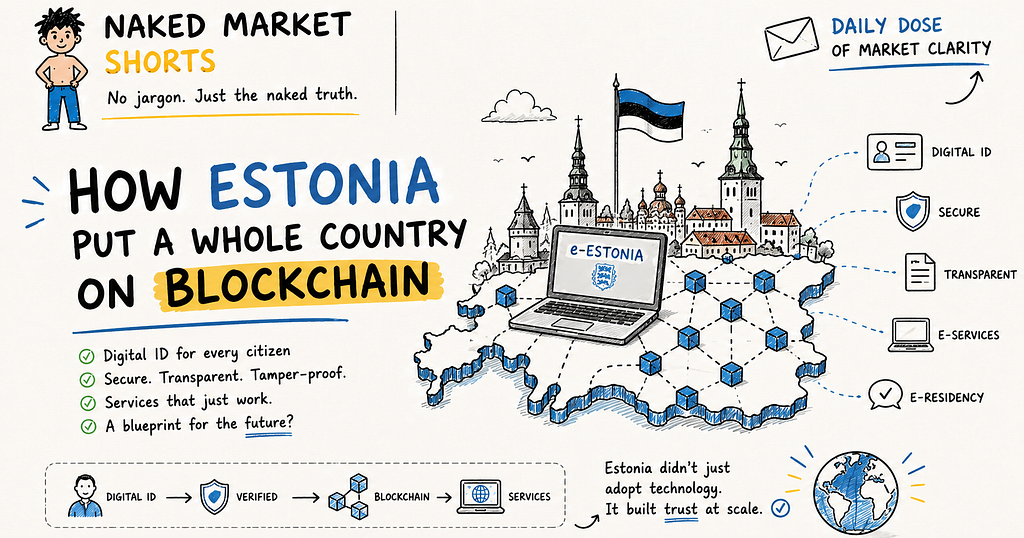
How Estonia Put a Whole Country On BlockChain
One tiny nation rebuilt its entire government around software and everyone says it “put the country on a blockchain.” That headline is wrong in a really interesting way.
Naked Market breaks down macro finance, blockchain infrastructure, AI systems, and automated trading to help you understand the future of global finance before the mainstream catches up.
Picture a Tuesday morning in Tallinn.
Someone wakes up, pours a coffee, opens a laptop still in pyjamas, and files their entire years taxes. Start to finish: about three minutes. No office, no queue, no shoebox of receipts, no form in triplicate. A few clicks, done, coffee still warm.
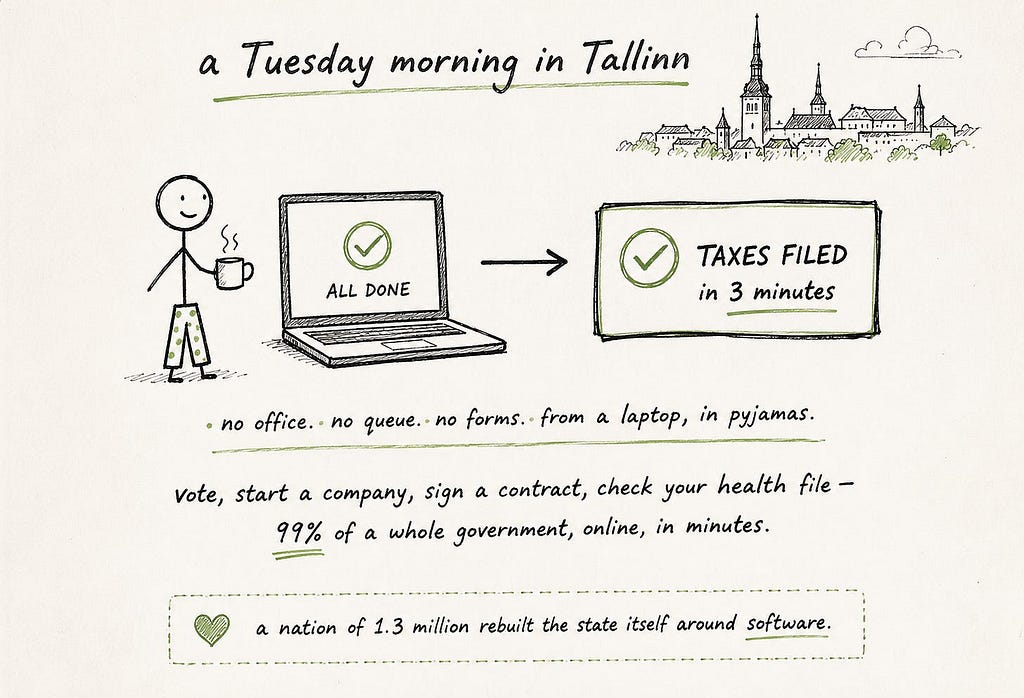
That same person could, from that same laptop, vote in a national election, start a company in fifteen minutes, sign a legally binding contract, check who has looked at their medical file, or register the birth of a child. In Estonia, ninety-nine percent of government services run online. A nation of just 1.3 million people — a former Soviet republic that was rebuilding almost from scratch in 1991 — quietly went and reinvented the entire idea of a government. On software.
And somewhere along the way, the internet decided on a snappy way to describe this: “Estonia put the whole country on a blockchain.” You have probably heard that line. It is on a hundred crypto threads.
It is also wrong. And the way it is wrong is the most useful thing in this whole letter.
First, let us kill the myth
Here is the fairytale version, the one that gets breathlessly shared: a brave little country took its citizens, its taxes, its votes, its health records — the entire nation — and poured all of it onto a blockchain, like Bitcoin but for people.
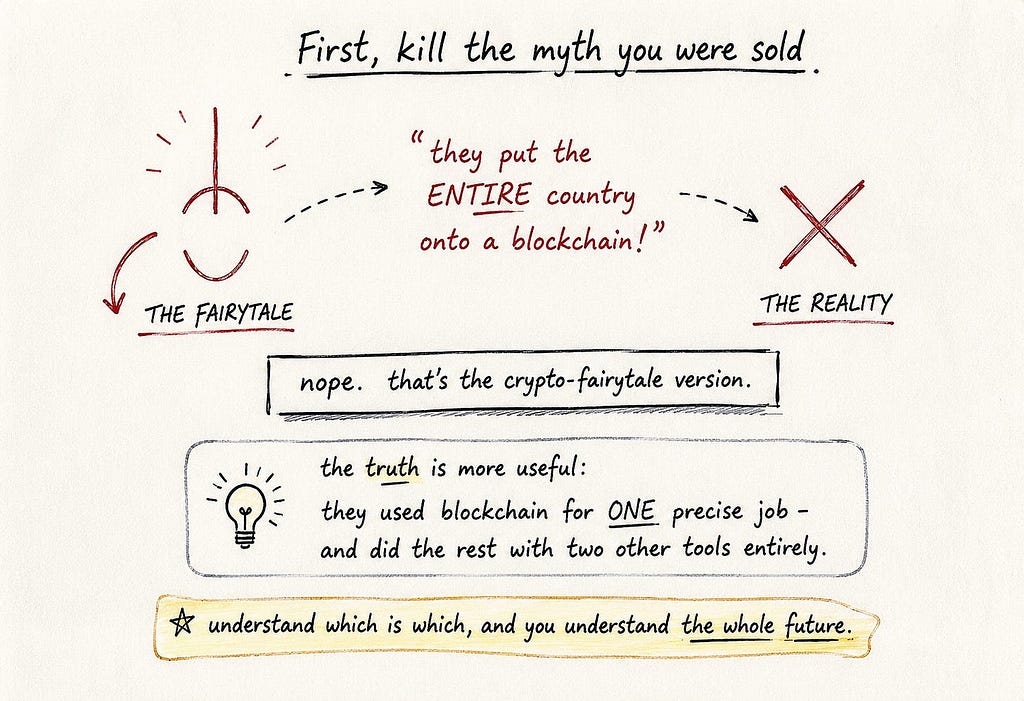
Nope. That is not what happened, and if you go in believing it, you will draw exactly the wrong lessons.
The truth is quieter and far more clever: Estonia used blockchain for one very specific, very narrow job. The rest of the magic — the taxes in three minutes, the whole paperless government runs on two completely different technologies that are not blockchains at all. And learning to tell those pieces apart is the entire skill. Because once you can see which job actually needs a blockchain and which does not, you can see straight through nine out of ten breathless tech headlines for the rest of your life.
So let us take the machine apart. It stands on three legs.
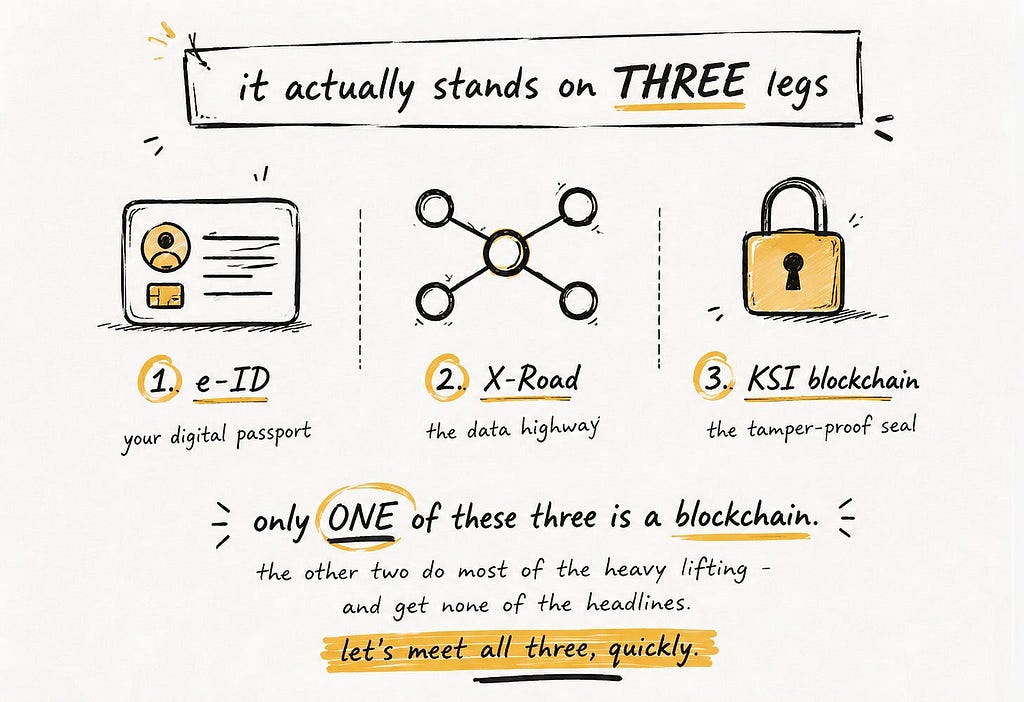
Only one of those three legs is a blockchain. Meet all three — it takes about four minutes, and it will change how you read this stuff forever.
Leg one: the e-ID — one key to your whole life
Everything starts with identity. Every Estonian gets a digital ID, think of it as a cryptographic key that proves, beyond argument, that you are you.
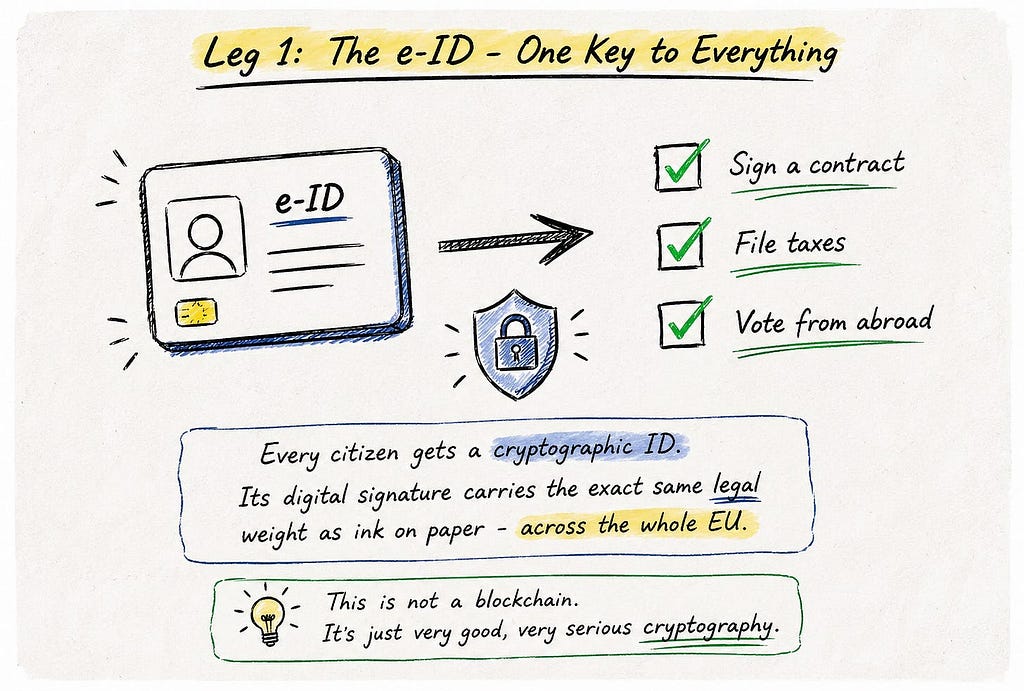
With it, you can sign anything digitally, and here is the part that matters: that digital signature carries the exact same legal weight as your handwritten one not just at home, but across the entire European Union. Thats what turns “a website” into “a government.” When a signature is legally real, you can do real things with it: file the taxes, sign the contract, cast the vote.
And notice this is not a blockchain. It is just very serious, very well-run cryptography. Leg one, no blockchain in sight.
Leg two: X-Road — a highway, not a warehouse
Now, the piece almost everybody misunderstands. When you file those taxes, the system needs to pull bits of your information from lots of different places — the tax office, your employer, maybe a bank. So you would assume the government keeps one giant database with everything about everyone in it, right?
It does the opposite. And this is genuinely brilliant.
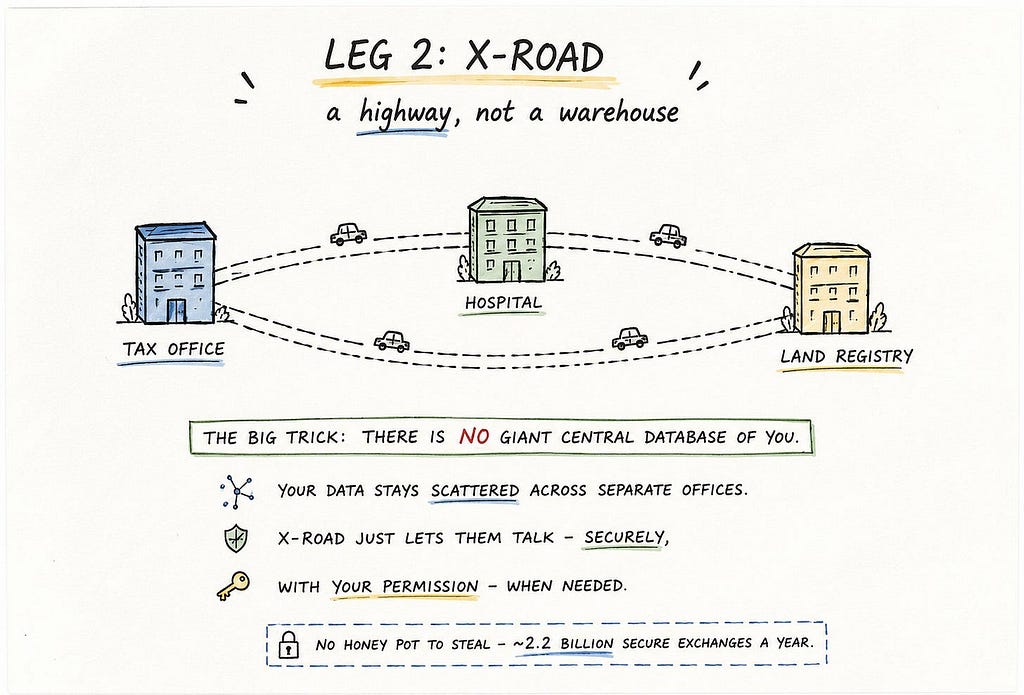
Estonias data-sharing system, called X-Road, is a highway, not a warehouse. There is no single mega-database holding your whole life. Your health data stays at the hospital. Your tax data stays at the tax office. Your property record stays at the land registry. X-Road is just the secure set of roads that lets those separate offices pass a specific piece of information to each other only when needed, and only with your permission while it all stays scattered.
Why is that so smart? Because there is no honeypot. No single vault a hacker can crack to steal everything about everyone, the way a giant central database always is. The information stays spread out, and the system quietly handles something like 2.2 billion secure exchanges a year. Still and I want to be honest about this none of that is a blockchain either. It is clever plumbing. Two legs down, zero blockchains.
So where on earth does the blockchain finally come in? For that, we need to talk about the day the sky fell in.
2007: the first cyberattack on an entire country
In 2007, Estonia got hit by a massive, coordinated cyberattack widely linked to tensions with its giant neighbour that knocked its banks, its media, and its government offline. It is remembered as the first full-scale cyberattack ever launched against a whole nation.
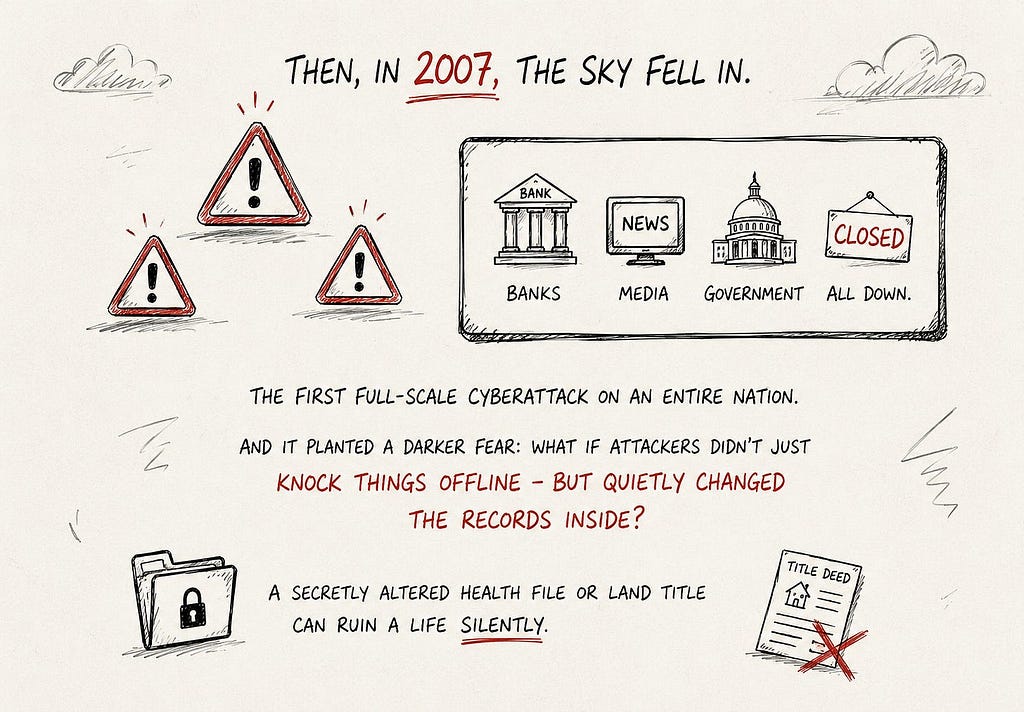
They survived it. But it left behind a much darker, quieter fear and this is the fear that gave birth to the blockchain part. It was not just “what if attackers knock our systems offline?” It was the more chilling one: what if, one day, an attacker or a corrupt insider doesnt crash anything at all, but silently sneaks in and CHANGES a record?
Think about how devastating that is. Quietly alter a land title, and a family loses its home with the paperwork looking perfect. Quietly edit a health record, and someone gets the wrong treatment. Quietly change a vote count, and a democracy rots from the inside with nobody able to prove a thing. A crashed system is obvious. A secretly edited one is a nightmare, because you may never even know it happened.
Estonia needed a way to make that kind of silent tampering impossible to hide. And that finally is the one job they handed to a blockchain.
Leg three: the blockchain, doing one precise thing
Here is how it works, and it is beautifully simple once you see it. Estonia does not put your actual data on the blockchain. Read that again, because its the whole trick.
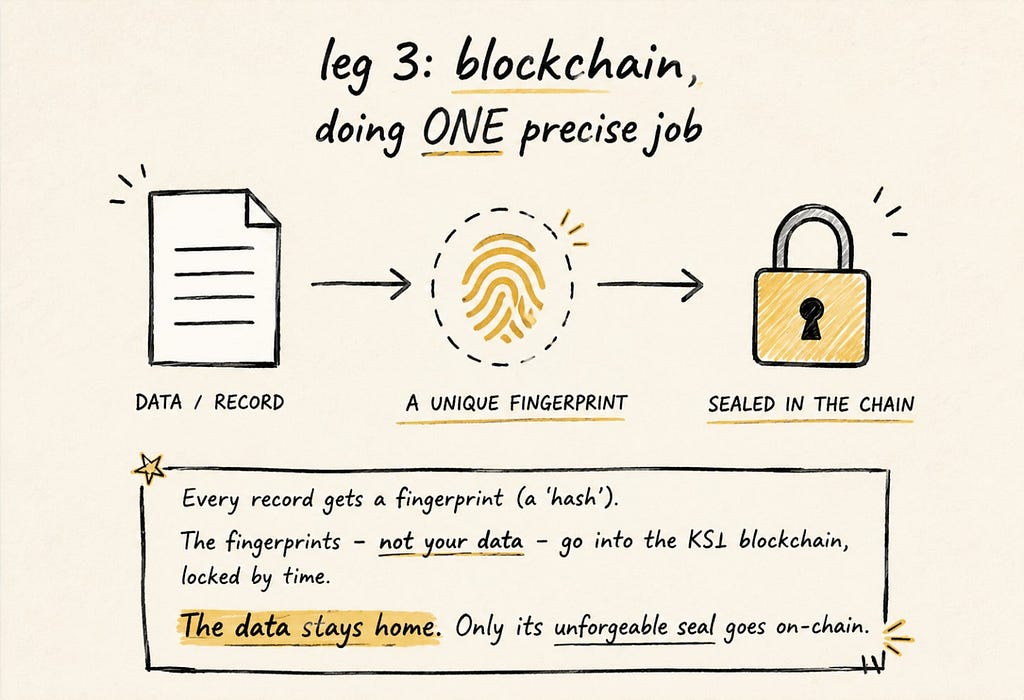
Instead, every important record — your health file, your property title gets run through a bit of maths that produces a unique “fingerprint” (techies call it a hash). Change even a single comma in the original record, and that fingerprint comes out completely different. Then and only that fingerprint gets sealed into the blockchain, stamped with the time. Your private data never leaves its home at the hospital or the registry. Only its unforgeable seal goes on-chain.
Now watch what that quietly makes possible.
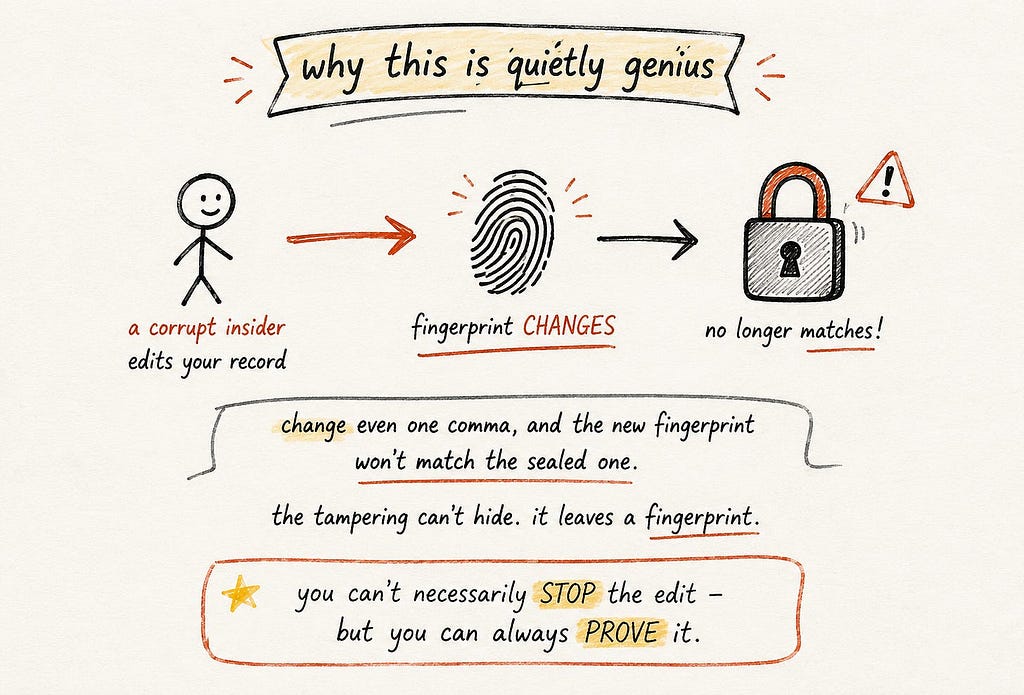
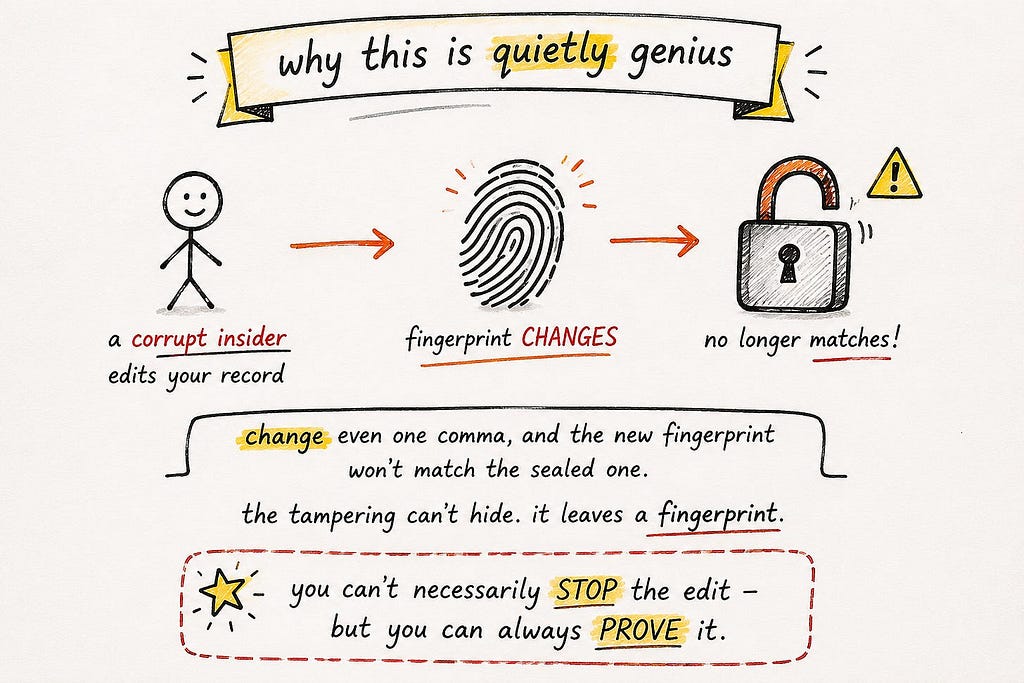
Say a corrupt official sneaks into the system and edits your record. The instant they change it, the records fingerprint changes too and it no longer matches the sealed one sitting in the blockchain, the one that cannot be secretly rewritten. Mismatch. Alarm. The tampering cannot hide, because it left a fingerprint at the scene.
It cant always stop someone from changing a record. But it makes it impossible for them to do it in secret. And in government, that is almost the whole game.
That is the entire role blockchain plays in “the country on a blockchain.” Not storage. Not running the government. Just this: an unbreakable seal that makes silent tampering leave a mark. One precise, brilliant job.
And no, this is nothing like Bitcoin
Quick but important point, because people mush these together constantly.
Bitcoin is a public blockchain anyone on earth can join, and the whole point is radical transparency. Estonias KSI system is the opposite kind: private and permissioned, run by the state, where the goal is not openness at all it is integrity. The data stays secret; only the proof-of-honesty is shared. Same core invention, the seal that cannot be forged pointed at a completely different goal. If that public-versus-private split is fuzzy for you, we pulled it fully apart right here; its one of the most useful distinctions in the whole field.
So what does a country actually get out of all this?
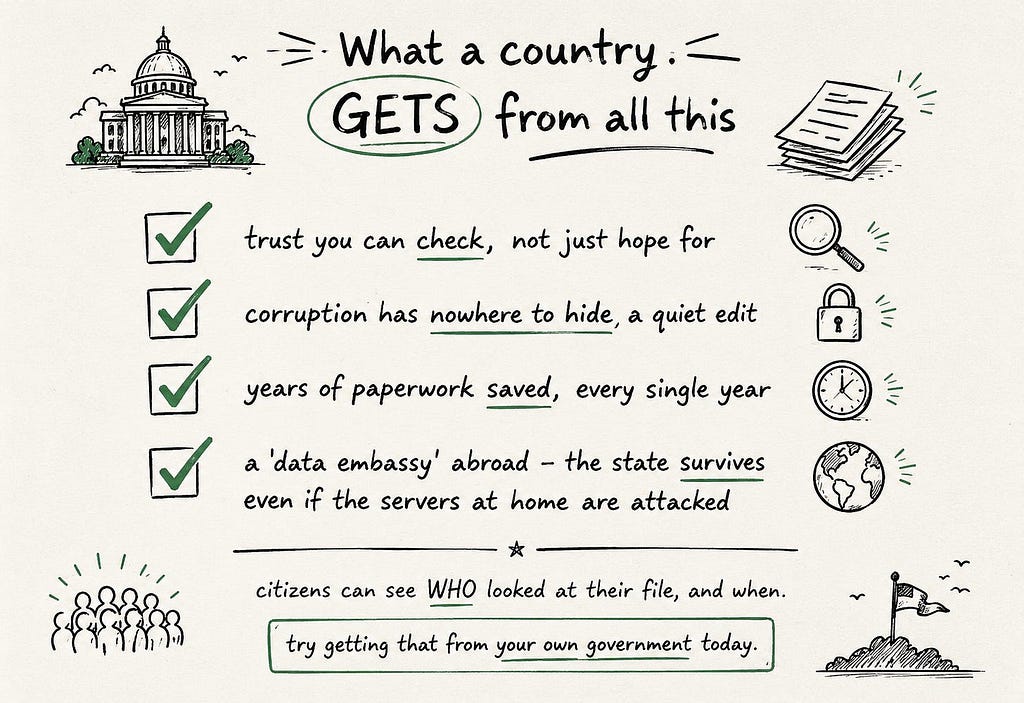
Quite a lot, it turns out. Trust you can check rather than just hope for. Corruption with nowhere to quietly hide an edit. Years of collective paperwork saved annually. Even a wild bit of foresight called a “data embassy”. Estonia keeps encrypted backups of its critical systems on servers in another country, so that even if its home servers were attacked or physically seized, the state itself could keep running from abroad. A country you cannot switch off. And in day-to-day life, the quietly radical part: an ordinary citizen can see exactly who looked at their file, and when. Try getting that from your own government this afternoon.
Now the honest part — it is not magic
This newsletter does not do hype, so here are the limits, plainly.
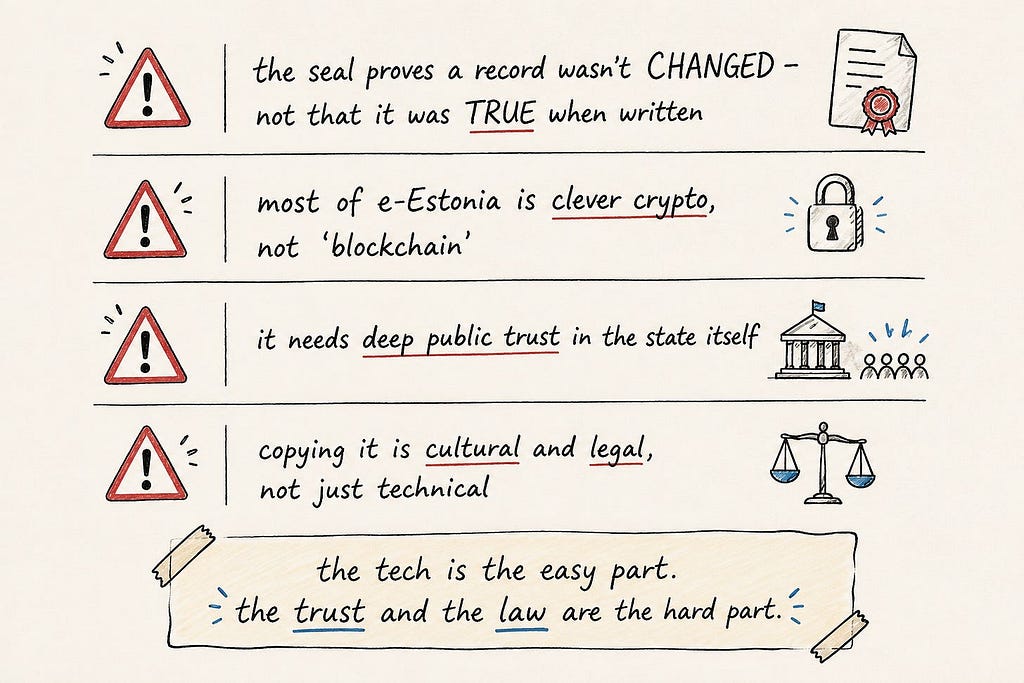
The seal proves a record was not changed it does not prove the record was true when someone first typed it in. If a clerk enters a lie, the system will faithfully protect that lie, perfectly, forever. (We keep hitting this same wall: a chain guards the record, never the honesty of the human at the keyboard.) On top of that, most of what dazzles you about e-Estonia is that clever non-blockchain cryptography, not the chain itself. The whole thing also rests on something you cannot code: deep public trust in the state. And that is why copying Estonia is so hard, the technology is the easy part. The trust, the laws, and the political will are the mountain.
Why this matters far beyond one small country
Here is the pattern to carry out of all this because it is the exact shape of where the whole world is heading.
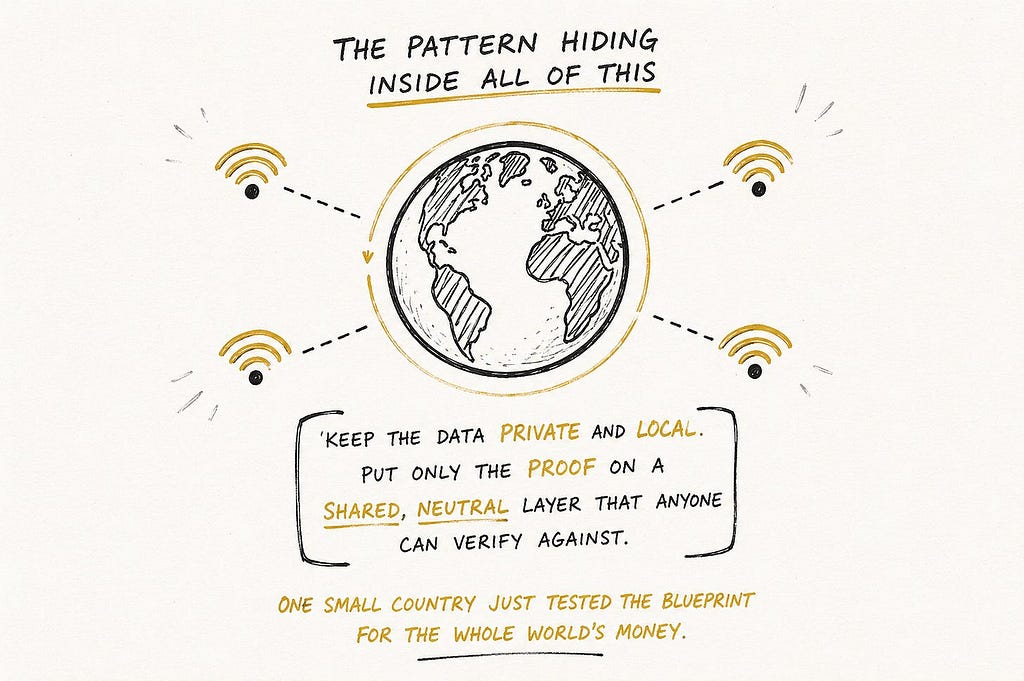
Estonias real breakthrough was not “put everything on a blockchain.” It was knowing precisely what to put on one and what to leave off. Keep the sensitive data private and local. Put only the proof onto a shared, neutral layer that anyone can verify against. That is it. That is the blueprint.
And if that sounds familiar, it should — because it is exactly the design the rest of the money world is now creeping towards. Not one company you have to trust. Not one country holding the master switch. Just shared, neutral rails underneath, where the data can stay private but the truth is provable by anyone. One tiny Baltic nation, out of sheer necessity after a cyberattack, quietly built a working miniature of the One Earth, One Currency idea — and its been running smoothly for over a decade. Its the same convergence we keep mapping, just wearing a government uniform.
The lens to carry
Next time you read that someone “put X on the blockchain,” dont be dazzled and dont sneer. Just ask these three quiet questions.
1. What is actually on the chain — the data, or just its fingerprint? Almost always, the smart designs put only the proof on-chain and keep the real data private. If someone claims theyve dumped all the sensitive data onto a public chain, be very suspicious.
2. What job is the blockchain really doing? Usually its one narrow thing — proving a record wasnt secretly changed. The other 90% of the system is ordinary (and often better) technology. Dont give the chain credit for the whole machine.
3. Whats the seal, and whats just a lie with a seal on it? A chain guarantees a record wasnt altered after the fact. It never guarantees the record was honest to begin with. Always ask who typed it in, and why youd trust them.
Which one are you?
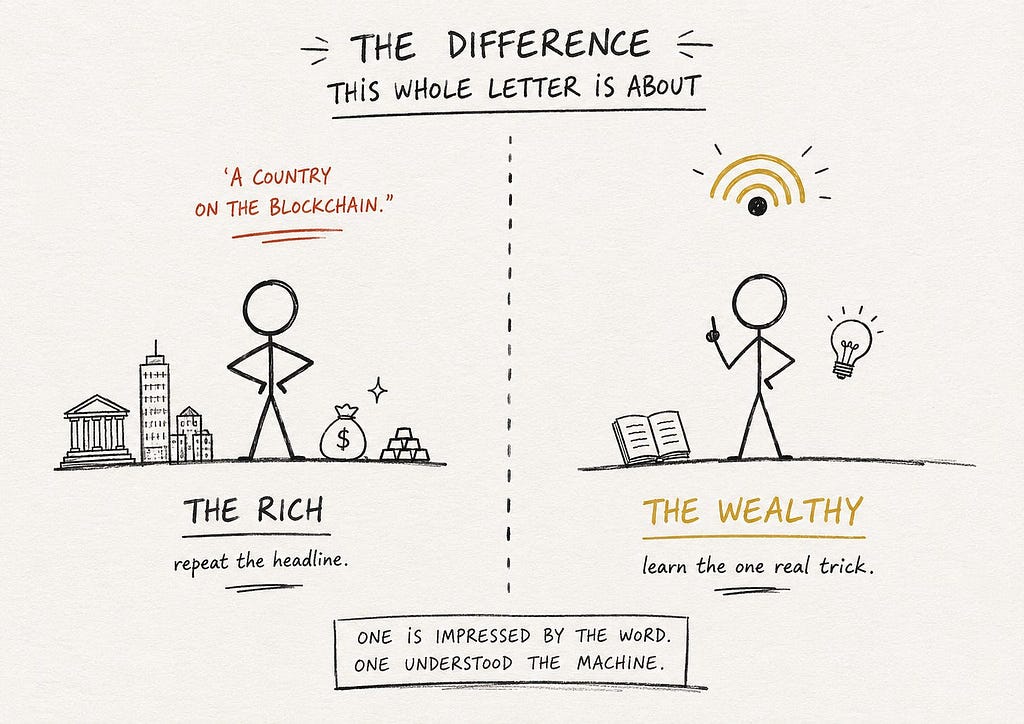
Two people just read the same headline “Estonia put a country on the blockchain.” The first repeats it at dinner, impressed by the word, and moves on. The second now knows the truth underneath: that the real genius was a tiny nation figuring out exactly what to seal, what to keep private, and what a blockchain is genuinely for. Same five words. Completely different understanding.
Thats the whole game we play in this newsletter, wherever in the world youre reading from. The rich collect headlines. The wealthy learn the one real trick hiding inside them. And the trick here is worth carrying everywhere: you almost never need to put the whole world on a chain. You just need to put the proof there and keep everything that matters exactly where it belongs.
If you want to keep reading finance and tech this way — subscribe.
One clear breakdown at a time, for readers all over the world.
Subscribe to Naked Market →
Keep going
- Start here → One Planet, 180 Currencies — the whole idea in one short read
- Why a Blockchain Cant Be Secretly Rewritten — the “unbreakable seal”, explained simply
- Public vs Private Blockchains — exactly the split Estonia chose, and why
- What a Blockchain Ledger Really Is — fingerprints, hashes, and shared records
- The New Rails: Blockchain as Infrastructure — where this pattern is taking the worlds money.
-More soon
How Estonia Put a Whole Country On BlockChain was originally published in Coinmonks on Medium, where people are continuing the conversation by highlighting and responding to this story.
 The British defense giant unveiled BlackThorn, a new family of modular warheads built specifically for the current wave of cheap, mass-produced weapons reshaping modern warfare, from autonomous drones and one-way attack munitions to counter-drone interceptors, missiles and unmanned ground vehicles. BAE Systems designed the warhead family to be modular, meaning the same core technology can […]