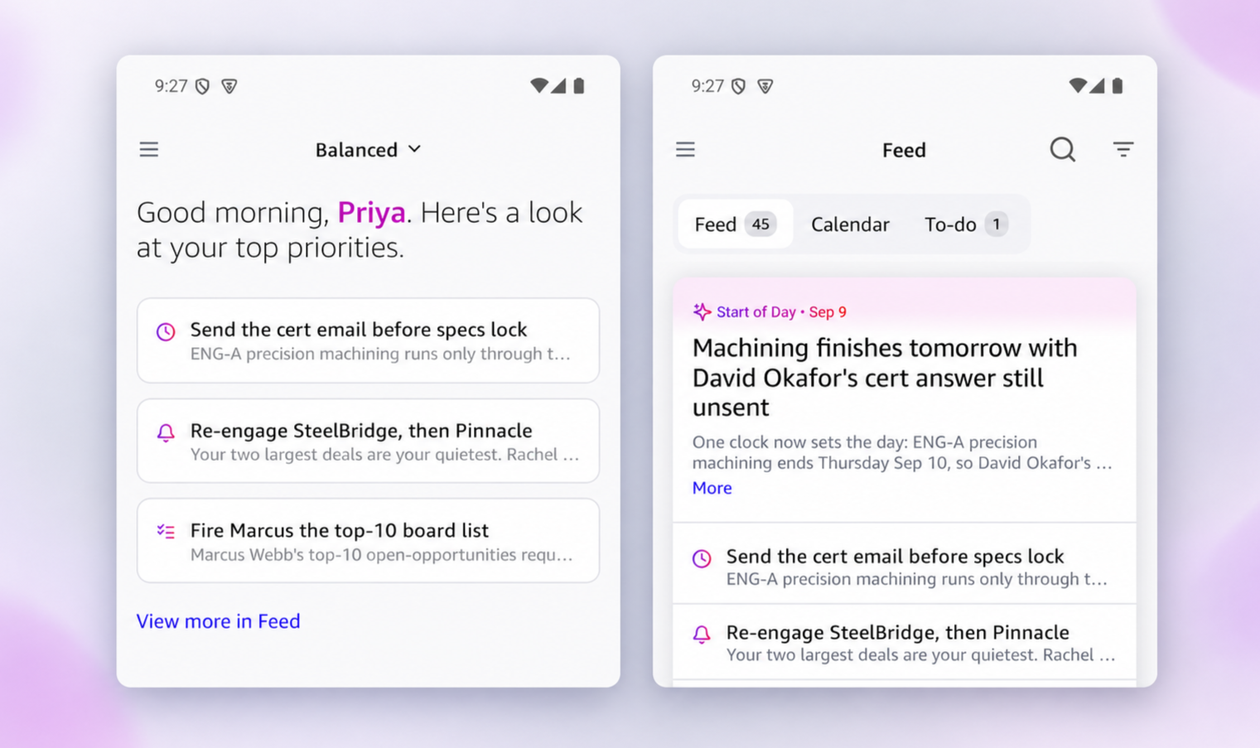
Amazon Quick’s new activity feed on mobile: the morning priority view, left, and the full feed. (Amazon Images)
Amazon is adding the Activity Feed and other features from its Quick desktop app to the AI assistant’s mobile apps for iOS and Android.
The Activity Feed is the signature feature of Amazon Quick. It combines email, Slack messages, calendar invites and CRM updates into one prioritized list, and lets people act on items (opening and responding to emails, for example) without switching apps.
Amazon said Wednesday that the Quick desktop app, released in preview in April, is now generally available on Windows and macOS. The company also said Quick’s agents now run in the cloud, so they keep working after a laptop is closed and deliver results to the feed.
The desktop and mobile apps now sync, as well, so a task started on a laptop can be picked up on a phone, for example.
Quick has a free tier, with paid individual plans starting at $20 per user per month billed annually, and business plans running $20 to $40 per user per month.
Quick is Amazon’s entry in a crowded market for AI assistants at work, competing with Microsoft Copilot, Google Gemini, OpenAI, Anthropic and others. Amazon’s announcements cited business customers for Quick including Southwest Airlines, LabCorp and the PGA Tour.
The desktop app came together fast, as part of a new effort inside Amazon to use small teams to move quickly: Swami Sivasubramanian, the AWS vice president of agentic AI, told GeekWire in June that a team of about six engineers started in late January and shipped April 28.
The new Highspot by Seismic branding, which replaced the company’s standalone logo Tuesday. (Highspot by Seismic Image)
Highspot’s merger with Seismic was completed Tuesday morning, ending the Seattle-based sales software company’s run as an independent business and folding one of the region’s biggest enterprise technology players into a San Diego-based rival.
The combined company is now operating under the Seismic name, led by Seismic CEO Rob Tarkoff. Highspot co-founder and former CEO Robert Wahbe is expected to join Seismic’s board of directors, as announced in February. Permira, the private equity firm that has backed Seismic since 2020, remains the controlling shareholder.
The Highspot name isn’t disappearing entirely. Its product is now branded “Highspot by Seismic.”
Tuesday’s announcement named Seattle as one of the R&D locations — along with San Diego, Boston, Vancouver, Toronto, London and Hyderabad and other sites — where the combined company’s 700-plus product, engineering, data science and AI employees are based.
Seismic will keep Highspot’s Seattle and Vancouver offices, adding to its global footprint, Tarkoff said in a statement responding to GeekWire’s questions.
The combined company has about 1,700 employees globally. Highspot’s total headcount was more than 700 at the time of the deal closing, according to Seismic. The company didn’t say how many of those employees are in Seattle.
“As with any merger of this scale, Seismic and Highspot are carefully evaluating our organizations to identify areas of overlap and integrate our company for near and long-term growth,” Tarkoff said. “Any decisions will be communicated directly and proactively to employees.”
Seismic says it has 2,500 customers and 3.5 million users, and plans to invest more than $100 million a year in research and development.
Financial terms of the deal, originally announced in February, were not disclosed. Highspot had raised $650 million since launching in 2011. Its last publicly disclosed valuation was $3.5 billion, set in 2022 when it raised $248 million in a round led by B Capital Group and D1 Capital Partners.
Other backers included Madrona, ICONIQ Growth, Salesforce Ventures, Sapphire Ventures and Tiger Global Management.
Highspot held the No. 1 spot on the GeekWire 200, our list of the top privately held tech companies in the Pacific Northwest, until the merger was announced in February. Companies come off the list after mergers and acquisitions that fold them into other entities. Everett-based fusion energy company Helion Energy took over at No. 1 in the March update.
Post updated with comment from Seismic CEO Rob Tarkoff on the Seattle offices and workforce.
The merger of Microsoft’s consumer and business Copilot apps lays the groundwork for the upcoming Copilot “Super App” that Microsoft CEO Satya Nadella has touted to developers and investors. (GeekWire File Photo / Kevin Lisota)
Microsoft is starting the process of combining its consumer and business Copilot apps into one, laying the structural foundation for an upcoming “Super App,” and trying to turn the company’s sprawling artificial intelligence brand into a unified product that people actually use.
The move is part of the company’s effort to better compete with ChatGPT, Gemini and Claude, attempting to turn its legacy in workplace technology and cloud infrastructure into a stronger position in AI apps and agents.
It also recognizes the blending of business and personal lives, and the reality that many people use the same AI assistants for both home and work.
The Copilot unification, detailed Thursday in support documents from the company, will take place gradually over the next several weeks, bringing major changes for some existing users.
Several features of the consumer app are going away starting on Aug. 18, including Copilot Podcasts, Group Chat and Deep Research. Also disappearing is Mico, the expressive blob introduced less than a year ago to accompany the consumer Copilot’s voice mode, although Microsoft expects it to live on in some of Copilot’s education features.
Commercial users will see far less change, with Microsoft calling them mostly cosmetic. For example, the Microsoft 365 Copilot app will be known simply as Microsoft Copilot, with a new icon and a new web address.
The unified app is a key step for the company, but it is not, on its own, the launch of the Super App. That larger move will bring together Copilot’s chat, AI coding, Cowork and new AutoPilot agents into a single app. Microsoft CEO Satya Nadella told investors on the company’s July 29 earnings call that the Super App will be out this quarter, meaning by the end of September.
The broader initiative is an attempt to remake and unify Copilot under Jacob Andreou, the former Snap executive Nadella put in charge of the product in March. Mustafa Suleyman, the DeepMind and Inflection co-founder who had run Microsoft’s consumer AI efforts since 2024, shifted to a narrower role at the time, focused on developing new AI models.
Andreou detailed the move in a memo to his 11,000-person organization in early July, as reported by The Information, citing the need to move on from features that weren’t gaining traction, and “earn and respect the right to exist in our customers’ lives.”
Microsoft said last month that Microsoft 365 Copilot surpassed 30 million paid seats, up from 20 million in April, with net seat additions more than doubling quarter over quarter. That amounts to just about 7% of the more than 450 million commercial Microsoft 365 paid seats the company reported in January.
Microsoft doesn’t disclose how many people use the consumer Copilot app, but Sensor Tower estimated 38.5 million monthly users in July, a fraction of ChatGPT’s 1 billion monthly users.
Here is more on what Copilot users can expect:
Gradual rollout: Migration will begin this week with a small group of Windows Insiders and will expand more broadly next week. Worldwide rollout will start with mobile and web in mid-August; Windows and Mac apps will follow in mid-September. Users will see the change at different times, and Microsoft says that’s expected. Mobile users will need to download an updated app.
Unified app and name: The consumer and commercial apps will become a single app called Microsoft Copilot, with a refreshed icon. The commercial web address will move from m365.cloud.microsoft to copilot.cloud.microsoft, with automatic redirects beginning in late August.
Work and personal will stay separate: Users will be able to sign in with a personal account, a work or school account, or both, and switch between them in the app.
Microsoft says data won’t flow between the two, employers won’t be able to see personal activity, and enterprise security, compliance and administrative controls will remain unchanged.
Chats and content will persist: Chat history, images and other content created in the consumer app will migrate to the new one. Files shared with or generated by Copilot will move to OneDrive, where additional storage requires a paid plan.
Deep Research will get only a partial replacement: Deep Research generates long, detailed reports by searching the web and pulling sources together. It’s being retired for consumers, and the substitute, a similar tool called Researcher, will be available only to subscribers of Microsoft 365 Premium, a higher tier than the Personal and Family plans.
Personal and Family subscribers will still be able to open their old reports from chat history and save them to Word, but won’t be able to create new ones.
Podcasts and Group Chat will go away: Group chat threads, messages and the images created in them will disappear after Aug. 18. Copilot podcasts — the AI-generated audio discussions the app made from websites and uploaded documents — will need to be downloaded individually from the podcast library before then.
Some features will be temporarily unavailable: Copilot Health may be missing for some consumer users mid-migration. Microsoft says it will return, and that heavy Health users will be migrated later so the feature will be waiting when they arrive.
Free limits may tighten: Microsoft says core Copilot chat will stay free “subject to capacity and limits,” but that some users will hit those limits sooner than they do today. Those who do can buy a paid Microsoft 365 plan, such as Personal or Family, which come with higher usage limits.
Implications for IT departments: Recall, the Windows feature that periodically captures screenshots of a user’s activity for subsequent AI searching, can be configured to leave certain apps out of those screenshots. Organizations that excluded the old Copilot app will need to apply that setting again to the new one. The exclusion won’t carry over automatically.
Editor’s Note: This story has been updated since publication to clarify which features may be temporarily missing during the transition, after Microsoft revised the information it provided.

 Login
Login