The U.S. Air Force has put its first hypersonic weapon into production, awarding Lockheed Martin a $694 million contract on Sept. 29 to build and field the AGM-183A Air-Launched Rapid Response Weapon, or ARRW, a missile the service had planned to abandon just three years ago, the Department of the Air Force announced on Oct. […]
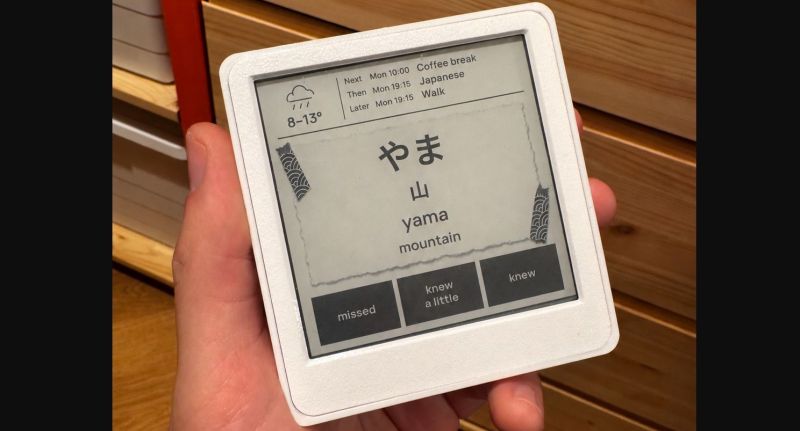
Learning a new natural language can be a daunting proposition at the best of times, with repetition and immersion generally considered to be the best ways to build up not only vocabulary but also that innate sense for grammar and cultural details that sneak into every spoken language. Flash cards are one way to help with vocabulary and sentence building, such as [Peter Hraska]’s Enkiplate project that uses the Inkplate 4Tempera being an interesting alternative to lugging a stack of cards with you.
Although the software also works in the browser, using the Inkplate or similar device means that you can keep it with you while it keeps track of your progress in learning the shown cards, with a starting pace of 12 cards per day to learn. It also shows you calendar items for that day and the weather using an online weather service.
Starting from basic kana, i.e. the two phonetic writing systems, the difficulty is slowly ramped up to cover kanji and then sentences. Due to the limitations of the 4Tempera’s ESP32-WROVER-E module’s local storage up to 16 flash cards can be stored at a time, with an application on a PC being necessary to obtain new cards.
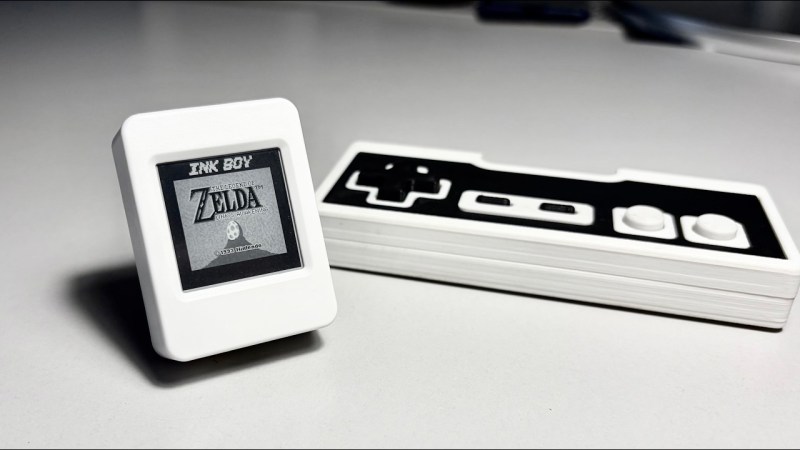
Slow refresh, ghosting and low-contrast — wait, are we talking about passive matrix LCDs, or e-paper displays? That might be why e-paper Game Boy emulators are a thing: the limitations of the black-on-grey e-paper screens remind us of the grey-on-green LCDs Nintendo used in the 80s. In this case [Bo Made It] made it out of a Waveshare ESP32-S3-ePaper-1.54, and got 30 FPS from it.
Now, regular readers might be thinking, “So, we’ve seen the 60 FPS e-paper monitor, how is this special?” It’s a fair question. The answer is that [Bo] is doing this on a randomly chosen dev board with a built in wavetable e-paper controller, rather than the bare inputs that allowed the [Wenting Zhang]’s project to work. On the other hand, [Bo] does credit [Wenting], particularly his e-ink PaperBoy project, with directly inspiring both the project and his implementation.
Again, the big difference is going through the blob of the controller, but it turns out you can still address individual pixels through it. [Bo] gave each pixel a ‘budget’ for up to 8 pulses it depending on how much it needs to change, speeding things up immensely. Our favorite part is how he achieves the Game Boy’s 4-bit greyscale by, in effect, deliberately ghosting the display. Pixels aren’t driven long enough to fully flip them if they’re going only one shade lighter or darker. This complicated matters, since going from black to ‘white’ now takes longer than ‘white’ to the next darker grey, and the exact timing needs to be worked out for each color transition. Getting that timing right took a lot of calibration, and we like how he used video to help automate the process.
That process is still ongoing, so there’s no GitHub link yet. [Bo] will open source everything when it’s ready, and we look forward to it. We also look forward to the PDA-like device he’s going to be using this display driver for. If this all sounds similar to a recent 20 FPS e-paper hack, that’s because it’s the same underlying technology.

 Login

 The U.S. Air Force has put its first hypersonic weapon into production, awarding Lockheed Martin a $694 million contract on Sept. 29 to build and field the AGM-183A Air-Launched Rapid Response Weapon, or ARRW, a missile the service had planned to abandon just three years ago, the Department of the Air Force announced on Oct. […]