❌

Reading view

There are new articles available, click to refresh the page.

A Stereo Vision Board For Hardware Hackers
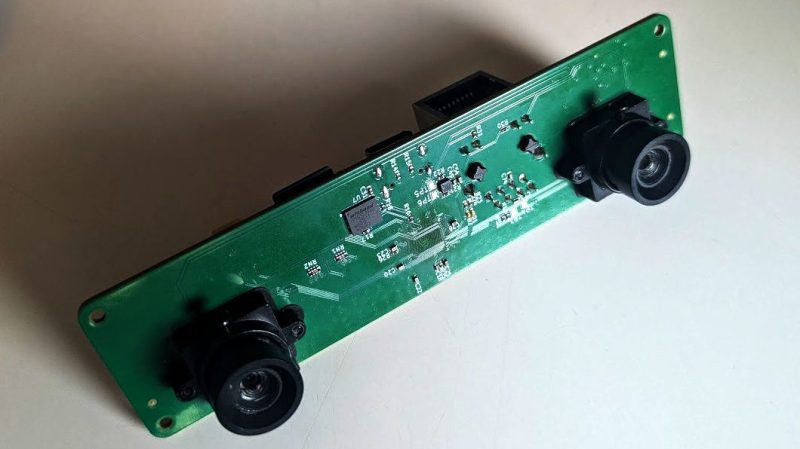
It’s plenty easy to do lots of vision tasks with a single camera, but using two cameras gives you lots of magical abilities, like depth perception! If you’d like to experiment with stereo vision, you might enjoy this board that [machinehum] built specifically for hackers.

The project came about because [machinehum] was particularly excited about the Rockchip RV1103, a 1.1 GHz single-core ARM chip. It comes with 64 MB of DDR2 RAM and a has a MIPI CSI-2 bus on board, which comes in handy for interfacing cameras. Thus, it was the perfect part to whip up a stereo vision board with on-board compute capability and Linux support right out of the box. The processor is paired with two OV9281 global-shutter cameras, as well as a LI2HH12 3-axis accelerometer to provide motion sensing. There’s also 4 MB of flash memory thrown on board, as well as a 10/100 Mbit Ethernet interface for good measure. [machinehum]’s write-up also lays out the software stack and how everything works in concert with Video4Linux2.

If you’re new to experimenting with stereo vision, you might find this to be a useful platform for getting started. Design files are on GitHub for the curious. We’ve seen similar projects built using the Raspberry Pi before, too, which itself is essentially just a fast ARM powered computer with useful camera interfaces built-in. Funny that.
A Thermal Camera That Uses WebUSB

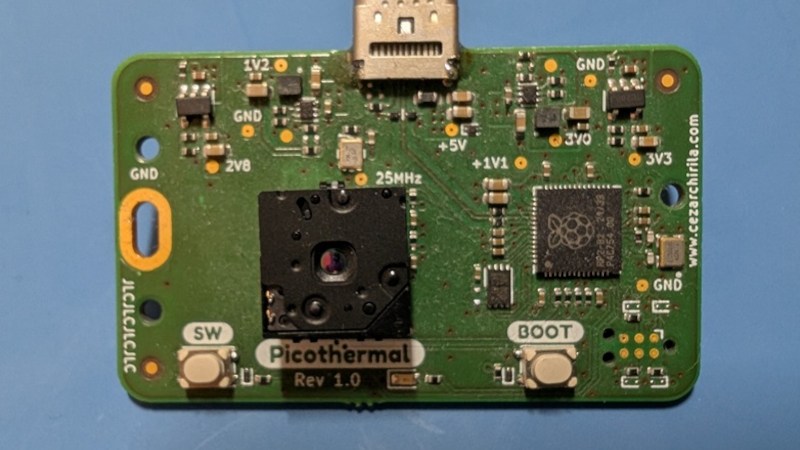
When creating a peripheral for a mobile phone, an obvious path is to create a companion app with which to talk to it. But as we all know today’s app is tomorrow’s non-functional abandonware, so to give his infrared camera a long life, [Cezar Chirila] made it talk WebUSB to a browser instead.

The hardware is conventional enough, a FLIR sensor talking to an RP2040. There’s very little in the way of supporting circuitry save for a power supply regulator, as so much that might be on a standalone project is already present in the USB host device. Running the thing is as simple as going to a landing page in a browser that supports WebUSB, and using the camera. The whole lot is in a GitHub repository, if you’re interested.

We’re big fans of WebUSB, for exactly the reason it’s been used here. While there are a few browser features which have been deprecated over the years β€” who remembers the BLINK and MARQUEE HTML tags β€” it’s likely WebUSB won’t be one of them. This could only be topped by having the microcontroller share a small USB disk with the landing page as an HTML file.

Meanwhile if you’re strapped for cash, there are cheaper thermal cameras out there.

Building An M7 Pan Tilt Head Controller

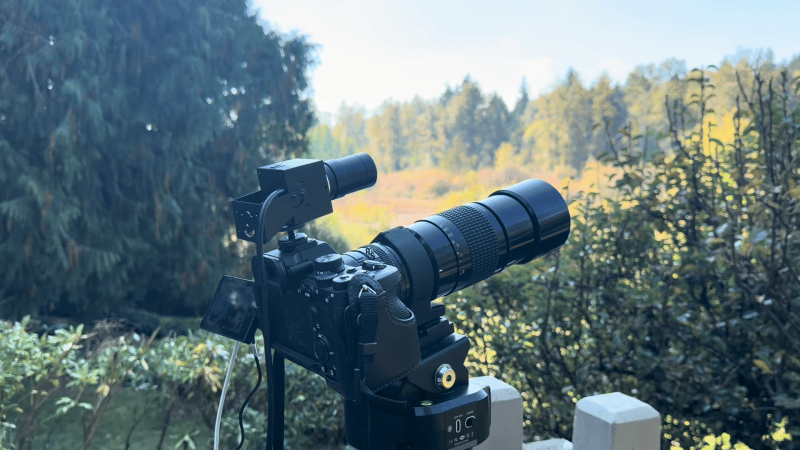
The Soonpho M7 Pan Tilt Head is a useful photography tool for remotely aiming a decently-sized camera. Only, [Kyle Housley] wanted a little more control than was available out of the box. Hence, he built a custom controller that could deliver just that.

The project is based around an ESP32-S3 paired with an NRF24L01 wireless module. The ESP32-S3 is hooked up to a computer to receive commands over serial on what movements to make. It then transmits over the NRF24L01 to another NRF24L01 module that has been hacked into the original M7’s controller. In doing so, it can command the M7 to move to a given specific pan and tilt position, or to make a smooth motion along a vector. It can also trigger shutter release in the attached camera as needed, to capture whatever is being looked at.

[Kyle] has used this rig to create a motion tracking system for aircraft photography. With a Yolo vision model running on a laptop, the pan-tilt head can be commanded to track aircraft passing by and photograph them when they’re in frame. It’s a pretty slick setup; we’d love to see similar done with the aid of ADS-B data, tooβ€”perhaps even with automatic image tagging and upload.Β 

❌