Katana CEO Matt Fisher has said a dollar stablecoin planned by 21 financial institutions for the first half of 2027 could generate yield through independent DeFi protocols, although holders would assume risks not covered by its issuing banks. Katana CEO…
MoonPay issues the token. It is backed by PYUSD. PYUSD is issued by Paxos and backed by actual dollars and Treasuries. Count the layers: there are two, and the law Congress passed last year describes one.
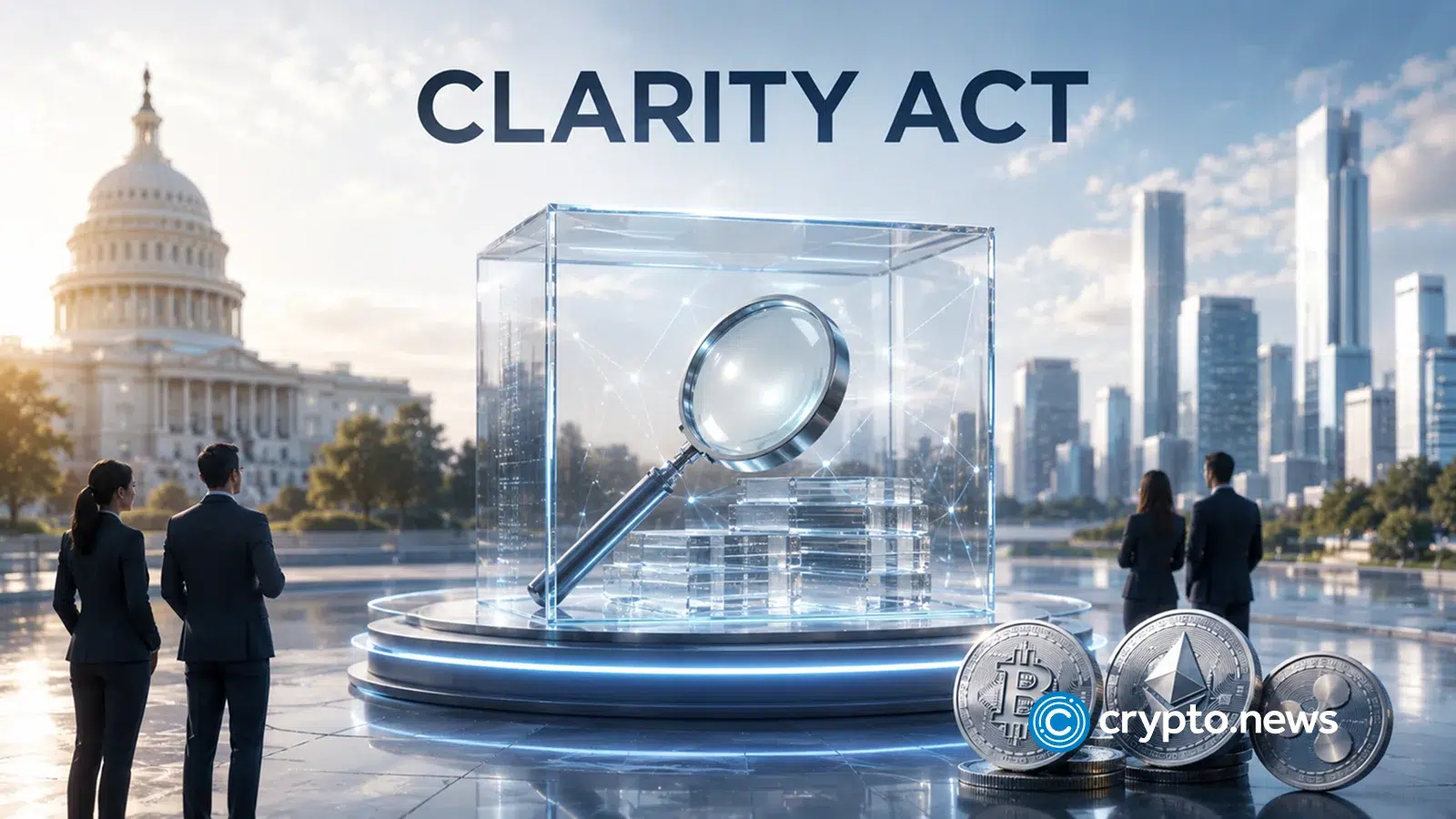
A new draft of the long-awaited crypto Clarity Act has dropped with amendments.
As first reported by Eleanor Terrett from Crypto in America and Punchbowl’s Brendan Pedersen, the updated bill contains changes including requiring non-decentralized DeFi protocols to register with the CFTC, and changes around how credit unions deal in crypto, according to reporters.
The specifics include that a decentralized finance app fails the test of being such a protocol test if someone can control or materially alter its functionality, if it doesn’t run solely on pre-established transparent encoded rules, or if someone can restrict or censor its use.
It also adds that a federal credit union may use a digital asset or distributed ledger system to perform, provide, or deliver any activity, function, product, or service it is otherwise authorized by law to perform.
JUST IN: An updated version of the Clarity Act has released ahead of next week's floor vote
"Latest changes include new DeFi requirements and credit union fix" — Punchbowl News
Lawmakers were hoping a crucial vote on the crypto market structure bill would go ahead in August before their five-week recess. It was delayed and the Senate will now vote on it on September 15.
The bill is not bipartisan yet, according to the reporters. Senate Republicans started circulating the updated legislation on Thursday.
The Clarity Act drafts a framework to formally divide oversight between regulators, distinguishing which digital assets are securities, commodities or stablecoins. Crypto industry executives have long called for such rules to be in place.
Though passed by the House of Representatives last July, it has been stalled this year, mostly because the banking lobby clashed with crypto companies over paying customers stablecoin yield.
A new draft tackling the issue of ethics started circulating in July, banning government officials from promoting or making money from crypto — something Democrats have criticized the Trump family for doing.
Despite the changes, a group of Democrats said the bill fell short and demanded amendments to the bill.
Pro-crypto lawmakers have blasted Democratic politicians who they think are deliberately holding back the bill.
President Donald Trump has urged lawmakers to get the legislation over the line. In August, he said that in order for the U.S. to remain the “undisputed leader in Bitcoin and crypto,” they had to pass the “very, very powerful legislation.”
The September 15 upgrade brings smart contracts, an AMM DEX, and RPC infrastructure to a chain that has never processed a single swap. Seven years of mobile mining come down to whether anyone builds on the other side. The most…
Arbitrum’s Watchdog Committee has proposed permanently excluding three DeFi projects from future DAO programs after flagging cases involving 457,553 ARB, valued at roughly $76,000. Arbitrum grant cases involve three different findings The Sep. 3 governance proposal said Good Entry, Limitless,…
A range-proof cache bug in the Elements codebase let an unknown actor mint unbacked L-BTC, drain 95% of the federation reserve through SideSwap, then negotiate its return on-chain via OP_RETURN messages. The network remains frozen, 598.5 BTC sits in the…
Nansen has integrated Outcome.xyz’s HIP-4 markets into its trading platform, becoming the first front end to support the venue as Hyperliquid opens its outcome-market infrastructure to outside builders. According to a press release shared with crypto.news, the integration is live…
Solana has captured $348 million in net real-world asset inflows over a 30-day period, pushing its tokenized RWA value to $720 million, according to RWA.xyz data.
That is a strong number for a network usually associated with memecoins, retail trading, fast DeFi, and consumer crypto apps. RWAs give Solana a slightly different story: institutional-style capital moving into tokenized Treasuries, credit products, and other real-world asset structures.
It is important not to blur these categories.
RWA inflows are not the same thing as meme-token liquidity. They are not the same as speculative trading volume. They represent capital moving into tokenized asset products, which is a very different kind of activity.
For more details, visit the official App platform.
TL;DR
Solana recorded $348 million in 30-day net RWA inflows.
Solana RWA TVL reached $720 million.
The data points to tokenized asset growth, not meme-market speculation.
Why RWA Growth On Solana Matters
Solana’s image has changed a few times.
At different moments, it has been seen as an Ethereum challenger, an NFT chain, a memecoin chain, a DeFi chain, and a consumer crypto network. RWA growth adds another layer.
Tokenized real-world assets are often treated as a more institutional category.
They can include U.S. Treasury products, private credit, tokenized funds, real estate exposure, and other assets that connect traditional finance with blockchain settlement.
For Solana to attract meaningful RWA inflows, it suggests the network’s speed and low fees are starting to matter beyond retail speculation.
The $720M TVL Level Gives It Weight
A $720 million RWA base is not small.
It does not put Solana at the top of every tokenization leaderboard, but it gives the chain real presence in the sector. The 30-day inflow number is even more interesting because it shows recent momentum rather than only accumulated value.
Momentum matters in RWA because institutional capital tends to move carefully.
If tokenized Treasury products and credit pools are expanding on Solana, the ecosystem may be gaining trust from issuers, allocators, or infrastructure providers who need more than fast trading.
Solana’s Speed Could Help RWA Products
RWAs do not always need high-frequency settlement, but speed and cost still matter.
Lower transaction fees can make token transfers, collateral movement, and settlement operations easier. Fast confirmation times can also make user experience smoother, especially if tokenized assets are integrated into DeFi or trading platforms.
That gives Solana a practical pitch.
It can offer RWA issuers a network with liquidity, users, low costs, and growing financial infrastructure.
Do Not Overstate Institutional Adoption
The careful part is language.
RWA inflows do not mean every major institution has adopted Solana. They do not prove that all tokenized products on the network are institutionally used. They also do not guarantee that the capital will remain if yields, incentives, or market conditions change.
The data shows inflows and TVL.
That is strong enough without exaggerating it.
The Solana Market View
Solana’s RWA growth gives the network a more rounded story.
It is still a retail-heavy, fast-moving ecosystem. But the $348 million 30-day inflow figure shows tokenized asset activity is building alongside the louder trading narratives.
That matters because sustainable networks usually need more than one use case.
If Solana can keep attracting both consumer activity and institutional-style asset flows, its ecosystem becomes harder to pigeonhole.
This article draws on RWA.xyz Solana network data and public DeFiLlama Solana metrics.
This article was written by the News Desk and edited by Samuel Rae.
This report is based on information released by App. at App
Aave governance is considering an emergency Guardian powers proposal that would allow vulnerable lending pools to be frozen quickly during active security threats, without requiring immediate public write-ups.
It is a slightly uncomfortable proposal, and that is exactly why it matters.
On one hand, DeFi users want transparency. On the other hand, publishing too much detail during an active exploit can hand attackers a roadmap. Aave contributors are trying to solve that tension: how do you act fast enough to protect users without making governance feel opaque?
The proposal does not allow guardians to seize user funds or liquidate deposits. It is about emergency freeze powers.
For more details, visit the official Governance platform.
TL;DR
Aave governance is discussing emergency Guardian freeze tools.
The proposal would allow faster response during active exploit situations.
It does not give guardians power to seize deposits.
Why Emergency Tools Matter In DeFi
DeFi moves fast when things go wrong.
A bug, oracle issue, bad debt event, or market manipulation attack can escalate in minutes. Waiting for a full public governance process is not always realistic when funds are at risk.
That is why many large protocols use emergency roles.
These roles are supposed to pause, freeze, or limit certain functions while the team or DAO investigates. The difficult part is designing those powers so they are strong enough to protect users, but narrow enough that they cannot be abused.
Aave’s proposal sits right in that design problem.
Transparency Versus Security
The public-notice question is the most interesting part.
In normal conditions, users should expect clear explanations. If a market is frozen, people want to know why. They want to understand whether their funds are safe and when normal operations may resume.
During an active exploit, though, immediate disclosure can be dangerous.
If the issue is not fully contained, a public write-up may expose technical details that help attackers move faster. That is the argument behind delaying some disclosures until the threat is under control.
It is not an easy trade-off.
Aave Has To Protect A Large System
Aave is one of DeFi’s core lending protocols.
That means its risk controls matter beyond one market. Aave deployments sit across multiple chains and assets, with users relying on the protocol for borrowing, lending, collateral management, and liquidity.
Emergency response is not a side issue.
It is part of the protocol’s safety design. If governance cannot respond quickly enough, users can suffer. If emergency powers are too broad, users may worry about centralization.
Finding the middle ground is the hard part.
What The Proposal Does Not Do
The proposal should not be exaggerated.
It does not mean Aave guardians can take user funds. It does not mean deposits can be seized. It does not mean liquidations can be manually forced outside protocol rules.
The proposal is about freezing vulnerable markets during emergencies.
That distinction is important because “emergency powers” can sound scarier than the actual mechanism.
The DeFi Governance Lesson
Aave’s discussion shows how mature DeFi protocols are thinking about crisis management.
Early DeFi loved pure automation. Over time, protocols learned that some emergency controls may be necessary, especially when billions of dollars are at stake. The question is how to make those controls accountable.
The best version of this proposal would protect users during live threats while preserving post-incident transparency.
That is the balance Aave governance now has to debate.
This article draws on Aave governance materials relating to the emergency Guardian powers proposal.
This article was written by the News Desk and edited by Samuel Rae.
This report is based on information released by Governance. at Governance
Router Protocol has announced a deprecation plan that will shut down the cross-chain messaging network and permanently burn 303 million ROUTE tokens.
The team said users will have a grace period to move assets back to origin chains before relayer nodes are disconnected. That makes this a user-action story as much as a tokenomics story. Anyone still relying on Router needs to pay attention to the timeline.
The most important thing is not to invent a cause.
The shutdown has not been framed as a hack or exploit. The team cited unsustainable relayer maintenance costs, so the story is about protocol economics and wind-down planning rather than a security breach.
Relayers, validators, message verification, audits, monitoring, liquidity support, and developer maintenance all cost money. If usage or revenue does not justify that cost, even useful infrastructure can become hard to sustain.
Router Protocol’s deprecation notice points to that problem.
A protocol can have real technology and still struggle as a business or network. In cross-chain crypto, that is especially true because competition is intense and users often move toward the fastest, cheapest, or most liquid route.
That leaves smaller networks under pressure.
The Token Burn Is A Big Part Of The Story
Burning 303 million ROUTE tokens is a major tokenomics action.
A burn permanently removes tokens from circulation, but in this case the context is not a bullish supply-reduction campaign. It is part of the network’s wind-down process.
That distinction matters.
Some token burns are designed to support long-term scarcity narratives. This one is tied to shutting down operations and completing deprecation. Traders should not treat the burn as a normal growth catalyst.
It is part of closing the book.
Users Need To Watch The Grace Period
The practical issue is asset movement.
If Router relayers are being disconnected, users need clear instructions on how and when to bridge assets back to origin chains. Missing a grace period can create headaches, especially if liquidity routes or interfaces disappear.
That is why the timeline matters more than the headline.
The token burn may get attention, but the user priority is simple: check exposure, follow official instructions, and avoid waiting until the last minute.
Coinbase Backing Does Not Mean Coinbase Liability
Router has been described as Coinbase-backed, but that should not be twisted into blame.
Early venture backing or ecosystem investment does not mean Coinbase controls daily operations or is responsible for the shutdown. Unless official sources say otherwise, the decision belongs to Router Protocol’s team and governance structure.
That nuance is important.
Crypto headlines often use investor names to make a story sound bigger. But backing is not the same as operational control.
Cross-Chain Infrastructure Remains Difficult
Router’s shutdown says something broader about interoperability.
Crypto needs cross-chain systems, but building them safely and sustainably is hard. Bridges and messaging protocols must deal with security risk, liquidity fragmentation, operational cost, user trust, and fierce competition.
Not every protocol survives that pressure.
Router’s wind-down is a reminder that infrastructure projects need durable economics, not just clever architecture.
The Market View
The Router Protocol shutdown is a serious event for ROUTE holders and users of the network.
It is not a confirmed exploit story. It is not a reason to blame every early backer. It is a protocol deprecation with a large token burn and a user withdrawal window attached.
For anyone still interacting with Router, the next step is boring but important: read the official notice, move assets if needed, and do not rely on relayer availability past the stated deadlines.
This article draws on Router Protocol’s official deprecation notice and related public materials.
This article was written by the News Desk and edited by Samuel Rae.
This report is based on information released by X. at X
Solana app Fomo has overtaken Pump.fun in 24-hour protocol revenue, generating $1.4 million in fees during the latest tracking window.
That is a pretty sharp move, because Pump.fun has been one of the defining apps in Solana’s retail trading cycle. For another app to flip it, even for a single day, tells us something about how quickly attention can move inside the Solana ecosystem.
But there is an obvious caveat.
One strong 24-hour window does not mean Fomo has permanently taken Pump.fun’s place. Crypto app revenue can swing fast, especially when traders pile into a new mechanic, launch format, or incentive loop. Still, this is exactly the kind of on-chain shift Solana traders watch closely.
For more details, visit the official Defillama platform.
TL;DR
Solana app Fomo generated $1.4 million in 24-hour protocol revenue.
That put it ahead of Pump.fun during the tracked window.
The flip is notable, but it does not prove permanent market dominance.
Why The Fomo Flip Matters
Solana has become one of the most active environments for fast-moving consumer crypto apps.
A big part of that comes down to cheap transactions, fast settlement, and a retail user base that is willing to try new trading experiences quickly. When an app catches attention on Solana, volume can appear almost immediately.
That is what makes the Fomo data interesting.
This is not just another token chart. Protocol revenue shows users are paying to interact with the app. That means actual fee generation, not only speculative market cap movement.
For Solana, fee-generating apps are important because they show there is economic activity happening on the network.
Pump.fun Is Still The Benchmark
Pump.fun has become a kind of reference point for Solana app culture.
It turned token creation into something simple, chaotic, and wildly popular. That made it one of the clearest examples of Solana’s retail flywheel: users create assets, traders chase them, liquidity moves fast, and fees stack up.
So when Fomo moves ahead of Pump.fun on daily revenue, people notice.
It does not mean Pump.fun is finished. It means traders are willing to rotate into another venue when the incentives, mechanics, or social energy line up.
That is how Solana works at its most intense.
Revenue Spikes Need Context
The danger is overreading the number.
A 24-hour spike can come from a launch event, a temporary incentive, a viral trading cycle, or concentrated activity around a small group of assets. That can make one day look bigger than the longer-term trend.
The better question is whether Fomo can repeat it.
If the app keeps generating strong fees over several days or weeks, the story becomes much more meaningful. If revenue drops back quickly, this may be remembered as a short burst of attention.
Either way, the $1.4 million day deserves coverage because it shows how quickly Solana’s app leaderboard can change.
Solana’s App Layer Is The Main Story
SOL price is not really the center here.
The better story is that Solana’s application layer remains lively. Apps are competing for users, creators, fee flows, and attention. That is exactly what a healthy consumer crypto ecosystem needs, even if some of the activity is speculative.
For builders, this kind of rotation proves there is still room to challenge incumbents.
For traders, it shows where capital is moving right now.
What To Watch Now
The next thing to watch is whether Fomo’s revenue holds up after the first surge.
If it keeps pulling traders away from Pump.fun, Solana may have a new app battle on its hands. If Pump.fun quickly retakes the lead, then Fomo’s flip still matters, but more as a sign of short-term rotation.
Either way, Solana’s revenue map is moving again.
And in this ecosystem, that usually means traders are awake.
This article draws on DeFiLlama Solana fee analytics and public Solana network data.
This article was written by the News Desk and edited by Samuel Rae.
This report is based on information released by Defillama. at Defillama
On August 23, 2026, an attacker used roughly half an ETH to acquire majority governance control over Term Labs Meta Vaults, then passed a routine-looking proposal that disabled the vault’s transaction delay and drained six vaults. No key was stolen and no core vault code was broken: with almost no one else voting, the attacker simply became the governance, extracting 2,841.74 WETH and 1,679,639 USDC, about $8.5 million, later swapped to DAI.
Protocol Background
Term’s Strategy Vaults are ERC-4626 vaults built on Yearn V3 infrastructure, governed through Aragon TokenVoting. Voting power isn’t tied to vault deposits directly: to get it, a depositor has to wrap their vault shares into a separate governance token, an extra opt-in step almost nobody took. A Zodiac Delay module was meant to sit between an approved governance proposal and its execution, giving roughly a week’s cooldown before anything it authorized could actually run.
Hack Analysis
Term’s voting power came from wrapping vault shares into a separate governance token, and almost no one bothered. On the ETH Meta Vault the total wrapped supply was just 0.5352 tokens, across the USDC vaults it was similarly thin. A depositor putting in about 0.5 ETH and wrapping the resulting shares ended up holding 0.4852 of that ETH Meta Vault supply, about 90.7%, while a separate wallet held all of the active voting power across all seven USDC vault proposals it opened.
Because the minimum proposer voting power was set to zero, opening a proposal cost nothing beyond gas. The attacker filed a proposal titled Veto strategy vault parameter change, using the exact wording the curator used for routine parameter updates, so it read on the surface like an ordinary item up for a veto vote rather than an attack.
Underneath that title sat 17 actions. The first three reset the Zodiac Delay module’s roughly seven-day cooldown and expiration to zero and handed control of it to an attacker-controlled executor. The rest recalled capital from all four of the ETH Meta Vault’s real strategies, deployed a new strategy called Fixed Recipient WETH Exit Strategy, gave it a debt ceiling of uint256 max, and routed the vault's balance into it.
Six days later, with the voting window closed and almost nobody having voted against a majority the attacker already held, the proposal became executable. At about 06:25 UTC on August 23, the attacker called executeProposal(), recalling WETH from four strategies and pulling roughly 2,841.74 WETH out through the planted strategy contract.
Twenty-two minutes later, a second attacker wallet ran the identical playbook against five USDC vaults in a single transaction, where it held all of the voting power across every proposal it had opened on those vaults. That transaction drained approximately 1,679,639 USDC, which was later swapped into DAI.
Root Cause
This wasn’t a bug in Term’s core vault code. The root failure is that voting power depended on an opt-in wrapping step almost nobody took, so a deposit worth a few hundred dollars was enough to become the effective government of vaults holding millions, and that governance had the authority to disable its own safety delay.
The formal governance settings, a 50% support threshold, 5% minimum participation, and a roughly six-day voting window, weren’t reckless on their own, but they meant nothing once one wallet held almost all the active voting power. A zero minimum proposer-power requirement meant opening the proposal cost nothing, and the proposal’s own opening actions could reset the Zodiac Delay module’s cooldown and expiration to zero, removing the one control meant to slow exactly this kind of action before it executed.
Whether the delay module’s exposure to governance was an intentional design choice or a distinct authorization failure hasn’t been publicly explained.
How QuillAudits Governance Review Could Have Prevented This
Governance participation and concentration monitoring. A review should flag when a governance token’s actively-wrapped supply is thin enough that a small deposit can cross a majority threshold, and require a minimum active-participation floor before proposals gain force, not just a percentage-of-supply threshold.
Scope-limit what governance can touch. The Zodiac Delay module existed specifically to slow dangerous actions, but the same governance process could reset its own cooldown and expiration. A review would flag any proposal-executable action that can modify the safeguard meant to gate proposal-executable actions, and wall that off behind a separate, higher-friction control.
Title and content review for proposals, not just code review. A malicious proposal disguised as a routine curator veto item passed unnoticed for six days. Requiring a structured, machine-checkable diff of what a proposal actually changes, surfaced independently of its title, would have caught the delay-module reset regardless of what the proposal was called.
Funds Flow After Attack
2,841.74 WETH and 1,679,639 USDC(swapped to DAI) drained from the vaults converged at a single address, 0xD5183d8BfC65a50863C62aF2538198A8288FFc13.
Stolen USDC was swapped into DAI and then transfer to another address 0x9210130f81c84d028DB83701fF379A79c9365135, and then swapped to ETH and deposited into tornado cash.
Since then, major ETH didn’t moved from attacher wallet, 300 of it moved out of the consolidation address to 0xC14007663A5bb9F13d4d2AEE8c6FE9075eF1d83e, and deposited to tornado cash.
Post-Attack Mitigation
Term Labs posts its first public acknowledgment, confirming a governance exploit hit its vaults, without giving a loss figure or technical explanation.
Term Labs follows up, confirming all Term Meta Vaults have been shut down and their DAO governance roles revoked, an irreversible step that blocks new deposits while leaving withdrawals open.
No key was stolen and no line of core vault code was broken. Almost nobody wrapped their shares into Term’s governance token, so a deposit worth a few hundred dollars was enough to become the majority, and that majority had the authority to disable the one mechanism built to slow it down. The vault executed exactly what its governance authorized, the governance itself was the vulnerability. A safeguard that governance can switch off isn’t a safeguard, it’s a formality waiting for someone to notice nobody’s watching.
The cloture vote, the CPI print, the FOMC decision, and the SEC’s 24-hour trading roundtable all fall in the same 10-day window. The outcome will shape crypto regulation for the rest of the decade. The United States Senate has 14…
Every HYPE unlock triggers the same panic cycle. Every time, the sellers never show up. The September batch will probably be no different, and the data from previous unlocks explains exactly why. Crypto Twitter lit up on September 6. The…
Uniswap’s v4 hook library has expanded with automated liquidity management tools, giving developers more ways to customize how pools behave.
Hooks are one of the big ideas behind Uniswap v4. They let developers add custom logic around pools, including fee behavior, orders, liquidity management, and other actions that can happen before or after swaps.
That is powerful. It is also risky if handled badly.
So the expansion matters not just because it adds features, but because it pushes Uniswap deeper into a more modular DeFi design where developers can build specialized trading logic on top of the protocol.
For more details, visit the official Blog platform.
TL;DR
Uniswap’s v4 hook library has expanded with automated liquidity management tools.
Hooks can support custom fee logic, order behavior, and pool-level features.
Third-party hooks still carry their own smart contract risks.
Why Hooks Matter
Uniswap became dominant by making decentralized trading simple.
At first, that meant basic liquidity pools. Then came concentrated liquidity. Now v4 is trying to make pools more programmable. Hooks are the mechanism for that.
Instead of every pool behaving in a fixed way, developers can add custom features.
That could mean dynamic fees that respond to volatility, automated liquidity adjustments, on-chain limit order behavior, or integrations with external risk tools. The idea is to let builders create more specialized markets without rebuilding an entire DEX from scratch.
That is a big shift.
Liquidity Management Is Still Hard
Providing liquidity is not passive in the way many users first assume.
Markets move. Ranges go out of balance. Fees may not compensate for impermanent loss. Liquidity providers need tools to adjust positions, manage risk, and improve capital efficiency.
Automated liquidity tools can help.
They may make it easier for strategies to rebalance or respond to changing market conditions. That could attract more sophisticated liquidity providers, especially if the tools are reliable and transparent.
But automation does not eliminate risk. It changes where the risk sits.
Open-Source Tools Need Careful Review
The v4 hook model invites experimentation.
That is exciting, but users should not assume every hook is safe just because it touches Uniswap. Third-party implementations can carry independent smart contract risk, design flaws, audit gaps, or economic vulnerabilities.
That distinction is essential.
Uniswap Labs can publish libraries, directories, and templates. Developers can build on them. But users still need to understand which code they are interacting with and whether that code has been reviewed.
In DeFi, composability cuts both ways.
Why This Matters For DeFi
Uniswap v4 could make decentralized exchanges more flexible.
If hooks work well, pools can become more than simple swap venues. They can become customizable financial environments with built-in logic for pricing, liquidity, fees, and execution.
That could help Uniswap compete with other DEX designs and app-specific liquidity systems.
It could also make the protocol more attractive to developers who want control without leaving the Uniswap ecosystem.
The Measured View
The hook library expansion is a meaningful builder-side update.
It does not guarantee UNI price upside. It does not remove smart contract risk. It does not mean every future pool will be safer or more efficient.
But it does show Uniswap continuing to evolve from a single DEX model into a broader liquidity platform.
That is the interesting part. v4 is not just about swaps. It is about letting developers decide what a pool can do.
This article draws on Uniswap materials relating to its v4 hook library expansion.
This article was written by the News Desk and edited by Samuel Rae.
This report is based on information released by Blog. at Blog
The XRP Ledger’s Automated Market Maker amendment has reached 80% validator consensus, starting the activation window for native AMM functionality on the network.
That is a meaningful moment for XRPL because it pushes the ledger closer to a more native DeFi model. XRP has always had deep exchange liquidity and a strong payments narrative, but DeFi has not been the network’s defining strength in the same way it has been for Ethereum, Solana, or other smart contract ecosystems.
A native AMM could help change that.
But the wording needs care. The amendment reaching 80% consensus does not mean the feature is already fully active. It begins the required holding period before enablement, assuming support remains high enough.
For more details, visit the official Xrpl platform.
TL;DR
XRPL’s AMM amendment has reached 80% validator consensus.
The vote starts the activation window for native AMM functionality.
The feature is not fully enabled until the activation conditions are completed.
Why Native AMMs Matter
An automated market maker lets users trade through liquidity pools rather than traditional order books.
That model is central to DeFi. It powers decentralized exchanges, liquidity provisioning, arbitrage, and a huge amount of on-chain market activity across other networks.
For XRPL, native AMM support could add a more direct DeFi layer to a network better known for payments and settlement.
That does not instantly turn XRPL into Ethereum. But it does expand what users and developers can do on the ledger without relying entirely on external infrastructure.
Validator Consensus Is The Key Step
XRPL amendments require validator support before activation.
The 80% threshold matters because it shows a supermajority of trusted validators supporting the change. But XRPL’s process also requires that support to hold through the activation window.
That design prevents sudden changes from going live too quickly.
It gives validators time to maintain or withdraw support, gives operators time to prepare, and gives the ecosystem a clearer path before protocol behavior changes.
So this is not a casual governance signal. It is a real protocol milestone.
DeFi On XRPL Could Look Different
A native XRPL AMM may not behave exactly like AMMs on other chains.
Every network has its own architecture, fee model, liquidity assumptions, and user base. XRPL’s strength has historically been fast settlement and payments. Adding AMM capabilities could bring more liquidity tools into that environment.
That may help developers build trading, liquidity, and payment products more directly on XRPL.
It could also give XRP holders new ways to participate in network activity, though any yield or liquidity strategy would carry risk.
Do Not Turn This Into A Price Promise
This is not an XRP price forecast.
Protocol upgrades can affect sentiment, but price depends on liquidity, market conditions, regulatory headlines, exchange flows, and broader altcoin demand. A native AMM may improve network utility, but that does not guarantee XRP moves higher.
The better story is infrastructure.
XRPL is moving toward broader DeFi functionality, and validator consensus suggests the ecosystem is aligned enough to advance the amendment process.
The Market View
The AMM amendment reaching 80% consensus gives XRPL a concrete DeFi milestone.
If support holds and the activation window completes, the ledger could gain a native liquidity layer that makes it more useful for decentralized trading and market-making.
For now, the key detail is sequence.
Consensus has been reached. The activation process has begun. The market now watches whether support holds long enough for the feature to go live.
This article draws on XRP Ledger amendment materials relating to the AMM consensus process.
This article was written by the News Desk and edited by Samuel Rae.
This report is based on information released by Xrpl. at Xrpl
Aave governance has approved a Base mainnet parameter update for its v3 deployment, adjusting risk settings around eMode and collateral caps.
It is not the flashiest DeFi story in the world, but it is exactly the kind of thing that matters if you actually use these protocols.
Aave does not grow only by launching big new markets. It also grows through careful, sometimes boring risk tuning. Collateral caps, borrowing parameters, eMode settings, and asset limits all shape how much liquidity users can access and how much risk the protocol takes on.
This update sits firmly in that lane.
For more details, visit the official Governance platform.
TL;DR
Aave governance approved parameter changes for Aave v3 on Base.
The update covers eMode optimizations and collateral caps.
This is risk tuning inside the existing v3 deployment, not a brand-new protocol design.
Why Parameter Updates Matter
DeFi lending markets live and die by risk settings.
If parameters are too conservative, users may not get enough borrowing power or liquidity. If they are too aggressive, the protocol can become vulnerable during volatility. Aave has to balance growth with safety across different chains, assets, and market conditions.
That is why governance updates matter.
They are the way the DAO adjusts the system as liquidity changes. A new asset gets deeper markets, volatility changes, or a chain like Base grows quickly, and the protocol needs to respond.
The Base update shows Aave continuing to manage that process.
Base Is Becoming Hard To Ignore
Base has become one of the busiest Ethereum Layer-2 networks.
That matters for Aave because lending markets follow users and liquidity. If activity on Base keeps growing, Aave’s deployment there becomes more important to the protocol’s broader strategy.
Parameter changes can help the market become more useful.
They may allow better borrowing conditions, more efficient collateral use, or safer limits around specific assets. The exact effect depends on the approved settings, but the wider idea is simple: Aave is tuning Base because Base matters.
eMode Is About Capital Efficiency
Efficiency Mode, usually called eMode, is one of Aave’s tools for improving borrowing efficiency between correlated assets.
For example, assets that behave similarly may be allowed higher loan-to-value ratios than unrelated assets. That can make lending markets more useful for advanced users, but it also requires careful risk controls.
If correlations break during stress, losses can move quickly.
So eMode adjustments are never just technical housekeeping. They shape how aggressively users can borrow inside certain asset categories.
Collateral Caps Keep Risk Contained
Collateral caps are another important control.
They limit how much of a specific asset can be used as collateral in the protocol. That matters because not every asset has the same liquidity, volatility, or market depth. If too much weak collateral enters the system, liquidations can become harder during a selloff.
Aave governance has spent years refining this kind of risk management.
It may not make for wild headlines, but it is one reason the protocol has remained one of DeFi’s core lending platforms.
The DeFi Read
This Base parameter update is best read as a sign of active governance.
Aave is not reinventing itself here. It is maintaining and adjusting an existing v3 market as usage evolves. That is a healthy thing for a major DeFi protocol.
For users, the important part is the impact on borrowing conditions and collateral availability. For AAVE holders, the bigger picture is that governance is still doing the day-to-day work required to keep a multi-chain lending protocol competitive.
In DeFi, that kind of work never really stops.
This article draws on Aave governance materials relating to the Base mainnet parameter update.
This article was written by the News Desk and edited by Samuel Rae.
This report is based on information released by Governance. at Governance
The Sui Foundation has launched a $10 million ecosystem fund aimed at decentralized AI infrastructure and DeFi-native protocols building on Sui.
It is a very Sui-shaped announcement: high-throughput chain, developer grants, AI angle, DeFi angle, and a clear attempt to pull more builders into its Move-based ecosystem.
The money is not all being sprayed into the market at once. The fund is structured around development support, security audit credits, technical assistance, and milestone-based backing. That is important, because grant announcements can sound bigger than they really are if the terms are ignored.
Still, the signal is clear enough. Sui wants to compete harder for builders in two of crypto’s busiest lanes.
For more details, visit the official Blog platform.
TL;DR
Sui Foundation has launched a $10 million AI and DeFi ecosystem fund.
The fund is aimed at teams building decentralized AI infrastructure and DeFi protocols on Sui.
Grant support is tied to development needs and milestones, not instant full disbursement.
Why Sui Is Leaning Into AI And DeFi
Sui is trying to stand out in a crowded Layer-1 market.
That is not easy. Ethereum has depth. Solana has retail energy. BNB Chain has distribution. Avalanche has institutional and subnet narratives. Newer chains need something sharper than “we are fast and cheap.”
AI and DeFi give Sui two markets with obvious demand.
AI infrastructure needs payments, coordination, data markets, agents, compute access, and identity rails. DeFi needs speed, low fees, liquidity, risk controls, and developer-friendly tools. Sui’s pitch is that its architecture can support applications that need high throughput without making the user experience painful.
A $10 million fund is a way to turn that pitch into actual projects.
Grants Are About Direction
Ecosystem funds are not magic.
They do not guarantee good apps. They do not guarantee users. They do not guarantee TVL. Crypto has seen plenty of grant programs that created short bursts of activity and then faded.
But they do show where a foundation wants the ecosystem to go.
By naming AI and DeFi, Sui is making a clear choice. It wants builders working on categories that can bring usage, liquidity, and attention. It is not just funding abstract research or scattered experiments.
That makes the fund easier to understand.
AI Needs Better Payment And Coordination Rails
The AI angle is interesting because crypto and AI are starting to overlap in more practical ways.
Autonomous agents may need wallets. AI services may need usage-based payments. Data contributors may need compensation. Apps may need programmable settlement. Those are areas where blockchains can be useful if the experience is smooth enough.
Sui is clearly trying to position itself as one of the places those experiments happen.
The challenge is separating real infrastructure from AI branding. A project saying “AI” is not enough. The market will want to see products that actually use decentralized rails in a way that improves the experience.
DeFi Is The Immediate Test
DeFi is probably the more immediate test for Sui.
If the fund helps launch lending markets, DEX infrastructure, derivatives tools, liquidity systems, or risk-management products, the effect may show up in network metrics. More deposits, more trades, more stablecoin activity, and more recurring users would all strengthen Sui’s case.
But again, grants only start the process.
The stronger signal comes when builders stay after incentives fade.
What To Watch
The next step is not the headline fund size. It is who gets funded.
Good grant programs are judged by the quality of teams, the usefulness of the apps, and whether the ecosystem gets something durable from the spending. Audit credits and technical support may be especially valuable if they help projects launch more safely.
For Sui, this is a sensible move.
The network needs builders. Builders need support. AI and DeFi are busy enough to justify the bet. Now the fund has to produce projects people actually use.
This article draws on Sui Foundation materials relating to its AI and DeFi ecosystem fund.
This article was written by the News Desk and edited by Samuel Rae.
This report is based on information released by Blog. at Blog

 Login
Login


 An updated version of the Clarity Act has released ahead of next week's floor vote