ChatGPT now lets users lock private conversations with a PIN or biometrics. Learn how Locked Chats works, its limitations, and the risks of resetting a PIN.
ChatGPT now lets users lock private conversations with a PIN or biometrics. Learn how Locked Chats works, its limitations, and the risks of resetting a PIN.
You may know that privacy laws aren’t respected everywhere. In some places you can be forced to decrypt your files, or worse, get accused of a violation just for having encryption. A VeraCrypt hidden volume helps with the first problem but not the second. That’s why the project developer built Phantomdrive.
Phantomdrive is a fully open source USB drive that shows up as an 8GB disk when you plug it in. The OS has no way to detect the rest of the storage. To unlock the hidden partition, you open a text file on the visible part of the drive, type password: YOURPASSWORDHERE and save it. The drive disconnects, remounts the hidden partition, and AES-256 handles the encryption and decryption on the fly.
Design
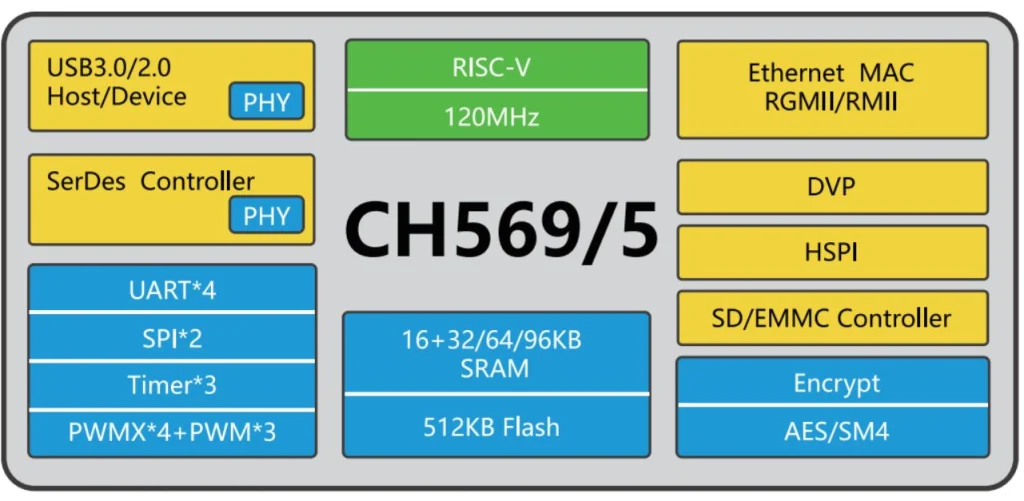
The hardware, firmware, and mechanical design are all open source. The developer built it around a small chip called the CH569, from the same company behind the CH340 USB-to-Serial chip you’ll find on most Arduino clones. It has USB3, SD/eMMC support, and a hardware AES block built in.
eMMC was too expensive due to AI-driven demand, so the developer went with an SD card instead. If someone tears the device apart they’ll find it, but everything on it is encrypted. The enclosure is sealed with epoxy, so any attempt to get inside means destroying it first. Once eMMC prices drop, a version using it will follow.
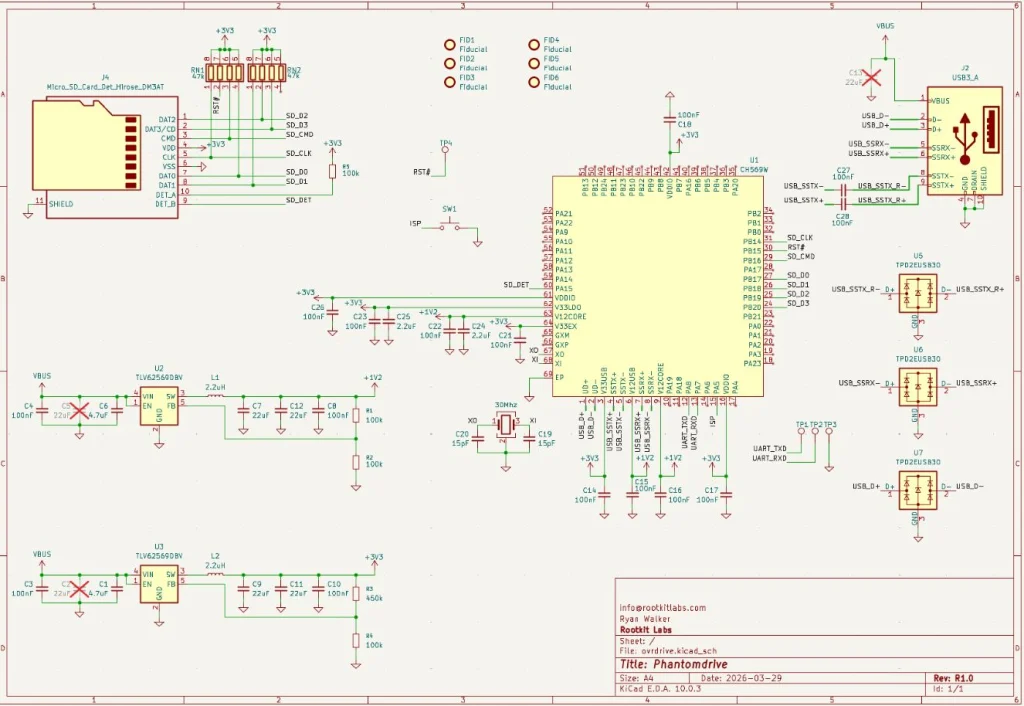
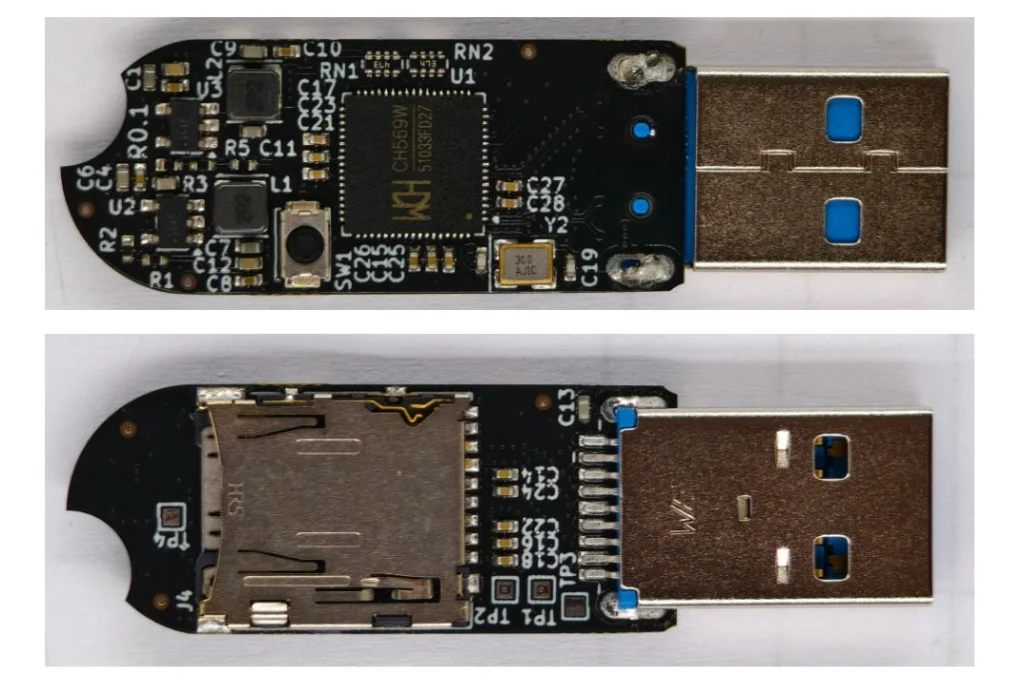
The board itself is simple. It’s a CH569 chip, a USB port, two buck converters, a firmware update button, an SD card, and some supporting components.
Cryptography
The developer verified encryption works through functional tests and ran it against OpenSSL’s AES implementation. Most of the GitHub issues that surfaced were AI-generated noise or already fixed bugs, with one real exception around AES-XTS covered below.
Key Derivation
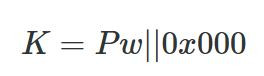
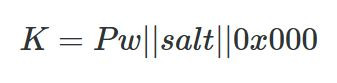
A Key Derivation Function (KDF) turns your password into an encryption key. The naive approach is padding the password to 32 bytes and using it directly.
That’s weak. A precomputed table could crack it without even brute forcing. To fix that, Phantomdrive adds a unique salt per device.
With different salts, an attacker has to compute keys for each device separately, and you can’t swap the SD card between devices. You can read your salt like this:
udevadm info --query=property --name=/dev/sdc | grep ID_SERIAL_SHORT
ID_SERIAL_SHORT=Phantomdrive:34FC1FA7145467F7
So, 34FC1FA7145467F7 is the salt for this device, which you will need to recover the data if it ever fails. Save that value. You can also change the Phantomdrive name and the USB PID/VID in firmware if you want more stealth. On top of the salt, the KDF runs 100,000 rounds of SHA-256.
That adds about 3 seconds to unlock time, which is already at the limit of what the chip can handle. Argon2 isn’t an option since it needs too much memory. If you need stronger security, you can increase the round count, use a software encryption layer on top, or look for a different device.
AES Modes
AES is a block cipher that works on 16-byte chunks. Different modes turn it into a stream cipher.
AES-ECB is the naive approach, encrypting each block directly. The problem is that identical plaintext blocks produce identical ciphertext blocks, which leaks patterns. Attackers can also manipulate the ciphertext in predictable ways. Not good.
AES-CTR solves this by encrypting a counter and XORing the output with plaintext.
The main risk with CTR is nonce reuse. If an attacker copies your ciphertext twice and can guess one version, they can recover the other. The developer gets around 9 MB/s write and 20 MB/s read with AES-CTR.
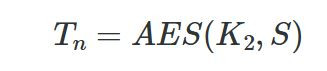
AES-XTS is the disk encryption standard and uses two keys. K1 protects the data, K2 generates a tweak per sector.
Each 16-byte block gets its own adjustment (T0, T1… Tn), then blocks are encrypted one by one to produce the final ciphertext.
It’s more secure but slower, around 6 MB/s write and 10 MB/s read on this hardware.
Firmware
The firmware is built on two open source libraries:
BSP: https://github.com/hydrausb3/wch-ch56x-lib
ISP: https://github.com/hydrausb3/wch-ch56x-isp
Password Snooping
The device doesn’t understand file systems. It just handles raw USB WRITE10/READ10 commands and passes them to the SD card. To detect the unlock password, the firmware scans every write for the string password: before passing data through.
void phantomdrive_snoop_write(uint8_t *buf, uint32_t len)
{
    const char *prefix = "password:";
    const size_t prefix_len = 9;
    uint32_t i;

    for (i = 0; i + prefix_len <= len; i++) {
        if (buf[i] != 'p')
            continue;
        if (memcmp(buf + i, prefix, prefix_len) != 0)
            continue;

        size_t pw_start = i + prefix_len;
        size_t pw_end = pw_start;
        while (pw_end < len && (pw_end - pw_start) < sizeof(pending_pw) &&
               buf[pw_end] != '\n' && buf[pw_end] != '\r' && buf[pw_end] != '\0')
            pw_end++;

        size_t pw_len = pw_end - pw_start;

        memcpy(pending_pw, buf + pw_start, pw_len);
        pending_pw_len = pw_len;

        memset(buf + i, 0, pw_end - i);
        return;
    }
}
Once the password is found, it gets copied into RAM and the buffer gets zeroed out so the password never touches the disk. Keep in mind, if you store a lot of data on the unencrypted partition and any of it contains the string password:, you could get a false match. If that’s a concern, you can change the trigger string in firmware or look for a different approach.
Video
The developer has also published a video, if you want to get into details of this project.
Summary
Phantomdrive is an open source USB drive that shows up as a plain 8GB disk while hiding the rest of its storage. You unlock the hidden partition by saving a password in a text file on the visible disk. The firmware catches it in the raw write traffic, keeps it in RAM, and never writes it to disk. Encryption is AES-256 on a CH569 chip, with a per-device salt and 100,000 SHA-256 rounds for key derivation. It’s limited by the hardware, so it’s weaker than memory-hard options like Argon2.
If you want to go deeper into how privacy can be preserved on real systems and how forensic traces are created and analyzed, our Anti-Forensics training is your next step. We covered advanced techniques for preserving your privacy and understanding what investigators can still see even when you think you have covered your tracks.
OpenAI expands ChatGPT's Chrome integration with tab access and browser automation. Learn what the update means for productivity, privacy, and enterprise security.
OpenAI expands ChatGPT's Chrome integration with tab access and browser automation. Learn what the update means for productivity, privacy, and enterprise security.
South Africans who fall victim to cybercrime now have more support available. MiDO Academy, The Cyber Helpline (UK) and Amazon Web Services (AWS) launched the pilot of The Cyber Helpline in South Africa, a free, confidential service providing practical guidance and compassionate support to individuals affected by online fraud, investment and employment scams, hacked accounts, phishing and smishing, social media fake profiles, sextortion, online harassment, identity theft, malware and ransomware incidents.
Built on Qwen3.5-2B, the System One model executes sub-31ms local inference, allowing enterprises to run automated classifications quickly, at low cost and completely offline without transmitting sensitive data to third-party cloud servers.
Quantum Readiness Day on September 24 is a useful reminder that the security work we do today is not only about preventing breaches tomorrow. It is about protecting data and digital trust for years to come.
Quantum Readiness Day on 24 September is a useful reminder that the security work we do today is not only about preventing breaches tomorrow. It is about protecting data and digital trust for years to come.
A quarter million commercial vehicles in India and sensitive data on tens of thousands of drivers were vulnerable to attacks because of flaws in widely used fleet management software maintained by a VE Commercial Vehicles, a joint venture between the Volvo Group and Eicher Motors, a security researcher has revealed.
A security researcher writing under the name tokay0 disclosed a flaw that could allow an attacker to access and control more than 600,000 deployed Shark model robot vacuums.

 Login