❌

Reading view

There are new articles available, click to refresh the page.

Cleveland’s big lesson for Seattle: A city’s job is to attract people

Charles Fitzgerald at an abandoned Westinghouse light bulb and fixture factory in Cleveland. (GeekWire Photo / John Cook)

Editor’s note: GeekWire has been examining the economic challenges facing Seattle and the lessons the region can learn from Cleveland’s industrial decline and ongoing comeback. This three-part series from GeekWire columnist and angel investor Charles Fitzgerald explores how Seattle can navigate its own economic transition, adapt to a changing technology landscape, and preserve the prosperity that generations of innovation have built.

As you think about Seattle’s next act, let me offer a catchphrase: Don’t be Cleveland.

Before anyone from Northeast Ohio takes me to task again, let me quickly clarify: Don’t be the Cleveland of the last half of the 20th century. Today’s Cleveland is a story Seattle should study.

I’m far from the only one worried about Seattle. City Hall, the Seattle Metropolitan Chamber of Commerce, and the newly formed Partnership for a Competitive Puget Sound are all sounding alarms about the region’s economic future.

An independent 127-page City of Seattle-commissioned economic assessment — Seawall: Building a Resilient Seattle Economy — takes issue with the Cleveland comparison I penned for GeekWire earlier this year. The report says claims that Seattle could become the “next Cleveland” are “likely hyperbolic,” while acknowledging that “Seattle has real economic challenges.”

Hyperbolic is far from the worst thing I’ve been called.

Despite a reluctance to fully embrace Cleveland as a cautionary tale, the city’s report provides more to agree with than disagree with. And kudos to the city for taking an honest look at the economy, including criticism of the mayor’s signature policies.

Preparing for Seattle’s Next Act

Over the past decade, Seattle delivered more broad-based prosperity than almost any U.S. region, according to the Seawall report. Wages rose across the income spectrum, with the biggest gains at the bottom. Even after adjusting for living costs, workers at the 25th percentile earned roughly 15% more than their counterparts in Atlanta, Charlotte, and Minneapolis.

That’s a remarkable record.

It also makes Seattle’s current economic anxiety harder to dismiss — and its prosperity worth protecting. If Seattle’s performance disappoints, where exactly would you rather be? Growth brings problems, especially when poorly managed. But the alternative is worse.

We saw the aftermath firsthand when we visited Cleveland earlier this year. Its story is a reminder that prosperity isn’t permanent — and rebuilding an economy after decades of decline is a lot harder than keeping one healthy.

Much like Seattle today, Cleveland 75 years ago was a very successful city riding decades of strong economic and population growth, and home to some of that era’s Big Tech giants. The Cleveland Browns even dominated the 1950s NFL.

But Cleveland’s prosperity unraveled quickly. 

The world changed. The Rust Belt started to rust. Employers closed down. 

Cleveland’s population dropped 59% from its 1950 peak to 2020 — from 914,808 to 372,624 residents.

It went from one of the nation’s richest cities to one of the poorest. Seahawks fans take note: the Browns have never been to the Super Bowl.

When we visited Cleveland earlier this year, we asked everyone from the mayor to real estate developers to arts leaders what they wish they’d done differently and sought their advice for Seattle. 

Author Charles Fitzgerald at an abandoned industrial site in Cleveland.

We learned a lot from a city hungry, united and focused on building prosperity for its residents.

Seattle rode the software boom to remarkable prosperity. Can it do the same in the AI era?

The warning signs are hard to ignore.

Amazon and Microsoft have cut more than 10,000 jobs across the Seattle metro area since 2023. Downtown office vacancy remains among the highest in the country. And the center of gravity for the AI boom is in the Bay Area, raising questions about Seattle’s ability to capture the next wave of growth.

The city’s economic report puts the challenge bluntly: “The version of the tech sector that drove the last wave of economic growth will not drive the next one.”

The report warns that Seattle’s next generation of startups may not be ready to replace the growth engines of the past. The risk isn’t just layoffs or empty office towers. It’s the company never founded, the midsize business squeezed by rising costs, or the engineer who leaves to build a startup somewhere else.

So how does Seattle prepare for its next economic chapter?

A Grand Unified Theory of Urban Success: Attract People

At its simplest, a city’s job is to attract people — and give them reasons to stay.

Population isn’t a perfect measure of prosperity, but it’s a useful proxy for a city’s appeal. People come for opportunity. They stay when the opportunities and quality of life are worth it. Growth brings challenges, but those are preferable to the alternative.

As Cleveland Mayor Justin Bibb told us, “I envy problems around growth.”

Seattle’s population has grown nearly 40% since 2000. 

But that growth is slowing as our economic engine sputters.
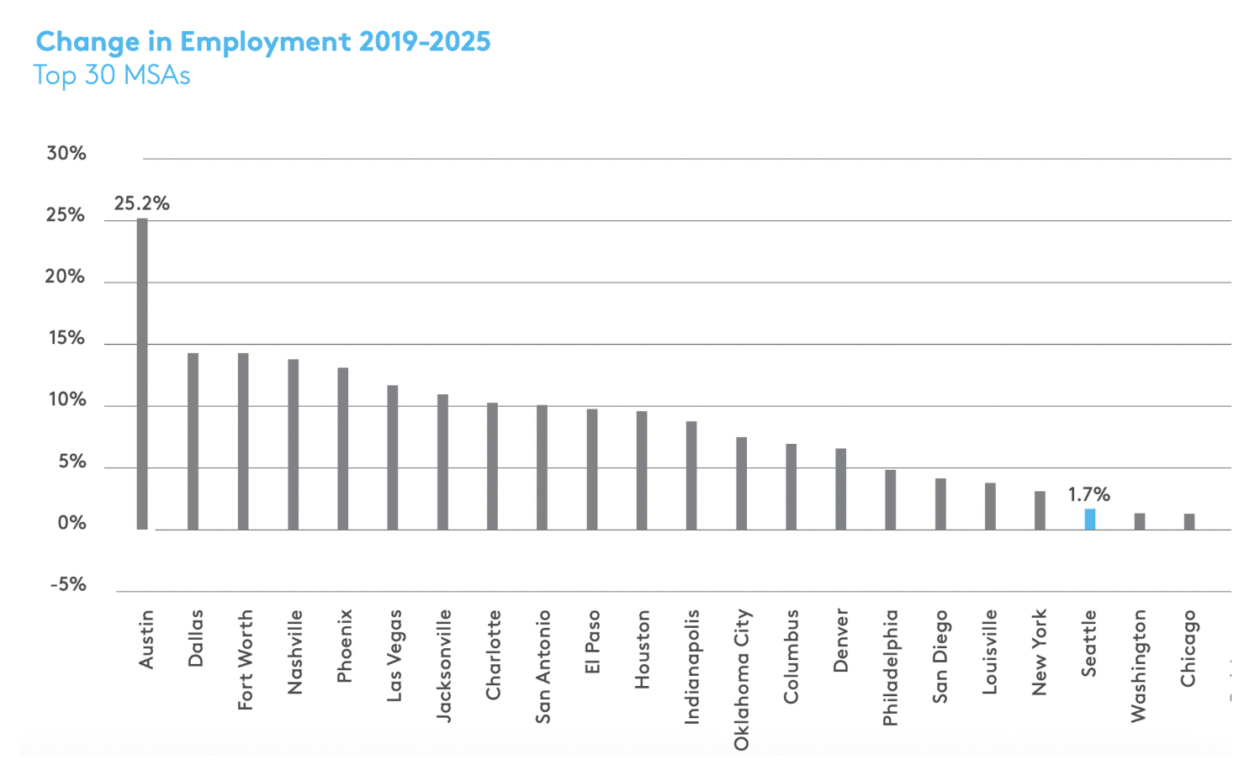
A new report shows weakness in Seattle’s job growth from 2019 to 2025. (Graphic via the Downtown Seattle Association)

The Boeing Bust of the 1970s, when Seattle’s population fell 7% and unemployment hit 17%, is a reminder that what goes up can come down.

Today, cities compete globally for talent, entrepreneurs and employers. That competition will only intensify as populations age and immigration restrictions tighten.

The most talented workers and entrepreneurs can go where they see the greatest opportunity — and where they feel wanted.

Consider what Seattle’s last century might have looked like without three people: Bill Boeing, Bill Gates and Jeff Bezos.

Boeing helped turn Seattle into an aerospace powerhouse. Gates chose to move Microsoft from Albuquerque to the Seattle area to usher in the software boom. Bezos and his then-wife, MacKenzie, famously drove their Chevy Blazer from Texas to Seattle to start Amazon.

Each helped shape the region’s economic future. We can’t predict who the next generation of business builders will be. But does Seattle have the same pull today? Or are the people we need choosing Austin, Miami, San Francisco or somewhere else?

Attracting newcomers matters. So does keeping the people who are already here. Do the economic opportunities still justify the cost of living? Is Seattle still a place where people want to live, work and play?

Residents have plenty of reasons to question the deal: public safety, housing costs, homelessness, schools, government services and taxes. Do the positives still outweigh the negatives?

Decades of growth brought extraordinary people and companies to Seattle. Our best chance of building the next era of prosperity is to keep them here — and give them room to build what comes next.

Yet we risk losing people and businesses we can’t easily replace: talented workers, entrepreneurs, executives, inventors, technologists, engineering teams and global headquarters.

As Seattle’s mayor waves goodbye to departing business leaders, the city’s own Seawall report offers a blunt warning: “Headquarters and top-tier tech jobs are very hard to replace.”

The report makes the broader case for growth, too. Losing tech jobs and companies won’t make Seattle more equitable, it warns. “If they leave, Seattle won’t become more equal, it will just become poorer.”

There’s a practical reason for that. Seattle’s fiscal model depends on a growing economy. 

More residents and businesses generate property and sales tax revenue without requiring higher tax rates on those already here. As the report puts it, “it is easier to distribute the benefits of a growing pie than a fixed one.”

That’s another way of saying that when government spending outpaces population growth, a stagnant economy leaves fewer options for paying the bills — a challenge we’ll revisit in the next post.

Thanks to Cleveland for reminding us prosperity is fragile, decline is real, and recovery can take generations. 

Seattle’s next era of prosperity is ours to build — or squander.

In the next post, we’ll look at what Seattle needs to do to get the fundamentals right to ensure the city is a great place to live, work and play.


Seattle voters view economy as weakening in survey that reveals short-lived World Cup euphoria

FIFA World Cup soccer matches in Seattle attracted huge crowds to watch parties in Pioneer Square and elsewhere, but the honeymoon faded quickly according to new data shared by the Seattle Metro Chamber this week. (GeekWire Photo / Kurt Schlosser)

Seattle embraced the global spotlight and rode a wave of economic euphoria when the FIFA World Cup came to town this summer, but according to new voter data out Tuesday, the city let that momentum slip away just as downtown businesses and major tech employers grapple with an ongoing economic squeeze.

The eleventh edition of The Index, a semiannual survey tracking voter sentiment commissioned by the Seattle Metropolitan Chamber of Commerce, reveals a sharp erosion in public confidence regarding the city’s economic trajectory.

According to polling of 700 Seattle voters conducted from Sept. 23 to Oct. 1 by public opinion research firm Fulcrum Strategic Group, 68% believe the city’s economy is getting weaker, 22% think it’s staying the same, and just 10% say it’s stronger.

While voters point to persistent quality-of-life concerns like public safety, homelessness and affordability, the findings underscore growing anxiety over Seattle’s business climate, at a time when major tech employers continue to evaluate their regional footprint and shift jobs across Lake Washington.

Seattle Metro Chamber President and CEO Joe Nguyen said the World Cup brought an energy and excitement downtown that was real and positive. But after a few months, there’s been no sustained honeymoon, and 65% of voters feel Seattle is losing positive momentum on public safety and quality of life.

“We demonstrated as a region what is possible when we all work together, and folks are already feeling that shift away,” Nguyen said during a media briefing Tuesday.

While chief concerns in the survey center on crime and public safety, economic health follows closely behind. In addition to widespread pessimism about the city’s overall trajectory, 71% of respondents agree that businesses are closing down or leaving for nearby cities because the cost of doing business in Seattle has gotten too high. Furthermore, 95% of those surveyed say it is difficult for small businesses to operate in the city.

When it comes to major employers — the tech giants and large corporations such as Amazon that anchor the regional economy and bear the brunt of taxes like the city’s JumpStart payroll levy — the survey reveals a striking disconnect.

The survey found 70% of voters recognize large businesses as essential to Seattle’s success, defying the narrative that the local electorate is anti-business. Andrew Thibault, partner at survey conductor Fulcrum Strategic Group, called it “the most interesting section” in the whole survey.

“Voters here deeply understand that their quality of life is connected to the health of the business environment and our ability to afford the things that we want to afford, like transit and schools, and environmental protections,” Thibault said. “All of those depend on a healthy business environment.”

But a significant knowledge gap persists around tax contributions. Voters estimated on average that large businesses pay just 37% of the city’s total tax revenue, with three-quarters believing that figure sits below 50%. In actuality, businesses pay 68% — more than two-thirds — of all city taxes, according to a recent tax analysis from the Chamber.

Underlying economic anxiety is playing out directly in City Hall’s budget debates. As major employers and tech giants navigate a shifting economic landscape — including recent reports showing downtown Seattle shedding 13,000 jobs in a single year while neighboring Bellevue’s tech hub expanded — voters are demanding a tighter rein on city spending.

The Index reveals that 66% of Seattle voters distrust the city to spend tax dollars responsibly, and nearly eight in 10 support requiring City Hall to prove existing spending is producing results before asking residents or major employers to pay more.

Those sentiments carry heavy weight as the city grapples with its budget. Facing what officials call “seismic shifts” in the tech sector, Mayor Katie Wilson’s proposed budget attempts to close a massive deficit through spending cuts while freezing the rates for corporate levies like the JumpStart payroll tax.

For Nguyen and the Chamber, the message from voters is clear: City Hall must focus on tangible delivery with existing resources rather than continuous policy shifts and progressive tax increases.

Pointing to the city’s reliance on core revenue streams like business and occupation (B&O), sales, and JumpStart taxes, Nguyen emphasized the risk of over-targeting a concentrated corporate base.

“Finagling with it too much creates a problem where the people who are reliant upon paying the taxes are also the ones being targeted,” Nguyen said. “So if they leave, it creates a multiplier effect in the wrong direction.”

Billionaire Jeff Bezos: ‘Success is not villainy’

Amazon founder Jeff Bezos is interviewed by Bret Baier of Fox News in Florida. (Screen grab via Fox News)

When Jeff Bezos sat down on Blue Origin’s Cape Canaveral factory floor for an interview with Fox News’ Bret Baier earlier this week, he laid out an unapologetic defense of free enterprise and wealth creation.

“Success is not villainy,” Bezos said.

The Amazon founder’s point was simple: building a massively successful enterprise isn’t something society should apologize for or view with suspicion, it’s the natural result of creating something people actually want.

“There’s nothing wrong with making unbelievably good chicken that people love,” Bezos said, referencing the growth of Raising Cane’s and why restaurant entrepreneurs deserve their wealth. “And it doesn’t make him a bad person.”

Bezos, who stepped down as CEO of Amazon in 2021 and left Seattle for Miami in 2023, is currently the second richest person in the world with an estimated net worth of $380 billion, according to Forbes.

Bezos and Amazon transformed the Seattle region. The company now employs roughly 50,000 corporate and tech workers in the Puget Sound region, divided between its primary headquarters in Seattle and its growing operational footprint in Bellevue.

And his recent comments come at a key moment for Washington state, where voters will decide on Initiative 645 — a high-profile ballot measure aimed at repealing the state’s recently enacted high-earner tax and prohibiting future income taxes.

Bezos, along with other business leaders like former Starbucks CEO Howard Schultz, have claimed that scapegoating wealthy entrepreneurs risks driving away innovation. Bezos argued that politicians targeting business leaders are misdiagnosing the problem, noting that while affordability and social challenges are real, heavy-handed government interventions often fail to solve them.

“If there’s a politician who’s picking villains and pointing fingers, that probably means they don’t have a solution,” Bezos said. He noted that executives who relied on blame-shifting inside his own companies “wouldn’t be in our company for long.”

Watch the full interview below where Bezos also discusses the impact of AI on jobs, the need to beat China in the race to the moon and orbital data centers in space. The portion of the interview where Bezos notes that “success is not villainy” starts in minute 16.

Microsoft responds to White House immigration crackdown as Trump honors Nadella

Microsoft CEO Satya Nadella receives the National Medal of Technology and Innovation from President Trump on Thursday at the “Science: A New Golden Age” summit in Washington, D.C. (White House video screenshot)

The Trump administration suspended Microsoft from the federal program the company uses to help foreign workers stay in the U.S. permanently, accusing the tech giant of abusing the system.

The announcement by Vice President JD Vance, during a news conference Thursday morning at the White House, came hours before President Trump gave Microsoft CEO Satya Nadella the National Medal of Technology and Innovation in a ceremony honoring Elon Musk and other tech leaders.

Vance said Microsoft laid off 6,000 American workers last year while getting 6,300 H-1B visas and nearly 3,000 green cards, which he said amounted to replacing U.S. employees with lower-paid foreign workers.

“There has been no company in the United States, unfortunately, that has abused the system more than Microsoft,” Vance said at the news conference, while adding, “Our message to Microsoft is you’re a great American company, but you’ve got to hire great American workers.”

Microsoft’s response: In a statement, the company said 80% of the roughly 6,000 H-1B applications it filed last fiscal year were to extend or change the status of people who already work for the company. The rest were for new hires who were already living in the U.S. legally, a group equal to about 1% of its U.S. workforce.

“They are not new arrivals to our country,” the company said.

Microsoft said it pays H-1B employees “the same as any other employees doing comparable work,” that its wages are “among the highest of all H-1B filings,” and that the vast majority of its U.S. employees are Americans.

The statement didn’t mention the suspension, but the company said it looks forward to “providing the Administration with additional information.”

Details of the penalty: The suspension covers the Labor Department’s Permanent Labor Certification program, known as PERM. It’s usually the first step when a company sponsors a foreign employee to live and work in the U.S. permanently. To get approved, the employer has to advertise the job and show the government that no qualified American worker was available.

Labor Secretary Keith Sonderling said the department won’t accept new applications from Microsoft or process the ones it already has pending. The move doesn’t stop Microsoft from applying for H-1B visas, the temporary work visas that many PERM applicants hold.

The department also suspended Adobe and six IT outsourcing firms: Cognizant, Infosys, Tata, Wipro, HCL and Capgemini.

Trump didn’t mention the suspension at the ceremony. Introducing Nadella, he credited him with making Microsoft “an early leader in superintelligence” and said, “Satya, we are honored to give you the National Medal of Technology and Innovation. It is so well deserved.”

The official citation honored Nadella “for his transformative leadership of a critical American technology company” and for building the “hyperscale infrastructure that enabled the training and global deployment of American superintelligence.”

Tech industry reaction: The announcement drew pushback in Seattle’s tech community.

“There has been a continuous, nonstop deluge of immigration-related news leading up to the midterms,” said Xiao Wang, co-founder and CEO of Boundless, a Seattle startup that helps people navigate the U.S. immigration process.

Wang pushed back on Vance’s characterization of H-1B workers as “foreign indentured servants,” noting there are wage requirements to prevent underpayment of employees. He emphasized the economic benefits of educating and employing the students and workers who seek these visas — and what happens if they’re discouraged or prevented from coming to the U.S.

“What I have been trying to warn folks about is the long-term chilling effects that would be detrimental to the long-term prosperity and competitiveness of the United States,” he said.

Wang said the idea that the layoffs and recruitment of foreign-born workers are linked doesn’t make sense. “Layoffs and hiring are not one for ones of each other, especially at giant companies like Microsoft,” he said.

Someone laid off from a gaming division at Microsoft isn’t interchangeable, for example, with an H-1B employee who’s an expert in agentic AI for a Copilot role, he said.

Priyanka Kulkarni, founder and CEO of the immigration technology company Casium, previously worked at Microsoft for more than a decade building enterprise AI technology. She personally navigated H-1B status before becoming a permanent resident.

“I worked alongside people from around the world whose expertise helped build technology used by American businesses every day,” she said, adding, “America wants to lead in AI. That requires attracting and retaining exceptional people, and giving them confidence that they can build a future here.”

Kulkarni called the phrase “foreign indentured servants” troubling, and said it exposes a contradiction in the administration’s action.

“If the concern is that workers depend too heavily on their employers, blocking their path to permanent residency could deepen that dependence,” she said. “Permanent residency gives people more freedom to change jobs, negotiate pay, and start businesses.”

In effort to diversify economy and build resilience, Seattle Mayor names 18 leaders to new task force

City of Seattle Mayor Katie Wilson set up a new task force to bolster the economy. (Photo via Katie Wilson for Mayor)

Seattle Mayor Katie Wilson is bringing together leaders from Amazon, Spotify, the Port of Seattle, organized labor, technology, cleantech, small business and other sectors as part of a new task force focused on rebuilding and diversifying the city’s economy.

Wilson on Wednesday announced 18 members of the Resilient Seattle Economy Task Force, which will look for ways to remove barriers to business growth, attract and retain companies and improve the process of starting and operating a business in Seattle.

“I’m charging this task force with identifying where the City can make connections, remove barriers and provide support within individual industries and across our economy,” Wilson said. “We need to diversify our economy while expanding opportunities for local entrepreneurs and young people.”

The effort builds on the city’s recently released Seawall: Building a Resilient Seattle Economy report, which called for Seattle to diversify beyond its heavy reliance on large technology companies and focus on sectors including artificial intelligence, cleantech, maritime, life sciences and space.

That report found that companies with at least 100 employees accounted for 74.5% of net job growth in the Seattle metro area from 2014 to 2023, while mid-sized companies accounted for just 16.6%.

The economic challenges have also put a spotlight on Seattle’s tax structure. As GeekWire recently reported, Seattle lost roughly 24,000 jobs between March 2020 and March 2025 even as city tax collections continued to grow, shifting more of the tax burden onto businesses.

Wilson has responded in part by freezing JumpStart tax rates in her proposed 2027 budget, citing “seismic shifts” in the technology sector.

The new task force will initially focus on downtown revitalization, business attraction and retention, cross-sector collaboration, and making it easier to open and operate a business. The task force also comes as Seattle’s business community has pressed City Hall for action on public safety, with dozens of regional CEOs recently calling for a 100-day plan with measurable goals and progress reports.

“Seattle is open for business,” said Beto Yarce, director of the Seattle Office of Economic Development.

The task force will hold industry-specific roundtables and listening sessions this year, with initial findings due in February 2027 and a final report expected in November 2027. Here’s a look at the task force members:

  • Jared Axelrod, Sr. Manager, Public Policy, Amazon 
  • Katie Garrow, Executive Secretary-Treasurer, MLK Labor 
  • Yifan Zhang, Managing Director, AI House 

Opinion: Washington’s new state income tax must be repealed

The Legislative Building in Olympia, where Washington lawmakers passed a 9.9% tax on household income above $1 million earlier this year. Initiative 645 on the November ballot would repeal it. (Photo by Nils Huenerfuerst via Unsplash)

Editor’s note: GeekWire publishes guest opinions to highlight a range of perspectives on issues shaping the tech and startup community. To submit a guest column, email tips@geekwire.com.

This fall, Washington state voters will once again have to defend their economic future and core competitive edge by voting yes on Initiative 645 to repeal the state income tax.

Earlier this year, state lawmakers established the new state income tax. Supporters claim that this tax will only impact higher-income earners. But the measure includes broad new income taxing powers that make every Washingtonian and those doing business in the state a target.

How do we know this? Legislators have made it clear by their actions — and actions speak louder than words!

Most notably, the income tax was written specifically to cover pensions, reversing Washington’s previous commitment to not tax pension retirement income. While teacher, firefighter and other pensioners are not initially paying the state income tax, the only reason to make their income subject to the tax is to require them to pay when it is lowered to apply to them.

Second, Olympia actually voted twice on the income tax — once to pass the income tax, and a second time to ensure they could expand it to everyone. They wanted to make clear their intent to voters.

Finally, the income tax is already driving people out of the state, which will result in lower tax revenues. We can be confident that Sen. Jamie Pedersen (who has stated publicly that he supports a universal income tax on all Washingtonians) and the Legislature will use that shortfall as justification to apply the tax to many more Washingtonians. So, unless you vote yes on I-645, you can expect to pay the income tax soon.

Even the state’s most prominent Democrats are calling out Olympia’s runaway spending. Former Gov. Christine Gregoire told Washington business leaders recently that Olympia has “a spending problem, not a revenue problem,” noting the state budget has grown from $33 billion to $80 billion since she left office. Former Gov. Gary Locke, similarly, called Olympia’s spending “out of control.”

Two Democratic governors, sounding the same alarm, should tell legislators to focus on spending cuts, not tax increases. But, instead of looking for savings, Washington’s political leaders passed the largest tax and spending increase ($9.3 billion) in state history in 2025, and then followed it up with another $2.3 billion spending increase in 2026.

The pattern is as clear in Washington as it is in other states that are falling behind competitively: no matter how much citizens hand over in taxes, legislators always think it’s never enough. Giving lawmakers even more of our tax dollars when they have failed to responsibly manage what they have hurts everyone in the state.

Beyond the impact to personal paychecks, there are two long-term consequences that will negatively impact voters — whether they pay the tax or not.

First, job creators and job opportunities are leaving the state. National IRS migration data already shows high earners leaving high-tax states at an accelerating rate. Washington ranks sixth highest in the nation for losing higher-income residents, and a state income tax will accelerate this trend. A 2026 Association of Washington Business survey found nearly 1 in 4 Washington employers are now considering relocating out of state, nearly triple the rate from just a year earlier.

Companies such as Starbucks, moving a large share of its corporate workforce to Nashville, are shifting operations and jobs out of the state in response to the increasingly hostile tax climate and the costs of doing business. Sadly, the result is that Washington has an unemployment rate hovering near 5%, tied for sixth highest in the country and nearly a full percentage point above the national average.

Second, avoiding the tax effectively means cutting all ties to Washington. Under the new law, it appears taxpayers can only shed their Washington domicile by spending 30 days or fewer in the state a year and selling their home. It’s no surprise active home listings are up an average 27% in much of Washington this year.

This rule is also an existential threat for the state’s largest nonprofits, as financial advisors are already telling clients the “gold standard” for anyone trying to sever ties is to stop philanthropic giving in Washington entirely.

The last time Washingtonians voted on an income tax was in 2010. That income tax proposal, I-1098, was rejected by a 64%-36% voting margin. Companies including Microsoft, Boeing and Expedia, as well as the founders of Amazon and T-Mobile, supported the effort to stop the income tax. They were right to do so for the benefit of their employees and the citizens of Washington.

In the years since, economic growth and investment enabled the state spending budget to dramatically increase from under $30 billion to more than $80 billion without an income tax. Washington cannot afford to follow the path of states like New York and Oregon, where out-of-control spending leads to higher taxes and an increasingly difficult climate for families and businesses. We need a state that can compete!

This November, voters have the opportunity to send a message to politicians by doing what they have done time and again: vote yes on I-645 to repeal the state income tax and help Washington succeed for generations to come.

Seattle’s tax burden shifted to business as jobs slipped away, new report finds

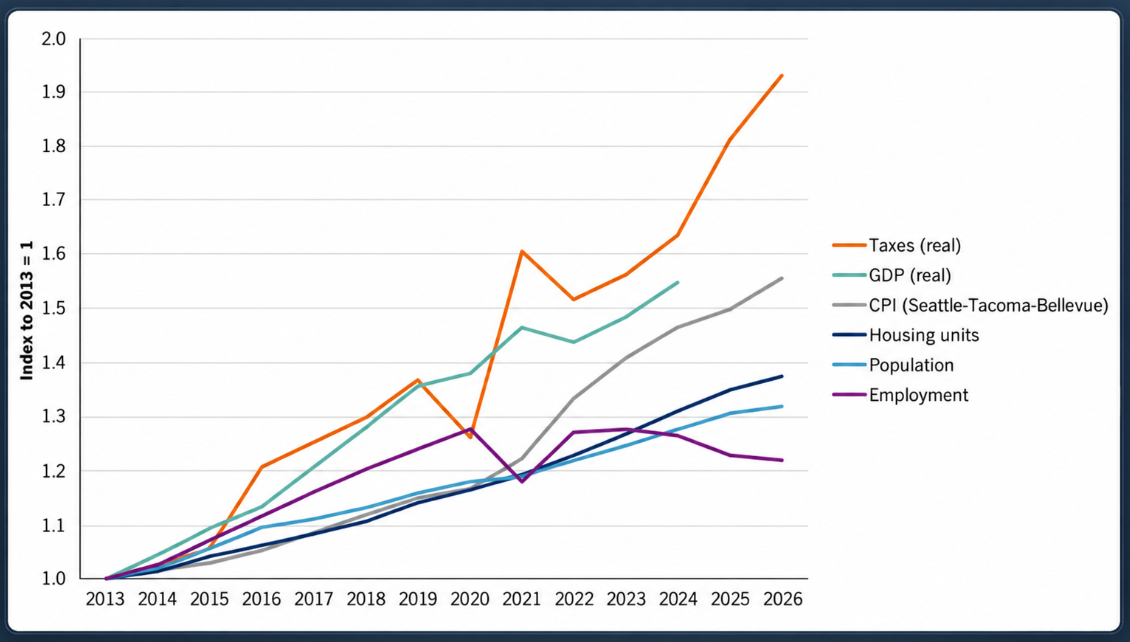
Taxes have outpaced population, employment and other other factors in Seattle (Image via ECOnorthwest)

Seattle’s tax collections have nearly tripled over the past decade, soaring from $900 million in 2013 to a projected $2.8 billion in 2026. But who pays those taxes, and how the tax revenue is collected, looks vastly different today than a decade ago.

A new report released by ECOnorthwest, commissioned jointly by the Downtown Seattle Association (DSA) and the Seattle Metropolitan Chamber of Commerce, show city tax revenues far outstripping population and job growth, driven by targeted corporate taxes on a small pool of major employers.

Between 2013 and 2025, Seattle’s tax revenues jumped 172%, outpacing population growth (31%), job growth (23%), and local inflation (50%). During that period, real tax growth grew 5.6 times faster than population and 7.5 times faster than employment.

The findings come as city leaders, major tech employers and regional business groups grapple with shifting post-pandemic work patterns and a political climate that has frequently placed large technology companies like Amazon in its sights.

According to the report, broad-based core taxes, such as property, sales, utility, and general Business & Occupation (B&O) taxes, comprised 83% of city tax collections in 2013. By 2026, those core broad taxes are projected to drop to just 52% of the total revenue.

Replacing them are narrow, targeted tax levies:

  • The JumpStart Payroll Expense Tax (2021): Paid by fewer than 500 companies, with the top 10 taxpayers footing 73% of the total bill.
  • The Social Housing Tax (2025): Paid by roughly 220 entities, with its top 10 taxpayers covering 66%.

Combined, two taxes that did not exist five years ago now account for nearly a third of all business tax dollars collected by the city. Overlap among top taxpayers means fewer than 20 companies account for roughly $356 million in annual City of Seattle revenue.

“Seattle’s tax collections are growing far faster than its population, jobs or inflation. Employers are carrying more of that burden. That trajectory is not sustainable,” said Seattle Metro Chamber president & CEO Joe Nguyen. “The question cannot always be how to collect more money. It must be how to deliver better results with the money we already have and build a tax structure that helps our economy grow.”

The heavy pivot to business revenue coincides with divergent employment trends between Seattle and its neighboring Eastside hubs.

Between March 2020 and March 2025, Seattle lost approximately 24,000 jobs, while the remainder of King County added 21,000. The report notes that Seattle lost 18,000 jobs in the single year leading up to March 2025 alone. And that figure that does not yet capture the full impact of major remote work policies and tech layoffs announced across the region.

The report arrives on the heels of previous GeekWire coverage tracking regional tech dynamics, including the shift of high tech jobs from Seattle to Bellevue, as well as broader political shifts in how West Coast hubs are responding to tech sector backlash and the AI boom.

However, in a sign that Mayor Katie Wilson is paying close attention to tech-sector headwinds and shifting job patterns, she proposed a $9.1 billion 2027 budget that would erase a $175 million general fund deficit and cut nearly $50 million in spending while freezing JumpStart tax rates.

Amazon pledges $1B to data center communities, warns that local opposition threatens U.S. AI lead

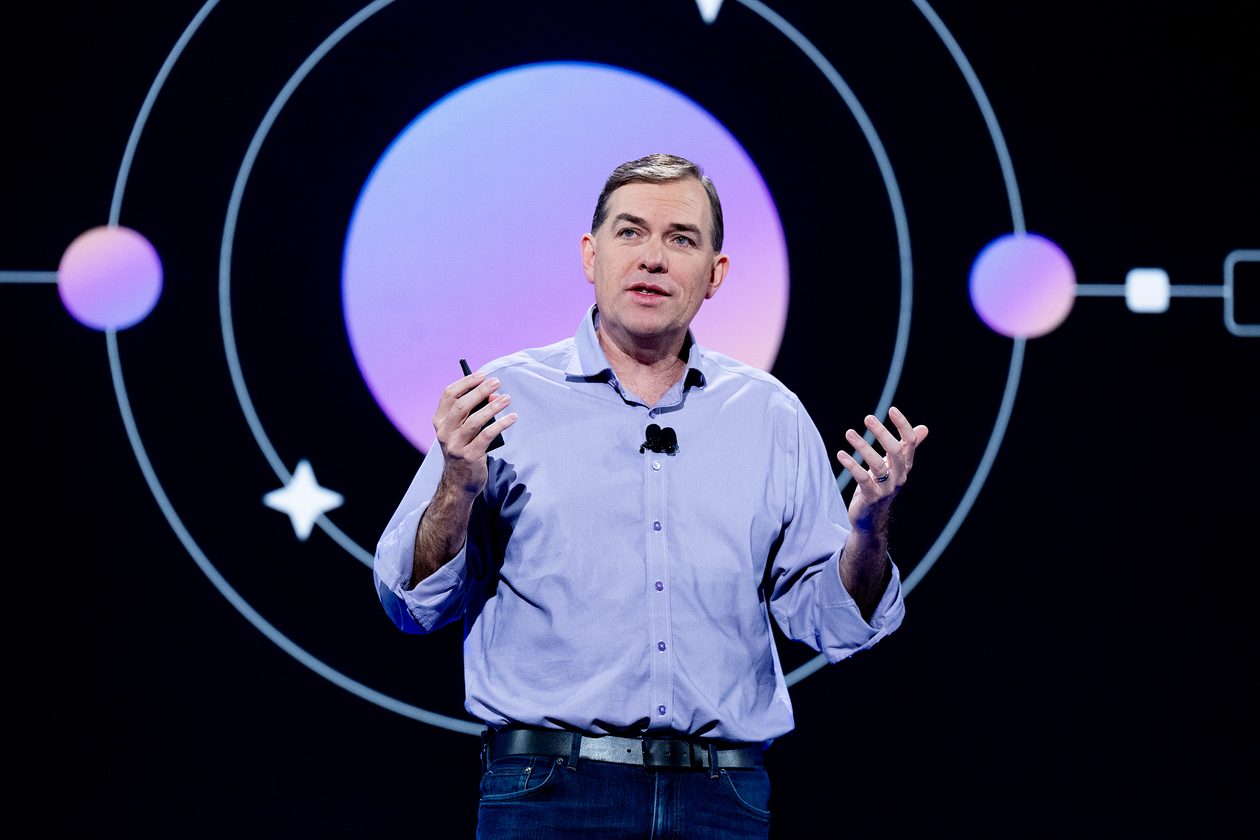
Matt Garman speaks on stage in a light purple button-up shirt, gesturing with both hands and holding a presentation clicker, in front of a dark screen showing a purple circle with orbit lines.
Amazon Web Services CEO Matt Garman, shown at AWS re:Invent in 2025, says local opposition to data centers threatens the U.S. position in the AI race. (Amazon Photo / Noah Berger)

Amazon says it will spend more than $1 billion over five years in the U.S. communities where it builds and operates data centers, responding to a growing backlash across the country against the tech industry’s massive AI infrastructure buildout.

The company’s new program, which it calls “Built Together,” will fund free community college, job training, energy upgrades for homes and schools, and other local projects identified by data center communities. It comes on top of more than $1 billion that Amazon says it has given to communities over the past three years.

Amazon also says it will stop using NDAs with government agencies on data center projects, install lower-emission backup generators at new sites, publish its energy and water use each year, and pay enough for power to keep local electricity bills from rising.

Announcing the commitments in a post Friday morning, Amazon Web Services CEO Matt Garman said local opposition to data centers — which he asserted is stoked by “misinformation and outright lies” — threatens the country’s position in the global race for AI leadership.

“Right now there are over 100 data center moratoriums being considered across the country,” Garman wrote. “If these measures are enacted, the U.S. could be writing its own losing ticket to this race, and the consequences would last generations.”

The business stakes: Amazon is making an unprecedented bet on AI, projecting about $220 billion in capital expenses this year, largely on data centers and chips. That’s more than the cash its business generates on an annual basis.

By comparison, the additional $1 billion in community funding over five years works out to about $200 million a year, or about one-tenth of 1% of this year’s projected capital spending.

Amazon’s AI strategy depends on finding communities willing to host its data centers. Microsoft, Google and other tech giants are spending on a similar scale, to meet current and anticipated AI demand, and they face the same problem.

Local opposition has become a real limit on the AI buildout. At least 75 data center projects worth about $130 billion were blocked or delayed in the first three months of the year alone, according to Data Center Watch, a group that tracks these disputes. An Economist/YouGov poll in late August found that 63% of Americans would oppose a data center in their community.

Pushing back on the narrative: Much of Garman’s post is a point-by-point rebuttal of what he calls myths about data centers.

He called it “false” that data centers are sucking up all the water in communities, “misleading and convenient scapegoating” to blame them for driving up all electricity rates, “untrue” that their backup generators emit huge amounts of pollution, and “false” that communities get nothing in return.

Amazon’s average data center uses less than 13,000 gallons of water a day, he wrote, and backup generators sit idle 99.9% of the time. Where electricity rates are rising, he attributed it primarily to an aging grid.

Garman pointed to “widespread reports of various countries intentionally seeding misinformation in the U.S. about data centers to trick us into slowing down.” OpenAI and X have each reported China-linked accounts posting about data centers.

However, PolitiFact reported last month that the role of foreign influence in the opposition to data centers has been exaggerated, with little sign the accounts reached a wide audience.

“We understand why there is apprehension in some communities where data centers are being built,” Garman wrote. At the same time, he said Amazon and other data center operators have already taken many steps to address those concerns.

The new commitments, he wrote, are a way to codify the company’s existing practices.

Where Amazon and Microsoft differ: Microsoft promised in January not to seek local tax breaks for its data centers. Asked by GeekWire whether it would do the same, Amazon did not make that commitment. The company said it is the largest taxpayer in almost every community where it operates, and that local governments offer incentives to attract its projects.

In his post, Garman pointed to St. Joseph County, Ind., where he wrote that Amazon is expected to pay more than $3 billion in taxes on land that would have generated $1.2 million under its prior use. In Madison County, Miss., he cited more than 2,300 construction workers now on the job and more than 1,700 operations jobs to come.

In 2023, Good Jobs First, a watchdog group that tracks corporate subsidies, reported that five Amazon data centers in Morrow County, Ore., would receive about $1 billion in property tax breaks over 15 years, which the group called the largest known subsidy in the company’s history at the time.

Microsoft also went further on NDAs, saying in March that it would terminate its existing nondisclosure agreements with local governments. Amazon said its change applies going forward, and that it doesn’t plan to revisit past agreements, most of which no longer apply once a project becomes public.

Power costs: Amazon was among seven companies that signed a White House pledge in March to pay for the power and grid upgrades their data centers require.

The new commitment repeats that pledge, which the company said reflects what it was already doing. Amazon has long structured its power agreements to cover the full cost of serving its data centers, it said, with rates approved by state utility regulators.

In his post, Garman disputed that data centers are to blame for rising electricity rates. Among states with large numbers of data centers, he wrote, rates have risen in some, including Illinois and New York, and fallen in others, including Indiana and Mississippi. He wrote that new grid capacity, funded by the private sector, should lead to flat or lower rates for nearby residents.

However, according to U.S. government data reported by CNBC, residential electricity prices in three states with high concentrations of data centers were up sharply in August 2025 from a year earlier: 13% in Virginia, 16% in Illinois and 12% in Ohio, compared with 6% nationally.

Climate goals: Amazon’s carbon emissions rose 16% last year as the company expanded its data center capacity. Kara Hurst, Amazon’s chief sustainability officer, said at Climate Week NYC last week that the company remains committed to reaching net-zero emissions by 2040.

Garman wrote that Amazon has been the largest corporate buyer of carbon-free energy since 2019. Under the new commitment, the company each year will publish the share of its energy that comes from carbon-free sources.

On water, Amazon says it is committed to returning more water to communities than its data centers use by 2030, and was 75% of the way to that goal as of 2025. Microsoft made a similar pledge in January.

Where the money goes: Amazon’s Built Together program is organized around three areas: education and job training, energy and water, and flexible funding for local priorities.

Addressing questions from GeekWire, Amazon didn’t provide a full breakdown of the $1 billion, but said it expects to put more than $100 million up front into community college endowments and roughly another $100 million into expanding its training centers.

Under the program, Amazon says it will:

  • Cover out-of-pocket community college costs for an estimated 300,000 students in data center communities over five years. The company says agreements with 26 colleges are already in the works.
  • Build 16 more training centers on or near data center sites, offering free certification programs in skilled trades. Amazon operates three of the centers now and has six more in development.
  • Fund energy-efficiency upgrades at more than 300 schools and community buildings and more than 30,000 homes.
  • Provide annual funding through local nonprofits and community foundations for projects such as roads, parks and fire equipment, with priorities set by each community.

“Every community is different,” Garman wrote. “What matters most in rural Oregon is not the same as what matters in suburban Virginia or a mid-size city in Ohio.”

The local funding will reflect those differences, he wrote, saying that Amazon is not deciding what communities need but rather “providing resources and letting communities decide.”

GeekWire reporter Lisa Stiffler contributed to this story.

Report: Downtown Seattle lost 13,000 jobs in a year, while Bellevue’s tech hub boomed

A display at the Downtown Seattle Association’s annual event. (GeekWire Photo / Lisa Stiffler)

Seattle’s economic engine is stalling, and downtown is taking the brunt of the hit.

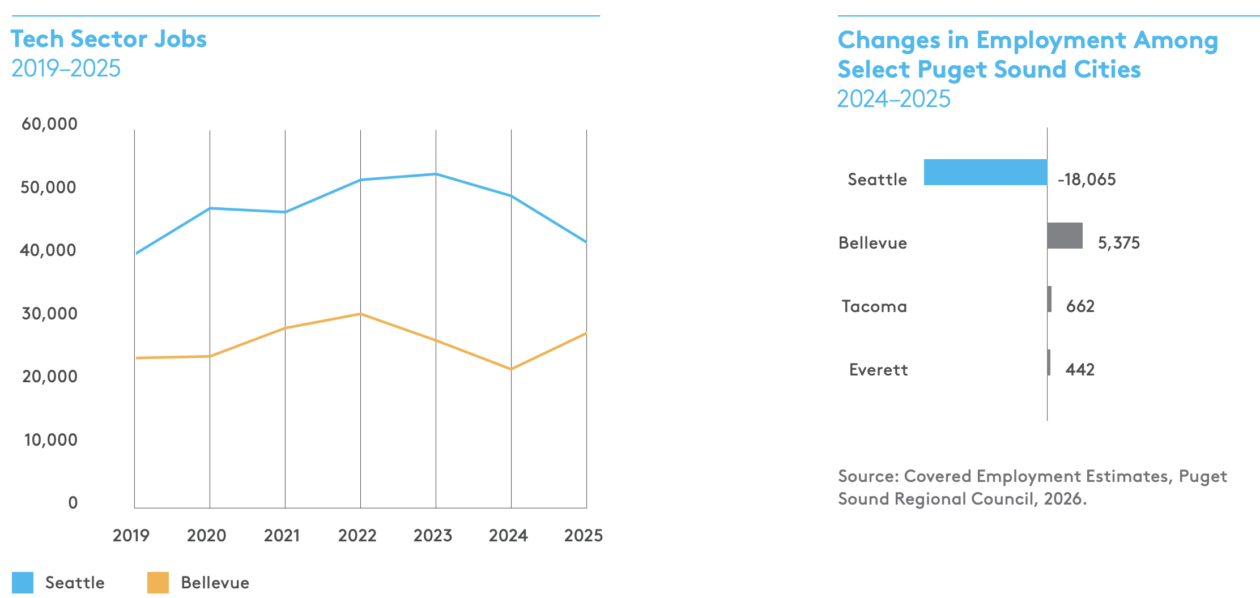
Between 2024 and 2025, Seattle shed 18,065 total jobs, with a staggering 70% of those losses—13,000 jobs—coming directly from the city’s downtown core, according to a new report released by the Downtown Seattle Association.

In some ways, it’s a tale of two cities.

While Seattle proper shrank, neighboring Eastside tech hub Bellevue gained 5,375 jobs over the same timeframe, highlighting a shifting center of gravity within the Puget Sound region.

A lot of that growth in Bellevue, and decline in Seattle is coming from one company: Amazon.

The online retail and cloud computing powerhouse employed 15,700 workers in Bellevue at the end of 2025, making it the largest employer in Bellevue at 9.85% of the total workforce, according to the city’s Annual Comprehensive Financial Report. That’s up from just a few hundred employees in Bellevue nearly a decade ago.

Amazon employs about 49,000 people in Seattle proper, though the Puget Sound Business Journal noted this week that the company has shed office space in downtown Seattle and dramatically slowed employment in the city.

A major shift is happening in tech employment as Bellevue’s tech employment grows, while Seattle’s shrinks. (Graphic via the DSA)

Other key findings from the Downtown Seattle Association report:

  • Tech Leads the Drop: Seattle’s sharpest sector declines were concentrated in Information and Technology, Professional Services, and Construction.
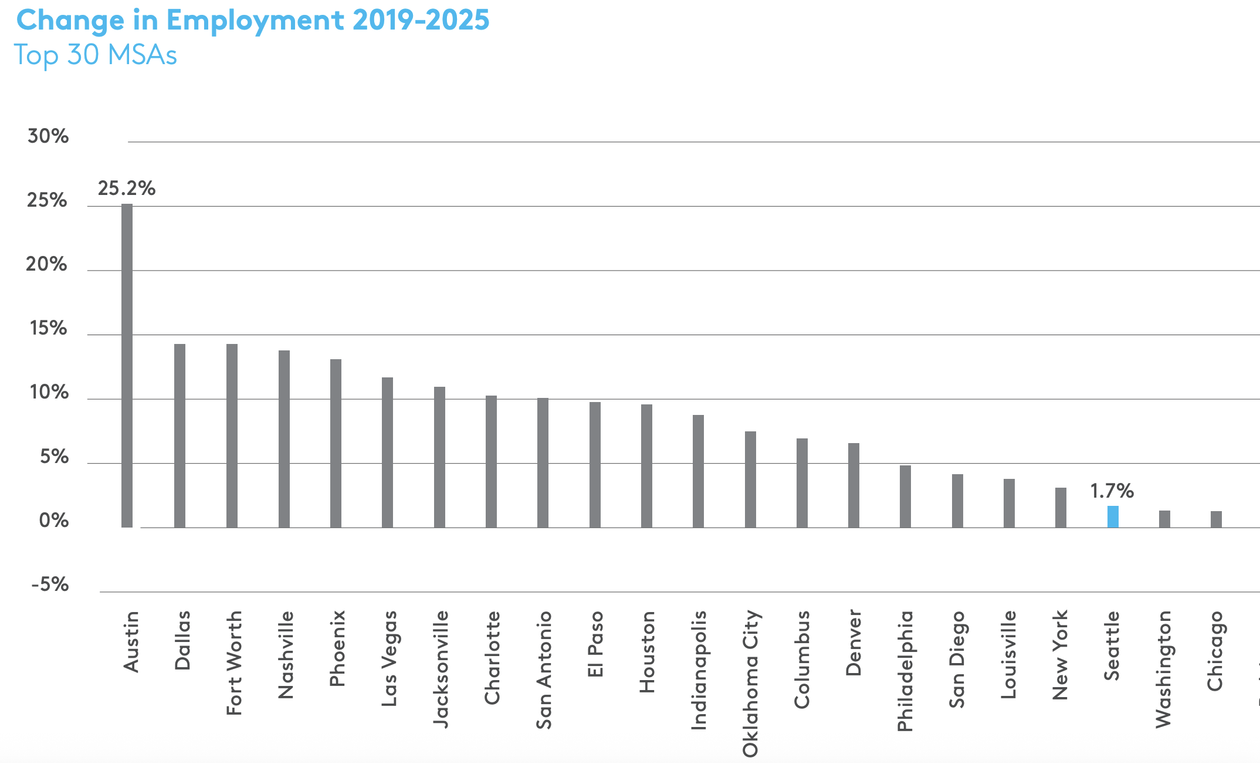
  • National Lag: Out of the top 30 U.S. metropolitan statistical areas, the Puget Sound region ranked 20th in job growth between 2019 and 2025. Total regional nonfarm growth rose just 1.7% over six years, vastly underperforming peer markets like Austin (25.2%), Dallas/Fort Worth (14%), and Nashville (14%).
  • Stagnant Commuter Foot Traffic: Inbound commuter visits to downtown Seattle remain stuck in the low 60% range compared to 2019 baselines, sliding 38% since the pandemic — a steeper loss than Bellevue (-21%), Austin (-23%), or Chicago (-32%).
  • Intra-Region Tech Shift: While Seattle’s tech headcount dropped from its 2023 peak, Bellevue’s tech job totals surged upward between 2024 and 2025, regaining momentum.
A new report shows weakness in Seattle’s economic growth from 2019 to 2025. (Graphic via the DSA)

The latest findings build on a growing chorus of criticism regarding the city’s fiscal climate. A June analysis by the DSA argued that Seattle’s controversial “JumpStart” payroll expense tax—passed in 2020 and targeting major employers like Amazon—is backfiring by driving business across Lake Washington.

The June report highlighted that since 2020, downtown Seattle lost roughly 30,000 jobs and saw office building values plummet 48%, while Bellevue—which levies no comparable head tax—gained jobs and expanded commercial values by 7%.

Though JumpStart projects $388 million in revenue this year, about 70% of that relies on just 10 major companies, underscoring how heavily Seattle leans on a handful of tech giants.

City of Seattle Mayor Katie Wilson has consistently pushed back against blaming downtown’s struggles on any single tax, pointing to broader post-pandemic remote-work trends, high interest rates and national tech restructurings that affect cities nationwide. She credited JumpStart with saving the city from drastic service cuts during the pandemic and noted that Seattle’s recovery remains resilient.

However, in a sign that Mayor Wilson is paying close attention to tech-sector headwinds and shifting job patterns in the region, she last week proposed a $9.1 billion 2027 budget, which would erase a $175 million general fund deficit and cut nearly $50 million in spending while freezing JumpStart tax rates.

Citing “seismic shifts” in the technology sector, the mayor’s freeze leaves the payroll tax untouched to offer big employers a period of tax stability, even as she continues directing JumpStart revenues beyond their original intent to cover core general fund operations.

“These were a set of taxes that may have provided some short-term gain to the city coffers, but are inflicting long-term pain,” DSA President and CEO Jon Scholes told GeekWire in an interview in June. “We predicted that at the time, and were sort of dismissed and ignored.” 

Facing ‘seismic shifts’ in tech sector, Seattle mayor freezes JumpStart tax rates in new budget

Seattle Mayor Katie Wilson delivers her proposed budget at Seattle Central Library. (YouTube screenshot via Seattle Channel)

Seattle Mayor Katie Wilson on Tuesday proposed a budget that closes the city’s inherited deficit largely through spending cuts and rules out new taxes on big business. That includes any increase to the JumpStart payroll tax she helped create, a decision that comes amid a rocky stretch for the region’s tech industry.

The $9.1 billion proposed 2027 budget, the first year of the city’s 2027–28 biennial plan, aims to erase a $175 million General Fund deficit without new progressive revenue.

Wilson’s plan cuts nearly $50 million a year in General Fund spending and eliminates 128 full-time positions, 15 of which are currently filled. It also continues using JumpStart revenue to prop up general city services, while keeping more than 30% of the tax’s annual revenue — about $140 million — dedicated to affordable housing.

Speaking at the Seattle Central Library on Tuesday, Wilson framed the decision as a response to economic conditions.

“We are watching seismic shifts in the tech sector, which anchors so much of our regional economy,” Wilson said. Raising additional progressive revenue presents high risks while downtown remains fragile, she added, noting that expanding taxes like JumpStart is “not the right move” right now.

The stance marks a notable turn for Wilson. Before taking office, she helped design and push for JumpStart as a community activist. As recently as July, she called raising the tax an option for closing the budget gap. On Tuesday, she acknowledged she is “continuing to direct JumpStart dollars beyond the programs it was originally intended for,” and said she aims to grow the tax’s housing share in future budgets.

Passed by the City Council in July 2020 during the height of the COVID-19 pandemic, JumpStart was pitched as a way to fund affordable housing, climate initiatives, small business support, and equitable development. It applies to businesses with large Seattle payrolls and taxes the pay of employees earning roughly $194,000 or more, at rates ranging up to 2.55% depending on payroll size and salary levels.

Because of high salaries and equity-heavy compensation across major tech firms, the tax falls heavily on big tech. Just 10 top taxpayers, led by companies like Amazon, Meta, and Google, account for roughly 70% of JumpStart revenue.

JumpStart was designed with guardrails to protect spending on housing and community development, but it quickly became a lifeline for City Hall during post-pandemic revenue shortfalls. Under Wilson’s predecessors, the city routinely shifted roughly $200 million or more a year from the tax into the General Fund to patch structural deficits.

By holding rates steady, Wilson’s budget offers Seattle tech employers a period of tax stability amid growing friction over the city’s business climate. Business groups have long argued that heavy payroll taxes undermine Seattle’s competitiveness, pushing job growth and tech investment toward Eastside hubs like Bellevue and Redmond that don’t impose comparable payroll taxes.

That debate was reignited in June by a Downtown Seattle Association report examining the tax five years after its passage. The report tied JumpStart to the loss of about 30,000 downtown jobs and found that downtown Seattle office properties lost 48% of their assessed value between 2020 and 2025, while downtown Bellevue’s rose 7%.

While Wilson cautioned at the time against blaming downtown’s complex post-pandemic recovery on a single policy, her decision to hold JumpStart rates steady reflects her administration’s apparent willingness to listen to business concerns as City Hall works to revitalize the commercial core.

On Tuesday, DSA President and CEO Jon Scholes welcomed her budget, saying that not adding business taxes while employers face headwinds is “important and a helpful signal to the business community.”

Last week, during the launch of Partnership for a Competitive Puget Sound, a new regional initiative brought together by Challenge Seattle to strengthen the area’s tech strategy, Microsoft President Brad Smith referred to the tax.

As structured, the payroll tax “is really a tax on tech jobs,” Smith said, “and that’s why you’re seeing more tech jobs move from Seattle to places like Bellevue and the Eastside.” He noted that San Francisco abolished its payroll tax the same year Seattle adopted one, in 2021.

“You should tax things you want to discourage, like cigarettes, not jobs,” Smith said at the time.

On Tuesday, Amazon offered its reaction to the mayor’s budget plan.

“We appreciate Mayor Wilson putting forward a budget that focuses on making use of existing resources,” an Amazon spokesperson told GeekWire. “Like Mayor Wilson, we believe the city’s first priority should be making sure those resources are used effectively and deliver results for residents.”

Beyond payroll taxes, Wilson’s budget speech and recent executive actions touched on several tech-adjacent priorities:

Housing permitting acceleration: Following an executive order last month launching a Housing Production Task Force, the budget funds a new Affordable Housing Ombud position to help community developers navigate city permitting faster.

Algorithmic pricing transparency: The budget funds implementation of the city’s Fair and Transparent Pricing policy. The City Council was scheduled to take a final vote Tuesday on the ordinance, making Seattle the first city in the country to ban algorithmic price discrimination (also known as surveillance pricing) for groceries.

Economic diversification and AI exposure: The budget proposal follows an executive order Wilson signed earlier this month aimed at diversifying Seattle’s economy. A city-commissioned report warned that local employment is 42% more exposed to AI disruption than the national average, prompting the order’s call for targeted support to retain growing startups.

Green technology investments: The budget maintains JumpStart-funded Green New Deal programs, including building decarbonization, urban forest support, and clean energy apprenticeships.

With the proposed budget now formally submitted, the Seattle City Council begins a nine-week review process chaired by Councilmember Dan Strauss. Public hearings are scheduled for Oct. 6 and Nov. 5, and councilmembers have until Oct. 20 to submit proposed amendments before Strauss presents a revised balancing package in early November.

A final council vote to adopt the final budget is slated for Nov. 20.

‘The warning signs are flashing’: New regional partnership calls for cohesive Seattle-area tech strategy

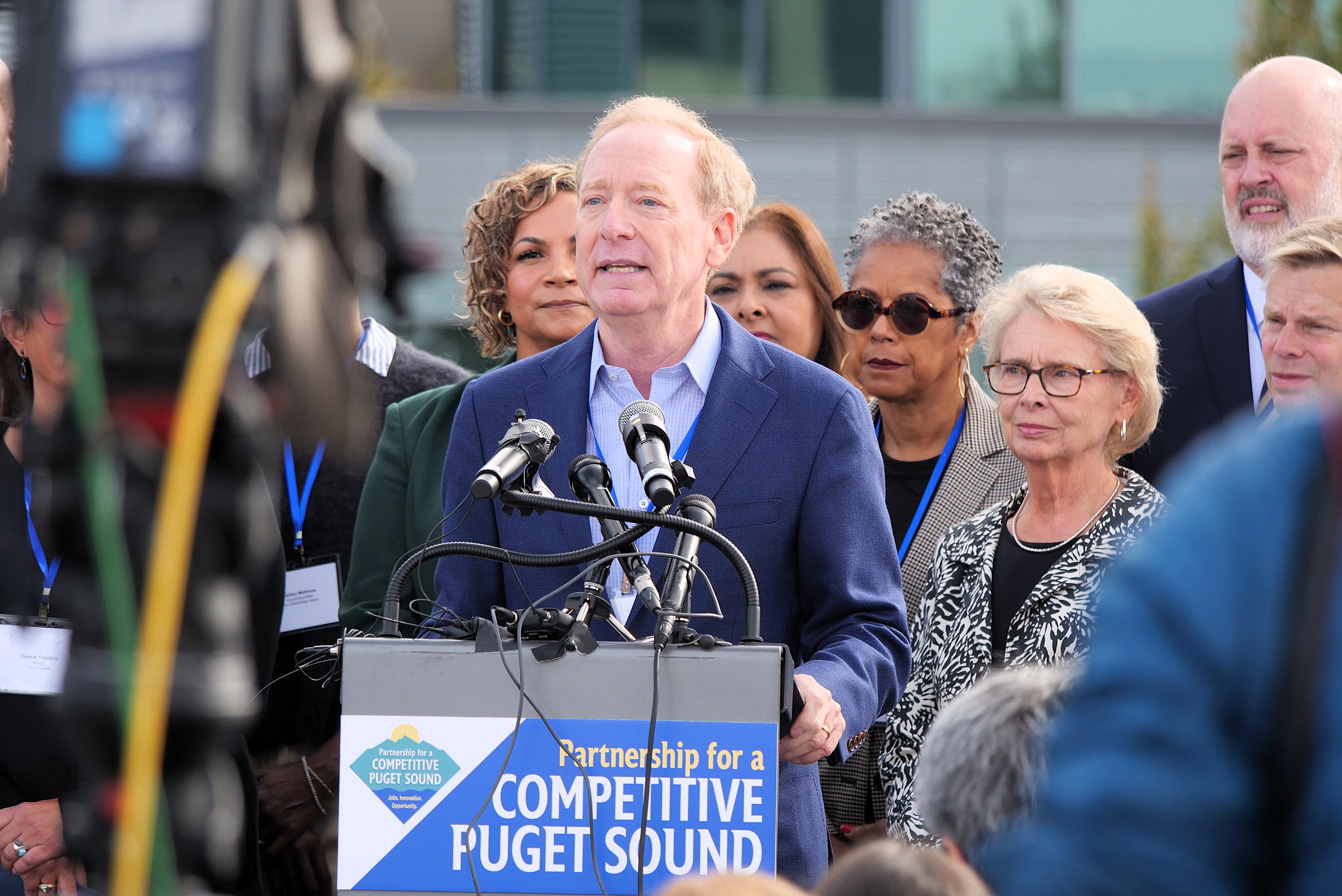
“You should tax things you want to discourage, like cigarettes, not jobs.” Microsoft’s Brad Smith at Monday’s launch of the Partnership for a Competitive Puget Sound, with former Gov. Chris Gregoire at his left. (GeekWire Photo / Todd Bishop)

Detroit, Cleveland and Pittsburgh each had their moment in the sun a century ago, Microsoft Vice Chair and President Brad Smith said Monday — and then the warning lights started flashing, and their leaders at the time failed to heed them.

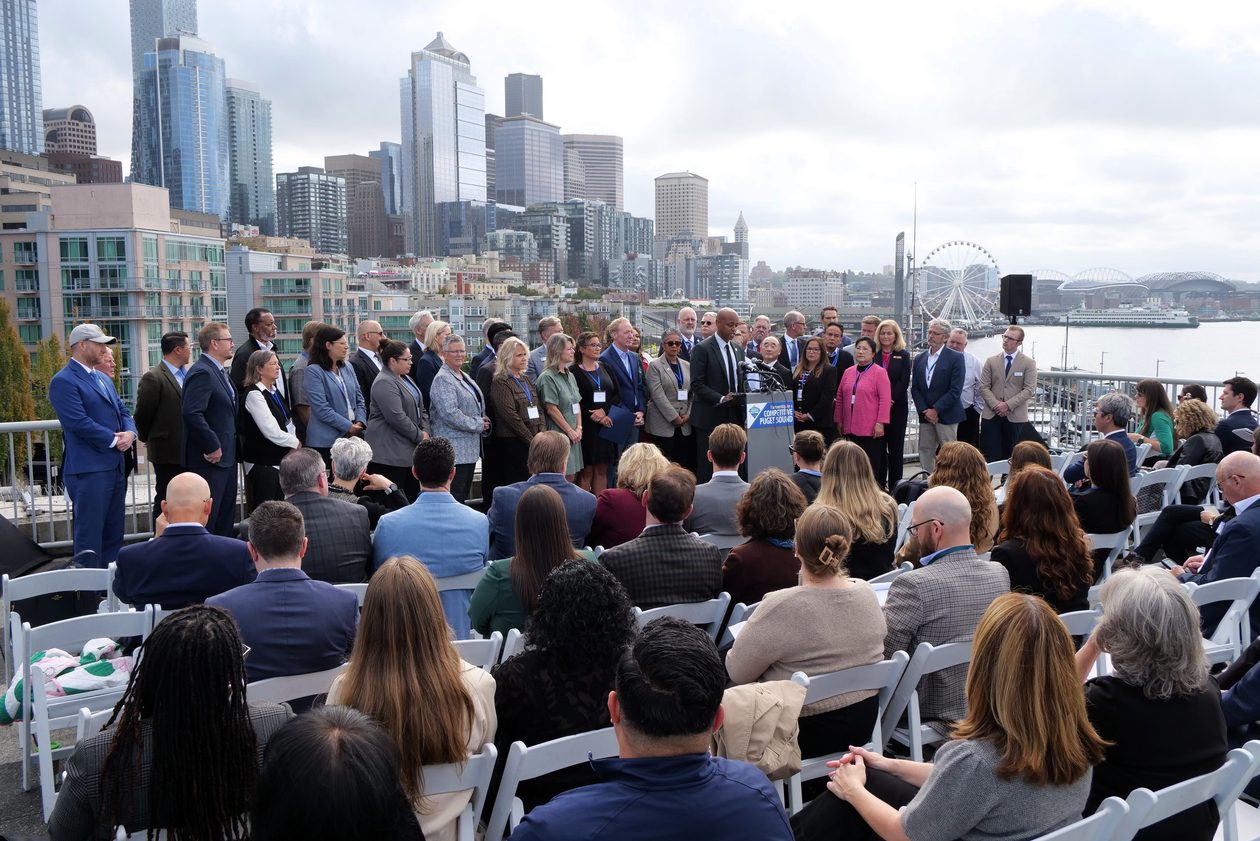
“Well, here we are. It is 2026,” Smith said at a press conference, flanked by dozens of regional leaders, with the Seattle skyline behind them. “And the warning signs are flashing on our economy.”

Smith was speaking at the launch of the Partnership for a Competitive Puget Sound, a Challenge Seattle initiative that brought together roughly 50 elected officials from King, Kitsap, Pierce and Snohomish counties — two county executives, around 20 mayors, port commissioners and about a dozen state legislators — along with labor leaders and business executives, behind a 20-point plan for reversing the region’s slide.

The region lost nearly 7,000 jobs in 2025, according to a report issued by the group, the first time in two decades outside a recession or the pandemic that Seattle-area employment growth has trailed the nation’s. Washington has fallen from 32nd to 47th in CNBC’s ranking of states by cost of doing business since 2017.

An ‘intentional’ regional tech strategy: The report makes a pointed observation about technology: aerospace has a coordinated regional agenda and tech doesn’t, despite tech accounting for nearly one in 10 regional jobs and about 24% of total payroll.

Aerospace knows what it’s working on: the next airplane, the space industry, sustainable fuels, supplier diversification. Technology, “despite being one of Puget Sound’s defining economic anchors, does not yet have an equally intentional regional strategy,” the report says.

King County Executive Girmay Zahilay addresses the crowd Monday, with the downtown Seattle skyline behind him. More than 32% of the city’s central business district office space sits vacant, according to the new regional report. (GeekWire Photo / Todd Bishop)

Without one, it adds, the region risks losing “jobs, technology investment, headquarters, talent, and company growth” to the Bay Area, New York, Boston and Austin. The goal is “not simply to promote growth, but to protect and strengthen the region’s position as a leading technology center.”

Challenge Seattle says it will write that strategy with the Puget Sound Regional Council, built around two priorities: keeping the big tech companies investing here, and making it easier for startups to scale. Related recommendations target industrial space for AI hardware startups, commercial space, and the region’s fusion cluster.

The report sets no budget or measure of success for the tech strategy, and no deadline beyond its general goal of progress within three years.

A regional wake-up call: Many of the recommendations are changes to how local government operates, not new spending: deadlines for permit decisions, a designated business contact in every city and county, and a strategy for dealing with the way taxes stack across state, county and city.

“This is, for us, a wake-up call,” said former Washington Gov. Chris Gregoire, CEO of Challenge Seattle, launching the initiative during the press conference. “We cannot resort to relying on yesterday’s success while tomorrow’s jobs go somewhere else.”

April Sims, president of the Washington State Labor Council, said businesses need predictability and enough margin to invest, innovate and take risks — but “working people need margins, too.”

King County Executive Girmay Zahilay said his office has hired an economic development team and is beginning an internal permitting audit. “AI is transforming our economy seemingly overnight,” he said, calling the 7,000 lost jobs “quite alarming.”

The group also released a playbook for Puget Sound mayors, drawn from interviews and surveys with local leaders, on building what it calls a culture of partnership with business.

Seattle as a Microsoft litmus test: Asked by GeekWire during the press conference what it would take for Microsoft to return and grow in Seattle proper, where it previously had offices in South Lake Union, Smith first pointed out that he was standing in front of Redmond Mayor Angela Birney.

“We have a great mayor, and every day we get up and we’re excited to go to work in Redmond, Washington,” he said, to laughter from the assembled officials.

Smith also pushed back on the premise: Microsoft moved to the Eastside from Albuquerque in 1979 and never had a large presence in Seattle, so he wouldn’t use the city as the point of comparison.

Then he turned to Seattle’s JumpStart payroll expense tax.

As structured, the payroll tax “is really a tax on tech jobs,” Smith said, “and that’s why you’re seeing more tech jobs move from Seattle to places like Bellevue and the Eastside.” He noted that San Francisco abolished its payroll tax the same year Seattle adopted one, in 2021.

“You should tax things you want to discourage, like cigarettes, not jobs,” he said.

He tied the issue to the larger impact of AI on jobs. “We need people to succeed to some degree in a world of AI,” Smith said. “And you don’t want to make the cost of employing people more expensive, at the same time that AI is increasingly adding its own new form of competition.”

“There’s nothing that would lead to the decline in jobs in this state faster than a replication of the JumpStart tax,” he said. “And if Seattle wanted to do one thing to increase jobs in Seattle, it ought to revisit whether a payroll tax makes any sense.”

Then he added a caveat: “That’s probably something that would impact other companies more than Microsoft.”

Amazon, which has been reported to be the largest payer of the tax, did not have a speaker at Monday’s event. Individual Amazon execs are listed in the acknowledgments in the Challenge Seattle report, though the report says participation doesn’t imply endorsement.

View from Olympia: During the press conference, Senate Majority Leader Jamie Pedersen, D-Seattle, was asked whether Washington risks becoming an outlier among states on taxes. The Legislature has been correcting course, he said, pointing to two moves from this year’s session.

One was the estate tax. Lawmakers raised the top rate to 35% in 2025, the highest in the country, and reversed themselves this March, returning it to 20% as of July.

The other was the millionaires tax — a 9.9% tax on household income above $1 million, signed by Gov. Bob Ferguson and projected to raise roughly $3 billion a year. It doesn’t take effect until 2028, and Seattle tech leaders warned it would push founders and investors out of the state.

Pedersen cast it as the fix for a different kind of outlier status: Washington’s business and sales taxes are high because it’s one of the few states with no personal income tax at all. The new tax would let Washington “join 41 other states that have a personal income tax,” he said.

Voters get the last word in November. Initiative 645, backed by Let’s Go Washington, qualified for the ballot in July and would repeal the tax. If it survives, Pedersen said, a statewide payroll tax is “vanishingly unlikely” next session.

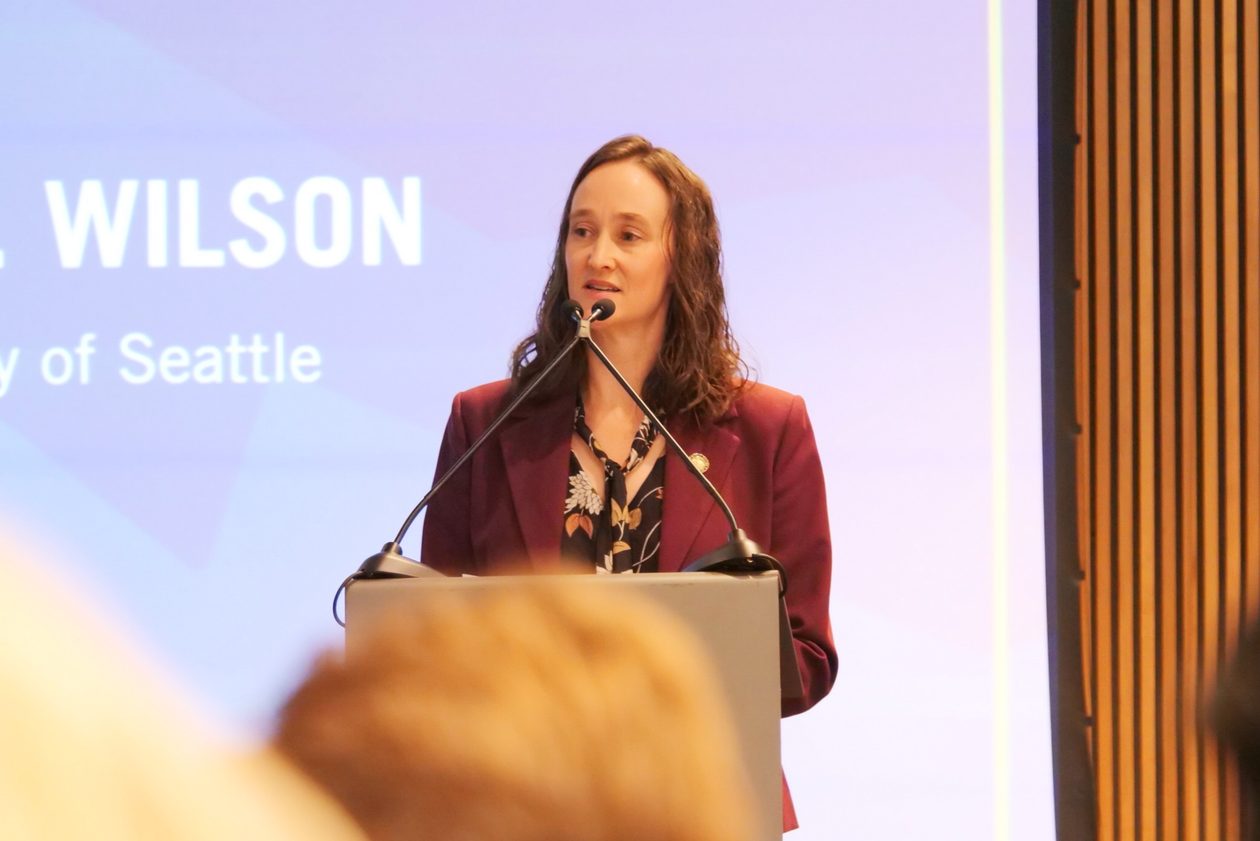
Seattle’s mayor weighs in: Seattle Mayor Katie Wilson, who was an architect of the JumpStart tax before running for office, was not among the speakers at the press conference. She opened the regional session that followed, and said the region needs to do a better job telling its own story.

Seattle Mayor Katie Wilson opens the regional action session that followed Monday’s launch of the Partnership for a Competitive Puget Sound. (GeekWire Photo / Todd Bishop)

“There are some forces and interests that are pushing a narrative that does not want Seattle or our region to succeed,” Wilson said, “and we must counter that with a new commitment to a shared sense of destiny, because Seattle’s success is Bellevue’s success, Pierce County’s success is Snohomish County’s success.”

She called it a fragile moment and said the time to act is now, pointing to the economic actions she announced last week in conjunction with an independent report commissioned by the city and released by Seattle’s Office of Economic Development.

That report, “Seawall: Building a Resilient Seattle Economy,” found Seattle’s tax structure unique among peer cities in the way it “specifically penalizes the hiring of senior, high-compensation workers,” with the burden falling overwhelmingly on large tech employers.

Hiring a software engineer at $650,000 in total compensation costs about $17,000 more a year in Seattle than in Bellevue at JumpStart’s top rate, the researchers found.

The city report, conducted by the economic consulting firm Formation, said Seattle should bet on cleantech, the sector where the city owns the utility, writes the building codes and controls permitting and land use. It’s one place where Seattle has real leverage over its own economy, the researchers argued.

“It’s striking how much agreement we share across labor, businesses, and government,” Wilson said. “This is not a call to ignore our challenges, but to tackle them with a shared sense of possibility.”

She did not address the payroll tax in her remarks.

❌