❌

Reading view

There are new articles available, click to refresh the page.

DOOM Played on Series of 555 Timers

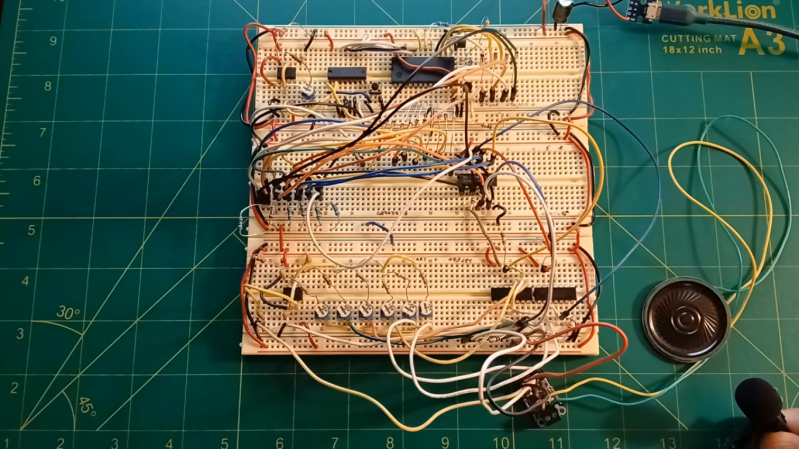
It’s technically true that any piece of software can be reproduced in hardware, although modern software’s size and complexity generally makes this a non-starter. But if we go far enough back in time, older software becomes easier and easier to implement in hardware. The original DOOM from 1993 might one day be recreated in full this way, but that day is not today. Instead, [Nick] has recreated the original music from that game, playing the opening track in nothing but 555 timers.

The circuit starts with a 555 timer that acts as a system clock with a rate of just over 7 Hz. These pulses feed a binary counter which in turn feeds a decoder, giving the circuit 15 positions. Each output of the decoder feeds to a diode matrix which stores information about what pitch the circuit should play. The circuit only needs to play six pitches so the diodes effectively connect each moment in time to one of these six notes. From there the circuit feeds into a set of switches which select different resistor networks of another 555 which is actually responsible for producing sound. The resistor networks have different values to adjust the timing of the 555 to produce different pitches.

Of course this entire exercise is largely academic as almost any microcontroller would be able to be programmed to play this chiptune quite easily, but it’s not a bad idea to get down into the weeds of digital logic from time to time in order to refine one’s skills and knowledge about what’s really going on in the inner workings of circuits. Or, go even deeper than that and build the logic gates themselves from first principles.


Circuit, DaLand Give Credit Unions a Direct Path to Bitcoin

Bitcoin Magazine

Circuit, DaLand Give Credit Unions a Direct Path to Bitcoin

Credit unions now have a production-ready path to offer Bitcoin and other digital asset services without relying on outside platforms after DaLand CUSO and Circuit, an 80-member credit union collaborative, announced that Circuit’s Digital Asset Initiative has moved into implementation.

The program grants participating institutions access to DaLand’s CODE Engine and Coin2Core technology, which integrates digital asset capabilities directly into core banking systems from Corelation KeyStone, Fiserv DNA, and Jack Henry Symitar. Under what DaLand calls a β€œHybrid Custody” model, credit unions retain custody, member relationships, and data rather than routing customers to third-party crypto platforms.

Three credit unions are already live on the platform: St. Cloud Financial Credit Union, which issued its own stablecoin, $CLDUSD; Canvas Credit Union, a $5 billion institution that became a DaLand owner after deployment; and Blaze Credit Union, which also invested as an owner. Together, DaLand says its production footprint now covers credit unions representing more than $10 billion in combined assets.

The announcement comes as the passage of the GENIUS Act and other federal digital-asset legislation push financial institutions to formalize their crypto strategies. Executives framed the move as a shift from studying digital assets to actually deploying them.

β€œWe weren’t looking for another concept to study,” said Canvas CIO David Pierce, adding that the credit union wanted infrastructure it could own rather than rent. Blaze’s Justin Burleson, a former NCUA official, said his institution wanted digital asset activity to stay visible to β€œexaminers, boards, and members,” rather than sit with an outside vendor.

Circuit, which spent the past year building educational programming around digital assets, said Phase 2 marks a shift toward hands-on evaluation. β€œInnovation moves faster when credit unions share what they’re learning,” said Circuit’s Chief Strategy Officer Ethan Cunningham.

Credit unions interested in joining can contact either organization directly.

This post Circuit, DaLand Give Credit Unions a Direct Path to Bitcoin first appeared on Bitcoin Magazine and is written by Mathew Di Salvo.

❌