
 Login
Login
Making Better Rubies At Home
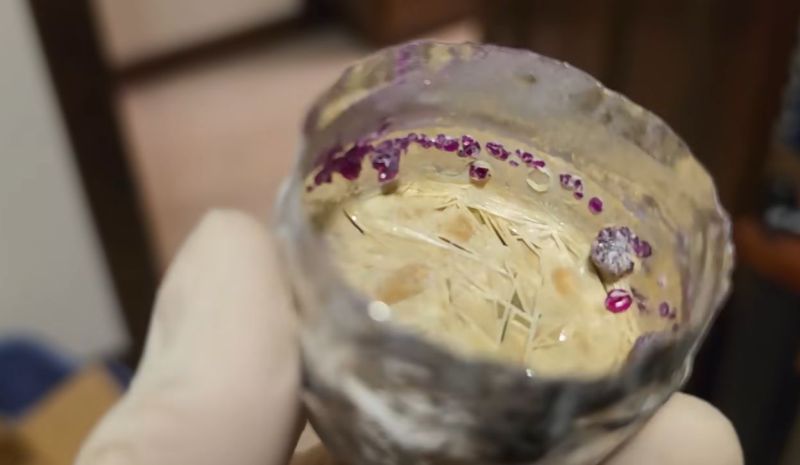
Sapphires and rubies aren’t just pretty, they also got a range of practical uses. This makes it even more useful to be able to make them at home for obviously completely innocent experiments. Cue [Gems of Science] and his attempts to make good-looking rubies, without resorting to the brute-force laser blasting approach that [Styropyro] previously used to create murky-looking gems.
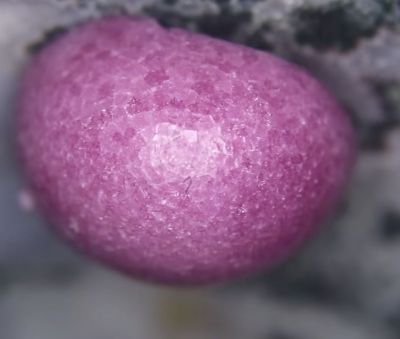
That basic method used involves blasting aluminium oxide with a laser, which results in a container full of what are technically gems, but – as the image on the right makes clear – not exactly the prettiest or easiest to shine up. Much of the problem here is that these are hollow geodes composed of countless tiny crystals instead of solid singular crystals.
Although there are commercial ways to fairly easily create large crystals from a small seed crystal, none of these lend themselves to a DIY hobbyist with just a garage to muck about in. This leaves one alternative: the flux method. Rather than melting the material that will be grown onto the seed crystal, this flux crystal growth method uses a solvent (flux) and temperatures that a home kiln can achieve.
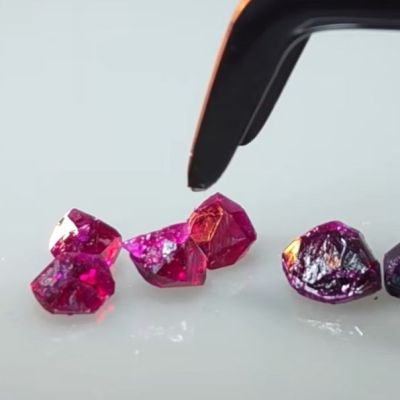
Of note here is also that it’s the addition of Cr3+ ions into the base Al2O3 matrix that makes a ruby into a ruby, by giving it its red glow. In order to grow crystals this way you need to pick not only a suitable solvent, but also use a crucible that doesn’t want to become part of said crystal. Unfortunately a platinum crucible runs into the thousands of USD, but a graphite crucible should do if you keep oxygen away from it.
For the flux molybdenum oxide was used, mixed with chromium oxide and aluminium oxide to provide the ingredients for crystal growth. Unfortunately added charcoal interfered with the molybdenum, ruining that batch. This led to trying out more crucible types to find a recipe that worked, thereby finding out that an ‘alumina’ crucible also contained silica, which poisons the reaction, resulting in only tiny ruby crystals.
Ultimately pure alumina crucibles seemed to work great, until they began to shatter en masse, resulting in pained wallet noises and the purchases of some pre-loved platinum crucibles. This worked really well, but now the flux was evaporating too quickly to enable large crystal growth, thus requiring additives to stabilize it. Along with temperature cycling to induce the growth of larger crystals, this finally generated some solid results. After a first batch of smaller rubies, next up larger ones of up to 10 mm were grown.
While cutting one of these large rubies to set into a ring it was clear that it was still rather flawed, with pockets of flux captured into the crystal, but with the basic method now more or less dialed in it should be possible to address these small flaws as well.
