Reading view

There are new articles available, click to refresh the page.

The Crypto Market In 20 Years

Spoiler: in two decades, nobody will call it “crypto.” Here’s what it actually becomes, and the one test that tells you who’s watching the real story.

Picture a morning about twenty years from now.

Someone wakes up in Lagos. Or Manila, or Istanbul, or a small town you have never heard of. They tap their phone to pay for coffee. Rent leaves their account. A cousin two countries away sends them money, and it lands before they have put the phone back in their pocket. Their savings sit in a currency that doesnt quietly lose value while they sleep.

None of that touches the slow, expensive banking plumbing you and I use today.

And heres the strange part: that person never once thinks the word crypto.

Because by then, crypto isnt a thing you buy and pray about. Its the thing everything runs on. Its plumbing. And nobody thinks about plumbing until it breaks.

Right now, almost everyone is arguing about the wrong question. “Is crypto going to the moon, or to zero?” Thats the question a rich person asks. They watch the price like a slot machine. The wealthy person asks something quieter: what is actually being built underneath all this noise?

Thats what this whole letter is about. Not the price of crypto in 20 years. The plumbing. Where the world’s money is quietly headed, who’s already moving it there, and one simple test you can carry for the rest of your life to tell the signal from the slot machine.

Grab your coffee. This is a fun one.

The Question Everyone’s Asking Is The Wrong One

Heres what most people believe about crypto: its a casino. A pile of volatile coins that either take over the world or go to zero, run by anonymous nerds and the occasional scammer.

And honestly? A lot of it is that. There are thousands of junk coins. People do lose their shirts. Im not going to pretend otherwise, this newsletter doesnt run on hype.

But the coins are the sideshow.

While everyone stares at the flashing prices, the most boring, most powerful institutions on the planet are quietly rebuilding the plumbing of money itself, on blockchain rails.

Not meme-coin traders. BlackRock. The largest money manager on earth, looking after more than twelve trillion dollars. Its CEO, Larry Fink, has said out loud, more than once, that he thinks every stock and every bond will eventually live “on one general ledger.” One shared record for the whole world. Thats not a metaphor. Thats a plan.

Visa is already settling billions of dollars in stablecoins across its network. JPMorgan has been moving money on a blockchain for years. When the suits and the ties show up quietly, while the crowd is distracted by prices, thats usually exactly where the real money is headed.

The prices are the noise. The rails are the signal.

We’ve Seen This Exact Movie Before

Let me tell you why Im so sure about the boring-plumbing thing. Because we lived through it once already.

Rewind to 1995. The internet exists, barely. And the smart, serious people had opinions. “Its for nerds.” “Its full of criminals.” “Its a toy, no real business will ever run on it.” “The fax machine works fine, thank you.”

There was even a famous economist who predicted the internet’s effect on the economy would end up being about as big as the fax machine’s. Seriously. That happened.

And then what actually took over the world? Not the flashy, futuristic stuff everyone was excited about. The boring stuff. Email. Online shopping. Typing your card number into a little box. Deeply unglamorous, and it swallowed the entire economy whole.

Now look at crypto in 2026. Same shrug. Same three sentences. “Its for nerds, its for criminals, its a toy, the banks work fine.”

We have seen this movie. We know how it ends. And just like last time, its not going to be the flashy stuff that wins. Its going to be the boring stuff: moving money, and owning things.

Why The Boring Stuff Always Wins

Theres a pattern every world-changing technology follows. Once you see it, you cant unsee it.

It goes: magic, then hype, then crash, then boring, then everywhere.

Electricity did it. Cars did it. The internet did it. First its magic that only a few weirdos understand. Then everyone gets excited and overpromises. Then it crashes and the whole world declares it dead. And then, quietly, while nobody is watching, it gets boring. Boring is the last stop before it takes over completely.

Nobody claps for the electrical grid. Nobody tweets about the water pressure in their building. You only think about that stuff on the one day it stops working. That is what winning actually looks like, in the end: invisibility.

So where is crypto on that curve right now?

Right at the “boring” turn. The 2021 mania is long gone. The total market is worth around 2.4 trillion dollars, down from a peak near 3.8 trillion, because the crowd got bored and wandered off to the next shiny thing. The headlines went quiet.

Good. Thats exactly when the real building happens. The boredom isnt the end of the story. Its the sign were finally getting to the interesting part.

So What Actually Changes? Three Layers.

Alright. If crypto in 20 years is plumbing, lets look at the actual pipes. There are three layers changing, and Im going to keep every one of them dead simple.

Layer 1: The money itself.

You have probably heard the word “stablecoin.” Heres all it means: a digital dollar that lives on blockchain rails. One token equals one real dollar, backed by actual dollars and government bonds sitting in a vault. Not volatile. Just a dollar that can travel.

Why does a traveling dollar matter so much? Because it moves instantly, any hour of the day, anywhere on earth, for almost nothing.

Some numbers that honestly surprised even me. In 2025, stablecoins moved around 10.9 trillion dollars. Visa, the entire Visa network, did about 14.2 trillion in the same year. So this quiet little “crypto” thing is already almost the size of Visa, and most people on earth have never touched one.

Send 200 dollars across a border the old way and youll lose about 6 percent to fees and wait a few days. Send it on these rails and its more like a tenth of a percent, done in minutes.

Think about who that actually helps. A nurse in Manila paid by a company in Berlin, who keeps her whole paycheck instead of feeding a chunk of it to middlemen. A shop owner in Buenos Aires or Lagos whose own currency loses value every single month, quietly holding digital dollars instead. For them this isnt speculation. Its survival.

And the law is catching up fast. In 2025 the United States passed something called the GENIUS Act, the first real rulebook for dollar stablecoins. Read between the lines and its clever: by blessing digital dollars, America quietly extends the dollar’s reach into the online world. Roughly 99 percent of all stablecoins are dollars. The world’s most popular currency just learned how to teleport. (I unpacked how this happened in the casino-chip story.)

Thats layer one. The dollar, climbing onto the shared rails first.

Layer 2: The things you own.

Next word: “tokenization.” Sounds technical. It really isnt.

Tokenizing something just means taking a thing you own, a house, a share of a company, a bond, a painting, and turning its ownership into a token on a blockchain. The token is the proof that you own it.

Heres why that quietly changes everything. Things that used to take weeks, lawyers, and a stack of paper to buy or sell become instant, global, and splittable. You could own fifty dollars worth of an apartment building on the other side of the world and collect your slice of the rent in digital dollars. A painting could have a thousand owners. A bond could settle in seconds instead of days.

Today this is still tiny, only about 27 billion dollars of real-world assets have been tokenized so far. But watch who is already doing it: BlackRock, JPMorgan, Franklin Templeton, live and in production, not slideshows. And the forecasts are wild. One widely-cited estimate from Boston Consulting Group puts it at 16 trillion dollars by 2030.

Now, Im not going to hand you that number like its gospel, this newsletter doesnt do that. Todays reality is less than one percent of it, and a forecast is just an educated bet in a nice suit. But the direction is not in doubt. Theres more than 400 trillion dollars of the world’s wealth locked up in things that are painful to sell, property, private companies, art. Tokenization is the key to that lock. Thats the real prize everyone is quietly racing toward. (I went deep on this in the 16 trillion dollar shift.)

Layer 3: The settlement layer. (this is the important one)

This is the piece almost nobody talks about, and its the whole game.

“Settlement” is just the boring final step where money and ownership actually change hands for real. Today that step is a slow, ugly patchwork, a maze of banks, clearinghouses, 180 different national currencies, and 3-day waits, all held together with duct tape.

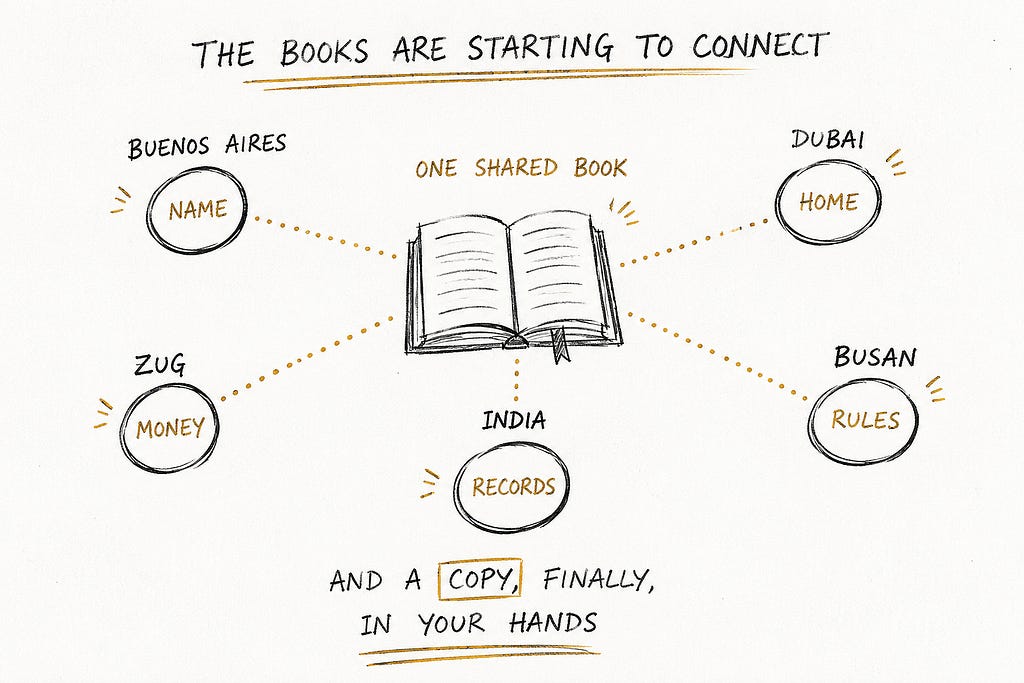
Now stack up what we just covered. Digital dollars that move in seconds. Assets turning into tokens. All of it needs one shared, neutral place to actually settle. One common ledger underneath everything.

Thats it. Thats the thing Larry Fink means by “one general ledger.” Different money and different assets sitting on top, but one shared plumbing beneath all of it.

Thats what I keep meaning when I talk about one earth, one set of rails. Not one currency forced on everybody. Nobody is taking your dollars or your rupees or your naira. Its one neutral settlement fabric under all of it, the same way the internet is one network underneath a million different websites. (If that idea is new to you, start with what a settlement layer really means and the new rails.)

Once you see money heading there, you cant unsee it either.

The 20-Year Walk

So lets actually walk the twenty years. Roughly, because nobody knows the exact dates, and anyone who tells you they do is selling something.

Now to about 2030. The rails get adopted quietly by the giants. Your bank, your brokerage, your payment app slowly start running on this stuff underneath, and you barely notice the switch. Meanwhile the coin casino thins out, thousands of junk tokens quietly die, and a small handful survive because they became actual infrastructure instead of a bet.

Around 2030 to 2038. Money gets programmable. Payments that trigger themselves the moment a condition is met. And, this is the wild one, AI agents that hold money and spend it on their own, running errands and settling bills without you lifting a finger. (I wrote a whole piece on AI agents getting their own bank accounts, and its already starting.) Tokenized assets go mainstream. Buying a slice of a building becomes as normal as buying a stock is today.

Around 2038 to 2045. Crypto goes invisible. The word itself fades out, the way “the information superhighway” quietly disappeared and just became “the internet,” and then just became… life. Nobody says crypto because theres nothing left to point at. Its simply how money works.

Who wins all this? The people who understood, early, that this was infrastructure and not a lottery ticket. Whole countries and ordinary people who climbed onto the rails first. Who loses? The folks who spent twenty years asking only one question, “is the price up today?”, and the middlemen whose entire job was being the slow, expensive step in the middle.

What Could Break This

Now let me do the thing most crypto writers wont, and tell you honestly how this could still go wrong. Because it might. Nothing here is guaranteed.

Quantum computers. Theres a real long-term risk that a powerful enough computer could one day pick the cryptographic locks that keep blockchains secure. People call the day it becomes possible “Q-Day,” and serious estimates cluster around 2035 to 2045. Let me be precise here, though, because the headlines love to scare you: the blockchain ledger itself stays safe. Whats exposed is a slice of the oldest, reused keys, including, famously, the roughly one million coins believed to belong to Bitcoin’s anonymous creator. And the fix, post-quantum cryptography, is already being built right now. A big 2026 study from Google, the Ethereum Foundation and Stanford actually pulled the timeline closer, which is exactly why the whole industry is already moving on it. Watch it. Dont panic about it.

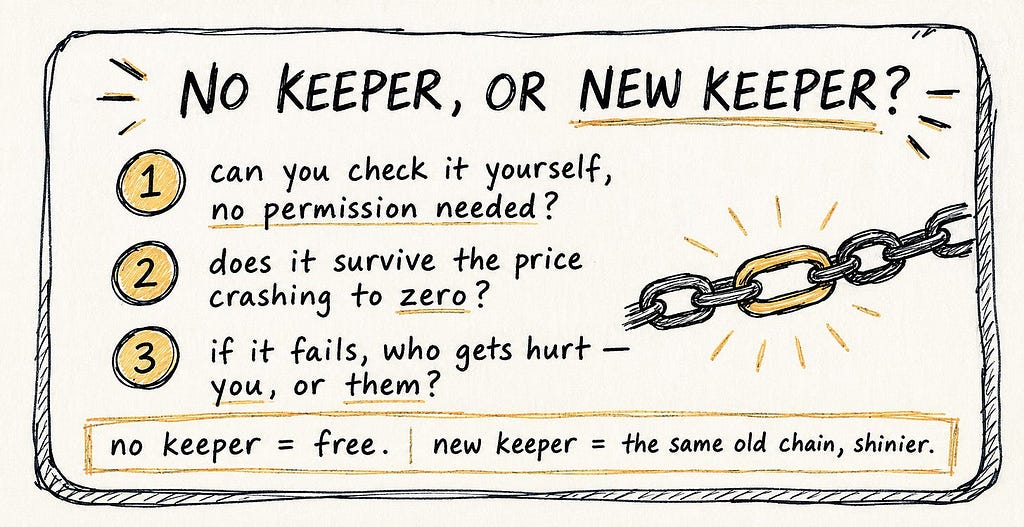
Who controls the rails. Heres the one that keeps me up more than quantum does. The entire promise is that the settlement layer is neutral plumbing. But whoever controls that plumbing controls an enormous amount of power. If a few governments or a couple of giant corporations capture it, “neutral” quietly dies, and we have just rebuilt the same old gatekept system with shinier pipes. This is the fight that actually matters over the next twenty years, and almost nobody is watching it.

Trust and theft. Hackers stole about 3.4 billion dollars across 2025. Before the world’s money runs entirely on these rails, they have to get boringly, unglamorously safe. Plumbing you dont trust is just a leak waiting to happen.

The honest takeaway: the direction is clear. The timeline and the winners are very much still up for grabs.

The Plumbing Test

Okay. Heres the tool I promised you, the thing to actually carry out of this letter. I call it the Plumbing Test, and you can use it on any technology for the rest of your life, not just crypto.

Every technology worth understanding runs the same path: exciting, then boring, then invisible. So ask three questions.

One. Is it still exciting, and a little scary? Then its still early. Lots of noise, lots of hype, the real story hasnt even started yet.

Two. Is it getting boring? Has everyone stopped tweeting about it? Then its quietly winning. This is the dangerous middle where the real building happens and the crowd looks away.

Three. Has it gone completely invisible, you forgot its even there? Then it already won. Game over. You just cant see it anymore.

Now run crypto through it. Right now its mid-transition, sliding out of “exciting” and straight into “boring.” And if you only remember one thing from this whole letter, make it this:

That slide isnt the death of the story. Its the middle of it.

The day money just works, the day you move value across the planet and never once think about the rails carrying it, thats the day this entire thing finished. And if you spent the whole twenty years staring at the price, youll have been watching the least important number the entire time.

One Earth, One Set Of Rails

So come back to that morning, twenty years out. Lagos, Manila, Istanbul, your own street, wherever you happen to be reading this. The money just moves. Different currencies on top; one neutral set of rails underneath. And not a single person calls it crypto, because theres nothing left to point at. Its just how the world works now.

Thats the whole thesis of this newsletter, in one picture. One earth, one set of rails. Not a prediction to bet your rent on, a lens to watch the world through.

The rich will spend the next twenty years asking if the price went up today. The wealthy will spend them watching the plumbing get built.

You already know which one you want to be. Thats why youre here.

If you want to keep seeing the plumbing while everyone else watches the price, thats the entire point of Naked Market. Subscribe, and Ill keep showing you the machinery underneath the headlines, in plain language, before the mainstream catches on.

Keep going

-More soon


The Crypto Market In 20 Years was originally published in Coinmonks on Medium, where people are continuing the conversation by highlighting and responding to this story.

How Blockchain + AI Could End Corruption

Weve always treated corruption as a problem of bad people. Its not, its a problem of bad situations. And for the first time, we have two tools that can fix the situation itself.

Naked Market breaks down macro finance, blockchain infrastructure, AI systems, and automated trading to help you understand the future of global finance before the mainstream catches up.

Picture this. Youre standing in a government office.

Youve got the right papers. Youve waited two hours. And the man behind the glass slides your form back across the counter without stamping it. “Hmm. This one could take a few weeks,” he says slowly. “Unless…”

He doesnt finish the sentence. He doesnt have to. You both know exactly how this goes a little cash slipped under the counter, and like magic, the stamp appears.

If youve lived just about anywhere on earth, you know this moment in your bones. Maybe it was a traffic cop. A hospital desk. A permit office. A border guard. And youre not imagining how common it is, either — roughly one in four people on the planet had a version of that exact moment in the last year. Paying a little extra, to a person with a little power, just to get something they were already owed.

Now, the normal reaction is to get angry at the guy behind the glass. What a crook. And fair enough — he is one. But heres the uncomfortable thing Ive slowly come to believe, and its the whole reason for this piece: the problem was never really him.

Put almost anyone behind that glass give them that much power, over something you badly need, with nobody watching — and youd get the same shakedown. Different face, same script. Which means corruption isnt mostly a problem of bad people at all. Its a problem of bad situations.

And that little shift changes everything. You cant fix human nature — good luck with that. But you can absolutely fix a situation. And two technologies youve heard a thousand overhyped things about blockchain and AI happen to be very good at quietly dismantling the exact situations corruption needs to survive.

Theres a twist coming, though. The same two tools, pointed the wrong way, could make all of it far worse. Both halves matter so stick with me.

Corruption always needs three ingredients

Heres the strange thing about corruption: for something so universal, its weirdly predictable. It almost always needs the same three ingredients sitting in the same room. Go back to our man behind the glass and youll spot all three.

One — hes the only game in town. You cant take your form to a competing clerk down the street. He is the one and only person who can stamp it. Youre stuck with him, and he knows it.

Two — he gets to decide, and the rules are fuzzy. Theres nothing forcing him to stamp your form today. He can drag his feet, misplace your file, discover a mysterious “problem.” The rules are just vague enough that hes got room to wiggle — room to make your life hard, or easy.

Three — nobodys watching. No one is looking over his shoulder. Theres no record of what he does that he cant quietly fix later. If he squeezes you for a bribe, who on earth would ever find out?

Put those three together — the only option, free to decide, and unwatched and you get a bribe. Every single time. In every country. No matter how kind or nasty the person behind the glass happens to be. An economist called Robert Klitgaard actually squeezed this into a little formula so tidy it belongs on a poster in every government building on earth:

And heres why that formula is secretly full of hope. If corruption came from evil hearts, wed be stuck forever — youd have to make people good, one soul at a time. But if it comes from those three ingredients, you dont need better people at all. You just need to quietly remove one ingredient from the room. Take away his monopoly, or his wiggle room, or his darkness, and the whole thing falls apart.

So lets remove some ingredients. One tool takes away the darkness. The other takes away the gatekeeper. Watch.

Blockchain switches on the lights

Start with the easiest ingredient to attack: nobodys watching.

Corruption is a creature of the dark. It lives in the file only one official can open, the record that gets quietly changed at midnight, the money that slips between two desks and simply vanishes. Take away the dark, and a huge amount of it just… cant happen anymore.

This is the one thing blockchain is genuinely, boringly great at. Forget coin prices and Twitter hype for a second. Strip all that away and a blockchain is really just a shared notebook. Everybody holds the same copy. Everybody can see whats written in it. And here is the magic part — nobody can secretly rip out a page or change something thats already written. If you try, everyone elses copy still shows the original, and youre caught red-handed.

Now imagine every government contract, every payment, every land title, written in a notebook like that. Suddenly our clerk cant “lose” your file, because copies of it exist everywhere. He cant quietly hand your neighbours land to his cousin, because the real record is still sitting there for the whole world to see. And anyone can follow the money from the second it leaves the treasury to the second its spent. The shadows just got a whole lot smaller.

And this is not some far-off daydream. Its already running, in places where it genuinely matters.

The country of Georgia — long haunted by property disputes and quietly rewritten land records — moved its land titles onto a blockchain, so ownership can no longer be fudged by whoever controls the database. Colombia ran school-lunch contracts on one, so every bid was out in the open and impossible to erase. The United Nations World Food Programme sends aid to refugees over a blockchain it calls Building Blocks, so the help reaches hungry people instead of leaking to middlemen on the way. The move underneath all of them is the same: take the ledger out of one officials private drawer, and put it in a shared notebook nobody can secretly edit.

AI removes the man behind the glass

Blockchain handles the watching. But what about the other two ingredients — the guy whos your only option, and his wiggle room to say no? Thats AIs job, and it does two very different things.

Job one: the watchdog that never sleeps. A human auditor can only check a handful of files. He samples a few, crosses his fingers, and prays the fraud happened to land in the pile he grabbed. An AI doesnt sample. It reads every single contract, invoice, and payment — millions of them — and it never gets tired, never looks away, and cant be taken out to a nice lunch. It catches the things no human ever could: the supplier who doesnt actually exist, the bill split neatly in two to sneak under a limit, the one company that somehow wins every contract.

This is already live. Colombia built a system that flags suspicious contracts before the money even goes out the door. Brazil and Portugal are running their own versions. And just like that, the one thing every crook is quietly counting on — that no one will notice — stops being a safe bet.

Job two: the vending machine. This one is sneakier, in the best way. Think about our clerk again. The reason he can squeeze you is that he decides. But what if he didnt? What if getting your permit worked like a vending machine — you feed in the right documents, and out pops the stamp, automatically, with no human in the middle to haggle with?

Thats exactly what these systems can do: take a decision thats currently “whatever the official feels like today” and turn it into a fixed, automatic rule. If the aid money is set to send itself the moment you qualify, theres nobody standing in the doorway with their hand out. It turns out you cant bribe a vending machine. (This is the same quiet machinery I wrote about when AI agents got their own bank accounts and started paying for things with no human in the loop — just pointed at a government office instead of a shop.)

Put them together, and the trap closes

Now line the two up, and you can see why people get excited.

Blockchain flips on the lights, so nobody can hide. AI plays two roles at once — the watchdog that never blinks, and the vending machine that deletes the middleman. One takes away the darkness. The other takes away the gatekeeper. Do both at the same time, and youve pulled every ingredient out of the room at once. No monopoly, no wiggle room, no shadows. On paper, thats the most powerful anti-corruption machine anyone has ever dreamed up.

Which is precisely the moment you should get suspicious. Because Ive only shown you the shiny half.

Here comes the twist

Nobody selling you “blockchain will save the world” wants to say this part out loud, so I will: our corrupt friend is not stupid. When you slam his old doors shut, he doesnt quit and go home. He goes looking for new doors. And these shiny new tools quietly hand him a few.

New door one: just lie at the start. Remember the magic notebook nobody can change? It has a loophole. It perfectly protects whatevers written in it — but it has no clue whether what got written was actually true. So the clerk stops trying to change the record. Instead, he simply writes the lie in the first place. He registers the wrong owner. He types “shipment arrived” for a shipment that never showed up. Now his lie is locked in — permanent, tamper-proof, and protected forever by the very system built to stop him. The notebook guards the record beautifully. It just cant tell whether the human holding the pen was honest — and the human at that entry point is always the weak spot.

New door two: bribe the person who built the vending machine. You cant bribe the machine, true — but somebody built it. Somebody wrote the rules deciding who gets a yes and who gets a no. So the bribe simply climbs one level up, to that person. And it gets worse. When a normal corrupt clerk gets caught, the corruption stops. But when the favouritism is baked quietly into the code, it keeps running long after anyones been arrested — rigging the game while looking perfectly fair and neutral. The crook stops being a person you can catch, and becomes a line of code nobody can even see.

And new door three — the one that should genuinely give you pause. That all-seeing eye we pointed at the corrupt minister? It can just as easily be spun around to watch you. The same money that can be programmed to reach a refugee in seconds can be programmed to expire, to freeze, or to punish. Pointed at the powerful, this technology sets ordinary people free. Pointed at ordinary people, the very same technology becomes a cage — the exact double-edge sitting underneath every government digital-money project being built right now. Nothing in the code decides which way it faces. Only the person holding it does.

So can it actually end corruption?

After all that, lets just answer the question in the title honestly. Can blockchain and AI end corruption?

No. Truthfully, no. Nothing ends it, because you cant delete the part of human nature that reaches into the jar when it thinks no ones looking. But heres the thing — that was always the wrong target.

What these tools can do is almost as good: they can drain the swamp corruption grows in. Make it far riskier, far more visible, and far more of a headache to pull off. Shrink its hiding spots from “basically everywhere” down to a few tight corners you can actually guard. Thats not a perfect world. Its just a much fairer fight — one where the crook has to work ten times as hard for a tenth of the reward. And that, honestly, would change the lives of billions.

Which leaves the real question — the one this whole piece has been sneaking up on. Its not “does the technology work?” Its “who gets to hold it?”

Because the very same machine either starves corruption or supercharges it, and it all comes down to one thing: is that all-seeing eye pointed at the powerful, or at the people? Are the rails open and shared by everyone — or owned by one hand that can flip the switch whenever it likes?

And that is why the thing this newsletter keeps circling back to actually matters. Corruptions favourite hiding place in the modern world is the gap between countries — the cracks between 180 separate national money systems, where more than a trillion dollars a year quietly disappears simply because nobody can see across the seams. A shared, neutral, open money layer closes those cracks and drags all of it into daylight — but only if it belongs to everyone and no one, not to whoever grabs it first. One Earth, One Currency was never really about paying faster. Its about building something transparent enough to starve the rot, without handing any single government the master switch. Thats the whole system were tracing here — and corruption is the sharpest test of whether we build the version that frees people, or the version that watches them.

Four things worth remembering

If you forget everything else, keep these four. Theyll quietly change how you read every corruption story from now on.

1. Its the situation, not the person. Corruption is just what happens when someones the only option, free to decide, and unwatched. So stop asking “is he a good guy?” and start asking “could he get away with it?” That second question actually predicts things.

2. Watch the new doors. These tools dont delete corruption — they move it. To the moment someone types the data in, and to the people who write the code. Thats where the next fight quietly goes.

3. Always ask which way the eye is pointing. Aimed at the powerful, its accountability. Aimed at you, its surveillance. Same exact technology — the direction is a choice a human is making, not a fact of the machine.

4. Open beats owned. A system no single person can switch off is the only kind that actually fights corruption, instead of just moving it upstairs to whoever owns the switch.

Where are you looking?

One last thought, because its the whole reason to read a newsletter like this instead of the daily noise.

When a corruption scandal hits the news, most people feel a jolt of anger, shake their heads, and scroll on. Totally understandable. But the people who really get where the world is heading arent watching the scandal at all. Theyre watching the machine underneath it — whos quietly building these new systems, and who is going to control them — because thats where the next hundred years of power, honest or crooked, is actually being decided. And this one reaches every single person reading this, in every country: one in four of us paid that hidden tax last year, and its almost always the people who can least afford it who pay the most.

We cant vote corruption out of the human heart. But for the first time in five thousand years, we can start taking apart the situations it needs to survive. Whether we end up building the version that frees people or the version that watches them is still — for a little while longer — genuinely up to us.

Thats the difference this whole newsletter is about, really. The rich react to the headline. The wealthy understand the machine.

If you want to keep reading finance this way — the structure under the headlines, before it gets obvious — subscribe. One clear breakdown at a time, for readers all over the world.
Subscribe to Naked Market →

Keep going

-More soon


How Blockchain + AI Could End Corruption was originally published in Coinmonks on Medium, where people are continuing the conversation by highlighting and responding to this story.

❌