❌

Reading view

There are new articles available, click to refresh the page.

Social Engineering: Exploiting Human Psychology in Offensive Security

Welcome back, aspiring pentesters!

Social engineering is one of the most important parts of pentesting, and in many real attacks it’s the part that decides whether the whole operation succeeds or fails. Sometimes it even makes the technical side easier. 

Earlier we looked at BadUSB attacks and several persistence methods, and those examples already showed how much can be done when a person simply plugs in a device or follows a convincing instruction. In a pentest, you can achieve real impact after just walking into an office and interacting with the environment without breaking into the corporate network remotely and hoping some serious vulnerability was left unpatched.

Many pentesters are stronger with systems than with people in everyday life. That’s one reason they gravitate toward technical work. Social engineering forces them to step out of that comfort zone even further. But understanding how people make decisions is a practical skill. When you design a scenario with human behavior in mind, the success rate of your interactions can rise. That’s why both red teams and blue teams will benefit from it. 

Evolutionary Legacy

The brain is an old application. It’s software that has been running for thousands of years. New features have been added over time, but the core logic was never fully rewritten. Different developers came and went. Some old functions were never documented. Some code paths were never reviewed. The system kept growing, but the original structure remained inside it.

That is a pretty good description of the human brain.

Our brains are the result of evolution, and the most vulnerable mechanisms are often the oldest ones. These mechanisms helped our ancestors survive in situations where there was no time for deep analysis. We cannot delete that legacy. We can only learn to control it at a higher level of thinking. But the older layer is still there, and every person remains vulnerable to it in the right conditions.

Who Is More Vulnerable?

If you follow the media, you might get the impression that older people are always the easiest targets. Stories about elderly victims are emotionally powerful, so they get more attention. But that does not mean the data supports the stereotype in a simple way. Europol statistics on fraud victims who reported to the police show that the 18-34 age group made up 27.7 percent of victims, the 35-54 group 23.4 percent, the 55-64 group 21.7 percent, and the 65+ group 18.5 percent. That already shows that younger adults are very much in the picture. And that is only the official reporting side.

Age itself does not seem to make a person automatically more or less likely to be deceived. Cognitive ability also does not give the protection many people assume. A joint study by several American universities involving 1,220 participants found no meaningful correlation between cognitive ability and the likelihood of becoming a fraud victim. So being smart does not make you immune. Even very intelligent people can be tricked. Paul Frampton, a respected particle physicist and Nobel Prize candidate, was caught in a simple dating scam that led him to attempt to carry cocaine across a border. That case became famous not because he was foolish, but because it showed that intelligence alone does not protect a person from manipulation.

Vulnerable Optimization

The human brain has barely changed in size for thousands of years, but the amount of information we ask it to process has exploded. An ancient Greek farmer had roughly our brain and a tiny fraction of our information load. Today we face constant messages, deadlines, alerts, meetings, and decisions.

To cope, the brain optimizes. One of its oldest shortcuts is stereotypical sequential behavior (SPB). I’ve seen something like this before, so I’ll react quickly instead of thinking it through. This saves energy and speeds up decisions, which was vital for our ancestors since a fast response to danger could save a life. It’s the short route in thinking, faster and cheaper than analysis, and usually good enough.

Giving a logical reason can raise the success rate, but surprisingly, even a meaningless reason works almost as well. The brain didn’t evaluate the explanation, it simply reacted to the fact that one existed.
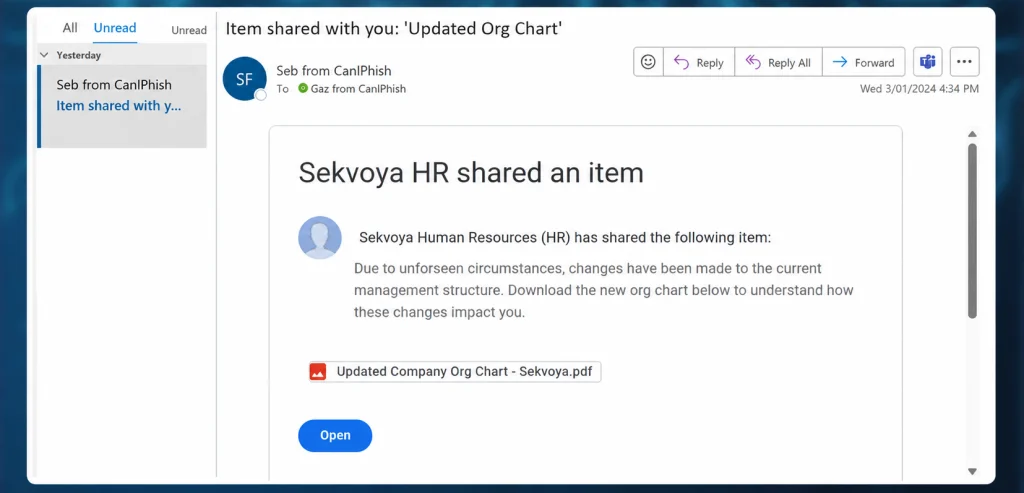
A phishing email with a short explanation (edited). Source: CaniPhish

Brain DoS

One of the easiest ways to force the brain into this energy-saving mode is to overwhelm it.

Emotional overload is one method. If someone triggers fear, stress, panic, or even strong excitement, they reduce the victim’s ability to think clearly. A frightened person doesn’t evaluate things carefully. They react, and that reaction is often automatic. Positive excitement can work too.

Hackers try to flood the brain with too much information from too many channels at once. A person trying to write a document, answer messages, listen to a coworker, and process notifications in the background will burn out mentally pretty fast. In that state, analysis gets difficult and the brain starts skipping into automatic behavior. That’s why overload is such a powerful social engineering tool. It pushes people away from deliberate thinking and into fast reaction.
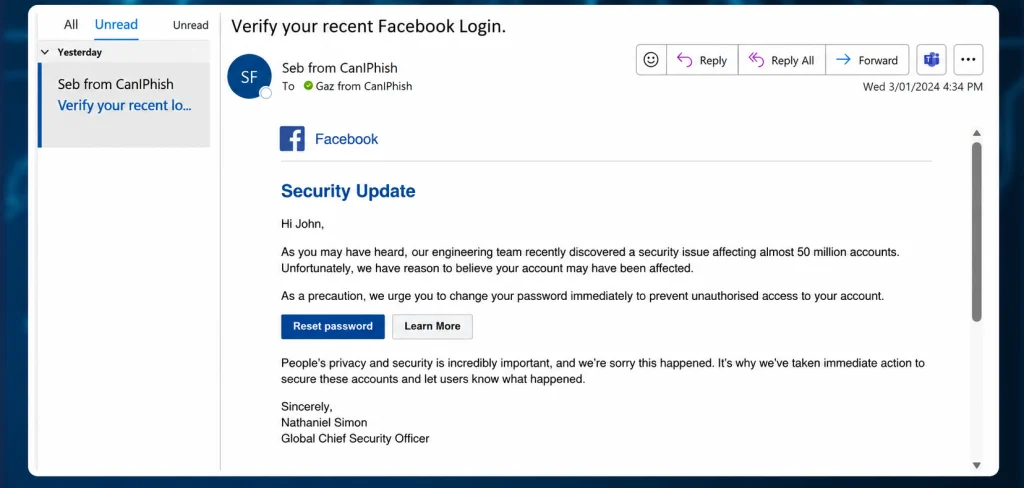
A phishing email exploiting fear. Source: CaniPhish

Most Common Psychological Exploits

The psychology of influence contains many principles, and they show up everywhere, in marketing, advertising, sales, politics, therapy, and more. But for a hacker writing a phishing email or planning a phone script, only a few of these tend to matter most.

The three big ones are authority, scarcity, and consistency.

Principle of Authority

People naturally trust experts in areas where they themselves aren’t experts. If someone appears qualified, successful, wealthy, or powerful, we tend to listen. That’s part of how we navigate the world.

The real vulnerability is that authority can be faked.

People use white coats on television to sell toothpaste. So-called success coaches pose in front of expensive cars or Dubai skyscrapers to create an illusion of status. Well-known restaurant chains use actors from popular TV shows to advertise food. That’s exactly how fake authority works. The external costume creates the internal belief.

The Milgram experiment is a good demonstration of this. In 1963, participants were willing to obey an authority figure even when it made them uncomfortable and conflicted with their own moral instincts. The lesson is that authority has a very real psychological effect. Evolution plays a part here too. Human society developed through division of labor, and that made us more dependent on specialists. We got used to trusting experts. Hackers abuse that instinct all the time.

Here’s an example of a phishing email that appears to come from a manager and can’t be ignored.
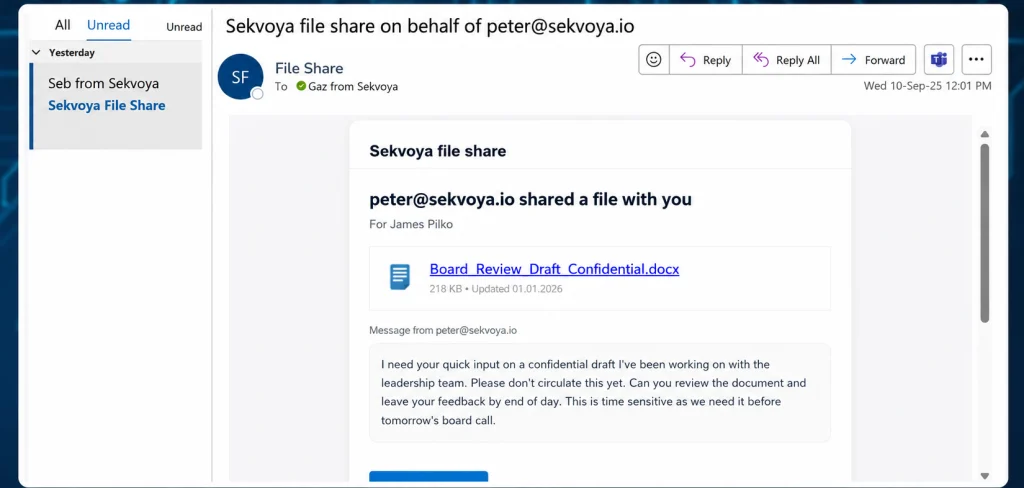
A phishing email exploiting the principle of authority (edited). Source: CaniPhish

Principle of Scarcity

Scarcity is about the fear of missing out. People value things more when they are rare, limited, or disappearing. A product that says “only three left” feels more urgent. A limited-time offer feels more valuable. Even when the item is not actually better, scarcity makes it feel that way. This is an old human pattern. Imported or hard-to-find goods often seem more valuable than ordinary local alternatives, even when they are not objectively better. The absence of abundance created desirability.

Principle of Consistency

Consistency is one of the least obvious but most effective manipulation principles. 

People prefer to be consistent with their earlier actions and statements. Society rewards consistency. A person who constantly changes their opinion is often viewed as unreliable or weak. A person who follows through is seen as stable and trustworthy. That social pressure matters a lot.

The problem is that being consistent is not the same as being correct. Once a person takes an initial step, they often become more willing to continue in the same direction. That saves mental energy and reduces self-doubt. It also fits the brain’s tendency to follow a behavioral script instead of starting analysis from scratch each time. Patricia Pliner’s study showed this clearly. Participants who first wore a badge supporting cancer research were later much more willing to donate to the cause. The first small commitment made the second one easier.

When a victim has already made a small commitment, continuing becomes easier than stopping.

Exploitation

To turn these principles into real social engineering operations hackers build scenarios. That scenario is most effective in a phone call, because a call allows hackers to guide the victim step by step and react to hesitation. Email phishing can also use these ideas, but the room for dynamic adaptation is smaller. The best phishing messages are not necessarily the loudest. They are the ones that fit the target’s mental state at the exact moment of delivery.

Emails and the 7% rule

In many social engineering assessments, a pattern appears again and again. When you send a large batch of phishing emails, a certain percentage of recipients will almost always act. The exact figure changes by organization, but the baseline rarely disappears.

Even when companies train users, run simulations and repeat awareness courses, there is often still a small percentage of people who click or respond. Why? Because at that moment, some of them are tired, stressed, busy, distracted or simply overloaded. At that moment, the person does not reach the analysis stage.

That is why training alone is not enough. Training helps, but it does not eliminate the human condition.

A phishing email triggering excitement. Source: CaniPhish

The most effective emails are often the ones that trigger stress or excitement directly. A message that creates urgency or a strong emotional reaction can overpower careful thinking. Once that happens, hackers move into the next steps.

Trigger Bypass Techniques

Most people have simple mental triggers that hold up even under pressure. The trick is that attackers can sometimes bypass those triggers by shifting the context.

A person might say they never share passwords. But that rule can get bypassed if the attacker presents a password generator, an IT support request, or a command they’re told to run for verification. The target can still believe they’re following their rule, even while being manipulated out of it. Verification habits can also be bypassed with fake signatures, familiar names, or a two-step sequence that starts with something safe. A short first interaction lowers suspicion, and then a second one carries the real pressure. That’s often more effective than starting aggressively. Company rules can be bypassed by changing the frame. A USB drive disguised as a personal gift feels different from an unknown device dropped on a desk. The same object reads very differently depending on the story around it.

That’s why social engineering isn’t about one universal trick. It’s about adapting the story to the trigger.

Protection

For companies, the best defense is a mix of organizational measures, technical controls, and incident response. Training lowers the success rate of simple attacks. Technical controls reduce the damage when someone does make a mistake. And since no defense is perfect, response procedures matter too. Organizations need to know what to do when a suspicious message, call, or request slips through.

Individuals should not be afraid to refuse. Don’t feel obligated to be polite when something feels wrong. If a call creates stress, stop and think instead of reacting automatically. Never make important decisions while overwhelmed. Learn to recognize manipulation patterns, and don’t keep a suspicious conversation going just because the other side sounds official.

Sometimes the safest choice is just to hang up.

Summary

There’s no guaranteed technique for success, and no guaranteed protection either. Human beings are vulnerable because evolution made us efficient, not perfect. That efficiency helps us survive, but it also gives social engineers a way in.

To reduce the probability of these attacks, we offer our Security Awareness and Risk Management training for companies. For pentesters, we offer The Science and Art of Social Engineering, where Master OTW walks you through the tools and techniques needed to become an effective social engineer.

The post Social Engineering: Exploiting Human Psychology in Offensive Security first appeared on Hackers Arise.

OSINT: Monitoring World Events with God’s Eye

Welcome back, aspiring cyberwarriors!

Lately we’ve been seeing a lot of posts about God’s Eye, a spy satellite simulator that runs in your browser. It’s a great tool developed by Bilawal Sidhu, but it requires certain paid APIs. Those APIs make the experience a lot richer, but they can be hard to get or you just don’t want to pay for them. That’s fine. For that reason we want to cover a fork developed by Gh0st-mods.

God’s Eye

God’s Eye is basically a website you run on your own computer that shows the Earth as a 3D globe with live public data on top of it. You can see planes in the air, ships at sea, some satellites, earthquakes and public traffic cameras. When you select those objects on the map, it tells you everything it knows about it. This can be its identity, speed, heading and other details. It looks like a spy movie. The data is just ordinary public feeds.

Let’s set up the fork and see how the free version works.

Setting Up

First, make sure you have all the dependencies installed.

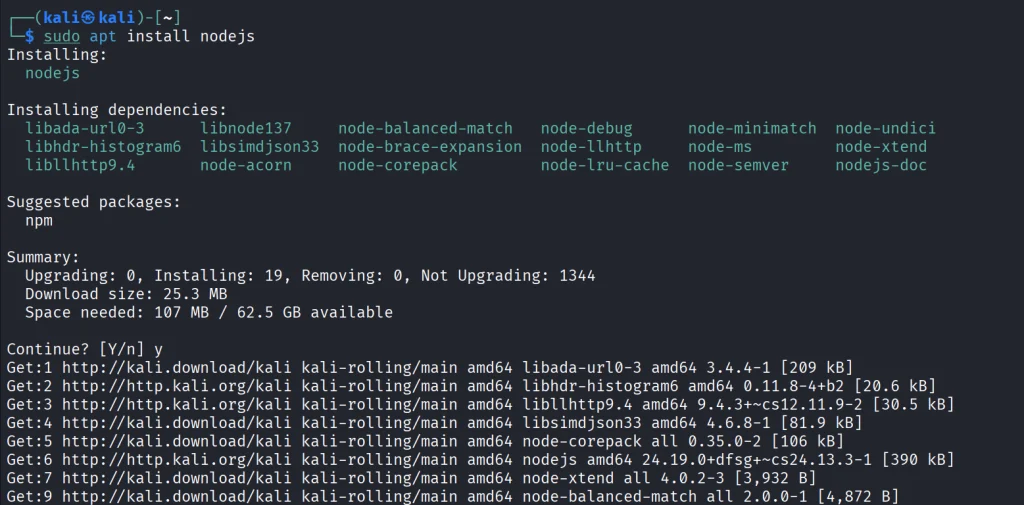
kali > sudo apt update
kali > sudo apt install nodejs
kali > sudo apt install npm

Then clone the repository and install what it needs.

kali > git clone https://github.com/Gh0st-mods/Gods-Eye-Ghost-Edition.git
kali > cd Gods-Eye-Ghost-Edition
kali > npm install
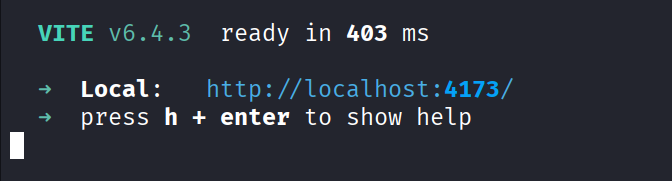
kali > npm run dev -- --host localhost --port 4173

The app is available at http://localhost:4173, so we can open it in a browser.

Let’s walk through some of its features.

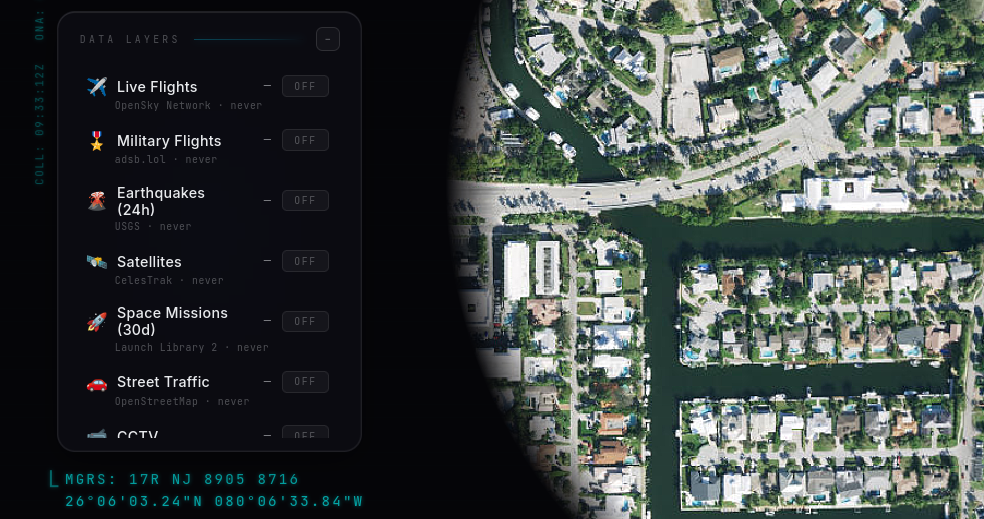
Data Layers

There are multiple data layers and many of them work without any API key. You can always add them to the .env file if you want a richer experience.

Aircraft Tracking

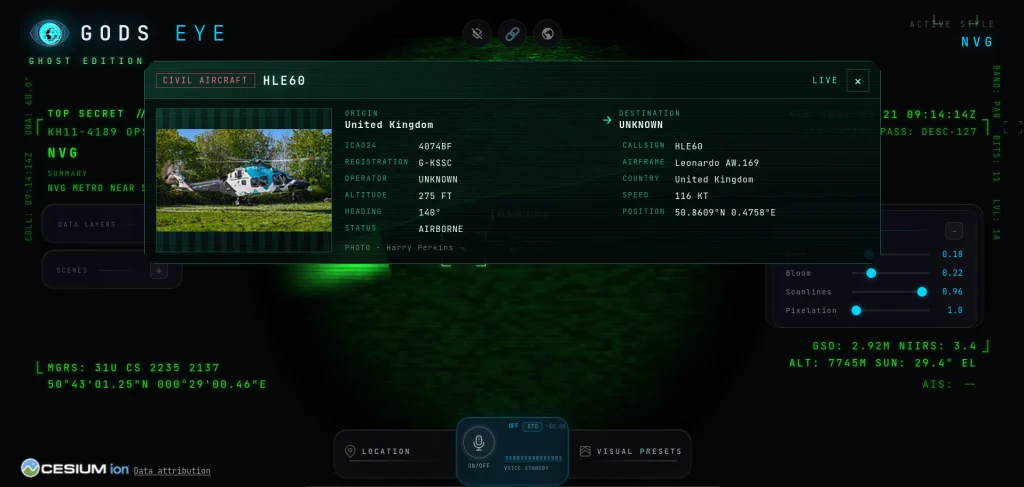
Each aircraft gets rendered in 3D flying over the Earth. You can switch visual presets too. Here we have a civil aircraft flying over the south of England.

Below you can see all the information on it.

Maritime Vehicles

These include transport and nontransport vessels. You’ll see plenty of them scattered across the globe. Here’s a tanker moored somewhere in Miami. Military vessels will also be shown on the map, so you can monitor their activity.

The satellite image quality looks good, since the tool sharpens it for you.

Dams

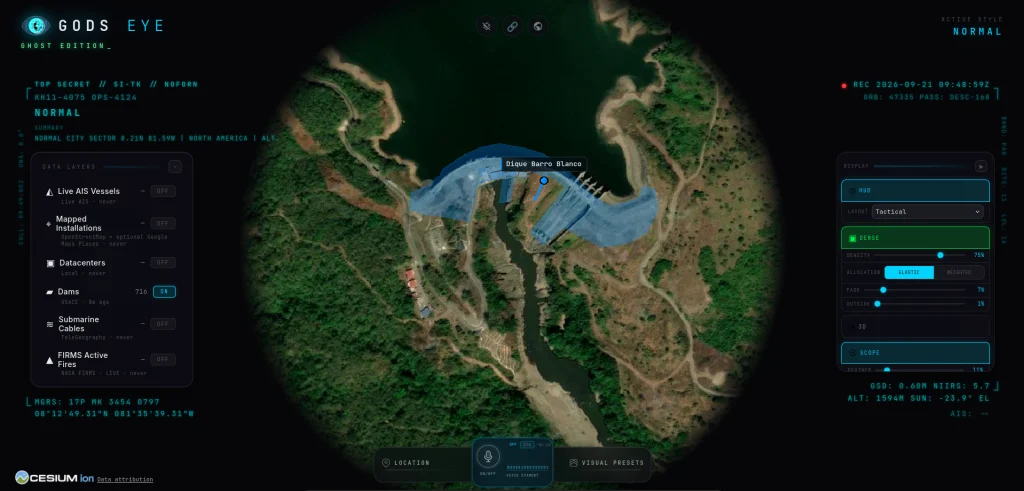
Water dams are part of critical infrastructure. Their locations are publicly available and integrated into the tool. Here is the Barro Blanco Dam in Panama. All critical facilities need good care and protection, especially during wartime, since they’re one of the things an enemy tries to attack.

Data Centers

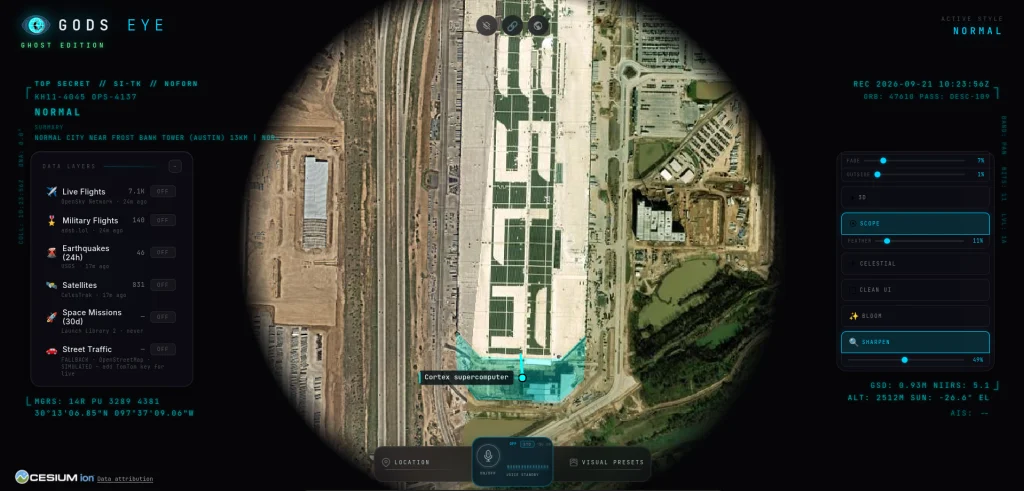
Just like dams, data centers are important targets. If an enemy attacks data centers (drones/missiles, sabotage or cyberattacks) the result can be permanent data loss. Data centers are the physical backbone of banking, payments, logistics, government systems, AI and often military/cloud services. Hitting them will inflict economic and operational pain. The effects will cascade across almost everyone, even those who are completely offline.

One of these attacks happened recently when Iran attacked Amazon data centers.

Source: Wired

Satellites and Earthquakes 

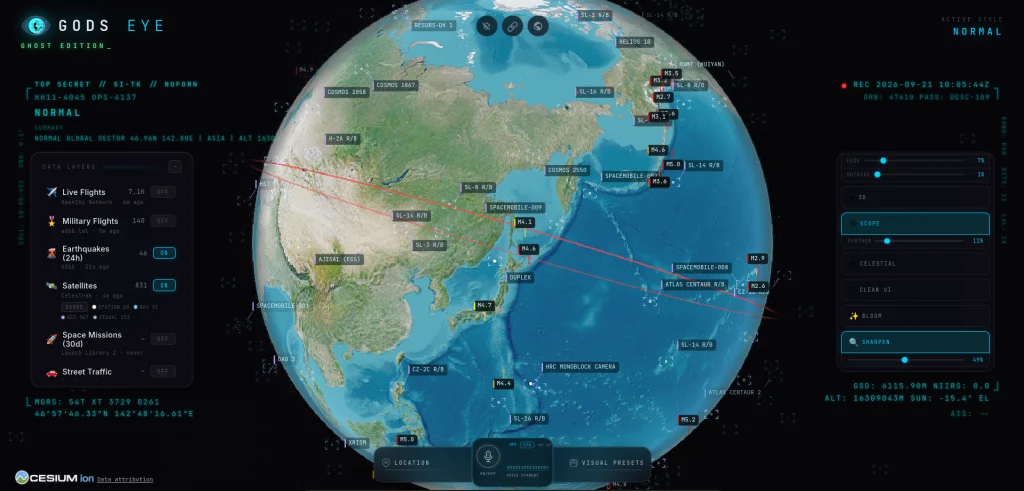
This isn’t the most notable feature on the platform, but it’s there and might be interesting to some. The data updates regularly. Below you can see several earthquakes hitting Japan in the last 24 hours. No surprise there, that region is highly seismic.

Summary

World monitoring apps are getting more popular. Some don’t even need to be installed, like Osiris. The original project by Bilawal Sidhu is great, but it still requires a paid Google API, which not everyone is comfortable with. The fork we covered today works for free out of the box. If you liked it, you might also want to check out ShadowBroker.

The post OSINT: Monitoring World Events with God’s Eye first appeared on Hackers Arise.

Open Source Intelligence (OSINT): Using Osiris for Global Intelligence

Welcome back, aspiring investigators!

We recently updated our article on ShadowBroker, which a lot of you liked. The latest release brought some new features and made the dashboard even richer.

But ShadowBroker is resource intensive and might need you to allocate a good chunk of resources to your VM, which not all systems have. Instead, there’s Osiris and it can do similar things without any installation. You can run it in the browser or host it on your Kali. Both versions are identical.

Osiris

Osiris is a global intelligence dashboard that aggregates live flight tracking, CCTV, earthquake monitoring, conflict zone mapping and 24/7 news feeds. It’s made to give you situational awareness across multiple intelligence domains. The tool was built with Next.js 16 and MapLibre GL and every data point is rendered via WebGL for 60fps performance even with thousands of concurrent entities on screen.

Dashboard

Let’s start with the live version. It’s available here.

The world looks busy once you enable all the data layers on the left side of the screen.

Camera Feeds

There’s a huge number of cameras available around the world that are free to access. They are usually scattered across different websites and don’t look nearly as good as they do on a map. The dashboard has integrated a big number of them, marked with green dots on the map.

Here’s a camera in Toronto. Looks empty at 5 am.

Aircraft Tracking

All kinds of aircraft and maritime vehicles can be tracked. Not only that, you can do a deep dive on the intel available for each one. Below you can see we picked a random flight over the UAE and the dashboard pulled up the company it belongs to, Tim Clark who is the CEO and some publicly known information on him.

You can do similar things with other objects on the map.

So if you’re monitoring military activity in a certain region, that can come in handy.

Critical Infrastructure

There are different data assets you can display by clicking the database icon on the right side of the screen. The data is relevant for various places, but mostly for the US.

Above you can see the critical infrastructure in New York (red) and nationwide (yellow).

Conflicts and Dangerous Zones

Wars, tensions and threats are differentiated by color and notes are assigned to each with a severity level.

Market Analysis

When someone loses, someone else wins. Osiris can do some Market AI overview, which you obviously shouldn’t take as legit advice. But you can see it does some basic analysis and warns of potential price spikes.

Satellite Tracking

All kinds of satellites are available on the dashboard and they can also be tracked. Here you can see Starlink flying over the Atlantic and Canada.

Malware Threats

Finally, you can view malware threats and attacks on the map. There was a big node in China linked to a lot of attacks, with more scattered around the rest of the country.

Hosting Locally

Although the live version is stable and its uptime is good, you might still want to run it locally. It’s pretty easy to set up:

kali > sudo apt install npm
kali > git clone https://github.com/simplifaisoul/osiris.git
kali > cd osiris
kali > npm audit fix --force
kali > npm run dev

Then it’ll be available at http://localhost:3000

Summary

As you can see, there are different platforms available for different setups. Having compared the two, ShadowBroker looks richer and more professional, but Osiris hosts a live version you can use without any installation and it already has most of what you’d want to test. The installation itself is quick and easy and the dashboard consumes way fewer resources than ShadowBroker. Test it yourself and see what you like.

You can learn more with us! Get our Cybersecurity Starter Bundle II and unlock WiFi Hacking, Python for Hackers, Radio Basics and other training.

The post Open Source Intelligence (OSINT): Using Osiris for Global Intelligence first appeared on Hackers Arise.
Hacking US Elections: The First Tranche of Declassified Election Integrity Documents

Why Every Cybersecurity Professional Should Read the Original Records By Gary S. Miliefsky Publisher, Cyber Defense Magazine For more than a decade, cybersecurity professionals have watched researchers at DEF CON’s...

The post Hacking US Elections: The First Tranche of Declassified Election Integrity Documents appeared first on Cyber Defense Magazine.

Wi-Fi Hacking: Wi-Fi Can Now Identify You Without Your Phone

Welcome back, aspiring hackers!

The density of WiFi access points in modern cities has now reached a point where a large-scale surveillance system may be able to identify almost anyone who walks near a router, even if that person is not carrying a mobile phone. Researchers from the Karlsruhe Institute of Technology (KIT) have published a scientific paper describing this kind of system and the technology that makes it possible.

At the center of this surveillance method is a feature called beamforming, which first appeared with the WiFi 5 (802.11ac) standard in 2013–2014. The basic idea was introduced with WiFi 5, but it became much more refined and effective with WiFi 6 (802.11ax), where the technology matured into something more practical.

Beamforming

Beamforming, also called spatial filtering, is a signal processing technique used to send and receive wireless signals in specific directions rather than spreading them evenly in every direction. In simple marketing language, this is often described as a router that “does not broadcast equally everywhere anymore, but instead follows the user with a focused beam.” That description is not wrong, but it leaves out the technical depth behind the idea.

Beamforming

From an engineering point of view, beamforming works by combining several antennas into a group called an array. When the signals from these antennas are timed and lined up correctly, they boost each other in certain directions. In other directions, they cancel each other out. The result is a signal that is far more focused and efficient than older systems, which simply broadcast outward in every direction at once.

Beamforming gives both senders and receivers the ability to focus on signals coming from one direction while blocking out noise from others. Because of that, the technique is used not only in WiFi, but also in radar, sonar, seismology, wireless communications, radio astronomy, acoustics, and biomedical engineering.

Identifying People Through WiFi Signals

As radio waves move through space, they do not simply travel in a straight, clean line. They interact with the world around them in many different ways. They can pass through objects, reflect off surfaces, become absorbed, become polarized, bend around obstacles, scatter in different directions, or refract as they cross boundaries between materials. This means that when a WiFi system sends a signal and later receives it back, the final result contains information about everything the signal encountered along the way. By comparing the expected signal with the received one, it becomes possible to measure interference and use that information to correct transmission errors. But that same interference also reveals details about the environment itself.

For example, when a person enters the path of a WiFi signal, the signal changes. Human bodies affect radio waves in measurable ways. The signal may weaken, shift, scatter, or behave differently depending on movement, posture, and position. If researchers analyze these changes carefully, they can infer a surprising amount of information about the surrounding environment. They may detect whether people are present, what they are doing, and in some cases even who they are.

This whole research area has grown into a separate field known as WiFi Sensing.

Most WiFi Sensing research is presented as useful and harmless, and in many cases it really is. It can support smart-home features, occupancy detection and other practical applications. But the privacy concerns are obvious. When these methods are combined with activity recognition and the massive spread of WiFi hotspots, they can reveal highly sensitive information. One of the most troubling possibilities is that someone could be identified in the range of a hotspot and then tracked over time without ever knowing it.

Using Channel Information for Identification

There are several ways a person can be identified through WiFi. One important method relies on analysis of Channel State Information (CSI), which is sent at the physical layer of WiFi communication. CSI is detailed and useful for WiFi sensing. It gives a rich picture of how the wireless channel behaves. The problem is that CSI is not always easy to access. In many cases, it requires modified firmware and specialized hardware support, which limits how widely it can be used in practice.

Comparison of CSI-based identity recognition methods

The table above compares roughly 25 different systems, evaluating them across several key dimensions. The Paper column lists the name of each system, while the Identities column shows how many different people each system is capable of distinguishing between. The Accuracy column then reflects how reliably each system correctly identifies a person. On the technical side, the Pre-Processing column describes the signal processing techniques each system applies to clean and transform raw WiFi data before passing it to a machine learning model, and the Model Architecture column identifies what type of model is used. The Perspective column shows how subjects were positioned or moving during data collection, such as standing orthogonally, performing gestures, or typing keystrokes.

Beamforming entered the picture for a different reason. As mentioned earlier, it was introduced in WiFi 5 to improve throughput and make wireless communication more efficient. But beamforming also depends on environmental information that is similar to CSI. The difference is that this information is gathered on the transmitter side rather than the receiver side.

Comparison of BFI-based WiFi sensing methods

The key new dimensions here are the Inference column, showing the wide variety of tasks these systems tackle, from respiratory rate monitoring and crowd counting to sign language recognition.

In a typical beamforming setup, client devices send something called Beamforming Feedback Information (BFI) back to the access point. BFI is a condensed snapshot of current signal conditions. It tells the access point how the wireless channel looks so that it can adjust its transmission for better performance.

The key difference between CSI and BFI is that BFI is transmitted back to the access point without encryption. This makes it much easier to collect using standard, off-the-shelf hardware, without needing any special software modifications. That significantly lowers the bar for potential misuse. The privacy concern gets even more serious when you consider that the IEEE is already working on making WiFi sensing an official standard through the upcoming 802.11bf update and based on the current draft, without putting strong privacy protections in place.

KIT Researchers Demonstrate Phone-Free Identification

Researchers at KIT showed that people can be identified using only BFI data, even when they are not carrying a smartphone or any other wireless device. The method does not depend on a person bringing along a tracked gadget. It works using ordinary WiFi devices already present in the environment and already communicating with one another.

Placement of TP-Link Archer BE800 access points, measurement locations, and participant walking routes in the WiFi-based identity recognition experiment

As radio waves move through space and interact with the human body, they create patterns that can be captured, analyzed, and compared. In that sense, the process starts to resemble imaging, almost as if the wireless system were building a rough picture of a scene without using a camera. The result is not a photograph in the normal sense, but the data can carry enough structure to support identity inference.

WiFi Routers as Silent Observers

“The technology turns every router into a potential surveillance device,” says Julian Todt, one of the study’s authors. “If you regularly walk past a café that has a WiFi network, you could be identified without your knowledge and later recognized by government agencies or commercial companies.”

That is a serious warning, and it captures the core concern very well. Intelligence services and cybercriminals already have many easier ways to monitor people, including compromising CCTV systems or intercepting video communications. But wireless networks are different. They create a nearly invisible surveillance layer that already exists in a huge number of places.

Unlike earlier approaches that depended on LiDAR sensors or on reflection-based systems using walls, furniture, and human bodies, this method works with standard WiFi equipment. By collecting BFI data, researchers can build representations of people from several different viewing angles. These representations are then used to distinguish one person from another, even when the number of people is large. Once the machine learning model has been trained, the identification process can happen in just a few seconds.

BFI vs CSI accuracy as the number of WiFi packets increases. BFI reaches near-perfect accuracy almost instantly, while CSI requires hundreds of packets to approach similar performance

Experimental Results

The study involved 197 participants. The researchers reported that they were able to identify individuals with nearly 100% accuracy, regardless of viewing angle or walking style. That is an impressive result, but it did not come easily. To reach that level of accuracy, the model needed a substantial amount of machine learning training. Each person in the training set performed around 20 walking passes before the model was trained.

BFI vs CSI accuracy across different walking styles. BFI maintains near-perfect accuracy regardless of how a person walks or what they carry, while CSI struggles significantly when walking styles change

During the research two TP-Link Archer BE800 routers were used. The experiment relied on channels 37 and 85. It also used two non-overlapping 160 MHz channels in the 6 GHz band available under WiFi 6E. The hardware included Intel AX210 WiFi network adapters.

Accuracy of five WiFi identification systems as the number of people grows. BFId (BFI) and LW-WiID maintain near-perfect accuracy even at 170 individuals, while competing systems degrade sharply with FreeSense dropping to near 15% at scale

The researchers stress that the technology is powerful, but also potentially dangerous. The risks are especially serious in authoritarian states, where systems like this could be used for large-scale population surveillance. In such settings, the ability to identify people without their phones, without cameras and without obvious visible monitoring would be a major privacy threat.

For that reason, the authors strongly recommend that privacy protections and security safeguards be built into the upcoming IEEE 802.11bf standard from the start, rather than added later as an afterthought.

WiFi 6 Routers as Motion Sensors

In fact, WiFi-based sensing has become so effective that some modern routers already include motion-detection features right out of the box, and manufacturers openly advertise them.

Xfinity

Features such as WiFi Motion Detection allow homeowners to monitor activity inside their homes through mobile apps, using nothing more than changes in WiFi signal patterns.

A feature designed for convenience in a home can also become part of a much broader surveillance system when deployed at scale.

Related WiFi and Bluetooth Scanning Tools

As an additional note, several tools already exist that monitor wireless activity in nearby environments. They don’t work exactly the same way as the techniques we covered earlier, but they’re still useful.

Pi.Alert scans devices connected to a WiFi network, detects unknown devices, and sends notifications when devices unexpectedly disconnect from the network. It is often used as a practical awareness tool for keeping track of what is present on a home or local network.

WireTapper discovers nearby wireless signals, including WiFi networks, Bluetooth devices, hidden cameras, vehicles, headphones, televisions, and cellular towers. It gives the user a broader view of the wireless environment around them, which can be useful for awareness and inspection.

Video

We also have an video on this topic with Master OTW and Yaniv Hoffman. In the video, OTW explains how hackers can use SDR, AI, and Wi-Fi signals to detect human movement through walls, how the technology works, and talk about practical ways to defend against it. Feel free to check it out.

Summary

As modern routers gain advanced sensing, they can also become tools for observing and identifying people through the way their bodies interact with wireless signals. The KIT research shows that this is a practical technology that can identify individuals with remarkable accuracy using ordinary WiFi hardware. Although WiFi sensing can be valuable for smart homes and automation, it also raises serious privacy concerns. Privacy protections will need to become just as important as performance improvements.

If you’re interested in Wi-Fi security, our Wi-Fi Hacking training can help you gain the necessary experience. This attack vector is often underestimated, and many organizations are vulnerable to it. It is definitely valuable in penetration testing.

The post Wi-Fi Hacking: Wi-Fi Can Now Identify You Without Your Phone first appeared on Hackers Arise.
❌