Reading view

There are new articles available, click to refresh the page.

The Agentic SOC: Transforming Data into Defensive Velocity

Security Operations Centers (SOCs) are currently confronting scalability challenges on two fronts: structural and cognitive. The day-to-day reality of modern defensive operations is stark: an analyst frequently begins a shift facing a queue deeply saturated with unvetted alerts. To process a single event, the analyst must open the alert, pivot to a secondary console to complete an investigation, manually enrich an IP address, copy a file hash into a third interface, and cross-reference an asset inventory that may not have been updated in months. Following this, they must author and refine queries, waiting for overloaded databases to return historical context.

The actual work of assessing the investigation’s results and moving to decision-making and action has not even begun. This is the administrative burden of the modern SOC. The true threats are not just those that attempt to bypass defenses, but the critical operational hours lost before an active mitigation attempt is even initiated. While analysts are highly trained professionals, the relentless requirement to perform manual data aggregation inevitably leads to exhaustion.

Misdiagnosing the Bottleneck: The Upstream Data Problem

Threat actors operate at machine speed, utilizing automation to pivot laterally across networks in a matter of seconds, frequently disappearing before defensive teams can even log into their terminals. Expecting human defenders to counter automated threat vectors by manually aggregating bad data is an architectural failure.

Every SOC inherits a highly fragmented data ecosystem. Telemetry is continuously generated by diverse sources, including firewalls, cloud workloads, identity providers, endpoint sensors, and legacy systems. This telemetry arrives in disparate dialects, varying formats, and highly inconsistent levels of fidelity. Before AI tools can accurately reason about a potential threat, or an analyst can initiate a logical investigation and run a playbook response, this raw telemetry must be synthesized.

Historically, organizations analysts take on these complex synthesis processes, manually normalizing data points across different vendor schemas. This represents a key misallocation of human intelligence. The asymmetry in modern security operations is not merely a discrepancy in speed; it is an imbalance in how security teams are forced to allocate their finite time. When operators spend the majority of their shifts wrangling data instead of actively investigating threats, the foundation of the SOC itself is inadequate. To achieve defensive velocity, organizations must recognize that fixing the data foundation is the mandatory prerequisite for improving all downstream security functions.

Architecting the Data Foundation with Singularity™ AI Data Pipelines

Addressing the upstream data problem requires the implementation of advanced data pipelines capable of resolving enterprise data chaos before it impacts the detection engine. Frameworks such as SentinelOne’s® Singularity AI Data Pipelines serve as this foundational layer, engineered to ingest telemetry from every source and in every format without requiring months-long integration projects or heavy manual engineering.

Modern pipelines utilize AI to normalize raw telemetry into standardized formats, specifically aligning with the Open Cybersecurity Schema Framework (OCSF). This structural alignment transforms fragmented logs into structured data that is immediately actionable. It eliminates the need for analysts to construct complex regular expressions during critical incidents simply to reconcile how two different software vendors format data, such as usernames or a timestamp.

Efficient data ingestion also requires dynamic, in-flight optimization. Not all telemetry possesses the same analytical value, and storing all generated logs in highly indexed, expensive storage tiers is financially and operationally untenable. Data pipelines optimize data streams by filtering out extraneous noise, trimming excess volume, and routing specific logs based on dynamic criteria. High-value security events are routed and indexed for rapid search retrieval, while lower-priority compliance or operational logs are routed to more cost-effective tiered storage. The result is a substantial reduction in infrastructure costs, a higher signal-to-noise ratio, and a structured data foundation that is completely prepared the moment an investigation is required.

When underlying data pipelines automatically enrich that log with identity and asset information, revealing (for example) that a specific financial director’s laptop in a remote office is communicating with a known botnet, the output transitions from a raw data point into a definitive starting point. Crucially, this enrichment occurs systematically before the human operator ever interacts with the alert. Solving this data problem end-to-end is a primary reason SentinelOne was recognized in the IDC MarketScape for AI SIEM.

Accelerating Detection via Singularity AI SIEM

When a clean, structured data foundation is properly established, the performance of downstream security tools accelerates. Modern detection engines, such as the Singularity AI SIEM, leverage indexless architectures to manage enterprise-scale telemetry. Because the data is normalized and optimized prior to ingestion, these platforms can execute petabyte-scale queries with minimal latency, ensuring investigative results are delivered before the analyst’s attention wanes.

Within this architecture, detection logic is executed continuously against a stream of clean, correlated telemetry. This transforms an ocean of disparate event logs into readable, centralized dashboards that provide immediate situational awareness. The quantitative benefits of this approach are substantial. With AI SIEM, organizations are already executing their queries 70% faster. Adding AI Data Pipelines further augments this workstream, providing cleaner data for AI to run at optimal efficiency. These improvements represent the direct result of ensuring that the data arriving at the SIEM is inherently fit for purpose.

AI SIEM remains a single, comprehensive SKU with customers automatically receiving integrated pipeline functionality for everyday data optimization rather than treating it as a premium add-on. For every unit of paid Data Ingest capacity, customers can process twice that volume through Data Pipelines. A customer with 500 GB/day SIEM entitlement can push 1 TB/day through the pipeline at no additional cost.

Transitioning to Agentic Reasoning Layers with Purple AI

The establishment of a structured data pipeline unlocks the capability for true agentic reasoning within the SOC. Unlike traditional rule-based automation, which executes static responses to predefined triggers, technologies like SentinelOne’s Purple AI operate as a dynamic investigative layer.

When an initial alert is generated, an agentic reasoning system does not simply pause and wait for human triage. It autonomously launches an investigation, comprehensively maps the potential blast radius of the incident, and synthesizes a clear, logical recommendation for containment. Then, the analyst logs into the console and is presented with a fully formed situational briefing rather than a blank investigation screen.

More importantly, an agentic AI layer possesses the capacity to evaluate broader adversarial campaigns rather than isolated security events. In isolation, a minor registry key modification, a singular file write, or a brief outbound network connection may not meet the threshold for a critical alert. Legacy security tools often fail to connect these disparate, low-signal events. However, Purple AI can assemble these seemingly unrelated activities into a cohesive narrative, exposing the overarching strategy of the attacker before a major breach occurs.

This level of autonomous intelligence is strictly dependent on the underlying architecture. Advanced AI algorithms cannot derive accurate conclusions from unparsed, low-quality telemetry. The analytical integrity of the agentic layer is entirely contingent on the principle of data quality; systems like Purple AI require clean, structured data to function effectively, avoiding the fundamental issue of “garbage in, garbage out”.

Governed Hyperautomation and the Human-in-the-Loop

The final component of a modernized, agentic SOC is the deployment of Hyperautomation to execute defensive responses. To counter threats effectively, organizations must deploy automated workflows capable of executing decisions at machine speed. These no-code workflows can be configured to trigger autonomously based on AI triage verdicts, the disclosure of new high-severity vulnerabilities, or specific incoming alerts. By automating the mitigation phase, the SOC evolves from an environment strictly dedicated to passive observation into a dynamic system that actively neutralizes threats.

However, the implementation of automated response mechanisms must be rigorously governed. Executing changes to enterprise infrastructure carries inherent risk. To mitigate this, automated workflows must integrate critical approval steps, ensuring that highly consequential actions are paused until human authorization is provided. The analyst retains the ultimate authority, defining the precise parameters of what processes may run automatically and what workflows require manual judgment.

Redefining the Analyst Mandate via Autonomous Security Intelligence

The strategic objective of integrating data pipelines, agentic reasoning, and Hyperautomation is not the removal of the human operator. Instead, the overarching goal is the restoration of the analyst’s primary function: exercising expert judgment.

By offloading repetitive tasks to technological systems, organizations systematically remove operational friction. The data layer filters out irrelevant noise, allowing the analyst to clearly see the threat. The AI investigation layer removes the administrative grind of data collection, allowing the analyst to focus purely on analytical thinking. Finally, the automated response layer eliminates procedural delays, ensuring the analyst’s decisions are executed rapidly enough to matter. This creates an intelligence fabric, known as Autonomous Security Intelligence (ASI), where data, investigation, and response function concurrently as a single, unified system.

Under this model, the operational output of a single analyst is exponentially multiplied, allowing one unburdened professional to accomplish the work of ten while still owning every critical decision. While the alert queue will perpetually require attention, the fundamental nature of the work fundamentally changes. The timeline of a manual initial triage to active investigation compresses from a multi-hour ordeal into a matter of minutes. The data arrives clean, the investigation runs automatically, and the response mechanisms are prepared. The hours previously consumed by administrative waiting are directly reallocated to strategic decision-making.

Conclusion

When defensive systems are finally architected to operate at the speed of the modern threat landscape, the role of the human operator transforms. Analysts are no longer forced to act as passive passengers, grateful to be carried by fragmented tools. They are elevated to the role of pilots, operating with full situational awareness, retaining their judgment, and actively directing the defensive posture of the organization. This is the paradigm of the agentic SOC, and it is entirely predicated on the foundation of clean, structured data.

Contact us today to learn more about how SentinelOne is leading the way forward with Agentic SOC.


The Autonomous SOC, Revisited: What 18 Months on the Road Has Taught Us

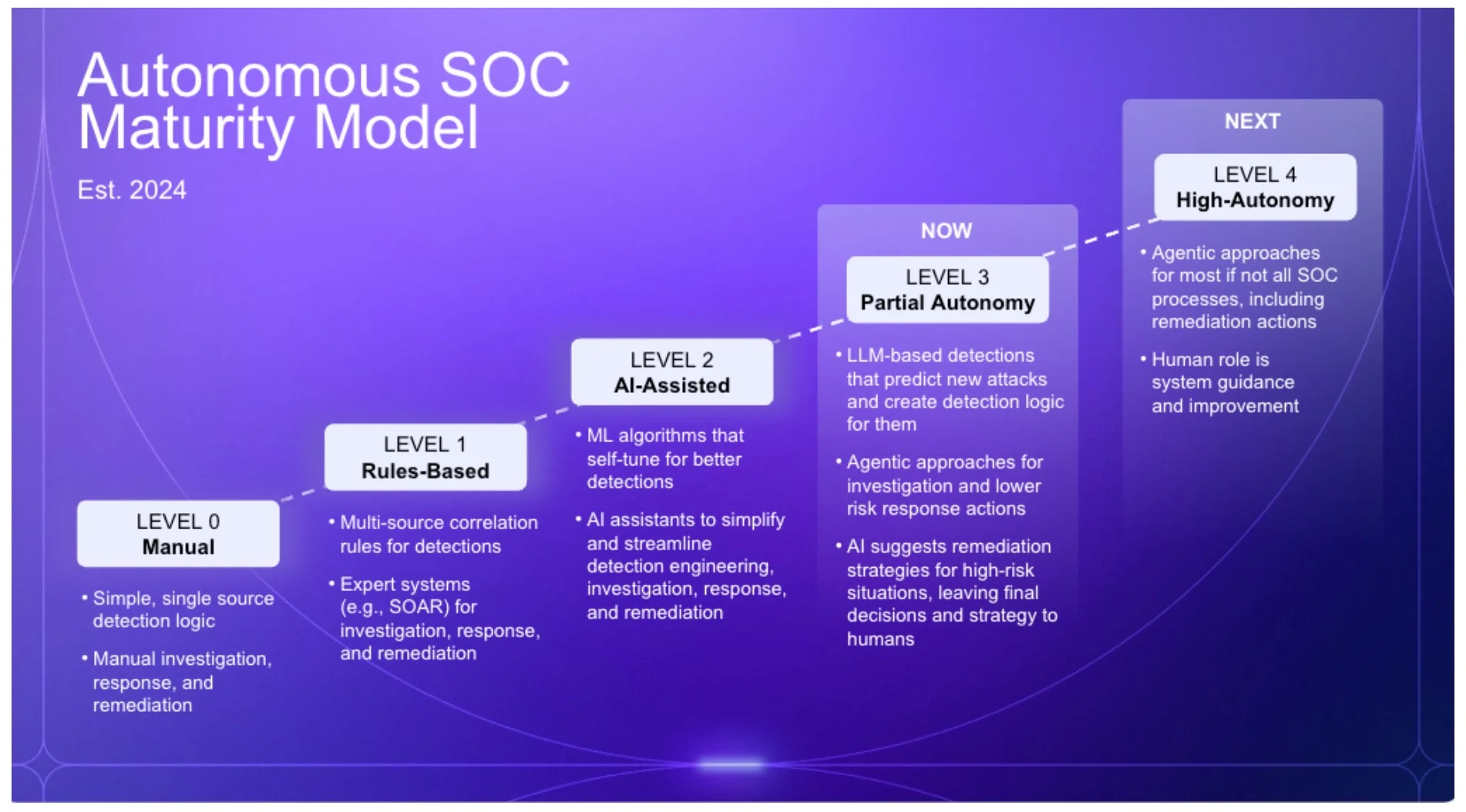
This post revisits SentinelOne’s Autonomous SOC maturity model, first introduced in “Autonomous SOC Is a Journey, Not a Destination” (December 2024).

When SentinelOne® introduced the Autonomous SOC maturity model, we made a deliberate choice: describe a journey, not promise a destination.

The industry had no shortage of vendors declaring that AI would transform security operations. We thought the more useful contribution was a framework for understanding what that transformation looked like, at what pace it was realistic, and what conditions each stage of progress required.

Security teams found the model useful. Not as a marketing claim, but as a map. CISOs and SOC leaders started placing their organizations on it, asking what it would take to move forward.

What happened next was telling. By RSAC 2026, ‘autonomous SOC’ appeared in vendor keynotes and product launches from companies that hadn’t used the term twelve months earlier. Add in pseudonyms like Agentic SOC and AI SOC, and the list explodes. Fast adoption brings loose definitions. For us, it’s worth being precise about what the concept means and what it doesn’t.

Here is what SentinelOne has learned from 18 months of real-world Autonomous SOC deployments.

What Held Up

Today, the progression still maps accurately to where organizations are and what separates each stage from the next. That accuracy holds even for a framework built before most organizations had meaningful AI deployment experience. The inflection points reflect real operational transitions at each maturity step.

The “journey not destination” framing has proven more important than we anticipated when we wrote it. In early 2026, Gartner published guidance to help buyers evaluate AI SOC claims more critically, noting that vendor credibility in this space depends on honest representation of where the technology is:

“Some vendors exaggerate capabilities (like being able to deliver a fully autonomous SOC), risking buyer trust and harming the reputation of legitimate solutions.”1

A maturity model is structurally honest. It reflects where you are, not where a vendor wishes you were. Gartner’s research found that while 40% of organizations are actively evaluating AI SOC capabilities, only 18% have actually deployed2. The gap between evaluating and deploying is rarely about technology. Most organizations cannot advance because they lack a clear view of where they stand or what the next stage requires.

When security leaders use the model as a reference point, the evaluation conversation changes. The question shifts from “does your product make my SOC autonomous?” to “what would it realistically take to advance, given where we are today?” A feature list cannot answer that question. An honest vendor can.

Watch our webinar on why most AI SOC deployments stall here.

What We Underestimated

The levels were always sound. What we underestimated was how much organizations needed to build before they could operationalize them. Customers understood where they wanted to go. But achieving Partial Autonomy (Level 3) requires a data foundation, a workflow architecture, and AI readiness that most teams were still building when we first published this model. That’s a fact about where most security organizations were in 2024.

The transition from AI-Assisted Operations (Level 2) to Partial Autonomy (Level 3) is primarily a governance problem, not a tooling one. The tools are capable. What most organizations are missing is an understanding of the foundation of data and trust that Partial Autonomy (Level 3) requires, including the role humans play in building it.

When analysts work with AI assistance, they leave traces. Which queries they accept. Which results they act on. Which steps they modify or override. Over time, the system learns which investigation patterns the team trusts, which AI recommendations get acted on, and where analyst expertise is required – the kind of institutional knowledge that only comes from doing the work. Partial Autonomy is built on that record, not installed on top of an existing stack.

The path from AI-Assisted Operations to Partial Autonomy starts earlier than most organizations realize. It begins before they’re thinking about autonomy at all. Every assisted workflow is building toward what comes next.

What Holds Organizations Back

The primary barrier between AI-Assisted Operations (Level 2) and Partial Autonomy (Level 3) is accountability.

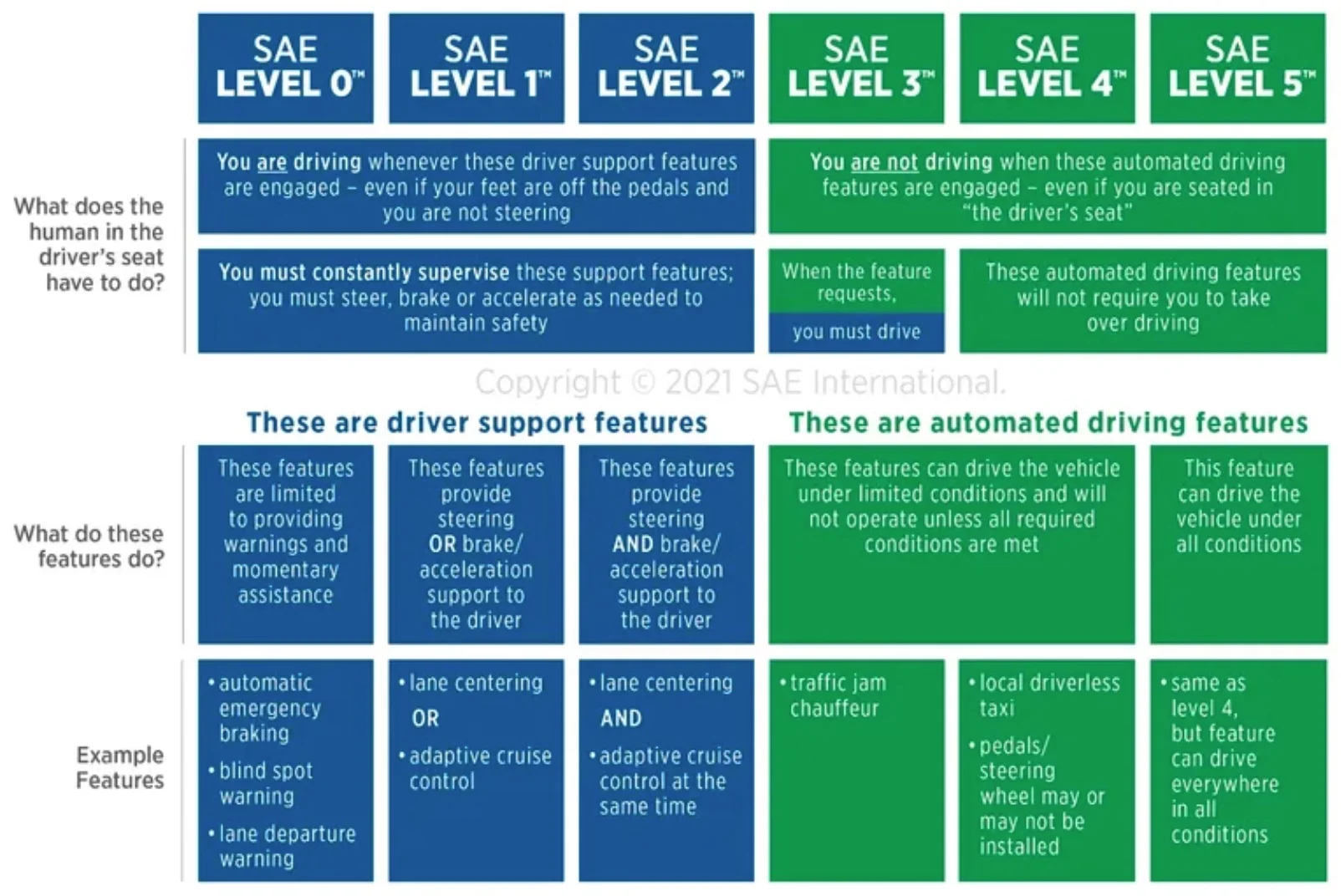
Consider how the automotive industry defined its equivalent of Partial Autonomy – SAE Level 3.

Taxonomy and Definitions for Terms Related to Driving Automation Systems for On-Road Motor Vehicles3

The designation applies only within specific, defined operational conditions. Outside those conditions, the human must take control. What qualifies a system for L3 is defined before autonomous operation begins: explicit parameters, a defined scope, and clear conditions for human override. Governance precedes autonomy.

Consider Waymo. It is the most capable autonomous system deployed at scale today — L3+ — operating without a safety driver under defined conditions. The vehicle is remarkable. But Waymo’s primary innovation is the organization built around it: the cloud infrastructure that keeps cars in autonomous condition, the human operations that handle exceptions the system cannot cover. The more autonomous the system, the more organizational maturity it required to build. High autonomy is an organizational capability.

The same logic applies in security operations. Accurate AI is the foundation. What makes Partial Autonomy legitimate is what gets built on top of it: defined rules of engagement, pre-approved policies, audit trails, and a clear organizational answer to who is responsible when an AI verdict is acted on. That accountability sits with the security team. When automation fires, it fires because someone made a deliberate governance decision to allow it. That is what makes it auditable, defensible, and durable.

Gartner’s readiness criteria for AI SOC deployments require that operational workflows be established in playbooks before AI is introduced4. In practice, the organizations that advanced most consistently treated that requirement as a sequencing discipline, not a box to check. They defined their rules of engagement before turning on automated response.

The second learning was the attacker asymmetry. Defenders who stall between AI-Assisted Operations and Partial Autonomy have often done the validation work. The AI logic checks out. What remains is the decision to extend that trust to autonomous action — and that decision takes time. Attackers move differently. They deploy, observe what works, and iterate. Governance is an externality. Trial and error with no consequences for failure is a significant operational advantage. The gap between a defender’s trust-building timeline and an attacker’s operational tempo is structural. It compounds.

Why High Autonomy Stays on The Horizon. And Why That Matters Less Than We Thought

Eighteen months of deployment have also changed how we think about the upper end of the model.

When the original post was written, High Autonomy (Level 4) was described as dependent on a level of AI reasoning we hadn’t yet seen in production security environments. That remains the right framing. What’s changed is how close that horizon has become. Two years ago, asking a model to reason through a multi-stage attack, correlate signals across data sources, and produce an auditable verdict required significant scaffolding and produced inconsistent results. That’s no longer true. The gap between where AI was and where High Autonomy requires it to be has narrowed substantially.

High Autonomy still requires more than capable models. Institutional trust takes time to build. Accountability structures have to go beyond controlled tests to survive real incidents. Human oversight has to be redefined from reviewing individual actions to governing a system’s behavior within a defined scope. Those are organizational problems, technology doesn’t solve them. That work is already underway at Partial Autonomy (Level 3). What the road to High Autonomy requires is only visible from Partial Autonomy. Organizations that haven’t operated there yet are planning for a destination they haven’t seen. The knowledge of what it takes is path-dependent, and it emerges from operation, not from design.

As organizations move deeper into Partial Autonomy, the distinction between levels matters less in practice. What security leaders actually want is relevant control: governance over the decisions that matter, without being burdened by the ones that don’t. You cannot be responsible or accountable for a system that asks you to review everything.

Control over the right decisions is what matters. An analyst reviewing every alert has maximum control and minimum leverage. A system that acts autonomously on well-understood threat patterns, surfaces only the ambiguous and novel cases for human judgment, and maintains a complete audit trail, gives the analyst control over exactly what deserves their attention. That is a better and more focused version of human oversight.

High Autonomy, seen through this lens, is AI that has earned sufficient trust within a defined scope. The remaining human decisions are the ones that require human judgment, because the governance architecture evolved to allocate human attention correctly.

In the same way, a pilot does not manually adjust every control surface for the duration of a flight. They set the destination, define the parameters, and monitor the instruments. The system handles thousands of micro-corrections that would be impossible to manage directly. The pilot’s job is to govern the conditions under which the aircraft flies itself, not to manage every control input directly. Nobody describes this as a lack of pilot control. It is a better allocation of pilot judgment. And it works because of the environment surrounding the autopilot: pilot training standards, airline operational doctrine, air traffic control, and regulatory frameworks. The technology is one layer of a much larger system.

The governance work done at Partial Autonomy is the same work that produces High Autonomy. Organizations investing in it now are not waiting for a future capability release. They are building the foundation on which High Autonomy operates.

What This Means for the Road Ahead

The first step toward Partial Autonomy is a policy decision. Define the conditions under which your organization will allow a system to act: which response actions, against which threat types, within what scope, under whose authority. Write it down, however rough. That document is the actual starting point. Without it, the tooling is irrelevant.

The work at Partial Autonomy is real, meaningful, and available now. Security teams that define accountability structures before deploying autonomous systems, build a record of AI efficacy in their specific environment, and treat governance as a prerequisite rather than an afterthought, are the ones that reach and sustain Partial Autonomy. They are also the ones best positioned for what comes next. That work produces a more integrated SOC — data, AI, and response operating as a unified system.

High Autonomy remains the north star. This clearly articulated ideal state stops organizations from settling too early. It is the same function that “zero trust” serves as an architectural principle: no organization fully achieves it. Every organization is better for pursuing it.

The tools are capable. The frontier models have advanced significantly since our maturity model was first introduced. The capability gap that once made waiting feel reasonable has narrowed. What remains is the institutional work. That work is always harder than buying a product, which is why vendors who are honest about it are worth paying attention to.

SentinelOne customers operating the Autonomous SOC are seeing it in their numbers: 75% faster investigations, 4x more threats handled, 42% fewer false positives5. Read the IDC Business Value Snapshot.

References

1 Gartner, “AI SOC Agents: Harnessing Innovation, Managing Expectations,” Kevin Schmidt, Alex Tytarenko, Steve Santos, 25 February 2026. G00841784.

2 Gartner, “AI SOC Agents: Harnessing Innovation, Managing Expectations,” Kevin Schmidt, Alex Tytarenko, Steve Santos, 25 February 2026. G00841784.

3 SAE International, “Taxonomy and Definitions for Terms Related to Driving Automation Systems for On-Road Motor Vehicles,” SAE Standard J3016_202104, April 2021. https://www.sae.org/standards/content/j3016_202104/

4 Gartner, “AI SOC Agents: Harnessing Innovation, Managing Expectations,” Kevin Schmidt, Alex Tytarenko, Steve Santos, 25 February 2026. G00841784.

5 IDC Business Value Snapshot, “The Business Value of SentinelOne Singularity AI SIEM,” Michelle Abraham and Matthew Marden, May 2026, sponsored by SentinelOne. #US54435826-BVS.

Third-Party Trademark Disclaimer 

All third-party product names, logos, and brands mentioned in this publication are the property of their respective owners and are for identification purposes only. Use of these names, logos, and brands does not imply affiliation, endorsement, sponsorship, or association with the third party.

❌