❌

Reading view

There are new articles available, click to refresh the page.

Digital Forensics: Analyzing Windows Prefetch Files for Evidence

Microsoft did not build prefetch for forensic analysis. It built it to make Windows faster. Prefetch loads files the system expects the user to need next, so the later fetch is quicker. It has been part of Windows since XP and Server 2003, and it is on by default through Windows 11. On Server 2003, 2008, and 2012, application prefetch has to be turned on in the registry.

Each prefetch file holds metadata about an application: the last time it ran, where its files lived, how many times it ran, and the files it touched. That still matters after the program itself has been deleted. A browser or Word prefetch file can show the application was used even when the executable is gone.

Location of Prefetch Files

Prefetch files live in C:\Windows\Prefetch. On a Windows 10 system the directory looks like this.
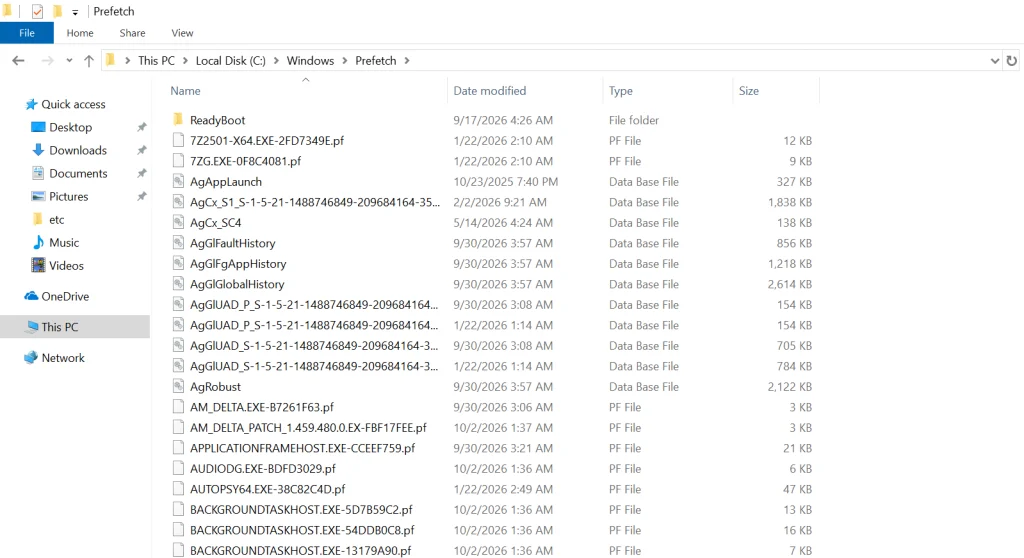
The files that end in .pf are the prefetch files. The .db files are database files. Leave those for later. The Date modified column is usually the last time that application ran.

For example, if DEVICEPAIRINGWIZARD.EXE-*.pf (the Bluetooth pairing wizard) was last modified on 10/03/2026 and a suspect says they never used Bluetooth and did not know how, this file is the contradiction. That doesn’t mean they’re lying, of course, since somebody else could have used their computer.

Analyzing Windows Prefetch

Although we can get some basic information by simply viewing the prefetch files, we need to parse the file to get all the information it contains. There are numerous programs capable of parsing these files and all of them work pretty well, but Nirsoft’s free WinPrefetchView is about the easiest to use with a nice, intuitive GUI (most of the forensic suites such as EnCase, FTK, and Oxygen are also capable of prefetch parsing).

Simply download and install it, then run it. It will grab all the prefetch files and parse them like below.
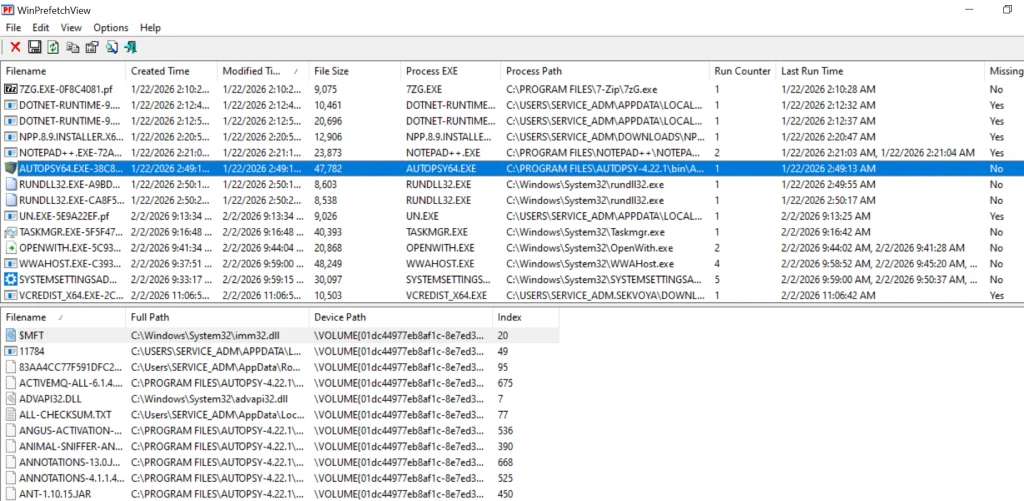
We selected Autopsy. The upper pane gives the path to the executable, the number of times it ran, and the last run time. The lower pane lists every file the program used, with a path to each.

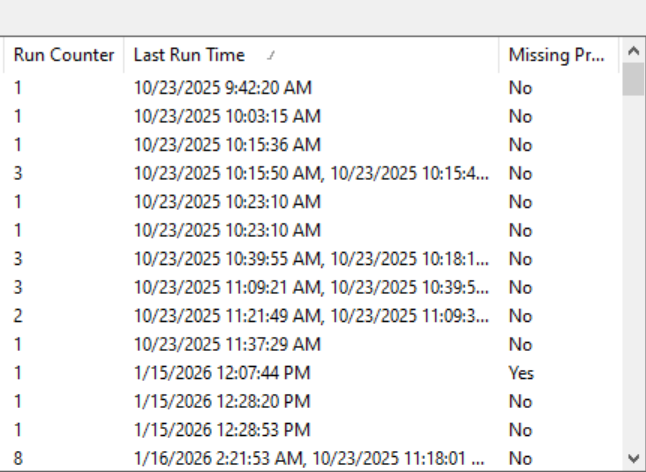
If we click on the β€œLast Run Time” tab to sort by time, we can recreate a timeline of events that took place on that system.
Disabling Prefetch

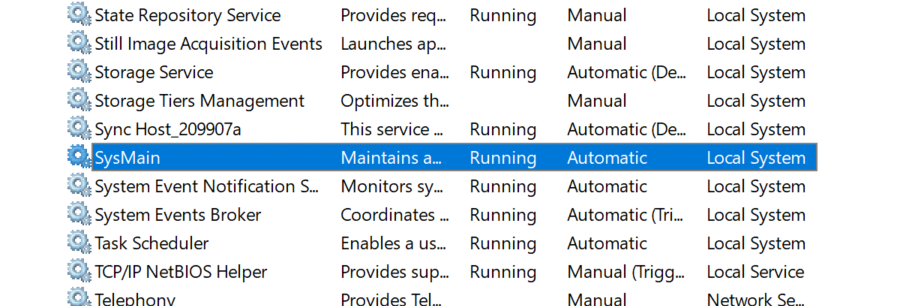
If the suspect were really digitally-savvy, they could disable prefetch. They could also disable, or stop, superfetch, which was introduced with Windows Vista and works similarly to prefetch except that it preloads applications based upon your usage patterns. To disable or stop it, go to Computer Management, select Services on the left, then double-click on Superfetch and choose the desired option. On Windows 10/11 it’s SysMain.Β 

Summary

Prefetch files can be useful in a forensic investigation in proving that the suspect actually used the application in question, even if the application has been removed from the system.

If you’re interested in digital forensics, we recommend our training on Anti-Forensics, where we show different ways users can cover their tracks and minimize their footprint.

The post Digital Forensics: Analyzing Windows Prefetch Files for Evidence first appeared on Hackers Arise.


Bitcoin Faces a Hawkish Fed Pause as Two Officials Seek Higher Rates

TL;DR: The Federal Reserve held the federal funds target range at 3.75% to 4.00% on October 28. For Bitcoin, a key market question is whether the latest policy message encourages holders to maintain cash rather than increase exposure.

The Federal Reserve held the federal funds target range at 3.75% to 4.00% on October 28. Its monetary policy statement said the economy was expanding at a strong pace and inflation remained elevated, while uncertainty persisted. The decision was approved by ten committee members, with Lisa Cook and Beth Hammack dissenting in favor of a quarter-point increase. For cryptocurrency traders, the immediate consequence is not a mechanical change to blockchain supply; it is a reminder that the price and availability of dollar funding continue to shape appetite for volatile financial assets.

The event and the market response

The central bank also published an implementation note preserving the rate paid on reserve balances at 3.90%, and describing standing overnight operations used to keep market rates near the target. Those tools operate in traditional money markets, but their effects reach crypto indirectly through Treasury yields, borrowing costs, the dollar and institutional portfolio decisions. Dollar-backed stablecoins likewise operate in an ecosystem where short-dated government securities and bank deposits remain important reserve assets. A policy hold is therefore relevant to both speculative trading and the economics of payment-token infrastructure.

Why the development matters to the crypto market

For Bitcoin, a key market question is whether the latest policy message encourages holders to maintain cash rather than increase exposure. Restrictive interest rates raise the opportunity cost of holding an asset that pays no coupon, although Bitcoin’s long-term supply argument is separate from that short-term trading calculation. The vote also makes the differences within the central bank visible, complicating any assumption that easing is around the corner. A better dashboard than one price candle combines yields, the dollar, ETF demand and derivatives positioning.

The connection between digital assets and traditional finance is now too substantial for investors to ignore. Dollar financing rates, the appetite for technology shares, brokerage activity and institutional allocation decisions can all influence crypto demand. None of those relationships is fixed, however: correlation changes as investors rotate between risk and cash. Using a single session to support a dramatic long-term prediction is tempting but unreliable. Readers are better served by a sober distinction between published facts, market observations and forecasts that depend on uncertain assumptions.

What the headline does not establish

There are limits to simple rate-cut narratives. A pause does not signal that a cut is imminent, just as two votes for an increase do not establish that the next decision will be a hike. Future inflation, employment and financial conditions will matter. Bitcoin’s performance around the announcement can reflect leverage, equity-market moves and positioning as much as the statement itself. Readers should separate the Fed’s confirmed decision from forecasts about what it will do in December; the committee has not committed to a specific next move.

What to watch next

Investors should watch upcoming inflation and labor figures, the path of Treasury yields and the Fed’s next communication. None of those signals guarantees a Bitcoin direction; together they will clarify whether the October pause is a temporary holding pattern or part of a longer restrictive stance.

Primary source: Official statement / source documentation. Additional source: Supporting document 1.

written by the News Desk and edited by Samuel Rae.

OpenBSD 8.0 Released With Enhanced Firewall Security and Critical Vulnerability Fixes

OpenBSD 8.0 was released on October 20, 2026, marking the project’s 61st release. This update includes significant improvements, including enhanced firewall security, memory-safety fixes, stronger validation for network daemons, and security updates to core components. Key updates include enhancements to PF, OpenBSD’s packet filtering firewall, as well as fixes for vulnerabilities related to virtualization, cryptographic […]

The post OpenBSD 8.0 Released With Enhanced Firewall Security and Critical Vulnerability Fixes appeared first on GBHackers Security | #1 Globally Trusted Cyber Security News Platform.

❌