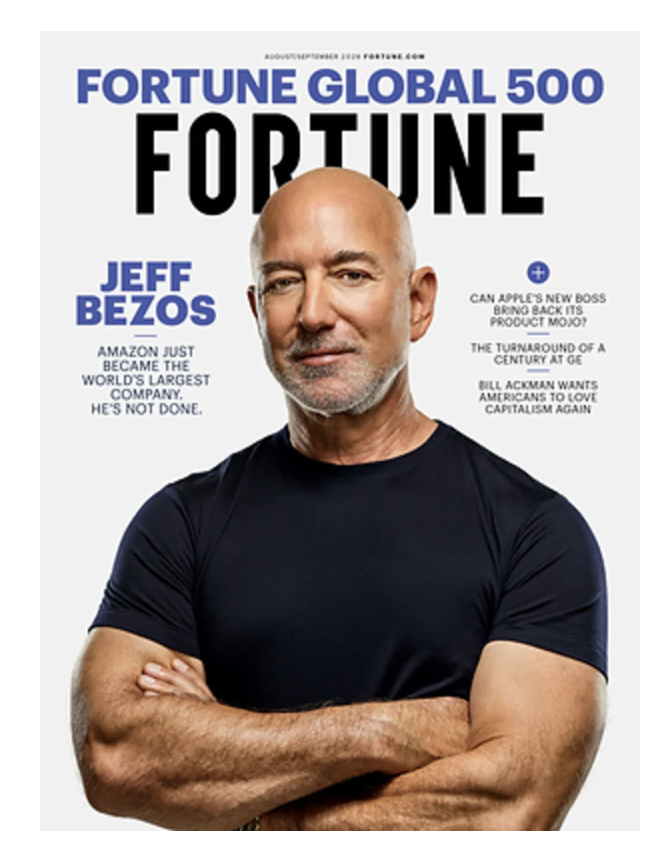
Amazon’s next pillar could be built on a foundation of silicon.
In a new interview with Fortune, Amazon founder and Executive Chair Jeff Bezos says the company’s custom chip business is on track to become one of Amazon’s most durable businesses, placing it alongside Marketplace, Prime, and Amazon Web Services as a core pillar of the company.
“A few of our offerings have become durable pillars, things like Marketplace and Prime and AWS,” Bezos told Fortune. “What I see right now is that our chips business, our silicon business, is lining up to be our next pillar.”
The comments offer one of Bezos’ clearest public endorsements yet of Amazon’s push to design its own chips for artificial intelligence, an increasingly important strategy as demand for AI computing soars and companies look for alternatives to Nvidia’s dominant processors.
More than a decade of investment
Amazon has invested heavily in custom silicon through Annapurna Labs, the Israeli chip startup it acquired in 2015. The company now develops its own AI chips under the Trainium and Inferentia brands, designed to train and run large language models while reducing costs for customers using Amazon Web Services.
AWS has positioned the chips as a lower-cost alternative for AI developers. AWS has positioned the chips as a lower-cost alternative for AI developers. Anthropic trains and runs its Claude models on Trainium, and OpenAI has committed to consume about 2 gigawatts of Trainium capacity, ramping in 2027.
The company disclosed revenue for its in-house data center chips for the first time earlier this year, and since then its Trainium, Graviton, and Nitro chips have grown to a combined annual run rate of more than $20 billion. Amazon has been pouring billions of dollars into AI infrastructure, including new data centers and custom networking hardware.
Amazon CEO Andy Jassy has repeatedly argued that demand for AI computing will remain strong for years, making investments in chips, servers, networking equipment, and power generation essential to the company’s long-term growth.
In an earnings release earlier this year, Jassy signaled plans to pour a record $200 billion in capital expenditures across Amazon in 2026, citing “seminal opportunities like AI, chips, robotics, and low earth orbit satellites.”
The real potential for Amazon’s chips business could come in going beyond the walls of its own data centers. Jassy wrote in his annual letter to shareholders this year that it’s “quite possible” Amazon will sell racks of its internally developed chips to third parties in the future.
Amazon’s fourth pillar?
This discussion about Amazon’s “pillars” goes back to Bezos’ 2014 letter to shareholders, where he described four characteristics of what he called a “dreamy” business: “Customers love it, it can grow to very large size, it has strong returns on capital, and it’s durable in time — with the potential to endure for decades.”
AWS, Marketplace, and Prime are considered the first three pillars. The question of what could become Amazon’s “fourth pillar” has been debated for more than a decade, with areas including shipping and logistics and Alexa cited as contenders in the past.
The company’s big bet on silicon also was emphasized by Jassy in the Fortune piece. He told the magazine that chips are often the key to computing. “The growth in AI has been so significant, but we have a chips business that we built over the last decade here that is growing very quickly,” he said.
The profile appeared alongside Fortune’s release of its 2026 Global 500 ranking, which placed Amazon at No. 1 for the first time, ending Walmart’s 12-year run as the world’s largest company by revenue after Amazon surpassed $700 billion in annual sales, as reported previously.
Walmart fell to No. 2, followed by State Grid of China, UnitedHealth Group, and Saudi Aramco. The magazine reports that Amazon is on pace to be the first trillion dollar company by revenue.
Amazon reports Q2 2026 earnings on Thursday afternoon. Check back with GeekWire for coverage.

 Login
Login