Turkish Aerospace’s Aksungur long-endurance drone has completed its mission with Aselsan’s aselBUOY 100P underwater acoustic listening system during the Turkish Naval Forces’ TURNAs-2026 unmanned maritime systems exercise, the company announced on X on Oct. 24, adding a new capability to the drone’s set of maritime missions. “With this integration, which offers an important capability for […]
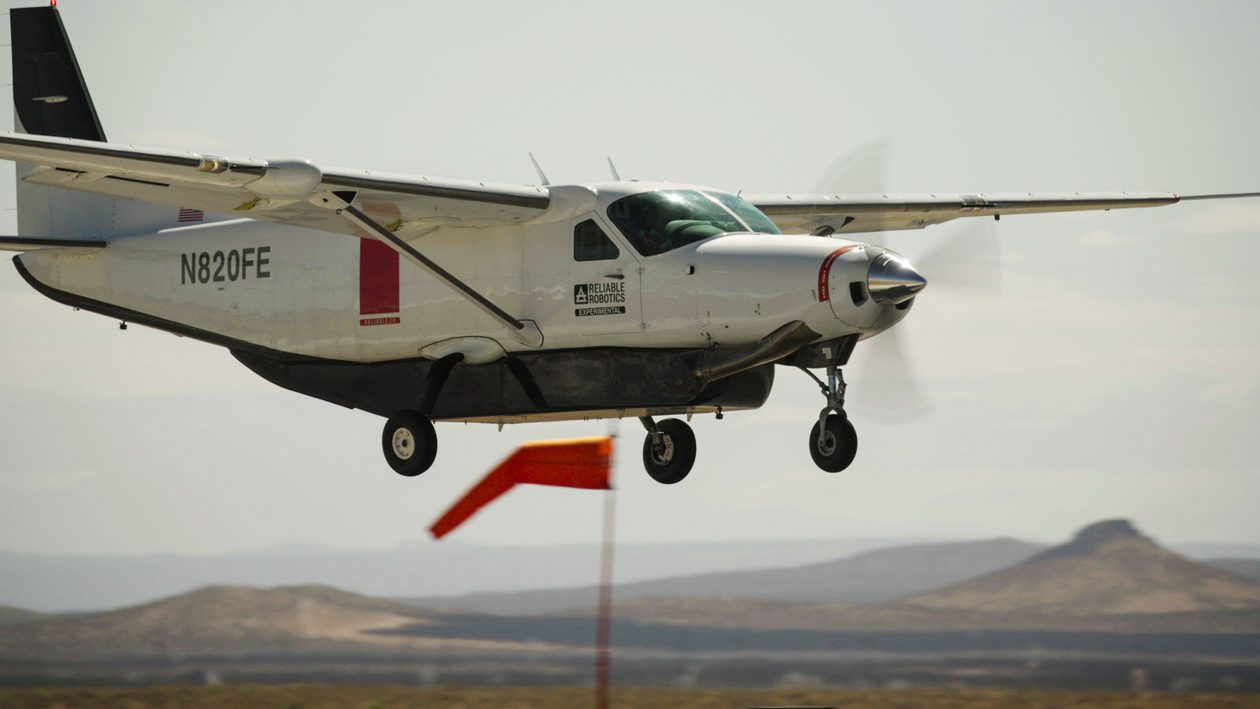
Reliable’s automated Cessna 208B Grand Cavan conducts autonomous operations in Mojave, Calif. (Reliable Robotics Photo)
Aviation startup Reliable Robotics is opening a new engineering hub in the Seattle area, establishing a radar research and development center in Bothell.
The Mountain View, Calif.-based company also announced Tuesday that it has raised $115 million, pushing its valuation above $1 billion. The funding will help expand its aircraft fleet, production facilities and engineering team as it works toward federal certification of its autonomous flight technology.
Reliable’s new office in the Bothell Highlands north of Seattle will open with about 25 employees and serve as its Radar Center of Excellence, a facility for developing and testing systems designed to help aircraft detect and avoid other aircraft. The company plans to grow the team and is heavily recruiting in the region, including roles across radar, embedded software, flight controls, guidance and navigation, simulation and systems engineering.
The expansion adds another player to the Seattle area’s growing mix of aerospace, robotics and autonomous systems companies.
Last month, GeekWire reported that San Diego-based Shield AI selected Des Moines, Wash., as the production and engineering hub for its X-BAT, an AI-piloted aircraft designed to take off and land vertically. The heavily-funded company is planning a 420,000-square-foot manufacturing and engineering facility and says it expects to employ about 4,000 people in the region by the early 2030s.
Reliable is developing systems that can automate aircraft operations, including engine startup, taxiing, takeoff and landing. Its longer-term ambitions include enabling aircraft to fly without a pilot aboard, with remote operators overseeing flights from the ground. The company is working toward certification from the Federal Aviation Administration.
Founded by former SpaceX engineers in 2017, Reliable has spent nearly a decade developing technology designed to work with existing aircraft rather than requiring entirely new planes. Its initial system is intended to keep a pilot in the cockpit while automating key flight operations, with more advanced levels of autonomy planned over time.
The 250-person company’s latest financing, including $90 million led by Nimble Partners and a $25 million term loan from Silicon Valley Bank, brings total funding to $380 million.
The company’s new Bothell lab will bring together engineers to design, build and test radar systems, including its active electronically scanned array air-to-air radar.
The technology is intended to support detect-and-avoid capabilities that would help autonomous aircraft safely operate in the national airspace alongside conventional planes.
“Seattle represents the past, present and future of aviation. For decades, engineers here have developed aircraft and systems that change how the world connects,” Chris Schulenberg, Reliable’s vice president of programs, said in the company’s announcement. “By expanding into the Pacific Northwest, Reliable is uniting the tech talent in Silicon Valley with the aviation expertise of Seattle.”
The Bothell office — located at 21222 30th Drive SE — will be led by Schulenberg and Marc Pos, a senior technical fellow focused on radar who previously spent more than two decades at Honeywell.
“Radar development is a hands-on process,” Pos said in a statement. “By bringing a team together in a centralized lab and engineering environment, with all of the resources we need at our fingertips, we can move from design through development and testing with the rigor, speed and precision unique to Reliable.”
Reliable also plans to expand its engineering operations in San Diego, where it will focus on aviation autonomy for military applications.
The two offices bring the company’s footprint to five locations, joining its headquarters and aircraft hangars in California and the operating hub of its subsidiary airline, Reliable Airlines, in Albuquerque, N.M.
Cummings Aerospace has fired two of its 3D-printed Hellhound S3 jet-powered drones from a launcher mounted on a utility vehicle, with a single operator using one handheld controller to send both on separate autonomous missions, the company said. The test took place on Aug. 25, 2026, at the Pendleton UAS Range in Oregon, where an […]
Welcome to Edition 9.15 of the Rocket Report! The launch I'm most looking forward to in the next few weeks is that of Japan's Martian Moons Exploration (MMX) mission. MMX is one of the marquee space science missions launching this year, and it's set to leave Earth as soon as Monday (US time) aboard a Japanese H3 rocket. The spacecraft will visit Phobos and Deimos, the two asteroid-like moons of Mars, deploying a rover and collecting specimens for return to Earth in 2031. Exploration at its finest.
As always, we welcome reader submissions, and if you don't want to miss an issue, please subscribe using the box below (the form will not appear on AMP-enabled versions of the site). Each report will include information on small-, medium-, and heavy-lift rockets as well as a quick look ahead at the next three launches on the calendar.
Reflect Orbital looks to India for launch capacity. California-based Reflect Orbital, the startup attempting to offer sunlight on-demand with in-space mirrors, announced the purchase of two launches Wednesday from Indian launcher Skyroot Aerospace, Payload Space reports. One of the launches will use Skyroot's Vikram-1 rocket, which became the first privately developed Indian rocket to reach orbit in July. The other will fly on an upgraded rocket called the Vikram-1U.
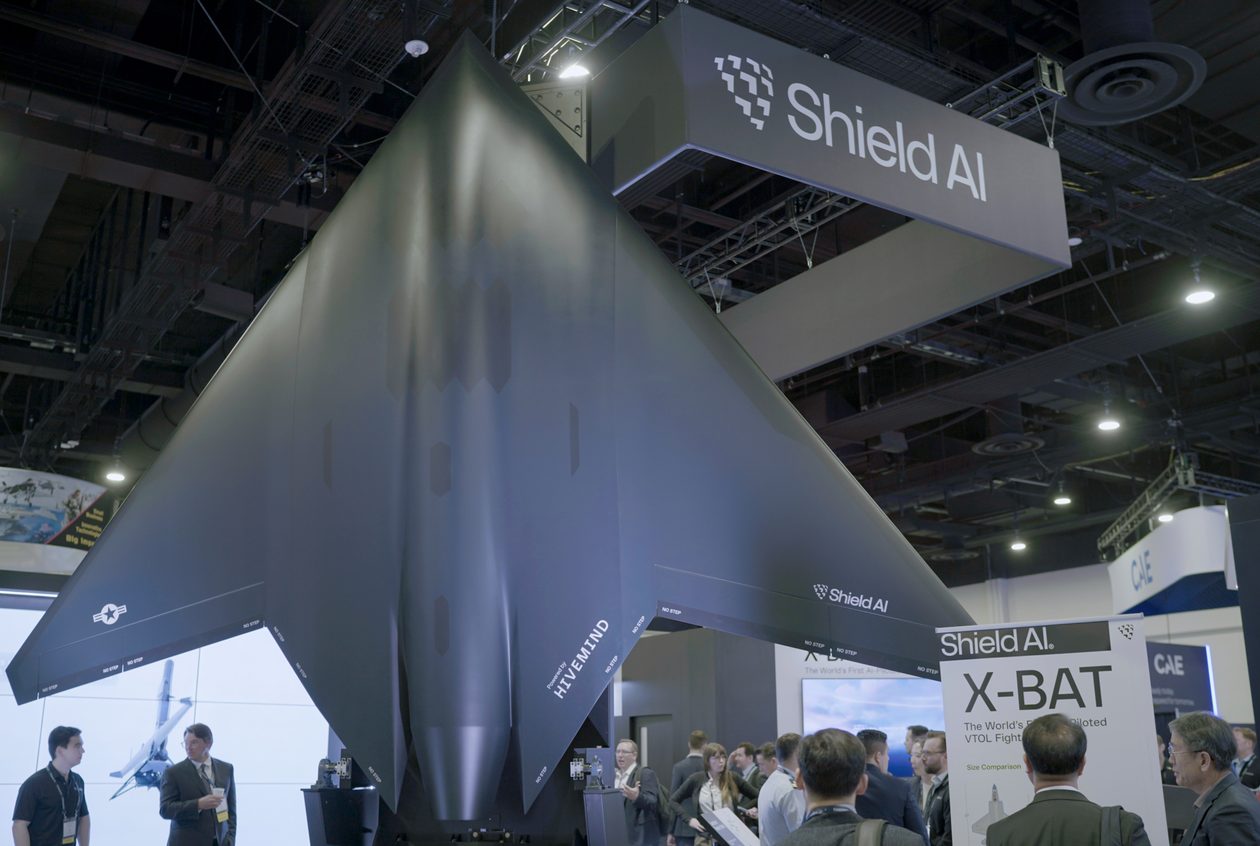
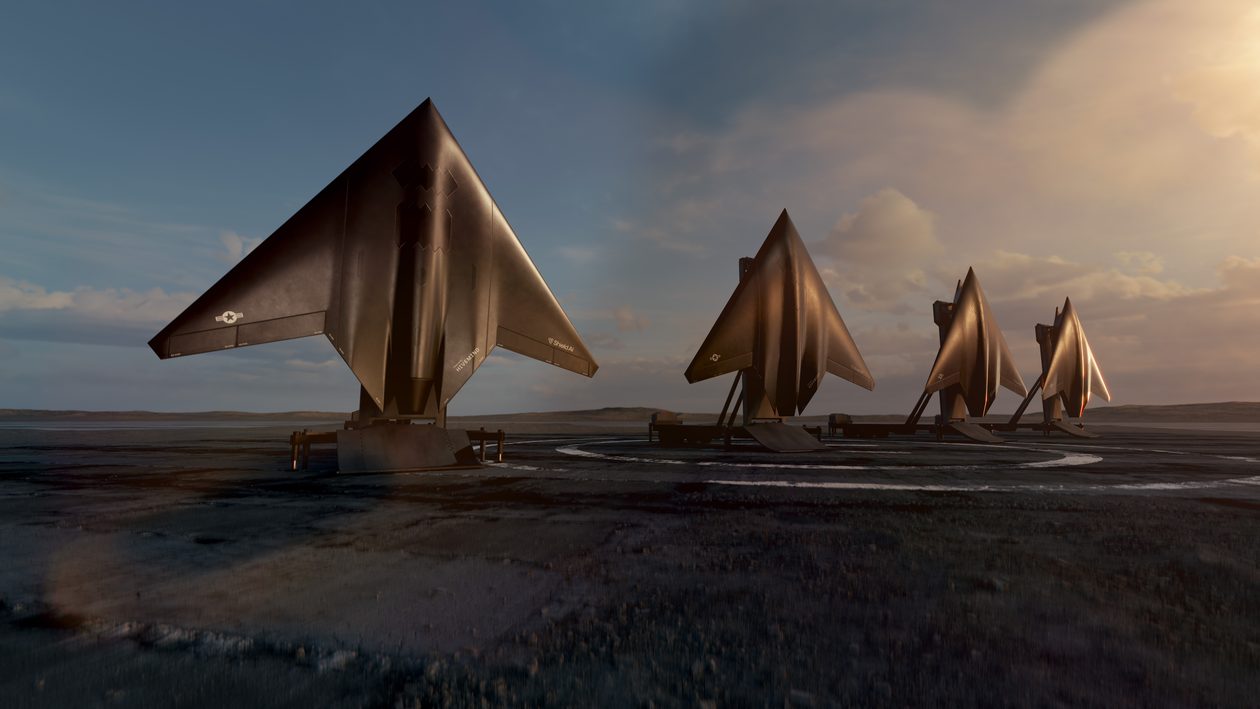
Shield AI’s new X-BAT autonomous fighter jet is designed to take off and land vertically. Photo via Shield AI.
Defense technology startup Shield AI has secured a $150 million contract from the U.S. Navy to advance development of its X-BAT autonomous fighter jet — providing fresh federal backing for the program as the company establishes its first major manufacturing footprint south of Seattle.
Last week, GeekWire reported on Shield AI’s plans to open a 420,000-square-foot engineering and production facility in Des Moines, Wash., dubbed “X-Forge 3.” The company, which is looking to add an additional one million square feet of space in the region, said it expects to employ about 4,000 workers in the Seattle area by the early 2030s.
The new $150 million contract with the Navy adds funding from the Office of the Under Secretary of Defense for Acquisition and Sustainment through its Defense Exportability Features program. The agreement supports efforts to design security and export capabilities directly into the X-BAT, a process that enables advanced U.S. military hardware to eventually be sold to international allies without exposing sensitive domestic technologies.
San Diego-based Shield AI, which raised a $2 billion venture capital round at a $12.7 billion valuation earlier this year, is matching the award with $150 million of its own capital.
Combined with a prior $100 million joint investment finalized in August under the Navy and Defense Innovation Unit’s (DIU) expeditionary strike effort, cumulative commitments behind the X-BAT now stand at $400 million.
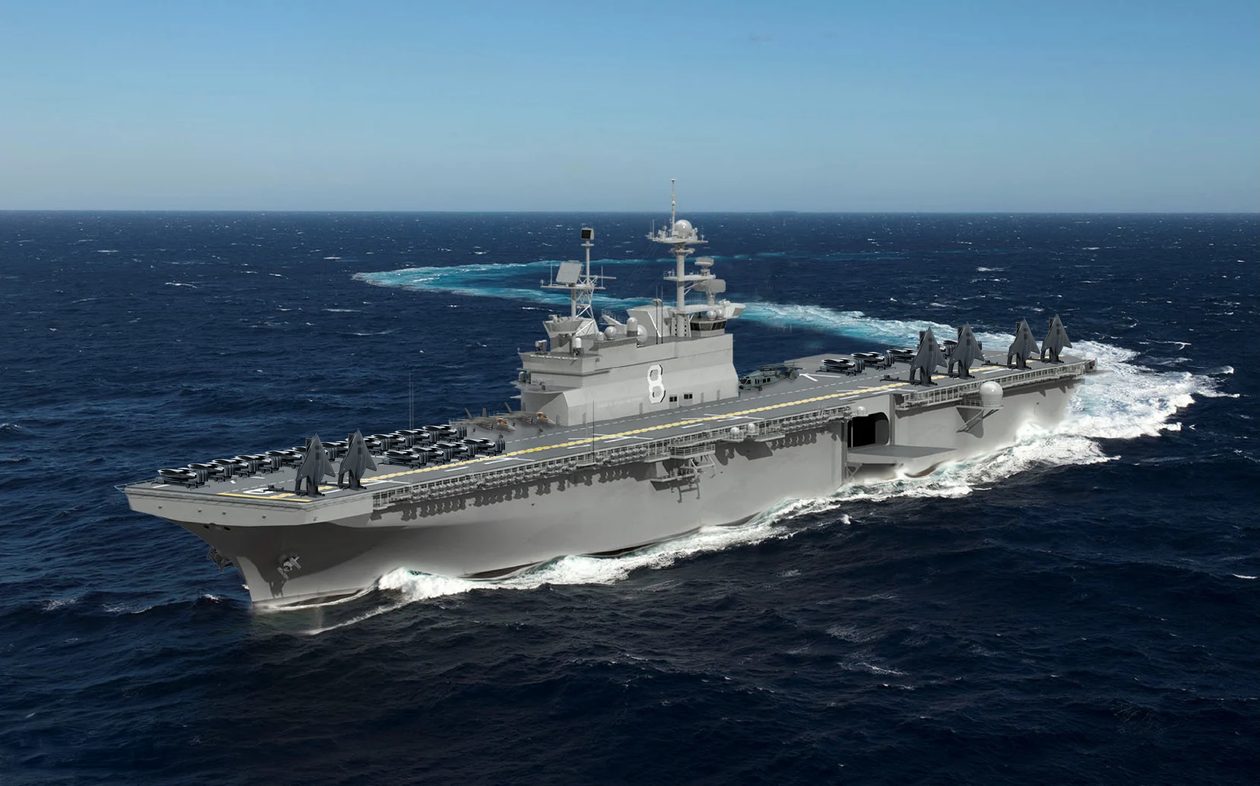
Designed to take off and land vertically, the X-BAT is built to operate from amphibious assault ships, destroyers, commercial cargo decks, and highway strips without relying on traditional concrete runways or aircraft carrier catapults. It launches from a specialized Launch and Recovery Vehicle — a mobile trailer that erects the jet vertically, allowing it to be towed on interstate highways or loaded onto ships.
At the time of its introduction last year, Shield AI co-founder and president Brandon Tseng, a former Navy SEAL, called X-BAT a “transformative, runway-independent aircraft” and noted that “airpower without runways is the holy grail of deterrence.”
The urgency behind runway-independent airpower was underscored last weekend when the U.S. Air Force withdrew strategic B-1 bombers from R.A.F. Fairford in Britain following reports of potential drone threats targeting the air base.
Shield AI expects to begin producing aircraft in Des Moines in 2028, scaling to a target production rate of roughly 150 jets per year by the early 2030s. While prototyping is based in Frisco, Texas, and flight testing will take place at Newton City-County Airport in Kansas, the Des Moines plant will house the core production line and engineering teams.
In an interview with GeekWire, Shield AI executives emphasized the speed at which it hopes to roll out the AI-piloted aircraft in Des Moines.
“This is a large program,” Armor Harris, senior vice president of aircraft at Shield AI, told GeekWire. “Building a next generation fighter jet is no small endeavor, and with the amount of interest that we’ve seen, both from our U.S. government customers and from international customers, we could be looking at building these at rates greater than fighter jets have been built in a really long time.”
Harris noted that keeping development and manufacturing closely linked allows the company to move significantly faster than traditional defense procurement cycles.
“We are testing early and often while working on the aircraft, mission systems, ship suitability and production in parallel,” Harris said in Thursday’s press release. “That approach helps us identify and resolve issues earlier, reduce development risk and move more quickly toward flight testing.”
An engineering team of roughly 500 across Shield AI and key suppliers — including GE Aerospace — is currently building flight-test aircraft.
While the X-BAT has yet to make its maiden flight, the program cleared major hardware milestones in mid-2026. Engineers completed ground engine light-off and thrust-vectoring nozzle integration using GE Aerospace’s F110 engine, alongside wind-tunnel testing to validate internal weapons bay aerodynamics at both low and high speeds.
The aircraft is powered by Shield AI’s Hivemind autonomy software, an AI pilot designed to execute tactical strike missions in contested environments where GPS and satellite communications are jammed.
The jet features a 1,000-nautical-mile combat radius and a 2,000-nautical-mile total range, topping the estimated 590-nautical-mile combat radius of the conventional Lockheed Martin F-35A.
Initial flight tests are scheduled for late 2026 in Kansas, with first production aircraft deliveries targeted for late 2028.
“X-BAT is being built to enhance the lethality, survivability and combat power of U.S. Naval Aviation,” said J.J. “Yank” Cummings, Shield AI’s head of mission solutions for the U.S. Navy and former commanding officer of the aircraft carrier USS Gerald R. Ford. “Its runway-independent design and small deck footprint can increase sortie generation and extend long-range air combat power.”
Leadership changes at Bellevue, Wash.-based companies are dominating the news in this week’s Tech Moves, plus some notable items in neighboring Redmond.
— Former Amazon leader Asic Demberel is now chief technology officer for Scala, a Bellevue-based startup offering an AI operating system for contact centers and customer operations. Demberel was with Amazon for 15 years, first working on fraud technology for AWS and leaving the company as general manager and engineering leader for Amazon Pharmacy Kiosks.
“You don’t walk away from 15 years at Amazon for an incremental challenge. It takes an exceptionally complex problem and an opportunity so massive that you simply can’t look away,” Demberel said of his decision to leave.
Scala was founded by Smartsheet CEO Rajeev Singh and former Accolade executive Ardie Sameti. It raised an $8.5 million seed round in February.
New Flyhomes leadership, from left: Tyler Moynihan, Nihit Nirmal and Wendy Tieu. (Flyhomes Photos)
— Flyhomes, a Bellevue-based company providing financial tools for home buying and selling, has named three leadership hires:
Tyler Moynihan has been named vice president of business development. He most recently held a leadership role at Opendoor, following nearly 12 years at Zillow that ended in 2023. While at Zillow, Moynihan helped lead major deals including the purchase of ShowingTime and a partnership with Opendoor.
Nihit Nirmalhas joined as VP of product. Nirmal, who is based in Singapore, launched an AI agent startup to handle corporate conversations and worked in multiple fintech leadership roles.
Wendy Tieu has rejoined Flyhomes as director of partner enablement. Los Angeles-based Tieu left the company in 2024 after seven years, taking leadership roles at MoeGo and Whatnot.
Heinz Marketing leadership, from left: Jenn Steele, COO and president; CEO Matt Heinz; and Maria Geokezas, retiring COO. (LinkedIn Photos)
— Heinz Marketing, a Redmond, Wash.-based B2B marketing and consulting firm, is shaking up its leadership. The company has named Jenn Steele as its chief operating officer and president, while Matt Heinz, who started the business 18 years ago, is moving from president to CEO.
Steele joins Heinz Marketing from Seattle’s SoundGTM, which she co-founded and led. She has held executive roles at numerous Seattle-area companies including CEO of Kissmetrics and top marketing and revenue positions elsewhere.
Maria Geokezas is retiring as COO after nearly 17 years with the firm. The company credits her leadership with shaping the organization and said “the whole team is deeply grateful and will miss her.”
Untamed Intelligence co-founders, from left: Ludovic Fourrage, Paul LeBlanc and Rachel Koblic. (LinkedIn Photos)
“Untamed Intelligence is an innovation studio dedicated to advancing human possibility. We begin by asking what human beings need to flourish and then explore how technology and learning science might help us get there,” the company said on LinkedIn.
Fourrage was previously senior program officer for the Gates Foundation. Before that, he was with Microsoft for more than 13 years, working in certification and learning leadership roles. Fourrage is also the founder of Nucamp Coding Bootcamp, serving as board chairman of the company.
The startup’s other co-founders are CEO Paul LeBlanc and Chief Product Officer Rachel Koblic. LeBlanc was president of Southern New Hampshire University for 21 years until 2024. Koblic has her own learning-focused consultancy and was chief learning officer for Matter and Space.
LogicGate hires, from left: Mike Zinne and Ram Venkat. (LinkedIn Photos)
— LogicGate, a Chicago company offering a no-code governance, risk and compliance platform, has named two Bellevue-based leaders:
Mike Zinnehas joined as chief customer officer, after working at companies including Quiq, Outreach and Zendesk.
Ram Venkat has taken the role of senior vice president of product, joining from Highspot. He also worked at Amazon and T-Mobile.
— The Technology Alliance has appointed Matt Medlin, a longtime CPA with a focus on venture-backed companies, chair of its board of directors. Two current board members have taken new roles, with Helion’s Jessie Thomas becoming vice chair and EY’s Alissa Garner Byersdorfer serving as treasurer.
The UW Climate Risk Lab has named two new members to its leadership council:
Brandon Middaugh, general manager of Microsoft’s sustainable markets and Climate Innovation Fund
Peter Whitney, Amazon Web Services’ business development manager for AI and modern data strategy, for the Americas
Frank Paskiewicz, an aviation regulatory expert who served with the Federal Aviation Administration for 28 years, leaving as deputy director of the Aircraft Certification Service
Sheikh Rabbi, CEO and co-founder of Magnetic Motion, a startup developing drop-in hybrid-electric propulsion systems for climate-friendly aircraft
— Evergreen Goodwill has promoted Derieontay Sparks to chief revenue officer, overseeing operations that support the nonprofit’s tuition-free education and workforce development programs.
— And in case you missed it, two top Microsoft executives shared this week that they’re leaving the Redmond tech giant: Peter Lee, the former head of Microsoft Research, and Ryan Roslansky, Microsoft executive vice president overseeing both LinkedIn and Microsoft Office. See the whole story here.
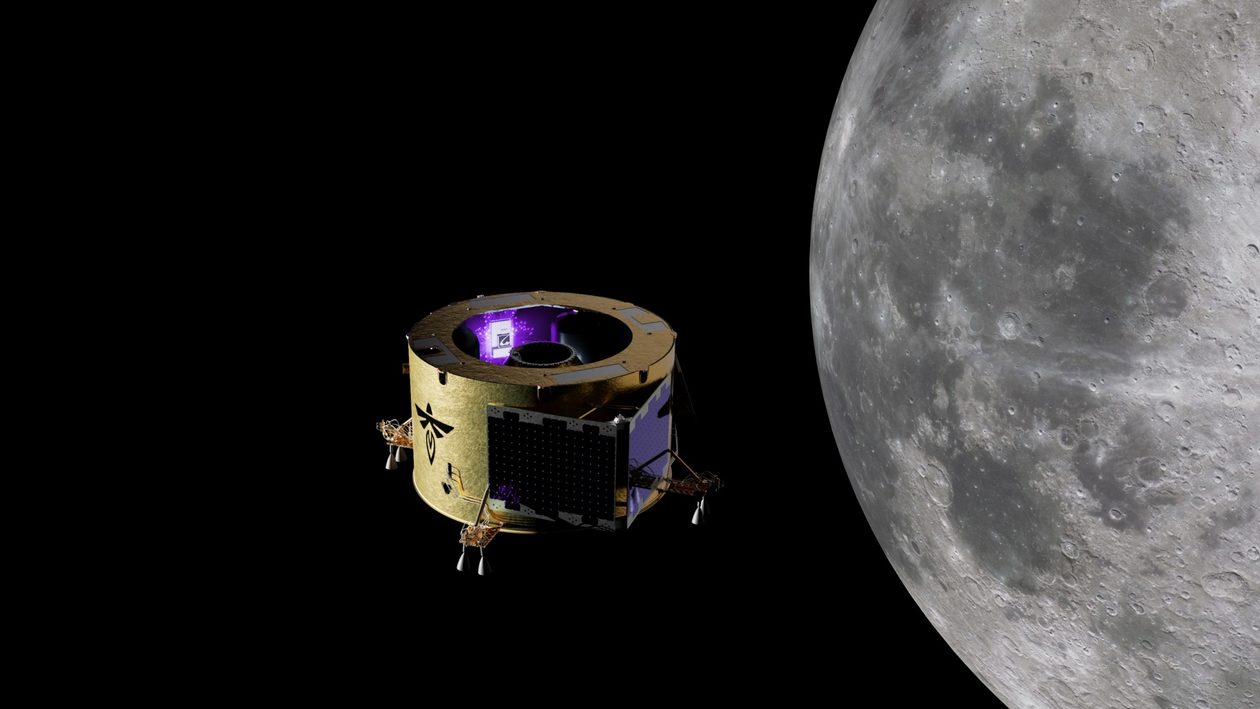
An artist’s conception shows Firefly’s Elytra spacecraft in lunar orbit, with Starcloud’s SC-1L data-processing payload highlighted in purple. (Firefly Aerospace Illustration)
Redmond, Wash.-based Starcloud has signed up to send its artificial intelligence data-processing hardware into lunar orbit on a Firefly Aerospace spacecraft.
Starcloud’s payload, known as SC-1L, will fly on Firefly’s Elytra orbital vehicle during a NASA-supported mission that’s scheduled for launch no earlier than 2028. The mission will demonstrate technologies that Starcloud plans to use on AI data centers in Earth orbit — and around the moon as well.
“Space is the future of data centers, and the moon is the next frontier for that vision,” Ezra Feilden, Starcloud’s co-founder and chief technology officer, said today in a news release.
Starcloud made its mark in Earth orbit last year with Starcloud-1, a satellite equipped with an Nvidia H100 chip. Starcloud-1 successfully trained a large language model called NanoGPT, marking a first for orbital computing. “We successfully validated our ability to run and train AI models on enterprise-grade GPUs in low Earth orbit, and now we’re taking this proven technology to lunar orbit,” Feilden said.
Starcloud’s SC-1L payload will be integrated aboard the Elytra vehicle for a mission aimed at delivering Firefly’s Blue Ghost lander to a lunar region known as the Gruithuisen Domes. After the lander separates from Elytra and descends to the surface, the orbiting vehicle will serve as a data relay for Blue Ghost.
The data-processing demonstration begins when the Blue Ghost mission ends. SC-1L will ingest data from Elytra’s onboard Solux vision system, execute high-performance AI computing in orbit and transmit the processed data back to Earth.
The Solux system is designed to serve as an autonomous navigation and tracking tool in space environments where global positioning systems are otherwise unavailable. Firefly expects the Elytra orbiter to operate in lunar orbit for at least five years.
“We’re proud to collaborate with innovative customers like Starcloud and collectively take another step toward establishing the infrastructure that will power a permanent human and robotic presence at the moon,” said Ray Allensworth, Firefly’s vice president of spacecraft.
Elytra will also use high-resolution telescopes and Firefly’s Ocula moon imaging service for surface mapping, mineral detection and reconnaissance. Firefly recently announced a collaboration with Nvidia to process the data for Ocula using Nvidia’s Jetson module.
In August, Starcloud reported raising $250 million in funding to support the creation of a constellation of AI data-center satellites in low Earth orbit, powered by Nvidia’s Space-1 Vera Rubin Module. Starcloud has filed an application with the Federal Communications Commission to operate as many as 88,000 satellites as orbital data centers.
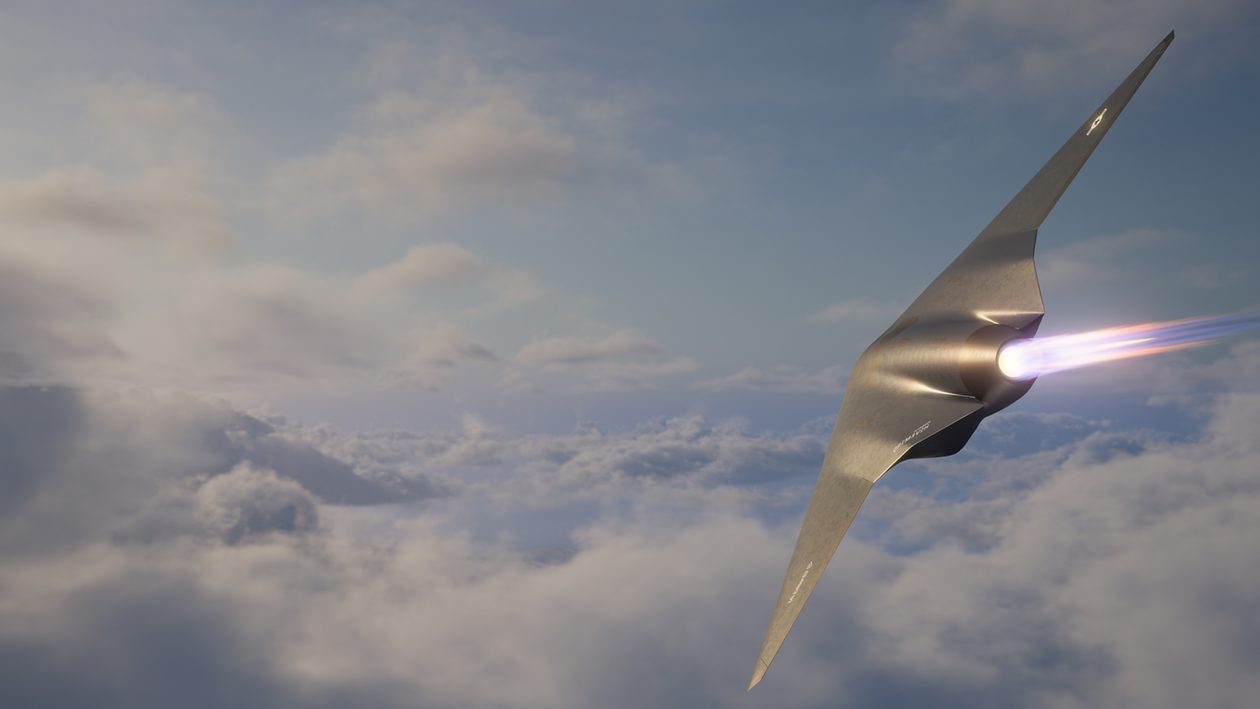
Shield AI’s new X-BAT autonomous fighter jet is designed to take off and land vertically. Rendering via Shield AI.
Traditional military air operations rely heavily on fixed, vulnerable targets: long concrete runways and aircraft carriers.
Shield AI’s new X-BAT autonomous fighter jet is designed to bypass that infrastructure entirely, utilizing a vertical takeoff mechanism and a mobile launch trailer that can operate from highways, remote outposts or standard cargo ships.
Operated without a human in the cockpit, the aircraft relies on aboard algorithms to navigate and execute strike missions where GPS and satellite communications are jammed. The X-BAT has yet to make its maiden flight, but Shield AI and GE Aerospace cleared a critical milestone this summer by completing ground engine tests and integrating the jet’s F110 thrust-vectoring nozzle.
With news that the X-BAT will be mass produced in the Seattle area — bringing 4,000 jobs to the region by the early 2030s — we decided to take a closer look at this groundbreaking aircraft.
Takeoff/Landing Style: Vertical Takeoff and Landing (VTOL)
ObjectiveCombat Radius: About 1,000 nautical mile combat radius (out and back), topping the roughly 590 nautical miles of the Air Force’s F-35A.
Total Range: 2,000 nautical miles.
Internal Payload Bay Capacity: Up to 2,000-pound class weapons.
Engine: GE Aerospace F110
Software: Shield AI Hivemind autonomy system.
Primary Propulsion & Flight Control: Autonomous AI agent, replacing human onboard pilot.
Logistics & Mobility: Road-transportable via dedicated Launch and Recovery Vehicle (LRV) trailer; highway-mobile and ship-deployable (destroyers, LHA/LHD amphibious assault ships, expeditionary bases). Tagline: “Earth is our runway.”
Target Production Rate: ~150 aircraft per year by early 2030s
Key Operational Milestones: First vertical flights expected in 2026. Production is set to start in Des Moines in mid-2027. The first jet is projected to be built in early 2028 and fly by that summer. The Navy could start using it by the end of 2029. Full production is planned for the early 2030s.
The X-BAT autonomous fighter jet will be built at a new facility in Washington state. Renderings and images via Shield AI.
DES MOINES, Wash. — Defense tech powerhouse Shield AI is establishing a massive advanced manufacturing hub in Washington state, tapping the Seattle region’s deep aerospace and tech roots to build a next-generation autonomous fighter jet called the X-BAT.
The project could transform the regional labor market: Shield AI says it expects to have 4,000 workers in the region by the early 2030s as it ramps up mass production of the AI-piloted, 26-foot long aircraft.
It marks a major expansion of advanced aerospace manufacturing in the Seattle region, bringing autonomous military aviation directly into Boeing’s backyard and cementing the state’s position at the center of the AI-defined defense era.
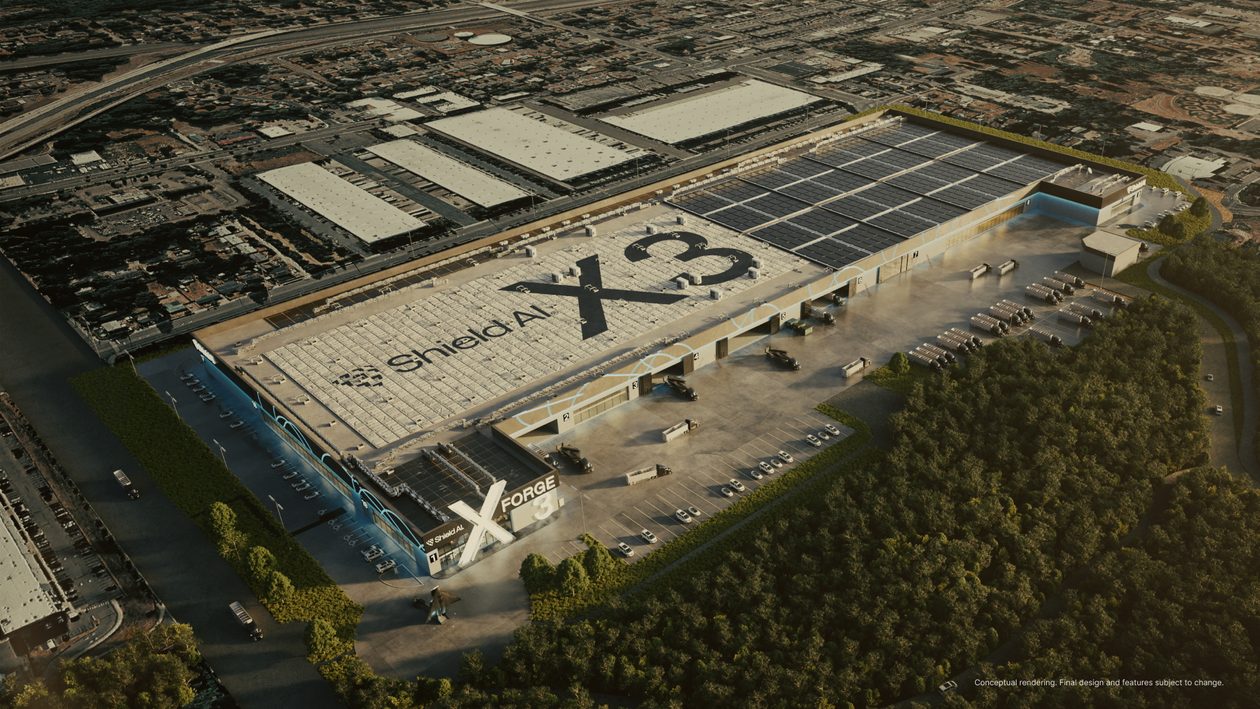
The San Diego-based company, valued at $12.7 billion following a $2 billion venture capital round earlier this year, is looking to complete construction on a 420,000-square-foot facility in Des Moines, Wash., just south of Seattle, next spring.
That physical footprint is expected to grow quickly. Armor Harris, senior vice president of aircraft at Shield AI, told GeekWire that the company is actively looking to add another 1 million square feet in the region to support its long-term manufacturing push.
Named X-Forge 3, the initial facility will serve as the primary manufacturing and engineering center for the X-BAT. It’s now under construction about 15 minutes south of Sea-Tac airport in the Des Moines Creek Business Park West, at 1800 S 216th St.
Developed by Panattoni, the site was selected by Shield AI midway through construction. The company is now taking it to completion, with Harris noting that they are “putting the roof on right now.”
Shield AI’s new X-Forge 3 facility south of Sea-Tac airport is currently under construction with an opening date slated for next Spring.
Unveiled last year, the X-BAT is an AI-piloted strike fighter that takes off and lands vertically, carries up to 2,000-pound class weapons in internal bays, and is designed for a 1,000-nautical-mile combat radius — which, when it takes flight, would top the estimated 590 nautical mile combat radius of the Lockheed Martin F-35A.
An economic analysis released by the company estimates Shield AI’s X-BAT program will inject roughly $73 billion into Washington state’s economy over the next two decades as production scales toward full capacity. Projections provided by the company say up to 27,000 direct and indirect jobs — including suppliers — will be generated by the expansion by 2046.
“This is a large program,” said Harris in an interview with GeekWire. “Building a next generation fighter jet is no small endeavor, and with the amount of interest that we’ve seen, both from our U.S. government customers and from international customers, we could be looking at building these at rates greater than fighter jets have been built in a really long time.”
Harris said he expects the first X-BAT aircraft to roll off the line in Des Moines in 2028, with full production ramping up to about 150 aircraft per year by the early 2030s.
The company evaluated more than a dozen sites for the facility, and chose the Seattle area for a simple reason: talent.
Harris cited the region’s robust aerospace legacy, as well as technology giants like Amazon and Microsoft and a burgeoning space and satellite industry which has taken shape in recent years. A number of fast-growing and heavily funded defense tech companies — including Anduril, Armada and Nominal — have also established beachheads in the region in recent years.
He described the X-BAT as a “modern sixth-generation fighter jet” that’s essentially a “flying sensor suite,” ingesting information in real time in order to make lightning-fast decisions.
Deep aviation and technology roots
Building that type of aircraft takes a very specialized workforce, one that Harris said is rooted across technology, aerospace, artificial intelligence, materials science and advanced manufacturing. Those are major strengths of the Seattle area workforce.
“We’re able to tap into that existing lineage and not have to necessarily train a workforce from the ground up, which would be hard to do on the timelines we’re trying to execute,” said Harris, who is planning to relocate to Washington state from Dallas.
To support its ambitious production schedule, Shield AI is actively recruiting across both software engineering and specialized aerospace roles. The initial hiring push for the Des Moines facility spans autonomy developers, flight-control software engineers, composite technicians, and shop-floor assembly specialists.
In one job listing for an engineering manager to lead the X-BAT hardware test software team, the company notes that the ideal candidate “has personally built or led the development of automated hardware test systems used in production, manufacturing, qualification, or other high-consequence environments.”
In another Seattle area job listing for a staff fuel engineer, the company says it is looking for a someone with “strong thermofluid fundamentals, engineering judgment, and the ability to understand fuel system behavior across demanding aircraft operating conditions while serving as the focal point between propulsion, vehicle teams, suppliers, and flight operations.”
Pay across those engineering roles ranges from $169,000 to $300,000 annually, according to the company job postings.
The company currently lists more than 110 open roles in the Seattle area, including a dozen or more in categories such as avionics and electrical; mechanical and thermal; software and networks; and aerostructures.
Choosing Washington also allowed Shield AI to buck a pervasive defense industry trend: separating engineering teams from physical factory floors to shave down labor costs.
While shifting assembly lines to lower-cost regions can cut costs, Harris said that remote manufacturing introduces hidden operational friction when building complex, software-defined aircraft like the X-BAT.
“We fundamentally believe in the colocation of engineering and production is the fastest way to bring capability to our customers,” said Harris, adding that combining engineering and production in a common facility is “one of the secret sauces of Shield.”
In a statement, U.S. Rep. Adam Smith (D-Wash.) — whose district includes Des Moines — welcomed Shield AI and the X-BAT manufacturing facility to King County.
“This hub will create high-quality jobs, strengthen Puget Sound’s expanding technology and aerospace sectors, and further diversify our local economy,” Smith said. “Reimagining aviation will have a rightful home here in Washington’s Ninth District.”
Katherine Caffrey, the city manager for City of Des Moines, welcomed the new jobs and economic investment in the community.
“Des Moines sits at the heart of the Puget Sound aerospace industry, and these jobs and this investment reflects exactly what we want Des Moines to be, a place where families can build strong careers close to home,” Caffrey said.
The ‘holy grail of deterrence’
Shield AI officially introduced the X-BAT program to the public at an October 2025 event in Washington, D.C., unveiling the aircraft before an audience of military leaders, elected officials and defense industry partners.
At the time, Shield AI co-founder and president Brandon Tseng, a former Navy SEAL, called X-BAT a “transformative, runway-independent aircraft” and noted that “airpower without runways is the holy grail of deterrence.”
That vision quickly gained momentum.
Last month, the U.S. Navy backed the program through an initial $50 million development contract, envisioning the autonomous fighter jets operating directly from destroyers, amphibious assault ships and converted cargo vessels to project long-range airpower without relying on traditional aircraft carriers.
Shield AI recently won a contract with the U.S. Navy for the X-BAT, designed to take off and land vertically.
That momentum grew internationally earlier this month, when Shield AI signed a five-year letter of intent with Polish defense companies PGZ and WZL-2. Under the framework, the companies are exploring plans to help build, supply, and repair the X-BAT, a partnership that could give NATO allies a fighter jet capable of operating even if local airfields and runways are destroyed or non-existent.
The X-BAT launches and lands vertically using a specialized Launch and Recovery Vehicle —a mobile trailer that erects the jet vertically, allowing it to be towed on interstate highways or loaded onto cargo ships to set up a field launch pad in minutes.
Harris noted that while a final site selection for manufacturing the LRV trailers has not been made, expanding production into the Puget Sound region remains on the table given the area’s deep manufacturing base.
In addition to the mammoth manufacturing facility in Des Moines, Shield AI announced that it is expanding its presence in both Texas and Kansas.
In Frisco, Texas, the company operates its X-Forge 1 site to handle core prototyping, software integration, and initial engineering for the autonomous fighter. Meanwhile, at X-Forge 2 in Newton, Kansas, Shield AI has expanded its airport footprint to serve as the program’s dedicated flight test, customer acceptance and maintenance hub.
Shield AI expects its X-Forge 2 site in Kansas to support approximately 1,800 regional jobs by the early 2030s, growing to 2,900 positions by 2046 with a projected $5 billion in regional economic impact over that period.
Addressing the cross-country logistics of moving completed aircraft from the Puget Sound assembly line to Kansas for flight testing, Harris explained that the X-BAT can be easily moved via the existing transportation corridors.
“The X-BAT is designed to be road transportable,” he said. “So we’re taking advantage of that.”
Beyond the immediate manufacturing logistics, Harris views the multi-billion-dollar expansion as a major long-term validation of the region’s industrial relevance.
“There’s been a strong narrative of like, ‘Hey, all the jobs are migrating elsewhere,’ and I think this is a big win for the region to capture a major program from a rapidly growing company like this,” Harris said. “This can be the backbone for years of growth in the future.”
That’s a message that Gov. Bob Ferguson is getting behind, saying Washington state is a place where “big ideas take flight.”
“Shield AI’s decision to build its new X-BAT manufacturing facility here is another sign that the future of aerospace is being built in Washington,” Ferguson said in a statement. “We welcome Shield AI and the thousands of good-paying jobs this investment will bring.”
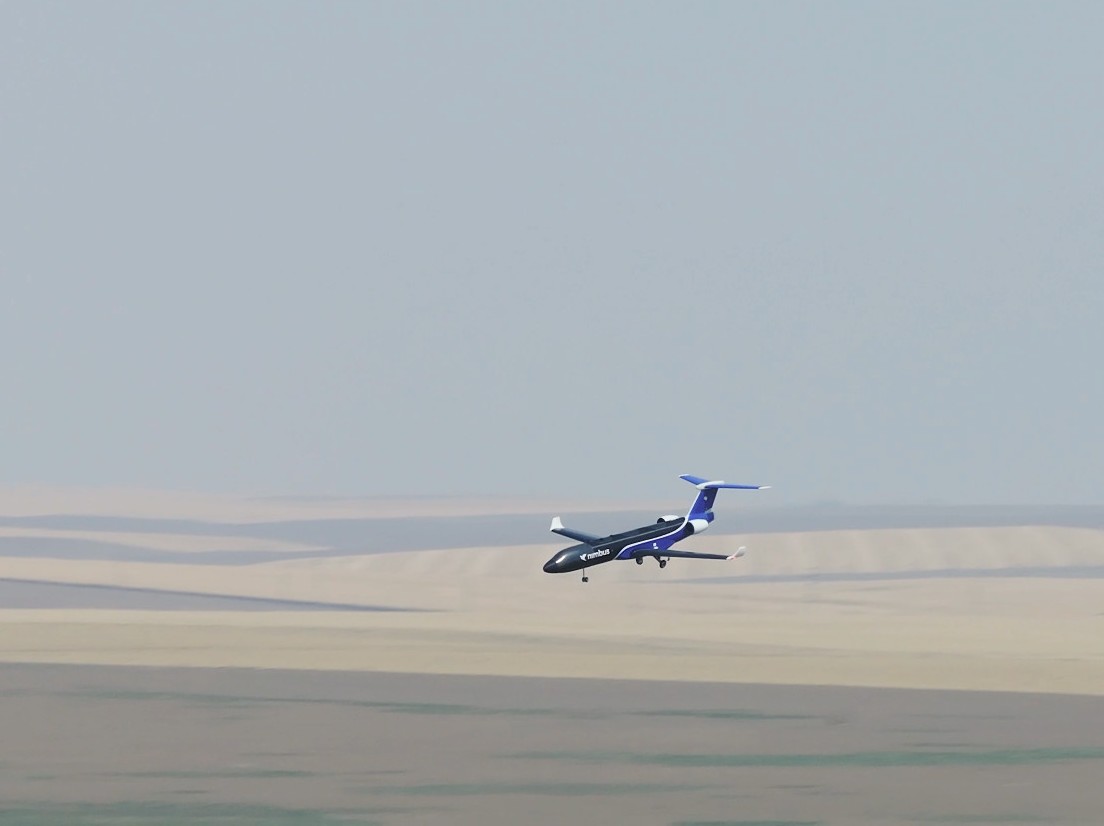
Nimbus Aerospace’s NX1, a one-quarter size prototype in a test flight this summer near the Pendleton Airport UAS Range in Oregon. (Nimbus Photo)
The team at Seattle-based Nimbus Aerospace had planned to finish testing its quarter-scale prototype earlier in the summer, but struggled to schedule one of the few pilots skilled in remote-controlled flight.
“Not many people wanted to fly this thing,” said Adrian Groos, co-founder and CEO of Nimbus. “It was a $1 million-plus model that was significantly bigger than anything else most people have flown, as well as heavier.”
The startup is developing a hybrid-electric aircraft with high-lift wings designed to improve fuel efficiency. Nimbus plans to build a six- to eight-passenger aircraft with a 1,500-mile range that uses half as much fuel as a comparable conventional plane.
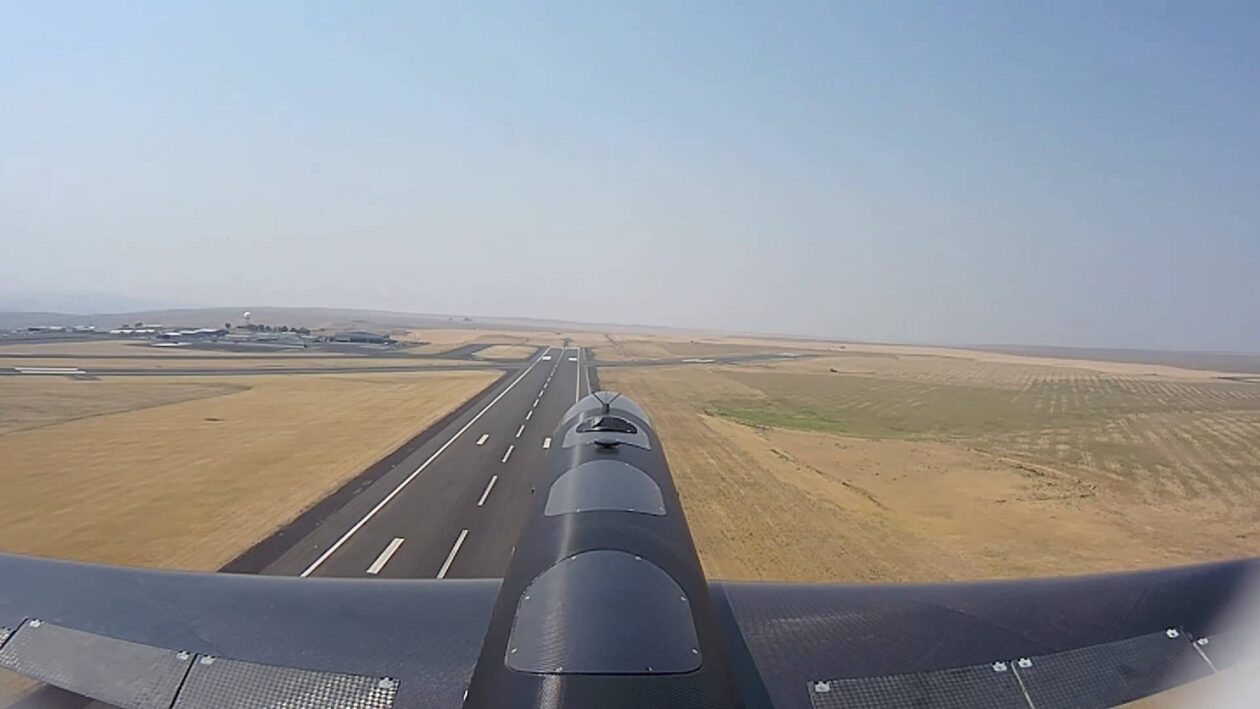
In June and August, the startup conducted two test flights of its NX1 prototype at the Pendleton Airport UAS Range in Oregon. The aircraft, which has a 15-foot wingspan and weighs 200 pounds, flew for 3 minutes 42 seconds in the first flight and 6 minutes in the second.
The tests achieved their goals of demonstrating the company’s manufacturing capabilities and the aircraft’s aerodynamics and stability, Groos said.
Nimbus has started engineering a full-scale prototype, with test flights targeted for 2028. The team is still deciding where to build the aircraft, considering Seattle against other locations around the country.
The ultimate goal is to begin delivering aircraft to customers in late 2030.
To get there, the team is working to navigate the Federal Aviation Administration’s certification process as smoothly as possible. The company has built a system called the ACT (AI Certification Tool) Platform to streamline and expedite FAA certification, and a former FAA deputy director of aircraft certification sits on the startup’s advisory board.
While the Nimbus product has a unique hybrid powertrain, components such as landing gear and lights use already-approved, pre-certified parts that will also be cheaper and easier to fix.
“We’re not trying to build a super novel design. That’s just a certification nightmare,” Groos said. “We’re trying to bring an aircraft to market that solves the needs that the people are asking for.”
And what customers want is a plane that burns less fuel and requires less maintenance, he added.
Aviation is one of the most difficult industries to decarbonize. It contributes 2.5% of the greenhouse gases emitted annually, but that percentage is expected to increase as other sectors go low-carbon and air travel increases. In addition to battery- and hydrogen-powered aircraft, sustainable aviation fuel, or SAF, is seen as the most promising solution for larger planes.
Washington state is also home to sustainable aircraft startup magniX, though others have shut down. Electric-aviation startup Zunum Aero and Outbound Aerospace folded, and ZeroAvia largely ceased operations in the state earlier this year, though it remains active in the United Kingdom. California-based Universal Hydrogen, which test-flew a hydrogen-fueled plane in Moses Lake, Wash., closed in 2024.
“People created products that weren’t really ready for prime time,” Groos said. That’s particularly the case for hydrogen-powered aircraft — the fuel is in limited supply and the path to certification is uncharted, he added.
The Nimbus NX1 prototype flying over the runway at the Pendleton Airport. (Nimbus Photo)
Other companies in the hybrid-electric space include Heart Aerospace, Electra.aero and Ampaire.
Groos and Nimbus co-founder and Chief Technology Officer Akim Niyonzima met on LinkedIn and began working on a sustainable aircraft in 2023. The five-person team also includes Chief Marketing Officer Eno Oduok. The startup, a past Techstars participant, has raised about $4 million from an unnamed family office. The company hopes to add six engineers over the next year.
Nimbus is going to move its NX1 to the Pendleton Airport UAS Range hangar, where it will be displayed alongside the Airbus Vahana eVTOL, a prototype all-electric, single-seat aircraft capable of vertical take-off and landing.

 Login

 Turkish Aerospace’s Aksungur long-endurance drone has completed its mission with Aselsan’s aselBUOY 100P underwater acoustic listening system during the Turkish Naval Forces’ TURNAs-2026 unmanned maritime systems exercise, the company announced on X on Oct. 24, adding a new capability to the drone’s set of maritime missions. “With this integration, which offers an important capability for […]
 Cummings Aerospace has fired two of its 3D-printed Hellhound S3 jet-powered drones from a launcher mounted on a utility vehicle, with a single operator using one handheld controller to send both on separate autonomous missions, the company said. The test took place on Aug. 25, 2026, at the Pendleton UAS Range in Oregon, where an […]