Meta took days to remove ads containing AI-generated child sexual abuse material (CSAM) on Facebook and Instagram. Some ads featured photos of real kids, including a press photo of a young member of a European royal family and images swiped from a popular Instagram profile of a preteen girl deemed an influencer.
In an investigation published Tuesday, the Tech Transparency Project (TTP) reported that Meta failed to detect 332 ads containing CSAM this year. The “vast majority” of ads promoted AI apps made in China, while many ads promoted so-called “nudify” apps that make it easy for bad actors to use AI and digitally alter images of children.
TTP matched “multiple CSAM ads to photos of real children that appeared online.” These ads seem to violate federal child pornography laws, since the Justice Department has clarified that AI CSAM is just as harmful as CSAM. The young royal’s image was “animated into a video of her performing a graphic sex act,” TTP found. Other ads animated a photo of a 14-year-old Instagram influencer “showing off her new sports club uniform” into “a video of her performing oral sex.” A third “preteen” victim “posing in a pink athletic outfit with pigtails” in a series of stock photos was morphed into a video where she looks frightened as she’s molested by an adult male, TTP reported.
Slashdot reader DeanonymizedCoward writes: Reuters reports that the US Military is disabling ad tracking on devices, to prevent adversaries from buying publicly-available tracking data to assist in targeting troops. Military officials say that they have disabled trackers on a variety of computers and mobile devices, according to letters released on Friday by Sen. Ron Wyden, and following reports that commercially-available tracking data has been used to target troops in the Middle East....
Wyden said in a statement that it was clear that the military's efforts "have not been effective at neutralizing this threat." U.S. Representative Pat Harrigan, a North Carolina Republican, said that U.S. enemies "should not be able to pull out a credit card and buy information that helps them track American troops." Rep. Harrigan remains silent as to the larger question of whether the general public should be able to pull out a credit card and buy information that helps them track anyone they please.
"The Pentagon said in an email it would respond to the lawmakers directly," Reuters reports:
The Army said in a statement that advertising IDs had been blocked on Windows computers "since before 2021" but that Android and Apple mobile devices had only had it disabled by default "since at least February 2026...." The effort to reduce the location data generated by smartphones comes as military officials weigh increasingly strict restrictions on phone use overall. In July, Reuters reported that some deployed personnel in the Middle East could be ordered to surrender their phones amid concerns that mobile videos they were posting to the internet were helping Iran target American bases in the region.
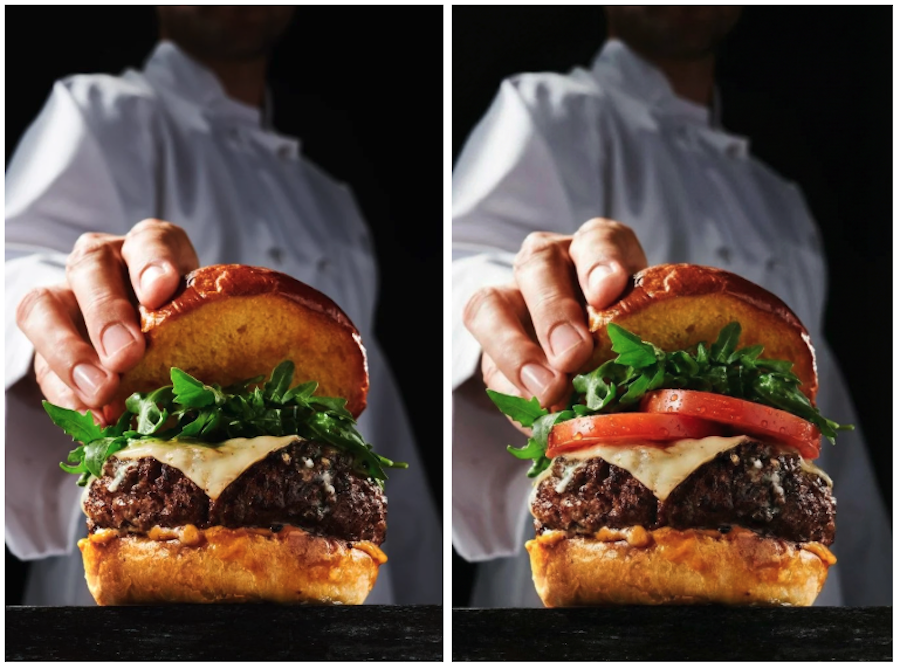
A hamburger photographed by SP Studio, left, and then tweaked by Scott Pitts in Pallat to add tomatoes. (Pallat Images)
Longtime Seattle food photographer Scott Pitts spent 25 years capturing commercial imagery for major brands, and now he’s using that quarter-century archive to train Pallat. The new AI-powered production system is designed to eliminate costly reshoots while keeping real studio craft at the center of generative creative tech.
The platform combines fine-tuned open-weight models with Pitts’ extensive archive, allowing art directors to modify existing campaign assets — like swapping a topping, adjusting lighting, or changing a backdrop — in minutes through software rather than starting from scratch back on set.
Pitts, a non-technical founder operating Pallat out of his Seattle photo studio, SP Studio, leads a nimble five-person team and believes domain experience is key to competing with generic AI platforms.
“We are close to the problem, and we’re looking at it from a photographic eye,” he said. “We’re making sure those outputs look photoreal, that they’re not going to get labeled as AI slop.”
To show how the tech works in practice, Pitts points to a recent shoot for a national steakhouse client. After completing a complex setup for a burger — carefully layering the bun, patty, sauce, and greens — the brand asked if they had shot a version with tomatoes. Rather than calling back the food stylist and rebuilding the set, Pitts dropped the final image into Pallat, prompting it to add two tomato slices with subtle condensation, natural translucency, and accurate drop shadows cast onto the cheese below.
In another instance, a commercial seafood brand prepared packaging imagery for a buyer presentation, only for the client to ask to see the fish presented on a white plate instead. Pallat to the rescue.
Scott Pitts, founder of Pallat, inside his Seattle photography studio at Fishermen’s Terminal in Interbay. (Mark Malijan Photo)
Commercial photographers have long tweaked images using tools like Photoshop, but Pitts sees AI as the natural next step for advertising workflows — distinct from news photography, where image manipulation remains out of bounds. Where Photoshop requires painstaking manual editing to adjust a scene, Pallat handles complex lighting, translucency, and material physics in minutes based on a simple prompt.
The startup recently signed its first enterprise customer and is currently working directly with brands as a hands-on production partner while building toward full software access.
Pitts sees the technology not as a threat to his craft, but as a natural progression. He started his career shooting four-by-five film, then transitioned to digital and video. AI is another progression.
“My hope is that me building Pallat is sort of this bridge between tech and creative,” Pitts said. “Craft is still important. Judgment and taste are still probably some of the most important things.”
Continue reading for Pitts’ answers to our Startup Spotlight questionnaire.
In 50 words or less, give us your startup’s elevator pitch.
Pallat is a photographer-led AI production system built for food and beverage brands, born from a working photo studio. It combines licensed photography with generative workflows to help brands scale photo-centric content while maintaining the creative control expected from commercial photography.
What problem are you obsessed with solving?
I’ve spent 25 years watching brands solve the same problem: invest in a shoot, then ultimately need more usable imagery than the initial shoot was designed to deliver. Generic generative tools can create images, but weren’t built around the quality, control and production standards food and beverage brands require.
I’m obsessed with using AI to close the gap. Pallat gives brands a way to extend photography they’ve already invested in and create new production-ready imagery grounded in a licensed dataset and the standards of a traditional photoshoot.
What surprised you after talking to customers?
Because we’re so close to the problem we’re solving, their need for a solution and high bar for quality didn’t surprise me.
What did was how much generated imagery disrupted their existing workflows. There is no obvious owner, no review path and no shared vocabulary for feedback and approvals. Brands are asking us to help establish new workflows, and that has turned out to be almost as important as building the tech itself.
How has AI changed the way you build your company?
AI is a big part of why a five-person team can build something like this. Our tech stack is built on open-weight models that we fine-tune using proprietary training data, while foundation models support planning and a handful of day-to-day operations.
Not to oversimplify it, but in many ways my role at Pallat parallels production. I built a team of experts, defined the problem we’re solving and established the criteria for the output. A growing part of my work is getting those standards out of my head and structuring evals so they hold when I’m not in the room.
What’s one thing people misunderstand about your startup?
That Pallat is trying to replace photography. It’s far from it.
Practical photos are important inputs, and our studio continues to create net-new ones to expand the system. Visual trends are always evolving, so datasets powering creative tech cannot be static. The future of production is hybrid: practical photography and generative imaging working together, with each deployed where it creates the most value.
What’s the toughest decision you’ve made in the past year?
Resisting the urge to broaden Pallat before we establish product-market fit. The goal isn’t to automate every step as quickly as possible. It’s to understand which problems in the workflow are best solved through software.
What’s the one piece of advice you give to other entrepreneurs?
I truly believe some of the most interesting AI companies will come out of service businesses where the founder knows the industry exceptionally well — where the friction lives, which shortcuts a client will notice, and what excellence looks like in their vertical.
I spent a long time assuming my 25 years in photography was the past and AI was the future, and I had that backwards. The years on set that sharpened my taste and judgment, our dataset and the client relationships are the true compounding assets.
We’ll know our company has made it when…
When an art director at a food or beverage brand drafts a shot list dividing it into two columns: “Capture as Practical Photography” and “Generate in Pallat.”
When that becomes a normal way of planning, Pallat will have done what we set out to do.
Movable shelving towers that hold items that are autonomously moved to Amazon employees who pack them for shipping. (GeekWire Photo / Lisa Stiffler)
Amazon is accused of artificially inflating the ad prices on its e-commerce site in a lawsuit filed Monday by Washington’s attorney general, the Federal Trade Commission (FTC) and 21 other states.
Amazon denies the allegations, saying its ad pricing has not harmed advertisers or shoppers and that the FTC’s claims mischaracterize how its system works.
Ads are sold on Amazon’s platform through so-called “second-price” auctions, in which businesses set a maximum price they’re willing to pay for an ad. If they’re the highest bidder, they pay only one cent more than the second-highest bid, and the auctions do not allow advertisers to see other bids.
Plaintiffs allege that beginning in late 2018, Amazon started adding surcharges to the prices, despite claims that it was still using a second-price system.
The lawsuit, filed in U.S. District Court for the Western District of Washington in Seattle, alleges the tech giant overcharged roughly 1.2 million ad customers by overriding and replacing auction results with “higher prices set by Amazon to increase its profits.” The amount collected through the allegedly deceptive pricing scheme totals $20 billion, according to the suit.
“Many small business owners in Washington rely on Amazon for their livelihoods, and our office is committed to making sure Amazon treats them fairly, transparently, and in accordance with the law,” said Nick Brown, Washington’s attorney general, in a statement.
Amazon posted an online response to the allegations. “The FTC’s claim fundamentally misunderstands how advertisers operate,” the company stated. “Advertisers adjust bids based on real-world performance, not descriptions of auction mechanics.”
The company said it prioritizes the relevance of an ad to the shoppers being targeted over bid price alone. As a result, Amazon said, 92% of winning ads in recent years were not given to the highest bidder, and ad performance has improved. Conversion rates — the percentage of shoppers who take a desired action after interacting with an ad — rose 24% from 2021 to 2025, according to Amazon.
The company also said that from 2019 to 2024, the average cost-per-click for sponsored product search ads was flat when adjusted for inflation.
Amazon acknowledged it has changed its ad pricing approach over time, saying that as the system prioritized ad relevance, winning bids increasingly fell below market value. As a result, the company now sets minimum prices, or “reserves,” for participating in an auction and for the minimum market value of the ad.
“Reserves like these,” it said, “are common across the industry.” The company said it does not charge advertisers more than their bid.
Amazon said it clearly explains its pricing process to advertisers. Plaintiffs dispute that, citing company employees who described creating fake auction participants.
The suit states that an Amazon senior scientist said that to increase auction prices, the company inserts “an invented auction participant representing how much Amazon thinks that particular ad slot is worth.”
The lawsuit is being led by the FTC and also includes the attorneys general of Alaska, Arizona, California, Colorado, Florida, Idaho, Illinois, Indiana, Iowa, Kentucky, Louisiana, Maryland, Nebraska, New Jersey, New York, North Carolina, Oklahoma, Pennsylvania, Rhode Island, South Carolina and Vermont.
The company is also in the FTC’s crosshairs in a separate, broader antitrust case accusing Amazon of maintaining an illegal monopoly in online retail, which is scheduled for trial next year.
Plaintiffs in the case announced Monday are asking the court to order Amazon to reform its practices, pay restitution and civil penalties for each violation, and cover attorneys’ fees.
Apple Maps ads are rolling out in the U.S. and Canada. See where sponsored listings appear, how Apple handles privacy, and whether users can disable them.
Apple Maps ads are rolling out in the U.S. and Canada. See where sponsored listings appear, how Apple handles privacy, and whether users can disable them.
Apple has begun rolling out ads in Apple Maps, with sponsored businesses appearing at the top of search results and in the "suggested places" section for users in the U.S. and Canada. Apple says the ads can be based on approximate location, search terms, or the area of the map being viewed, but are not tied to users' Apple Accounts and personal data remains on-device. 9to5Mac reports: Ads appear just like every other business listing, except they have a small blue badge that says 'Ad.' You can see examples of ads [embedded in the article]. Like Apple's ads policy with other services, the company touts user privacy protections for ads in Maps. Per Apple Newsroom: "Ads on Maps builds on Apple's broader privacy-first approach to advertising, and maintains the same privacy protections Maps users enjoy today. A user's location and the ads they see and interact with in Maps are not associated with a user's Apple Account. Personal data stays on a user's device, is not collected or stored by Apple, and is not shared with third parties."

 Login
Login