โŒ

Reading view

There are new articles available, click to refresh the page.

Hacking the Modern Tamagotchi With UART

Although not technically the first virtual pet, the Tamagotchi handhelds certainly popularized the idea and made it a worldwide phenomenon. In the late 90s it was hard to go out in public and not see them dangling from backpacks and belt loops. They turned out to be more than a passing fad, too. There have been Tamagotchis in various forms since then, and one of the latest, the Tamagotchi Paradise, is uniquely hackable thanks to this custom UART interface.

The build starts with a simple and inexpensive CH340G UART adapter with a built-in USB interface. A custom 3D printed enclosure is used to house the adapter and also help to expose the interface to the Tamagotchi. This is done by wiring three pins to nickel strips, which are threaded through slits in the case and looped back around to create a pogo-style adapter for the Tamagotchiโ€™s custom dock. Normally this would be used to link to other Tamagotchis, but in this case the USB-to-UART adapter mimics it, allowing for all kinds of in-game shenanigans. The projectโ€™s creator [Squalius] shows it off by connecting it directly to a browser tool in Google Chrome.

Not only that, but this can also be used to modify the software running on the handheld entirely, with the video showing demos playing not onlyย Super Mario but alsoย DOOMย (of course). This isnโ€™t too surprising given that these games are built with modern 32-bit ARM microcontrollers. For the 90s purists, though, it probably wonโ€™t surprise anyone to know that these devices have been the subject of various hacks almost since they came out.
Building a Microscope with a 3D View

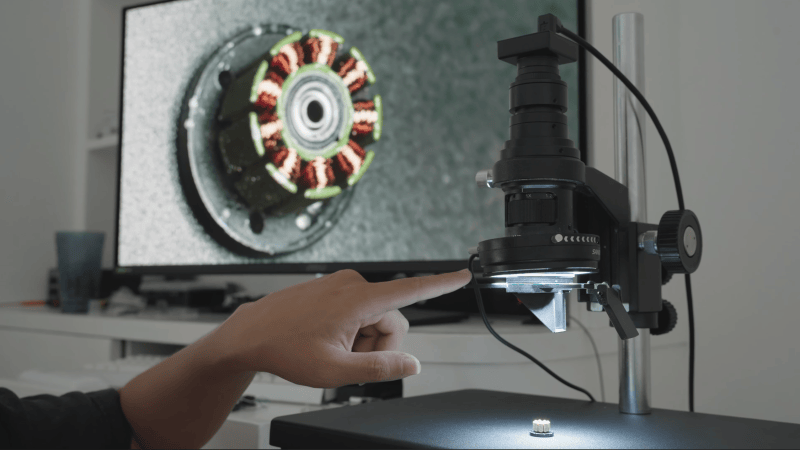
A man's hand is seen adjusting a lever connected to a lens, which is pointing down towards the windings of a small motor. A screen behind this shows an image of the windings, taken from an angle slightly to the side.

As electronic components grow ever smaller, a microscope has become an increasingly indispensable tool for any fine work; when inspecting electronics, though, especially solder joints, [Corebb] found a top-down view too limiting, so he built his own microscope with a rotating side-angle view.

The microscope itself is made of a commercial C-mount microscope lens assembly and a USB camera; the lens has a variable magnification factor up to 200x, which is plenty for electronics work, and is mounted on an adjustable stand to move the focal point. This is paired with an LED ring for illumination and two polarizing filters, one mounted on the lens and one one the lighting ring; when adjusted to 90 degrees from each other, these eliminate glare from reflective surfaces.

To view subjects from the side, [Corebb] built a snap-on adapter. This uses a pair of mirrors to capture a view from the side of the object and direct this through the main microscope lens. An additional concave lens compensates for the increased length of the optical path, and ball bearings let the whole adapter rotate around the microscope and capture the subject from any angle. [Corebb] tried 3D-printing the adapter, but found that flexing caused too much jitter; in addition to being sturdier, a machined aluminium part reduced shadows by allowing for thinner supports. The adapter snaps onto the microscope with small magnets, which keep the optical path consistently aligned.

This isnโ€™t the first time weโ€™ve seen a soldering microscope with a view from the side, but this does look much more affordable. If youโ€™d like to try the polarized light source with your microscope, weโ€™ve covered that before.

โŒ