Reading view

There are new articles available, click to refresh the page.

Ukrainian drones deliver robots directly into battle by sea and air

In the latest twist on battlefield innovations, Ukraine has used both flying drone carriers and drone boats to send ground robots armed with weapons or explosives into battle.

The drone-assisted deployments have enabled slower wheeled robots to bypass tough terrain and Russian defenses, and to carry out an unusual robotic amphibious assault on a contested position. Such tactics also showcase the Ukrainian military’s ongoing experimentation with using drones and robots to offset a Russian military advantage in manpower while also sparing Ukrainian soldiers from making dangerous assaults.

On July 19, a Russian military Telegram channel posted a video showing a Ukrainian hexacopter drone carrying a ground robot suspended below by a cable, according to the Ukrainian government-run news platform United24. The Russian Telegram channel described the Ukrainian heavy bomber drone as deploying a four-wheeled ARK-1 robot armed with explosive anti-tank mines on the ground where it continued toward Russian military positions—and apparently generated plenty of outraged comments from pro-Kremlin social media users.

Read full article

Comments

© Dmytro Smolienko/ Ukrinform/Future Publishing via Getty Images

The $1.5 Trillion Defense Budget Without a Strategy

“This is not at all a strategy-driven [FY 2027 defense] budget. This is a budget-driven budget. If you look at the Truth Social posts by the President [Trump] and the statements of the people around him, he [President Trump] makes very clear that this budget was driven by a budget number, a budget target, an arbitrary level that was set based on five percent of last year's GDP…They set this arbitrary level and then at relatively the last minute in the budget development process the [Defense] Department was told come up with a request that gets you to this number, this $1.5 trillion number. And so they did.”

That was Todd Harrison of the American Enterprise Institute and one of the nation's top experts on defense strategy and the defense budget, speaking last Tuesday at the Brookings Institution as part of a panel on The FY 2027 defense budget: How much is enough?

Remember, as I wrote last week, the Trump FY 2027 defense request is for $1.15 trillion with another $350 billion request to be placed in a FY 2026 reconciliation package; and there now also is the new FY 2026 supplemental request, which has another $67 billion for the Defense Department.

House members have been weighing all the defense numbers and this week may be voting on a FY 2026 reconciliation package of $95 billion with only $73 billion for defense – far less than what was being sought.

Last Tuesday, Harrison went on to explain what may have been going on: “I say it is absolutely not a strategy-driven [FY 2027 defense] budget because they didn't have to make hard choices. They made some easy choices.”

As an example, Harrison said, “Do you want, you know, a fourth generation fighter jet? Buy some new fourth generation [F-15s]; or do we want to continue buying the fifth-generation fighters like the F-35 we have in production; or do we want to invest in sixth generation fighters? Do all of them, right? You can do all three at once, if you have a virtually unlimited budget, you don't have to make those hard tradeoffs.”

And, in fact, all three are included in the proposed FY2027 defense budget.

But Harrison goes on to suggest another way to view this Trump defense budget giant increase saying, “There's still a limit to how much the department can consume in terms of this funding…because I don't think they [the Trump budgeteers] actually intend this to be like a one-year budget authority number, especially with the reconciliation [set at $350 billion]. I think it is actually more like a five-year budget number that they're trying to get pre-funded up front, but they actually plan to spend it at a slower pace over the next five years.”

Harrison also looked at “the parts that I think absolutely don't belong in here are these big pots of money they created in defense-wide accounts that have very little description with them.”

For example, he picked out “$54 billion in the Defense Autonomous Warfare Group (DAWG) line item. That is a single program element that's got $54 billion in it,” Harrison said. “That's unprecedented. If you read the budget description with it, it gives very little detail. You know, it's [clears throat] supposed to be investments in drones and things like that, but like tell us

quantities, tell us specific types of drones, like tell us what you're going to be using it for, and that detail is not there.”

Harrison went on, “It appears they haven't figured that out yet, so I think $54 billion is quite a reach, trying to ask for that much money for something that has not yet been well defined. So, I think that there are areas here where they've really overshot and they've tried to just throw everything in there and ask for a super high number. And I wonder if they almost expect that they're not going to get that full number -- that Congress will cut them back down quite a bit. But they were just trying to reach that overall $1.5 trillion level.”

As Yahoo Finance pointed out earlier this month, the $54 billion for DAWG sought for FY 2027 is 243 times greater than what DAWG got this year, and “now exceeds the entire Marine Corps budget request of $52.8 billion and represents nearly 15% of the entire $350 billion reconciliation package.”

Harrison’s view: “You get to the endgame, Congress is going to have to sort through this and say, ‘Okay, what are the what things in here are serious things that really do need to get funded one way or the other, and we'll have to figure out how to make that happen, and what are the other things that were just budget gimmicks or just filler?’"

Harrison was not the only expert on last Tuesday’s Brookings panel.

Joining him were David Wessel, who runs Brookings’ tax and fiscal policy in the economic studies program; and Mara Karlin, professor at John's Hopkins University’s School of Advanced International Studies, who has worked for six Defense Secretaries over her career.

Wessel took a broader financial view saying, “The President is proposing a big defense budget at a time when we have unsustainable fiscal trajectory, and so I think that raises an important question and that question is…budgeting is about tradeoffs and the President and Congress at the moment seem to be avoiding trade-offs. There are ways we could offset if defense spending is really important. We should think about ways to pay for some of it either by cutting some other places in defense or raising taxes. And there's some ideas floating around on that, but none of them are politically popular.”

Wessel also raised two other issues: “I think it also requires some trust on the part of the public that the money is being well spent and that relies on Congress doing oversight. And secondly, that we are sticking with a military that is nonpartisan and follows the leadership of the President and the Congress, but is not totally politicized. And I'm afraid that the trust in the military is being eroded by some of the personnel decisions that Secretary of Defense Pete Hegseth is making. And I think that's a problem.”

As for Karlin, she referred to the Trump national strategy and focused on what she called “a break with the bipartisanship that has characterized how folks have thought about these threats for a long time.”

Karlin noted, “The real emphasis of this [Trump national] strategy is on the Western Hemisphere, right? The real threat is seen in this strategy as these alleged narco-terrorists as they're so named…So, that's the priority.”

But, she adds, “You then see China mentioned, but in a pretty circumscribed way, just the first island chain. And in general, the language reads a lot softer than almost any recent defense strategy. You see a desire to downgrade involvement in European affairs, a little bit of mention of the Middle East, but in no way signaling that we would be starting this massive [Iran] conflict. And so here's where I think, there's some confusion worth highlighting because traditionally a national defense strategy is a decoder ring. It's going to tell you where the Secretary of Defense will put their energy and attention.”

“When we look at this budget, this very large budget, that's really at kind of World War levels,” Karlin said, “and frankly, the number [$1.5 trillion] isn't really merited by the strategy.”

She explained, “If one were really to just prioritize the Western Hemisphere and this quite circumcised focus on China as a major threat, and not be involved in most other regions of the world, in fact, the Trump administration could have put out a quite tiny defense budget request. So I leave you with a bit of perplexity.”

Two more things Harrison mentioned need recording.

“I forgot to address the [Trump] battleship issue,” Harrison said at one point, “because you know that's in here and far from defending it, I think that's one of those examples of things that got thrown in because they didn't have to make tough choices.”

Then he explained, “No one in the Navy can say with a straight face that we're going to go from starting a brand-new, clean-ship design in FY 2027, to procuring the lead-class [battle]ship in FY 2028, to going to all the way by FY 2031 being at full rate production, ready to buy them at one per year. That doesn't pass the laugh test…And so are we just setting ourselves up to spend a few billion dollars chasing, you know, this weird idea before we eventually have to cancel it and then things go back to the way they were before.”

Finally, Harrison said, “I think there needs to be some fundamental look on the congressional side at just how do we reform the budget process to get it working again; open the aperture to things like changing the start date of the fiscal year [which now begins October 1], re-jiggering the committee structure.”

I believe Harrison is questioning why each year the Armed Services Committees in both the House and Senate each authorize spending programs, and then the House and Senate Appropriations Committees set the actual dollar-level of funds made available for that year.

“You know,” Harrison said, “I'm talking a lot of third rails here, but I think we're at that kind of point like we were in the early 1970s where Congress realized it [the budgeting process] just wasn't working. I think that they need to do some serious inward-looking reform like that.”

I agree, having twice worked on the Senate Foreign Relations Committee in the 1960s, and followed defense spending over the past 60 years. Harrison is right – the Legislative Branch system for passing Executive Branch funding needs to be repaired.

The Cipher Brief is committed to publishing a range of perspectives on national security issues submitted by deeply experienced national security professionals. Opinions expressed are those of the author and do not represent the views or opinions of The Cipher Brief.

Have a perspective to share based on your experience in the national security field? Send it to Editor@thecipherbrief.com for publication consideration.

Read more expert-driven national security insights, perspective and analysis in The Cipher Brief

Winning Battles, Losing Strategy: Why Military Superiority No Longer Guarantees Victory

America’s battlefield dominance remains unmatched, but Iraq, Afghanistan and now Iran shows that tactical success increasingly fails when military power is not matched by a coherent political strategy.

No military in modern history has possessed the technological reach, global mobility and combat capability of the United States. Yet, its greatest battlefield victories have increasingly produced some of its most difficult strategic dilemmas.

This contradiction lies at the heart of American military intervention over the past several decades. Washington has repeatedly demonstrated its capacity to defeat formidable opponents, overthrow governments and deploy troops across vast distances. But military supremacy has not always produced the stability, legitimacy or political order American policymakers sought.

Afghanistan revealed the limits of occupation and state-building, ending not in lasting transformation but in the return of the Taliban in 2021 after their initial ouster by American forces twenty years earlier. Iraq showed how removing a hostile regime could unintentionally strengthen Iran’s strategic position and deepen regional instability. Iran itself has proven resilient, with external pressure often hardening rather than weakening its strategic posture. Meanwhile, the Arabian Gulf has become an unpredictable region, where security, energy and great-power rivalry intersect with global consequences.

These cases raise a central question: why do tactical victories so often produce strategic setbacks?

The answer lies in the changing character of ‘limited war,’ in which military superiority remains decisive on the battlefield, but political endurance increasingly determines strategic outcomes.

The Post-War Pattern: Tactical Success, Strategic Frustration

The paradox at the heart of American military intervention is neither new nor uniquely American.

Since the end of the Second World War, the United States has repeatedly demonstrated an unparalleled ability to project power globally. From Korea and Vietnam to the Gulf War, Afghanistan, and Iraq, no nation has matched America’s technological sophistication, logistical reach, intelligence capabilities, or ability to sustain expeditionary operations over long distances. This record is well documented in studies published by the RAND Corporation and the U.S. Army War College Press.

Yet history demonstrates that battlefield dominance alone does not guarantee political success.

The Korean War (1950-53) ended in containment rather than reunification, while Vietnam (1965-75) exposed the limitations of overwhelming firepower against an adversary willing to absorb enormous losses in pursuit of political objectives. The Coalition victory in the 1991 Gulf War reinforced the belief that precision-guided weapons, advanced command-and-control systems, and overwhelming technological superiority had fundamentally transformed warfare.

Following the collapse of the Soviet Union (1991), many policymakers concluded that American military superiority could reshape political realities well beyond the battlefield. Historical assessments by the U.S. Department of State Office of the Historian and the U.S. Army Center of Military History trace the evolution of these campaigns and their strategic consequences.

While military force remains highly effective at defeating conventional armies, destroying infrastructure, and removing governments. It has proven considerably less effective at building legitimate political institutions that can endure after foreign forces depart. As Carl von Clausewitz argued in his classic work, On War, war is an extension of politics by other means. Military victory therefore achieves little if political objectives remain undefined, unrealistic, or ultimately unattainable.

The challenge confronting modern intervention is not one of military capability but of strategic translation. Tactical victories increasingly fail to produce durable political outcomes because the post-intervention political environment is often more complex than the military campaign itself. As scholars of strategy, such as Lawrence Freedman, and the research communities at the Center for Strategic and International Studies (CSIS) and Royal United Services Institute (RUSI) have argued, the decisive challenge for modern military power is no longer winning the battle but securing a sustainable political end state.

Iraq: Breaking the Anti-Iran Bulwark

The invasion of Iraq in 2003 removed Saddam Hussein from power but also eliminated Iran’s principal regional counterweight.

What Washington saw as a decisive blow against a hostile regime became, in strategic terms, a gift to Tehran.

The collapse of Iraqi state institutions created a vacuum filled by sectarian competition, militia politics, and external influence. As Iraqi institutions weakened and political fragmentation deepened, sectarian identities grew more powerful, armed groups gained legitimacy, and the state’s monopoly on force eroded.

Iranian influence expanded through political allies, security networks, and Shia militias that embedded themselves in Iraq’s evolving political, post-Saddam order.

In an ironic twist, the U.S. intervention in Iraq was meant to reduce internal danger and violence; instead, it fostered a more favourable environment for Iran and the country’s political influence.

The United States spent enormous blood and treasure removing a regime that had contained Iran for decades. In seeking to eliminate one threat, Washington disrupted the regional balance and inadvertently strengthened another. Historically, Iraq stands not only as an example of a military campaign governed by ‘shock and awe,’ but remains a stark warning about the unintended consequences of overthrowing a state without understanding what will replace it.

The occupation of Iraq damaged U.S. credibility in the Middle East by disrupting power balances without a clear post-war strategy.

It increased uncertainty among allies, created opportunities for rivals, and enabled Iran to expand its influence, reshaping the strategic landscape and contributing to greater instability.

Afghanistan: The Limits of Military Occupation

Nowhere is this paradox of modern limited war intervention more apparent than in Afghanistan.

The United States and its allies rapidly dismantled Taliban rule following the attacks of 11 September 2001. Within months, al-Qaeda’s sanctuary had been destroyed, Taliban formations dispersed, and a new Afghan government established under international protection. Militarily, the campaign was remarkably successful. Contemporary assessments of the campaign and its objectives are documented by the U.S. Department of State Office of the Historian and the CFR.

The challenge emerged only after the battlefield had been won.

Over the next two decades, Coalition forces invested enormous resources attempting to build functioning political institutions, professional security forces, and a democratic state capable of sustaining itself. Yet legitimacy proved far more difficult to establish and sustain than military capability. Extensive investigations by the Special Inspector General for Afghanistan Reconstruction (SIGAR) repeatedly highlighted the disconnect between military achievements, governance reform, corruption, and institutional resilience.

Corruption, weak governance, factional politics, and ongoing insurgent pressure steadily eroded public confidence in Kabul’s authority. The human, financial and strategic costs of the intervention have been comprehensively documented by the Brown University Costs of War Project.

The Taliban understood a fundamental principle of limited war: they did not need to defeat NATO militarily, only to outlast the West’s commitment to supporting Kabul.

As domestic political support in Coalition capitals diminished, strategic patience shifted in favour of the Taliban-led insurgency. The collapse of the Afghan government in 2021 demonstrated that two decades of military success could not compensate for the absence of enduring political legitimacy. Subsequent analyses by the CFR and the SIGAR conclude that institutional fragility ultimately proved more decisive than Coalition military capability.

Afghanistan, therefore, offers a broader lesson. In modern limited wars, technologically superior powers often discover that destroying hostile forces is considerably easier than replacing the political order those forces once sustained.

The lesson from Afghanistan is not unique.

In modern conflicts, technologically advanced militaries increasingly find that battlefield success is becoming decoupled from political outcomes. This reflects a broader evolution in limited war, where endurance, legitimacy and the capacity to impose continuing costs frequently outweigh conventional military superiority.

Recent assessments by the RUSI, the CSIS and the Modern War Institute at West Point (MWI) increasingly argue that political resilience and strategic endurance have become as important as battlefield dominance in determining the outcomes of contemporary conflicts.

Conclusion: Rethinking Military Success

There is an old regional saying that, rather than killing the snake, repeated attempts to strike it often make it more dangerous.

The 2026 Iran War is the starkest test of that proposition in a generation.

The US-Israeli military campaign that began on 28 February inflicted severe damage on Iran’s nuclear and missile infrastructure and, according to multiple reports, killed Supreme Leader Ali Khamenei. Judged by the metrics Washington and Jerusalem set—degrading capability and decapitating leadership—the campaign appeared to succeed.

Yet strategic outcomes are far less straightforward.

Reporting from Reuters, the BBC, and other outlets indicated that despite the shock of the strikes, the Iranian system moved quickly to preserve continuity. The Revolutionary Guard and other coercive institutions positioned themselves as defenders of a nation under attack. This pattern aligns with longstanding scholarship on external pressure and authoritarian resilience, which shows that coercion may consolidate regimes as easily as it weakens them. Iran’s economy was battered, its proxies pressured, and its deterrent credibility damaged, but the outcome Washington most wanted to prevent—regime survival—persisted.

This is not a defence of the regime, nor an argument that the strikes were unjustified.

Rather, it is an argument that force applied without a coherent theory of political aftermath can entrench the very resilience it seeks to break.

Iran has been hit hard, but it has also adapted, hardened, and become more difficult to read strategically. That unpredictability does not stop at Iran's borders; it radiates outward, especially across the waterway connecting Iran to global markets.

The lesson from Iraq, Afghanistan, and Iran is not that military intervention should never occur, nor that the United States should retreat from its global responsibilities.

Instead, the character of limited war is evolving in ways that increasingly favour politically resilient adversaries over technologically superior expeditionary powers.

This shift has become a recurring theme in contemporary strategic analysis published by the RUSI, the CSIS, and the MWI.

Cheap autonomous systems have fundamentally altered the economics of military power.

During the Cold War, technological superiority rested upon expensive platforms fielded by a handful of industrialised states. Today, relatively inexpensive drones, AI-enabled targeting systems and commercial technologies have dramatically lowered the barriers to resistance, enabling weaker actors to impose disproportionate costs upon militarily superior opponents.

Recent assessments by the Center for Strategic and Budgetary Assessments (CSBA), CSIS, and RUSI suggest that the strategic premium once attached to technological superiority is steadily being eroded.

Meanwhile, democratic powers continue to operate under political constraints imposed by public opinion, electoral cycles, international law, alliance commitments, and coalition management.

Their adversaries often face far fewer such limitations.

Victory is therefore no longer determined solely by military technology, but increasingly by which political system can sustain the contest for longer.

This observation reflects the enduring insights of Carl von Clausewitz and later strategic thinkers such as Robert Endicott Osgood, whose work Limited War: The Challenge to American Strategy (1957) emphasised the intimate relationship between military operations and political objectives.

The United States remains the world’s most capable military power.

Nothing in Iraq, Afghanistan, and now Iran diminishes that reality. These conflicts, however, reveal that military superiority alone no longer guarantees strategic success.

The ability to destroy an adversary’s military capability is no longer synonymous with the ability to shape the political environment that follows. As recent analyses by the International Institute for Strategic Studies (IISS) and RUSI continue to argue, the decisive challenge for modern armed forces increasingly lies in translating battlefield success into enduring political outcomes.

The challenge for American policymakers is therefore not simply how to strike harder or faster, but how to ensure that military action serves coherent political objectives capable of enduring long after the shooting stops.

Great powers rarely decline because they lose battles.

More often, they decline because they mistake military victory for strategic success.

Military technology can destroy armies. It cannot, by itself, create political legitimacy.

Until strategy gives equal weight to what happens after the battlefield falls silent, even the most technologically advanced militaries will continue to confuse tactical victory with strategic success.

The Cipher Brief is committed to publishing a range of perspectives on national security issues submitted by deeply experienced national security professionals. Opinions expressed are those of the author and do not represent the views or opinions of The Cipher Brief.

Have a perspective to share based on your experience in the national security field? Send it to Editor@thecipherbrief.com for publication consideration.

Read more expert-driven national security insights, perspective and analysis in The Cipher Brief

The Pentagon Built a Faster Engine, Nobody Built the Steering

The Department of War has just executed the most ambitious acquisition reform in six decades. It scrapped JCIDS — the requirements process that ossified innovation for a generation; replaced program offices with portfolio executives, and built a Warfighting Acquisition System designed for speed.

The changes deliver on years of reform proposals. They also risk repeating a costly mistake of the post-9/11 wars: chasing evolving threats with rapid fixes while no one is responsible for understanding them. Industry will help determine which path prevails.

Counter-drone fight as test case. We’ve seen this movie before

Consider the counter-drone fight, the clearest test of the new system. Washington treats it as an engineering puzzle: build a better jammer, field a cheaper interceptor. The technology shelf is full — directed-energy weapons at $12 a shot, drone-on-drone interceptors with more than a thousand kills in Ukraine.

While the technology works, the process for getting it to the warfighter does not.

Soldiers today engage FPV drones that cost a few hundred dollars with $400,000 Stinger missiles, because the cheap interceptors proven in Ukraine still have no fast path into U.S. formations. A new drone variant appears on the battlefield every week, built from commercial parts and open-source software. A firmware update that defeats a jammer costs nothing and takes hours. Our counter, even through the reformed system, takes months.

This is not a technology gap. It is a cycle-time gap. And I have seen it before. From 2010 to 2013, I led the Army’s Rapid Equipping Force at the height of the counter-IED campaign in Afghanistan. The structural parallels are exact: cheap dual-use components, knowledge that spreads faster than countermeasures, adaptation at near-zero cost, tactical variation that defeats one-size-fits-all solutions, and an institutional reflex to throw technology at a systems problem. We spent $75 billion on counter-IED and lost that fight anyway. Drones are IEDs that fly.

The part nobody owns

Here is what the reforms miss: Successful innovation runs in six phases — detect, define, develop, deploy, assess, distribute. The reforms invested almost entirely in the middle two, develop and deploy. Nobody persistently monitors how the threat evolves at the tactical edge. Nobody scopes each unit’s problem with enough precision to drive useful solutions. Nobody measures whether fielded systems actually work against an adversary who adapts after every engagement. And nobody moves what one unit learns to every other unit facing the same threat at operational speed. Three of the six phases have no organizational owner.

The department built a faster engine. Nobody built the steering — the mechanism that decides which problems the engine should be pointed at, whether the solutions worked, and who else needs to know.

Industry’s new role

That gap is the industry's opportunity — and its obligation. The DoW can’t solve this problem by itself. Companies that want to matter in this market need to do their part. They should start by doing three things differently.

First, invest in problem discovery, not product pitches. Requirements still originate in headquarters, not from soldiers watching the problem in context. The companies that win the next decade will be the ones that put engineers and business developers forward with operational units to understand problems before proposing solutions. The quality of your solution is determined by the quality of the problem you choose to solve. Einstein’s formula applies: 55 minutes on the problem, five on the solution. Most of industry has that ratio inverted.

Second, build for adaptation, not for the requirement. If your product cannot change in weeks — modular hardware, software-defined behavior, upgrades at firmware speed — it is obsolete on delivery. The adversary’s development cycle runs in days. A requirement frozen at contract award is a snapshot of a threat that no longer exists.

Third, plug into the new portfolio structure as a sensor, not just a supplier. Industry keeps asking the department for a clearer demand signal, and fairly so. But the demand signal has to come from somewhere, and the fusion cells that Portfolio Acquisition Executives need — nodes that merge ground truth from the field with what industry and the labs know is possible — cannot function without industry feeding data in and absorbing assessment data out. Companies that operate at that tempo will define the portfolios. Companies that wait for RFPs will trail them.

Doing these three things means stopping three others. Stop building to frozen requirements and calling it responsiveness. Stop treating a prototype contract or a demo-day win as the finish line — it is the starting line of the assessment the department never runs. And stop spending capture budgets decoding what headquarters wants instead of discovering what the warfighter needs. The hours are the same; the direction is not.

New authorities need new operators

None of this works without people, and people are where the reform agenda is thinnest. The department is converting the Defense Acquisition University into a Warfighting Acquisition University, trading compliance training for scenario-based judgment. That is the right instinct. But this year’s defense authorization offered little else on workforce, which means the authorities changed faster than the people who must wield them.

We know what works: experiential, problem-first education. Hacking for Defense has spent a decade putting university students to work on real national security problems alongside the people who own them. It has produced a generation of founders and public servants who know how to interrogate a problem before building a solution. That model needs to scale — into the department’s schoolhouses, into two-way exchanges between government and industry, and into industry’s own training pipelines, which today produce engineers who have never seen the field and capture teams fluent in the FAR but not in the mission.

The department has reformed how it acquires. It has not yet reformed what it acquires, whether it worked, or who else needs to know. Industry can wait – and hope – the government will close that gap, or it can help close it — by discovering problems & opportunities at the edge, building for adaptation, and educating a workforce trained to out-cycle an adversary rather than out-comply a regulation.

In this fight, the adversary does not need to out-technology us. He only needs to out-cycle us. We have already paid $75 billion to learn where that leads.

Pete Newell is a retired U.S. Army colonel, former director of the Army’s Rapid Equipping Force, and CEO of BMNT. He co-created Hacking for Defense with Steve Blank and is the author of “The Innovation Targeting Cycle.”

The Cipher Brief is committed to publishing a range of perspectives on national security issues submitted by deeply experienced national security professionals. Opinions expressed are those of the author and do not represent the views or opinions of The Cipher Brief.

Have a perspective to share based on your experience in the national security field? Send it to Editor@thecipherbrief.com for publication consideration.

Read more expert-driven national security insights, perspective and analysis in The Cipher Brief

The West Must Tell Russians the Truth About the War

Tell the Russian people about the carnage in Russia’s war with Ukraine. Tell them about the Russian lives lost and the crushing financial cost of a five-year invasion of a sovereign nation. Former President Ronald Reagan ensured that he got information into the former Soviet Union to truthfully speak to the people about their government’s lies about the cost – in lives and money – of their war in Afghanistan. After ten years, in 1989, the Soviets withdrew from Afghanistan, the final chapter in the Cold War.

Russia’s Vladimi Putin seemingly doesn’t care about the Russian lives lost or the crushing financial cost of a five-year invasion of Ukraine. Over 1.4 million Russian casualties (killed, wounded, missing, or captured), and over 500,000 killed at a cost of over $500 billion. Are the people in Russia aware of the magnitude of this tragedy? Are they aware of Mr. Putin’s view that Ukraine has no right to exist and he is justified in invading a sovereign Ukraine that gave up its nuclear weapons for security assurances?

Indeed, Ukraine’s casualties are over 600,000, with close to 140,000 killed, including 16,000 civilians. The cost so far is close to $600 billion, with a price tag of $U.S. 1 trillion to reconstruct a devastated Ukraine. This is the price Ukraine is paying because of the Russian invasion and Mr. Putin’s goal of attempting to recreate the Russian empire.

President Donald Trump has reached out to Mr. Putin numerous times to secure a cease fire and an eventual peace treaty. To date, those efforts have been unsuccessful, but Mr. Trump persists, fortunately. But until we secure a cease fire, Ukraine needs the support of the U.S. and the European Union, for the weapons and missile defense systems needed for its survival.

Fortunately, the recent NATO Summit of 32 allied countries reaffirmed their strong support to Ukraine, pledging 70 billion Euros to Ukraine and giving Ukraine a green light to produce PATRIOT missile interceptors.

But the U.S. – and our NATO allies -- can do more to get the truth to the Russian people. The truth about the hundreds of thousands of Russians killed in Ukraine and the bereaved families that are paying the ultimate price.

Although the United States Information Agency closed in October 1999, it transferred its important mission to the Department of State. And hopefully our colleagues at State are working hard to ensure that we are getting the message to the Russian people that the war must end; that they and the people in Ukraine have suffered enough. That Mr. Putin and his cronies need to explain why so many men and women died, in a war Mr. Putin created, as he enriches himself. A war that has made the Russian Federation a pariah state.

This should be a whole government mission: to disseminate primarily in Russia the truth about the hundreds of thousands of Russians (and Ukrainians) killed and maimed in a war created by an arrogant and inept Putin.

Although the audience for this important message is the Russian people, China should also be mindful of the tragedy of the war in Ukraine. Indeed, China is aligned with a Russian pariah state, heavily sanctioned by the international community. Is this the image China wants to share with the world?

The NATO Summit was clear in its support of Ukraine, the victim of a cruel and brutal Russian invasion. It’s time for the Russian government to listen to the Russian people and end this bloody war.

The author is the former associate director of national intelligence. All statement of fact, opinion or analysis expressed are those of the author and do not reflect the official positions or views of the U.S. government. Nothing in the contents should be construed as asserting or implying U.S. government authentication of information or endorsement of the author’s views.

The Cipher Brief is committed to publishing a range of perspectives on national security issues submitted by deeply experienced national security professionals. Opinions expressed are those of the author and do not represent the views or opinions of The Cipher Brief.

Have a perspective to share based on your experience in the national security field? Send it to Editor@thecipherbrief.com for publication consideration.

Read more expert-driven national security insights, perspective and analysis in The Cipher Brief

US military sent explosive drone boats into combat for the first time

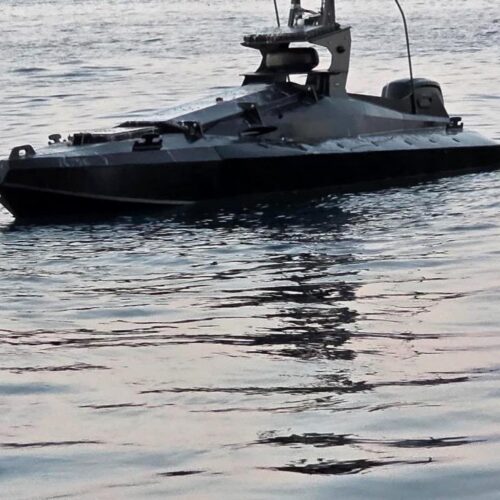
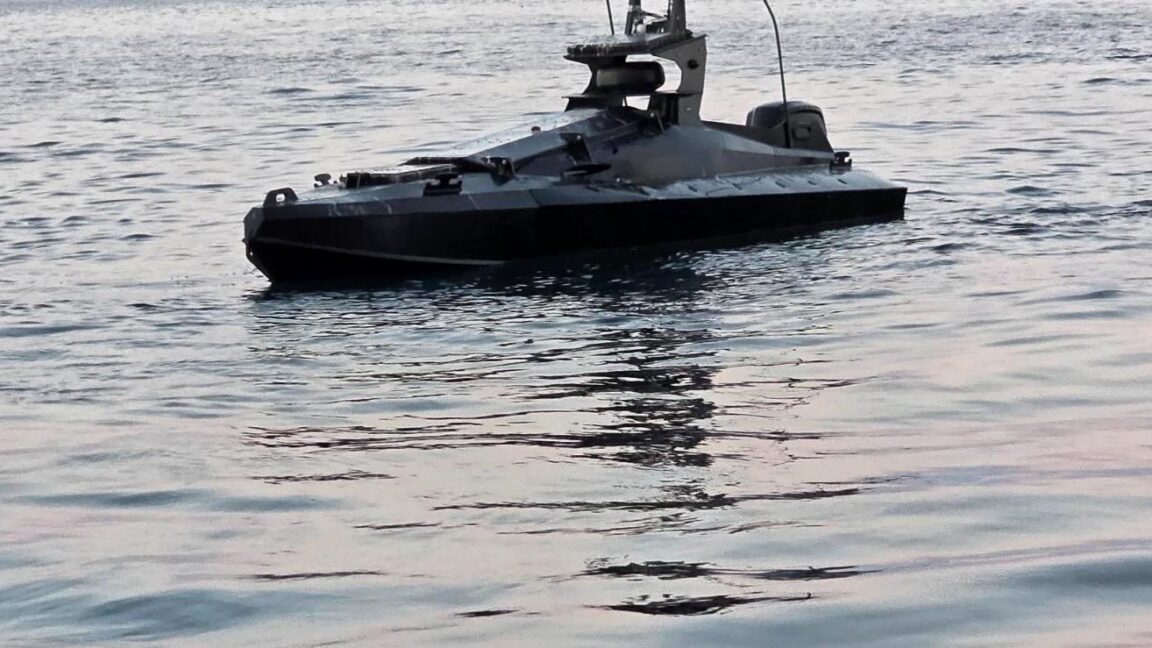
For the first time in its history, the US military sent explosive-laden drone boats into combat by attacking an Iranian midget submarine and naval port. The unprecedented use of such kamikaze sea drones by the United States comes nearly a decade after Iranian and Houthi forces first demonstrated such weapons.

The US military shared a video showing three “one-way attack surface drones” exploding after approaching an Iranian midget submarine and ship maintenance facility at Iran’s Bandar Abbas Naval Base on the night of July 12. US Central Command, the US military combat command responsible for Middle East operations, described the strikes in a social media post as the “first time American forces have employed sea drones in combat operations.”

The US drone boats were able to “make a low-speed, uncontested approach” to their targets before exploding, according to USNI News, a news service from the nonprofit US Naval Institute. USNI News also identified one of the targets as an Iranian Ghadir-class midget submarine that was out of the water while being suspended from a gantry.

Read full article

Comments

© US Central Command

Inside the $87.6 Billion Iran War Supplemental

“In addition to supporting OEF (Operation Epic Fury, the Iran War) costs incurred by DOW (Department of War), the [$87.6 billion Fiscal Year FY 2026 Supplemental Trump administration] request provides $768 million to the Department of Energy to support nuclear and other energy security requirements, primarily for the National Nuclear Security Administration (NNSA) for OEF-related activities.”

I was intrigued by that segment, from a June 24 letter to House Speaker Rep. Mike Johnson (R-La.) from Trump’s Office of Management and Budget Director Russell T. Vought, because I could not imagine what costly “nuclear and other energy security requirements” NNSA – the U.S. nuclear weapons complex – could be playing in the Iran War.

However, a chart attached to Vought’s letter said that $672 million was for NNSA to fund “activities for complete and verifiable termination of Iran’s ability to develop or acquire a nuclear weapon, including the disposition of proliferation sensitive material, technology, equipment, and infrastructure.”

Another $95.5 million, destined for the Department of Energy’s Environmental and Other Defense Activities elements, was listed for “support of Operation Epic Fury and other classified purposes.”

Perhaps members of the Senate Armed Services Committee can find out about the plans behind this $782 million package for NNSA and Energy this morning [July 14], when they question Jules W. Hurst III, who is up for confirmation as Under Secretary of Defense (Comptroller).

By the way, when was the last time a U.S. President went to war and added a tax to help pay for it? As an old-timer I remember – it was 1968, when then-President Lyndon Johnson got Congress to pass a nine-month, 10 percent surcharge on individual and corporate taxpayers to help pay for the Vietnam War. Low-income individual taxpayers were entirely exempt from the surcharge.

Since then, both Republican and Democratic Presidents used deficit spending and borrowing to pay for military conflicts. So far this year, the nation’s total deficit has increased through May 2026 by $1.25 trillion, according to the Treasury Department, with Defense Department spending running $20 billion more through May 2026, than it was last year.

But I remind you, Congress now has three defense funding requests before it: a $1.1 trillion FY 2027 base budget request; an additional $350 billion request to be placed in a 2026 reconciliation package; and now the new FY 2026 supplemental request, which has $67 billion for the Defense Department.

No one can say for sure how Congress will deal with these requests that total over $1.5 trillion.

For comparison, I point out that according to a December 8, 2014, Congressional Research Service study, Congress, over the prior 13 years, approved total appropriations of $1.6 trillion for Afghan and Iraq “military operations, base support, weapons maintenance, training of Afghan and Iraq security forces, reconstruction, foreign aid, embassy costs, and veterans’ health care for the war operations initiated since the 9/11[2001] attacks.”

What the Vought chart also shows is that almost 23 percent of the funds in what has been described as the Iran War supplemental, went for different and, in some cases, totally unrelated purposes that I will describe below.

As for the NNSA money, a FoxNews story June 24, said, “The funding would support the removal and elimination of Iranian nuclear materials, including uranium hexafluoride (UF6), uranium in various forms and research reactor fuel, including highly-enriched uranium, according to details shared by a White House official.”

FoxNews also said, “The request also would fund U.S. verification activities inside Iran, support inspections by the International Atomic Energy Agency, strengthen nuclear-smuggling detection efforts and expand Nuclear Emergency Support Team operations across the Middle East.”

In short, Trump is asking for funds to deal with Iran’s enriched uranium before he has any agreement with Tehran that gives the U.S. access to that material.

Perhaps Trump thinks in the end he will have immediate success with Tehran as in he did in Venezuela. There, after the U.S. seized President Nicolas Maduro in January 2026, and four months later, in May, NNSA removed from Venezuela 13.54 kilograms – approximately 30 pounds – of highly-enriched uranium from a legacy research reactor in that country which had been shut down since the early 1990s.

The supplemental request also contains $1.5 billion for the State Department’s of which $850 million is for the Counter-Unmanned Aircraft Systems program at high-risk diplomatic posts overseas along with security upgrades and equipment replacement. Another $300 million for Embassy construction and maintenance would be used to address needs following the start of the Iran war in Bahrain, Dubai, Karachi, Lahore and Riyadh, according to the Vought chart.

The State request also includes $100 million for the Diplomatic and Consular Service account to meet unanticipated needs related to the Middle East situation including departure assistance to U.S. citizens seeking to leave the region with their families. Transfer authority and an increase in repatriation loan level is also being requested to meet the needs of destitute U.S. citizens.

Another $1.35 billion for the State Department is sought to deal with the Ebola Virus, or as Vought put it in his letter to Speaker Johnson, “These funds would be used to limit the spread of Ebola beyond the Democratic Republic of the Congo and Uganda to other vulnerable nations and ensure the virus does not reach U.S. shores.”

Some $800 million for State is proposed for the International Humanitarian Assistance account, formerly managed by USAID, and another $550 million for Global Health Security, which funds “would support contact tracing, personal protective equipment and commodity procurement, disease surveillance, laboratory capacity, and cross-border coordination,” according to the Vought chart.

There is another $2 billion for the U.S. Coast Guard to support OEF where Pentagon “assets are not available to support Western Hemisphere operations. This includes funding for operations at the Southern Border, ” according to the Vought chart.

Meanwhile, the largest amount, other than for OEF in the supplemental, is $11.1 billion for the Agriculture Department, the bulk of which, $10 billion, would be for American farmers as “temporary economic assistance for row and specialty crops planted in crop year 2026,” according to the Vought chart. An additional $1.1 billion is being requested specifically for farmers in Florida “to rebound from devastating losses that were the result of crippling storms this past winter.”

I believe that money has political implications because rural Americans are pulling away from the President. As Brookings Institution polling recently showed, “Only 24% of white rural voters think that the condition of the economy is excellent or good, while 77% rate it as fair or poor. Just 16% say their family’s financial situation is better than it was two years ago (near the end of the Biden administration), compared to 49% who say they are worse off.”

Then there is $1 billion in the war supplemental to assist in the final design and construction for renovation of New York City’s Penn Station. In a New York Times op-ed last Friday, Rep. Jerold Nadler (D-N.Y.) said that the White House last year took control of the $8 billion Penn Station project from the [New York] Metropolitan Transportation Authority.

Rep. Nadler wrote, “Behind closed doors, Mr. Trump has already attempted a quid-pro-quo, offering federal funding for New York’s transit needs only if Penn Station and [Virginia’s] Dulles Airport are renamed for him.”

However, Nadler also noted, “It’s still $7 billion short, and with top appropriators already opposing the supplemental funding request, it’s unlikely to be approved anyway.”

Another $1 billion in the war supplemental, according to the Vought chart, is for the Labor Department’s Pension Benefit Guaranty Corporation “to increase the benefit levels for participants of certain pension plans that were sponsored by Delphi Corporation and terminated as a result of General Motors ' bankruptcy in 2009.”

The money would reverse pension reductions for some 20,000 retirees that have spent years arguing their pensions were unfairly reduced after the Pension Benefit Guaranty Corporation assumed responsibility for the company’s pension plans during GM’s 2009 financial crisis.

According to the Detroit Free Press, “Various legislative efforts to restore the benefits have failed or stalled, despite bipartisan support. Perhaps knowing it's a potentially powerful issue in the Midwest, Trump (and President Joe Biden before him) has signaled his support of the workers in politically sensitive moments such as just before the 2020 election.”

Then there is $500 million for the National Park Service in Washington, D.C. for, as the Vought chart explains, improvements to the World War II Memorial on the Mall and restoration and construction for the Tidal Basin Seawall along West Potomac Park to include the planting of hundreds of new cherry trees and stabilizing the surrounding grounds.

Last Friday, the conservative group Americans for Prosperity pointed out that even the supplemental’s defense and Iran-related spending “deserve further scrutiny,” noting that $15.6 billion for the Pentagon are justified by Vought simply as “Administration priorities,” “Readiness,” and “Classified Programs.”

In fact, I think the whole package needs congressional oversight, and from the reactions of some key Senate and House leaders, that’s what it’s going to get.

The Cipher Brief is committed to publishing a range of perspectives on national security issues submitted by deeply experienced national security professionals. Opinions expressed are those of the author and do not represent the views or opinions of The Cipher Brief.

Have a perspective to share based on your experience in the national security field? Send it to Editor@thecipherbrief.com for publication consideration.

Read more expert-driven national security insights, perspective and analysis in The Cipher Brief

Ukrainian drone strikes forced Russia to stop shipping in vital sea corridor

Ukrainian drone strikes have forced Russia to completely halt shipping in the Sea of Azov in less than a week, showing once again how a country without traditional naval power can still effectively blockade maritime corridors.

Ukraine’s Unmanned Systems Forces have flown one-way attack drones to target and strike more than 100 Russian tankers and other ships in total, along with posting video evidence showing such drone strikes occurring every night between July 6 and July 14. The campaign has forced Russia to completely shut down the shipping route that flows from Russia’s Don River into the Sea of Azov, and to halt all Kerch Strait shipping transits from the Sea of Azov into the Black Sea, according to Reuters reporting.

The shutdown of such maritime lanes has further isolated the Russian-occupied Crimean Peninsula by cutting off seaborne delivery of fuel in particular. Crimea had already been experiencing severe fuel rationing and power outages as Ukraine stepped up its mid- and long-range drone strike campaign on Russian energy infrastructure and supply lines, leaving behind damaged oil refineries with billowing black smoke and burned-out trucks littering highways.

Read full article

Comments

© Planet Labs PBC

An Outlook for What’s Next in Iran War

With tensions rising all week, the U.S. has launched a new round of strikes against Iranian military targets and maritime assets. The strikes follow an announcement made by President Donald Trump just hours earlier, declaring the ceasefire agreement with Tehran as ‘over’. The fresh wave of strikes signals a U.S. shift back to a strategy of military pressure and economic coercion. The Cipher Brief reached out to Former National Intelligence Manager for Iran at ODNI Norm Roule for context.

"For now, the U.S.-Iran diplomatic track remains alive, but its ability to produce meaningful near-term progress is uncertain, and its long-term survival and utility are increasingly at risk. U.S. strikes in Iran over the past two days will degrade important elements of Tehran’s capabilities in the short term and may buy space for Pakistani and Qatari mediators to reduce tensions and bring about at least a temporary halt in the attacks. However, even if the latest U.S. retaliation deters Iranian attacks in the near term, Tehran is unlikely to abandon its claim of administrative control over the Strait of Hormuz or halt retaliatory attacks against Gulf states that host U.S. bases. Iran’s actions support its long-standing intention to be viewed as a regional hegemon with veto rights over Gulf security, using asymmetric weapons to offset U.S. and Gulf conventional advantages.

Specifically, Tehran is highly likely to continue periodic harassment of shipping to undermine confidence in the security of the Omani transit route. However, Iran is unlikely to try to close the Strait outright unless the United States reinstitutes a blockade against Iran. An effort by Tehran to close the Strait would alienate its customers, unify much of the world against it, and risk a wider war with the United States that the Iranian regime might survive but cannot win. Iran almost certainly believes that it does not need to close the Strait to weaponize it. It only needs to make passage so uncertain enough that insurers, shippers, energy firms, and Gulf governments begin pricing Iranian permission into the movement of commerce and eventually decide they have no choice but to accept a construct that gives Iran permanent influence over passage and Tehran the right to charge fees to those who use it.

The United States is determined to show Iran that these actions carry material costs and that Tehran will not be allowed to control an international waterway. The latest U.S. strikes against Iran, following Tehran’s missile and drone attacks against commercial shipping and Gulf targets, were significant and went well beyond the more limited retaliation that followed earlier Iranian provocations. U.S. forces struck more than 80 Iranian targets on July 7 and approximately 90 additional targets on July 8, including Iranian air defense, command-and-control, coastal surveillance, anti-ship missile, drone, naval, and logistics assets, as well as more than 60 IRGC small boats. Press reports claim U.S. strikes or explosions at key sites near Bandar Abbas, Chabahar, Qeshm, Sirik, Bushehr, and Kharg Island, Iran’s principal oil export terminal. President Trump has threatened further escalation, including attacks against Iranian infrastructure and Kharg Island, if Iranian attacks continue.

This was a significant attack package, but one that still avoided leadership targets and most major civilian infrastructure. The strikes show that the United States will defend its regional partners and the international status of the Strait of Hormuz, and that it has a good understanding of the military system and infrastructure it needs to target to degrade Iran’s attack capabilities in the near term.

Although it remains unclear whether Tehran will de-escalate to avoid further damage, doing so would be consistent with its past behavior and would fit its long-term strategy of episodic attacks that unsettle shipping and test, but do not cross, the line that would ignite a large-scale conflict with the United States. The nature of Iran’s attacks to date, however, shows that Tehran is willing to assume a greater risk of renewed large-scale conflict with the United States if that is the price of forcing others to treat Hormuz as a waterway subject to Iranian permission. The tenor of Iranian rhetoric toward the United States has also sharpened after the former Supreme Leader’s funeral, including public revenge threats against the President. Defiance rather than cooperation is likely to define Iran’s near-term approach.

The Gulf states seek to avoid escalation, but they continue to firmly reject Iran’s claim of control over the region’s central maritime artery. Bahrain, Kuwait, and reportedly even Qatar have now all been drawn directly into the latest Iranian response. This response shows that Tehran is not only threatening commercial shipping and Gulf energy exports, but also targeting Gulf states with the sensing, communications, and command architecture it believes supports U.S. deterrence in the region. These attacks also message that U.S. basing will not protect Gulf states from Iranian attack.

The Gulf states’ immediate focus has been to remove ambiguity regarding safe passage and Iran’s persistent threats by using Qatari, Omani, and Pakistani diplomatic channels, as well as by exploring alternative transit, pipeline, and international maritime arrangements to reduce Iran’s leverage over Hormuz. Iran’s strategy depends on undermining the perception that Omani waters offer protection from Iranian attacks. Tehran’s rejection of reported UAE-backed efforts to develop an International Maritime Organization role in managing the Strait underscores that Iran is fighting not just over shipping lanes, but over who has the authority to define safe passage. Qatar’s role in this regional dynamic is complicated: it is both a valued diplomatic channel and the region’s dominant LNG exporter. At the same time, the reported attacks on Qatari-linked vessels and Iranian pressure on Gulf basing infrastructure show that mediation won’t insulate Doha from Iranian missile and drone strikes.

Energy markets face increased pressure that is likely to vary in intensity over time. Gulf exports had been recovering since mid-June, but the security architecture underpinning that recovery is now visibly eroding. Treasury’s revocation of the oil license granted to Iran after the June deal strips Tehran of the principal early economic concession it gained from the reopening arrangement. Brent and WTI both rose sharply on the news, reflecting not only fear of lost barrels but fear that Hormuz is again becoming a contested operating environment. Nonetheless, the market is responding in a way that shows it sees this week’s flare-up as contained, and that robust production from Saudi Arabia, the UAE, and other producers, reduced Chinese imports from Iran, and the demonstrated resilience of energy markets will prevent a major price shock. In short, existing supply and demand conditions reinforce the prevailing belief that the regional strikes will not evolve into a broader conflict. Should this view be significantly challenged, however, oil prices could quickly move into the $80s or $90s. Longer-term, there is still a disconnect between current market sentiment, the heavy drawdown on global strategic reserves, and the fact that Gulf reliability has been damaged. Even if the Strait remains open, buyers, insurers, and refiners will now treat Gulf supply as politically contingent in a way they did not before the war."

The Cipher Brief is committed to publishing a range of perspectives on national security issues submitted by deeply experienced national security professionals. Opinions expressed are those of the author and do not represent the views or opinions of The Cipher Brief.

Have a perspective to share based on your experience in the national security field? Send it to Editor@thecipherbrief.com for publication consideration.

Read more expert-driven national security insights, perspective and analysis in The Cipher Brief

US seeks cheaper hunter-killer drones after Iran destroys $1B worth of Reapers

The US military has lost dozens of Reaper drones collectively worth more than $1 billion while carrying out surveillance and attack missions over Iran. Now the Pentagon is seeking large numbers of cheaper drones that can perform such missions despite the expectation that many will be lost in combat.

In a call for industry pitches, the Defense Innovation Unit’s notice described the US military’s current reliance on drones and crewed aircraft, each costing more than $30 million, as being “unsustainable against adversaries utilizing layered defenses enabled by increasingly low-cost antiaircraft capabilities.” It envisions deploying more “cost-effective” drones to “overwhelm enemy air defenses even while experiencing numerous [drone] losses.”

That is, in practice, what Ukraine’s military has been demonstrating with its long- and mid-range strike campaign against Russian supply lines, oil refineries, and various energy or industrial targets within Russia or occupied Ukraine. The Ukrainian campaign has been overwhelming Russia’s overstretched air defense capabilities by launching hundreds of relatively inexpensive drones and missiles on a daily basis to attack targets far behind the frontlines, while continuing to damage or destroy Russia’s most sophisticated air defense systems.

Read full article

Comments

Putin’s Running Out of Scare Tactics and Options

Russian President Vladimir Putin can no longer conceal the cost of his Ukraine war from the Russian public. There are fuel shortages throughout the Russian Federation. Videos show hundreds of automobiles lining up to get a few liters of gasoline at gas stations around Moscow. Gasoline sales to civilian vehicles in occupied Crimea have been suspended as the Ukrainian blockade of the peninsula takes effect. Russia continues to make painfully slow progress in its efforts to capture territory in Ukraine and at a staggering cost in casualties.

“…sound out idols... by pos[ing] questions here with a hammer... scrutiny will reveal that they are actually hollow and meaningless—not the high, noble standards of conduct that their proponents claim them to be." Friedrich Nietzsche

Twilight of the Idols

Ukrainian Defense Minister Mykhailo Fedorov recently says that Ukraine has successfully regained the strategic initiative on the battlefield and Kyiv’s use of long-range weapons to hit targets deep inside of Russia is aiming to force Moscow to end the war through asymmetric attrition. Ukraine has recently intensified precision strikes 20-300 kms behind Russian lines to isolate Russian infantry, destroy high value air defense systems and disrupt the flow of supplies to the front line. The long-range drone campaign is systematically targeting Russia’s energy infrastructure with devastating economic and psychological effect.

Vehicles are lining up to cross the Kerch Strait bridge following successful Ukrainian drone strikes on the Tavriiska thermal power plant, major electrical substations and the Kerch and Dzhankoi oil depots. These strikes have caused blackouts in Sevastopol and Simferopol, the two largest cities in the peninsula. The panic caused by the energy shortages and the fear of total collapse has led many to flee, causing the massive backups at the bridge—with sometimes as many as 2,500-3,000 vehicles lining up to cross. The Crimean Peninsula is the crown jewel of Putin’s campaign against Ukraine which he re-ignited with its annexation in March of 2014.

But Crimea is just one of the many challenges facing Putin. Omsk is burning, having been struck on July 6 by Ukrainian forces in their deepest strategic strike of the war. The Omsk oil refinery is located approximately 2600 kms from Ukrainian territory and is Russia’s largest oil refinery and its top producer of gasoline. There are still lingering oily black clouds over Moscow from the June 18 Ukrainian strike on the Gazprom Neft refinery in southeast Moscow—just ten miles from the Kremlin. The refinery was struck by over 200 drones and sent thick greasy black clouds of burning petroleum directly over the high-rise and residential areas fthat are avored by Moscow’s elites. The clouds created “black rain” and forced disruptions at Moscow’s four airports.

A few weeks before, there were oily black clouds over St. Petersburg as Russia hosted its annual St. Petersburg International Economic Forum in early June. International visitors to the Forum (whose attendance has seen a significant drop since 2022) were re-routed to avoid risk of Ukrainian drone strikes and to avoid the clouds of burning petroleum. This read like quite the humiliation for the architect of Russia’s current economic disaster.

As devastating as Ukraine’s attacks have been, the situation on the front is even worse.

A recent thinktank study indicates that Russian forces have suffered 1.4 million total casualties including 450,000 deaths on the battlefield. Approximately 32% of Russian casualties result in death, a fatality ratio that is much higher than modern Western military standards would allow. Reports by analysts and Russian military bloggers indicate that once a Russian soldier is deployed directly into an active combat zone, their average life expectancy drops to just 20-25 minutes. The average survival time for a raw recruit measured from the moment they arrive at a regional training ground to their death in Ukraine, ranges from ten days to three weeks. Even by the Russian standards that were established for casualties in World War II, these losses are staggering and must be causing alarm bells to go off amongst Russia’s elite leadership. There is more visible criticism of how Putin is conducting this war than has even been seen before.

On the diplomatic front, challenges for the Russian president are rising. This week’s NATO summit is yielding results on Europe’s commitment to defense spending and re-armament, led by Germany which is considering incurring state debt to finance defense spending which would be unprecedented for a postwar German government. Putin’s confidence in his ability to count on President Trump to put pressure on Ukraine to end the war on terms that are favorable to Moscow may be eroding and Trump has recently acknowledged Ukraine’s success in the war.

Putin’s reliable ally in Belarus, Alexander Lukashenko, seems also to be reconsidering the state of play and his enthusiasm for allowing Moscow to drag Belarus deeper into the conflict with Ukraine. resident Zelensky recently demanded Belarus take offline four relay facilities in Belarus’s Brest and Gomel regions near the Ukrainian border. These relay stations acted as signal boosters for Russian drones used to attack Ukrainian cities. The relays have been taken offline.

President Zelensky has just authorized a forty-day intelligence and security operation to heavily amplify pressure on the Kremlin to end the war. He is arguing that Russia’s elites live in Moscow and St. Petersburg and therefore, the war must be brought to their doorsteps. He also predicted that “When not one hundred drones but a thousand start reaching Moscow…Putin will be advised to move somewhere beyond the Urals. Zelensky is right and Ukrainians know Russia better than anyone in the West.

Despite the pressure he is under, it is too early to count Putin out. He has largely and cleverly managed his tenure as Russia’s leader. He is still two years short of Stalin’s 29 year record at the helm, but he is getting close and in his 27 years of running Russia, he has dug his tentacles deep into every level of the country’s power structure and has certainly accumulated kompromat on any potential rival or replacement. Many have speculated that if Putin departs the scene, his replacement could be an even worse partner for the U.S. and the West. I won’t argue that any replacement or coalition that follows Putin will be less anti West than Putin, but whatever constellation follows, they will not have the benefit of having roots and leverage as deep in Russia as Putin does.

For the moment, Putin still has escalatory options he can use to respond to increasing pressure.

In recent weeks, Russia has taken steps to close or severely restrict seven critical railway border crossings and road traffic crossings into Finland, Estonia, and Latvia. Apparently, negotiations are under way to restrict crossings into Kazakhstan and other central Asian states. The motivations for the abrupt closures are unclear but they suggest that Putin may be considering a mass mobilization and is trying to stem the likely departure of military age males to avoid the departures that have occurred since February 2022.

Mobilization alone will not solve Russia’s problem of shortages of equipment and training for conscripts as well as Russia’s World War I-style battlefront tactics. President Zelensky spoke on the margins of the NATO summit this week and said Ukraine is causing over 30,000 Russian casualties a month.

Putin can also rattle the nuclear saber again, but that is likely to be largely ignored as has his previous saber rattling. Most experts are confident that Putin has received firm guidance from his only remaining reliable ally China that he should not open the nuclear Pandora’s box in Ukraine.

The intelligence and security services in the Baltic States, Sweden, and Poland have recently assessed that Putin may try a provocation against one of the bordering NATO states in order to force an Article V action—which he hopes Trump would reject. But few analysts think Putin would risk an all-out war against NATO. That would be a path that could only accelerate Ukraine’s path toward NATO membership and could lead to further disasters for the Russian military, which many experts considered to be the most powerful conventional military in Europe prior to February 2022.

Putin’s most likely response to his current challenges is to continue to take advantage of weaknesses in Ukraine’s air defenses, particularly against ballistic missile attacks and hope that at some point, Ukraine’s morale weakens and pressure increases on Zelensky to end the war on terms that are more favorable to Russia. Such a change in Zelensky or Ukraine is inconceivable to any rational analysis of the current state of the war, but Putin is clearly not rational.

The Cipher Brief is committed to publishing a range of perspectives on national security issues submitted by deeply experienced national security professionals. Opinions expressed are those of the author and do not represent the views or opinions of The Cipher Brief.

Have a perspective to share based on your experience in the national security field? Send it to Editor@thecipherbrief.com for publication consideration.

Read more expert-driven national security insights, perspective and analysis in The Cipher Brief

The West Needs to Prepare for a Russian Defeat in Ukraine

We are good at winning wars and generally bad at what comes after. Far from a partisan observation; this is a pattern with receipts. We removed Saddam Hussein in three weeks and then spent eight years discovering that we had no plan for Iraq. We helped topple Qaddafi in 2011 and left Libya to sort itself out, which it did into a decade of competing militias and open-air slave markets. We spent twenty years in Afghanistan and still managed to be surprised when the government we built collapsed in eleven days. The American way of war ends at the moment of victory. The credits roll, everyone goes home, and the sequel is a disaster nobody bothered to consider.

There is exactly one modern exception, and it is instructive. When the Soviet Union came apart in 1991, a Democratic senator from Georgia and a Republican senator from Indiana looked at roughly 30,000 nuclear warheads scattered across four newly independent, newly broke republics and decided, radically, to think ahead. The Nunn-Lugar program spent American money to secure, consolidate, and dismantle those weapons before they could walk out the door to Tehran or to a bidder we would like even less. It was unglamorous, it was expensive, and it worked. Three decades after the largest state collapse in modern history, there has been no loose-nuke catastrophe. We planned once. It went well. We have not repeated the experiment since.

I raise this because we may be about to need it again, and the warning lights are coming on faster than the planning is.

Start with the battlefield. Russia has absorbed somewhere near 1.4 million casualties since February 2022 in order to advance, in its showcase offensives, at a pace measured in tens of meters a day. That is more than any major power has taken in any conflict since the Second World War. In early 2026 that grinding pace stalled outright, and for the first time since 2023 Ukraine recaptured more ground than it lost. Russian military recruitment fell twenty percent in the first quarter of this year, into the teeth of the worst labor shortage the Russian economy has ever recorded. An army that cannot recruit and an economy that cannot spare the men are not a combination that trends toward Berlin.

Then follow the money, because wars end when the money does. Russia's federal budget deficit hit 5.9 trillion rubles in just the first four months of 2026. That is larger than the entire deficit it ran in all of 2025, and against a full-year plan of 3.9 trillion. The liquid portion of the sovereign wealth fund, the rainy-day cushion, has shrunk from 6.5 percent of GDP at the start of the war to 1.8 percent this April. Oil and gas revenue in 2025 fell to its lowest level since 2020, and in the first two months of 2026 it dropped nearly by half year-on-year. The Kremlin is raising its value-added tax from 20 to 22 percent and cannot borrow abroad, because we long ago cut it off from the markets. Putin is a man selling his furniture to make rent.

And here is the part that should be keeping planners awake at night: Ukraine has learned to hit the one thing Russia cannot armor. Kyiv's drones have taken more than a third of Russia's oil-refining capacity offline, roughly 38 percent by some counts. Gasoline output is down seventeen percent from a year ago. Refineries at Kirishi, Ryazan, Nizhny Novgorod, Yaroslavl, and outside Moscow itself have been forced to halt or throttle production. Russia, one of the largest oil producers on earth, has banned gasoline exports and is now rationing fuel to its own citizens, who are queuing at pumps in a country that floats on crude. A petrostate that cannot keep its own drivers in gasoline is a petrostate whose social contract is running on fumes.

Now the honest caveat, because I have watched too many confident men predict Moscow's collapse and end up eating the prediction. Russia has a genius for absorbing punishment that would break others, and "the regime is about to fall" has been the graveyard of Western analysis for a century. Vladimir Putin may well hang on for years. I am not promising you a collapse. I am telling you that a Russian defeat, a real one, military exhaustion bleeding into political rupture, inside the next two years, has moved from a fringe scenario to one that a serious government insures against. You do not buy fire insurance because you expect to burn. You buy it because you cannot afford the one time you do.

So what does the insurance look like in this case? A few things, none of which require us to want Russia to come apart.

First, dust off Nunn-Lugar and write the sequel now, before the crisis. Russia has roughly 1,800 strategic warheads today. If central authority in Moscow wobbles, the question of who controls them becomes the only question that matters. What’s worse, New START quietly expired this past February and is no longer around to give us the courtesy of counting them. We need pre-negotiated channels for securing those weapons, ideally including China and India, whose interest in not having loose Russian nukes on the market is every bit as sharp as ours.

Second, decide in advance what we will and will not recognize. A fragmenting Russian Federation could throw off breakaway republics the way the USSR did in 1991. The moment to agree on which borders and which authorities we will treat as legitimate is before a dozen regional governors declare themselves president, not while it is happening. Improvised recognition is how you turn a collapse into a set of proxy wars that makes Putin’s destabilizing behaviors look like child’s play.

Third, keep the technocrats employed. The most dangerous export of a collapsing weapons state is not a warhead; it is the underpaid engineer who knows how to build one. In 1992 we worried about Russian scientists boarding flights to Iran, Iraq, and Libya. This time we should build the landing pads, research funding, visas, civilian projects, before they start looking for the exits.

Fourth, tell Ukraine and our European allies what "victory" actually means, so that we are not improvising the peace the way we improvised Baghdad. A defeated Russia is not a solved Russia. It will still have grievances, a reconstituting army, and a long memory. The objective is a Russia that loses this war and cannot start the next one, a vacuum we will spend the 2030s regretting.

None of this is a prediction that Moscow falls next spring. It is the recognition that we have been surprised by nearly every ending we should have seen coming, and that the cost of preparing for a Russian defeat that never arrives is a few think-tank salaries and some awkward classified memos. The cost of not preparing for one that does is measured in warheads we cannot account for.

We have the receipts on what happens when we refuse to think ahead. We also have a single example of what happens when we do. Let’s choose the sequel we actually storyboarded.

The Cipher Brief is committed to publishing a range of perspectives on national security issues submitted by deeply experienced national security professionals. Opinions expressed are those of the author and do not represent the views or opinions of The Cipher Brief.

Have a perspective to share based on your experience in the national security field? Send it to Editor@thecipherbrief.com for publication consideration.

Read more expert-driven national security insights, perspective and analysis in The Cipher Brief

What is the oldest American object ever launched into space?

Did you know that the space shuttle once launched the Statue of Liberty into space?

In fact, there were two "Lady Liberties" on board Discovery when it lifted off on its fourth flight in April 1985. To be fair, each statue was only 15 inches tall (38.1 centimeters), but they were also each made of copper that was removed from the full-size statue during its then-still-ongoing restoration.

After the weeklong STS-51D mission was over, one of the space-flown statues was placed on display, and the other was melted down to create copper seals, which were then sold to the public by the Statue of Liberty Ellis Island Centennial Commission.

Read full article

Comments

© collectSPACE.com

Overland AI lands Marine Corps deal worth nearly $20M to build self-driving military vehicles

Overland AI’s autonomous ground vehicles lined up at the company’s proving grounds. (Overland AI Photo)

Seattle-based Overland AI has landed a U.S. Marine Corps contract to produce autonomous ground vehicles, a milestone the defense-tech startup says makes it the first ground autonomy company to serve as the prime contractor on a military production deal. 

The nearly $20 million agreement — $19.7 million, according to the Department of War — calls for Overland to deliver more than a dozen autonomous ground vehicles, along with the software that runs them. Initial deliveries are expected to begin sometime in early 2027.

The agreement was announced June 29. The vehicles will work with a Marine Corps system that shoots down enemy drones. Overland’s vehicles will initially handle resupply for those crews rather than replace any existing vehicles, co-founder and CEO Byron Boots said in a media briefing, as reported by trade publications DefenseScoop and Defense One

Boots is a University of Washington machine-learning professor who leads the school’s Robot Learning Laboratory and is the Amazon Professor of Machine Learning at the UW’s Allen School of Computer Science & Engineering. He co-founded Overland in 2022 with Stephanie Bonk, the company’s president, spinning it out of the UW

The company’s technology is designed to let military vehicles drive themselves across rough, off-road terrain in places where GPS isn’t available. 


Overland has grown to more than 100 employees and raised over $140 million in venture funding, including a $100 million round in February led by the venture firm 8VC. It opened a 22,000-square-foot production facility in Seattle last year, and ranks No. 9 on the GeekWire 200, our index of the top privately held Pacific Northwest tech companies. 

The company isn’t alone in chasing military ground autonomy. One of its rivals, Maryland-based Forterra, won a larger, $92 million Marine Corps production deal earlier in June — but as the autonomy supplier under prime contractor Oshkosh Defense, rather than holding the contract itself. That’s the distinction Overland is claiming as a first. 

Overland’s deal came through a Pentagon program called APFIT — short for Accelerate the Procurement and Fielding of Innovative Technologies — which fast-tracks funding to move promising technology from prototypes into production. For Overland, it marks a step from testing and demonstrations into building vehicles at scale for the military. 

“We’re registering extremely high demand from U.S. operational units who want to incorporate this technology into their concepts of operation,” Boots said in the briefing, pointing to the war in Ukraine as evidence of a growing role for uncrewed vehicles.

Overland has been working for years with the Army, Marine Corps and Special Operations Command, also completing a multiyear DARPA autonomy program. The new contract builds on recent work integrating its self-driving technology into Marine Corps vehicles.

Drone Warfare: Ukraine’s Drone Industry, Part 3 – Export Strategy

Welcome back!

This is the final article of our Drone Warfare series on Ukraine’s rise as a drone powerhouse. But Ukraine’s success story is not one it achieved alone. The country’s drone industry was built with the support of partners from around the world who helped Ukraine during its most difficult times. Here we look at Ukraine’s export strategy and how it can serve as a way to give back by sharing hard-earned battlefield experience and technology with the nations that helped make this success possible.

Battlefield Experience

For most of the war, Ukraine’s drone sector existed on the demand side of the defense market. The country needed huge volumes of FPV drones, interceptor drones and reconnaissance systems simply to keep pace with the battlefield. By 2026, that position began to change. Ukraine started to present itself not only as a state that needed drones, but as a state that could supply them, co-produce them, and teach others how to use them. In March 2026 President Volodymyr Zelenskiy discussed joint arms production with Dutch Prime Minister Rob Jetten and said Ukraine was ready to export interceptor drones that are not needed on its own battlefield.

interceptor
Interceptor drones and the latest AI developments. Source: Ukraine’s Arm Monitor

Ukraine is not trying to sell a platform developed in peacetime and polished for foreign buyers. It is offering weapons and systems that were shaped by daily combat against a technologically capable enemy. That gives Ukrainian exports a different value proposition. They are presented as battlefield-tested tools that have already survived the hardest possible proving ground.

The Export Model

Ukraine’s export strategy depends on the fact that it is producing more than it can immediately absorb on the front line in certain categories, especially interceptor drones. In June 2026 Ukraine said it could produce 2,000 interceptor drones per day, with about half potentially available beyond domestic needs, and that it could supply at least 1,000 interceptor drones a day to allies facing Shahed attacks if investment improves. That is the logic behind the export conversation. Ukraine is not opening the floodgates on every weapon it makes. It is identifying categories where production has moved beyond immediate domestic consumption.

Business Insider also reported that Ukraine wants to protect its own security first and only share technologies that do not compromise its battlefield position. That means exports are likely to focus on systems that are already partially superseded on the Ukrainian front, or on systems that can be co-produced under controlled conditions.

Europe

Europe is the most obvious destination for Ukraine’s export strategy because the continent is already moving in Ukraine’s direction. The Netherlands are going to spend €248 million on drones for Ukraine, with production split between the Netherlands and Ukraine. On 17 June 2026 the Netherlands pledged another €500 million for drones and air defense equipment. These are signs that European governments are beginning to fund drone production as an industrial activity.

drone with a gun attached to it
The Drone Squad Fury unmanned aerial platform developed by OM Defense Systems on display at the Eurosatory defense exhibition in Paris, June 2026. Source: Militarnyi

The broader European defense picture points the same way. It was reported that G7 countries and the United States had agreed to allow Ukraine-based and European firms to produce long-range missiles and air defense systems under license. Europe is no longer only buying Ukrainian results, it wants to buy into the production model behind them.

airbus' new drone models
Source: Airbus’ drone portfolio

The broader European defense market is also moving in Ukraine’s direction. For instance, Airbus partnered with the French counter-drone startup Alta Ares. Under the June 2026 memorandum of understanding, Airbus will integrate Alta Ares’ AI-guided interceptors, including the Black Bird and X-Lock systems, both combat-tested in Ukraine since 2024, into its Fortion IBMS command-and-control platform, connecting Alta Ares’ targeting software and interceptor drones to Airbus’ battle management systems to create a sensor-to-shooter chain against drone and cruise missile threats.

Middle East

The Middle East is the second major market because it faces a different but equally urgent drone threat. In March 2026 Zelenskiy said Ukraine was ready to send instructors to the Middle East and export interceptor drones that are not needed at home. Business Insider added that Ukrainian officials see older Ukrainian counter-drone technology as still useful for allies facing Shahed attacks, even if those systems are already outdated by Ukraine’s own battlefield standards. A weapon does not need to be the newest model to be valuable if the user’s threat environment is less intense than Ukraine’s.

middle east
Ukrainian interceptor drone in open terrain (desert-like background works well for the Middle East angle)

That makes the Middle East a natural fit for Ukraine’s export model because the buyer often wants a system, not just a drone. The package includes interceptor drones, training, radar integration, and electronic warfare resilience. Zelenskiy explicitly framed the issue that way, saying that without radar coverage and software that can operate under jamming, an interceptor is not a real defender.

Production

The most interesting part of Ukraine’s export strategy is not the sale itself. It is the move toward co-production. The point of co-production is to make exports more durable and less vulnerable to disruption. It also lets allies develop industrial capacity while Ukraine keeps access to the newest combat-tested designs. The G7 agreement reported by The Guardian shows a model where production can be shifted into partner territory while still drawing on Ukrainian experience and requirements. That approach helps solve three problems at once. It spreads risk away from the battlefield. It makes procurement faster for partners. And it creates a legal framework for sharing sensitive technology without handing over full control of the most advanced systems.

The Financial Logic

The export strategy also has a budget logic. Drone exports and co-production can help bring in foreign money, expand industrial capacity, and reduce pressure on the domestic defense budget. The Netherlands’ funding would support drones and air defense equipment for Ukraine, while Ukraine’s officials see export volume as a way to unlock more production capacity. The practical idea is that external orders help keep factories busy, while revenue and investment help scale the next generation of systems.

ukraine presents its technologies
Ukraine’s Drone Industry arrives in Düsseldorf. Source: DroneXL

This logic is important in wartime because the domestic state cannot fund every possible expansion on its own. Exports make production more sustainable. They also let Ukraine distribute risk across several partners rather than relying only on its own budget and wartime aid flows. In other words, the export strategy is partly about money, but it is also about industrial resilience.

Main Constraints 

Ukraine’s export strategy is still tightly constrained by its own security needs. Ukrainian officials want to keep priority for domestic forces and treat exports as selective. That means the country is not trying to become a free-market weapons bazaar in the middle of a war. It is trying to manage surplus capacity without weakening the front line. There is also the issue of sensitivity. Not every system can be exported, and not every partner can receive the same level of access. Licensed production in allied countries solves part of that problem, but only part. The more advanced the system, the more likely it is to remain under stricter Ukrainian control. That is why the export strategy is likely to be layered. That means some hardware is going to be sold directly, while some systems will be co-produced, some software and training will be shared for integration, and some capabilities will stay in-house.

Strategic Value

Ukraine’s biggest advantage in the export market is not price alone. It is combat credibility. Allies are interested because Ukraine’s drones and counter-drone systems were developed in the harshest possible environment. A state that has spent years fighting under heavy electronic warfare pressure, missile strikes, and mass drone attacks has something to offer that many peacetime defense industries do not. That does not mean Ukraine will dominate global drone exports. Competition is still strong, and certification with production security all remain real obstacles. But the country has already crossed an important threshold, where it’s no longer only asking for help. It is now a partner that can supply systems, share production, and train others to fight the same kind of war.

Conclusion

Europe wants production. The Middle East wants interception. Ukraine wants revenue and industrial depth. That creates a new model built around selective exports and battlefield-tested expertise. Ukraine is no longer only defending itself with drones, but it is using drone expertise to build alliances. That is the meaning of its export strategy today.

The post Drone Warfare: Ukraine’s Drone Industry, Part 3 – Export Strategy first appeared on Hackers Arise.

Congress Questions Pentagon Spending—and the Future of Trump’s Battleship

“I’m deeply concerned that the Presidential proposal for $350 billion mandatory funding [to be carried in a reconciliation bill and not an appropriations bill] for defense will have no Appropriations [Committee] input on the enactment. That’s not the right way to fund the Department of Defense, because it took the Department ten months to explain to Congress how they were going to spend the $150 billion in mandatory funding they received last year. It’s unacceptable, and I have no confidence the Department will do a better job responding to us in the future. There’s also no guarantee that a reconciliation bill will pass.”

That was Rep. Betty McCollum (D-Minn.) speaking last Wednesday at the House Appropriations Committee meeting that marked up the Fiscal Year 2027 Defense Appropriations Bill.

Ranking Democrat on the panel’s Defense Subcommittee, McCollum was questioning the Trump administration’s second year of seeking to put a major chunk of proposed defense spending in a reconciliation bill, where it could avoid both pre-passage congressional review and require only a majority vote for Senate approval.

It turned out that McCollum had bipartisan support for her view.

The House Appropriations Committee, in its report on the bill it later approved that day, included several examples of problems caused by using mandatory spending in a reconciliation bill, along with remedies it proposed..

I will discuss them below, along with one other critical issue – problems in U.S. Navy shipbuilding -- that the House committee also raised in its report.

Remember, however, these are just one committee’s suggestions and they still have a way to go to be adopted by the full House and Senate.

One mandatory spending example in the Committee report relates to the controversial F-35 Lightning joint fighter program.

The President’s fiscal year 2027 budget request includes $7 billion in discretionary funding for 32 F–35 aircraft and $10 billion in mandatory funding for 53 F–35s. Additional modernization funds sought for the F-35 program includes $2 billion in discretionary funding and $2.4 billion in mandatory funding.

In its report, the House Appropriations Committee said it “has serious concerns regarding how the Office of Management and Budget (OMB) bifurcated the funding request and questions the rigor that was used to split the request between discretionary and mandatory funding. For example, radars and other critical components were either funded in full on one side of the ledger

or the other, inconsistent with the total flyaway costs for discretionary and mandatory quantities.”

The Committee report continues, “Further, OMB made assumptions on program savings associated with executing a multi-year procurement contract, for which a corresponding legislative proposal has not been submitted, and applied all the savings to the discretionary request. As a result, the discretionary budget request actually procures a quantity of only six aircraft, rather than the 32 it purports to fund.”

Another Committee report example related to more than $43.4 billion for several critical munitions that is included in the $350 billion mandatory package. The committee said, “In many cases entering into MYP (multi-year procurement) contracts will require both discretionary and mandatory funds. The topic of accelerating munitions production has been a priority of the Department and Congress alike, though splitting funding into two funding processes could lead to incongruencies that will not be easily remedied.”

Splitting weapons programs between the discretionary and mandatory funding prevents Congress from considering requests as a whole, the Committee report says, thus preventing “effective oversight and program continuity and also to preserve production lines and commitments to industry partners and allies.”

The report adds that this year the House Committee is only considering the discretionary portion of the request, but will be “working with the [Defense] Department to ensure that budget justification materials submitted for fiscal year 2028 are adequate to evaluate the full-funding profile, regardless of funding mechanism or whether funding was previously enacted or provided in any future reconciliation package.”

The Appropriations panel report also directs attention to problems in the Navy’s shipbuilding program where the President’s fiscal 2027 budget request includes over $60 billion in discretionary funding for the Trump administration’s so-called Golden Fleet Initiative.

As the report puts it, “The Committee remains firm in its conviction that funding alone does not guarantee on-time delivery and is no substitute for sound program management and rigorous oversight. The Committee is concerned that an accelerated pace of investment, absent commensurate accountability, risks repeating the cost growth and schedule slips that have plagued nearly every major shipbuilding program in recent years.”

Getting specific, the report says, “The Committee is particularly troubled that the Navy’s cost-to-complete request for shipbuilding totals $2.6 billion in fiscal year 2027. The cumulative cost of these delays and overruns now rivals the price of the ships themselves, eroding the buying power of every dollar appropriated for new procurement. The Committee believes that the Navy has not consistently demonstrated the ability to identify, report, and correct adverse cost and schedule trends in a timely manner.”

For a remedy, the Committee “directs the Secretary of the Navy to submit a report to the House and Senate Defense Appropriations Subcommittees not later than 90 days after the enactment of this Act, and quarterly thereafter,” on each major shipbuilding program: to include the current delivery schedule, cost-to-complete with drivers of any growth; and actions the Navy has taken or intends to take to recover any schedule and contain cost growth.

The Committee report also directed the Government Accountability Office next year to assess any recurring cost growth and schedule delay across major Navy shipbuilding programs and the adequacy of the Navy’s response to identify and arrest such trends early.

The Committee also took aim at two specific submarine shipbuilding programs, starting with the Columbia-class which is the sea-based leg of the strategic nuclear triad, and the Virginia-class attack submarine.

According to the Committee report, “the lead Columbia-class submarine is delayed by as much as 18 months and that the Virginia-class program is delayed by as much as 42 months,” adding, “Delays of this magnitude present significant risk to strategic deterrence, erode undersea superiority, and degrade long-term operational availability and readiness.”

Because, according to the Committee report, “incremental funding in a constrained industrial environment serves only to introduce further risk,” the panel recommended “full funding for one Columbia-class submarine and two Virginia-class submarines.”

The House Committee report also took aim at the nascent Trump Guided Missile Battleship (BBG(X) program for which the President’s FY 2027 budget seeks $1 billion in advance procurement and $837 million in research and development funds.

The report says, “The Committee notes that the [Trump battleship] program has not finalized ship design, completed a formal analysis of alternatives, or established a stable set of requirements, and that the Congressional Budget Office has estimated the lead ship could cost in excess of $20 billion.”

The report added the Committee has cautioned in the past that “committing funding to construction before achieving design stability and solidifying requirements is a principal cause of the cost growth, schedule delay, and industrial base instability that afflict Navy shipbuilding.”

The Committee report also warned “that BBG(X), as a nuclear-powered surface vessel, will draw on the same finite pool of nuclear-capable shipyard capacity, skilled workforce, reactor components, and supplier base on which the Columbia-class submarine, Virginia-class submarine, and Ford-class aircraft carrier programs depend.”

Given the situation, the Committee said that “introducing a new nuclear surface combatant [the BBG(X)] without careful planning could compound those constraints and place at risk the delivery of [shipbuilding] programs the Committee considers higher priorities for the nuclear-capable industrial base.”

As a result, the Committee requested detailed reports from the Navy Secretary: One that “addresses the validated requirements and key performance parameters for the large surface combatant [BBG(X)]; the status of the analysis of alternatives and ship design, including a design maturity assessment and the criteria the Navy will use to certify design stability prior to any commitment to lead-ship construction.”

And a second report that deals with the “Navy’s strategy to design and construct BBG(X) without interfering with existing nuclear-powered shipbuilding programs,” and also “how the Navy will sequence and resource BBG(X) so as not to jeopardize the delivery schedules of those programs.”

If that were not enough, the Committee also added a section to the actual legislation, Section 8147, which, by law, would limit the Department of the Navy from using funds to contract to build the lead ship of the Trump-class battleship program, BBG(X), until the “Secretary of the Navy certifies to the congressional defense committees that the weapon systems planned for inclusion in such lead ship are at a sufficiently mature technology readiness level.”

In a column last April, I noted some weapons Trump wants to include on BBG(X) are still in development and any design for such a ship was at least two years away. I now repeat what I wrote two months ago, my bet is that none of these Trump-class battleships will ever actually be built.

The Cipher Brief is committed to publishing a range of perspectives on national security issues submitted by deeply experienced national security professionals. Opinions expressed are those of the author and do not represent the views or opinions of The Cipher Brief.

Have a perspective to share based on your experience in the national security field? Send it to Editor@thecipherbrief.com for publication consideration.

Read more expert-driven national security insights, perspective and analysis in The Cipher Brief

❌