Walmart’s new $120 annual membership combines Walmart+, Sam’s Club Plus, free delivery, fuel discounts, and streaming perks, saving you nearly $100 compared with buying both memberships separately.
Smart TVs running operating systems from Samsung, Vizio, and Roku continue sending data to automatic content recognition (ACR) endpoints after users opt out of tracking in the devices’ settings, according to research published on Monday. The paper from Northeastern University researchers points to potential privacy violations from some of the biggest TV brands.
ACR captures video screenshots or audio clips from smart TVs and sends the data to remote servers, where it's used for things like measuring content viewership and serving targeted ads.
As Amazon blocks AI agents from shopping on its site, Walmart is taking the opposite approach, introducing new technology that lets AI agents make purchases on customers' behalf, with controls over spending and transaction approvals.
Walmart and Wing are partnering on drone delivery service that is expanding across the U.S. (Walmart Photo)
Walmart looks like it might beat Amazon to the skies over the Seattle area as the retail giant announced this week that it plans to bring automated drone delivery to the region in 2027.
The move is part of a broader nationwide push by Walmart and drone operator Wing — a subsidiary of Google parent Alphabet — to scale across nearly 20 U.S. metropolitan areas. By adding Seattle and Denver in its latest expansion push, the partnership aims to eventually offer 30-minute aerial delivery from more than 270 Walmart stores coast-to-coast, reaching over 40 million potential customers.
Details on which Seattle-area stores will offer the service have not yet been announced. There are no Walmart stores within Seattle city limits, but The Seattle Times reported that permit filings point to initial groundwork underway at store locations in Federal Way and Tacoma.
Federal Way Mayor Jim Ferrell said his community south of Seattle is looking forward to bringing the region “an incredible new convenience” with the advanced delivery solutions.
“The future has arrived and its being delivered by Walmart by drone!” Ferrell said in a news release.
Wing’s electric aircraft fly at speeds up to 60 mph, serving homes within a six-mile radius of participating stores. The drones carry payloads up to five pounds to drop household essentials from groceries to small electronics. Once operational, eligible local shoppers using either the Walmart or Wing app will automatically see airborne drops as a checkout option.
KIRO 7 captured a demonstration of Wing’s delivery system in Bellevue this week, showcasing how the aircraft take off and raise and lower orders.
While Seattle-based Amazon has pushed aggressively to expand its Prime Air drone fleet to nearly 500 U.S. cities and towns, the tech giant has yet to launch commercial drone deliveries in its hometown. Instead, Prime Air operations remain concentrated in markets like Arizona, Texas, and Florida.
Amazon isn’t ignoring the Pacific Northwest entirely, however. The Portland Business Journal reported last month that Amazon filed permit applications to build a Prime Air hub at a North Portland facility, targeting an early 2027 launch that has already drawn early pushback from nearby residents concerned about noise and safety.
Those noise concerns mirror a broader backlash taking shape in established test markets. The New York Times and others reported last month on residents living beneath Amazon’s drone flight paths in Richardson, Texas, who have taken exception to the constant low-altitude buzz of delivery aircraft disrupting their suburban way of life.
Wing has sought to head off potential noise backlash by re-engineering its aircraft acoustic profile. According to the company, its latest drones feature custom propellers designed to reduce high-pitched whines, keeping sound levels at roughly 43 to 50 decibels at cruising altitude and around 62 decibels during hovering drops — a level Wing claims is quieter than a standard delivery truck.
But Walmart and Wing have still encountered friction at the local level. In metro Atlanta, county leaders shut down a proposed Walmart drone hub after more than 1,000 nearby residents signed a petition citing noise, safety, and privacy concerns.
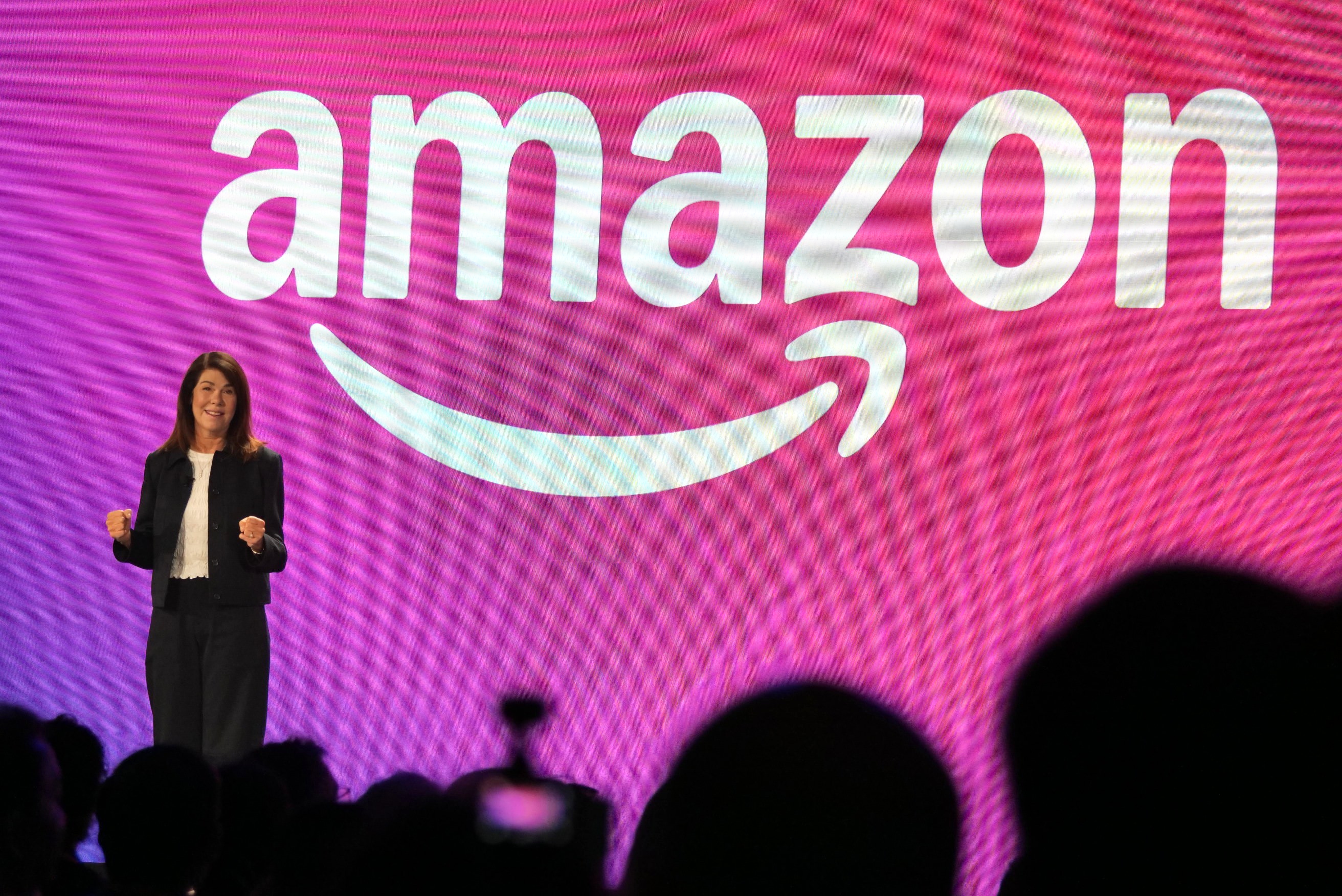
Mary Beth Westmoreland, Amazon’s VP of Worldwide Selling Partner Experience, speaks Tuesday morning at Amazon Accelerate at the Seattle Convention Center. (GeekWire Photo / Todd Bishop)
Amazon is introducing tools to let independent sellers manage their sales on four of its biggest rivals — eBay, Shopify, TikTok and, yes, even Walmart — from Seller Central, the same dashboard they use to run their Amazon businesses.
The multichannel selling tools, announced Thursday at Amazon’s Accelerate seller conference in Seattle, are rolling out gradually to U.S. sellers over the coming months at no extra cost. At first, sellers can connect their accounts on the other platforms, import and link listings, see all their orders in one place, and fulfill orders across channels.
The data question: The move raises natural questions about Amazon’s motives, including what the company might do with data from sellers’ businesses on rival platforms. In an interview, Mary Beth Westmoreland, Amazon’s VP of Worldwide Selling Partner Experience, brought the issue up unprompted.
“A seller’s multichannel data that might surface in Seller Central, it’s never used for anything other than surfacing it to that specific seller. Period,” she said. “We never use that data for any other purpose.”
Pressed on whether the data could affect a seller’s standing on Amazon, such as by pushing their products lower in search results for charging less elsewhere, she was more emphatic. “We never, ever, will touch this data or use it for any other reason other than to show it to you,” she said.
Questions about how Amazon could use seller data for other purposes are not hypothetical. In 2020, The Wall Street Journal reported that Amazon employees had used data about independent sellers to develop competing house-brand products, and in 2022 Amazon agreed with European regulators not to use sellers’ non-public data in its own retail business.
Amazon said at the time that it prohibits employees from using non-public, seller-specific data to decide which house-brand products to launch. When it settled with European regulators, the company said it still disagreed with “several of the preliminary conclusions” in the case.
The Federal Trade Commission’s pending antitrust case also accuses Amazon of punishing sellers who offer lower prices on other sites, an allegation Amazon denies. The case is set for trial in March 2027.
Why, then, is Amazon doing this? Westmoreland said sellers told Amazon that managing sales across so many platforms takes too much time. “They said we would love it if we could use some of the cool tools in Seller Central everywhere we sell, and so that’s what we did,” she said.
In addition, she said, the company believes sellers who succeed on other platforms will bring a wider range of products to Amazon, which makes its store more appealing to shoppers, so helping sellers elsewhere ultimately benefits Amazon, too. More than 95% of Amazon’s independent sellers already sell through multiple channels, according to the company.
What Amazon already offers: The new multichannel tools in the Seller Central dashboard add to a collection of services Amazon already offers to merchants who sell elsewhere, potentially boosting its other services.
Buy with Prime lets merchants offer Prime delivery on their own websites, with Amazon handling customer service and returns.
Amazon also announced Thursday that merchants using Multi-Channel Fulfillment in the U.S. can now offer Prime delivery on their own websites at no additional cost. It launched a separate pricing program that it says can cut their fulfillment fees by 15% to 25% for the first six months.
Selling services to merchants is a big business for Amazon. Independent sellers account for more than 60% of units sold on Amazon worldwide, and the fees Amazon charges them brought in $46.8 billion in the second quarter, more revenue than AWS.
How it works: Sellers connect their other accounts through a multichannel settings page in Seller Central. The Manage Orders page then shows unshipped orders from every connected channel on one screen. A seller can select a Shopify order, for example, and send it to Amazon for fulfillment, with tracking updates flowing back to Shopify automatically, according to Amazon.
Westmoreland said the connections to other platforms mostly use their standard APIs, along with existing agreements through Veeqo, the multichannel shipping software company Amazon acquired in 2021 and now offers free to sellers. Sellers don’t have to use Amazon’s fulfillment services to use the new tools, she said.
Amazon says more features are coming, including the ability to edit a product description once and have it update on every channel, AI-generated listings for other platforms, and a dashboard showing how much sellers earn on each product across channels, including ad spend and traffic data from the other platforms.
The competition: The new tools also put Amazon in competition with companies that already sell multichannel software, including Rithum, formed from the combination of ChannelAdvisor, CommerceHub and Dsco, and Linnworks.
Shopify offers its own version, Marketplace Connect, which lets merchants manage their Amazon, Walmart, eBay and Target Plus sales from inside Shopify — essentially the reverse of what Amazon is now offering.
Westmoreland called Amazon’s tools “one more option” for sellers. She also said sellers had told the company they were already paying for this kind of software: “Hey, I’m paying for it, and it’s hard to do. Can you do this for me?”

 Login