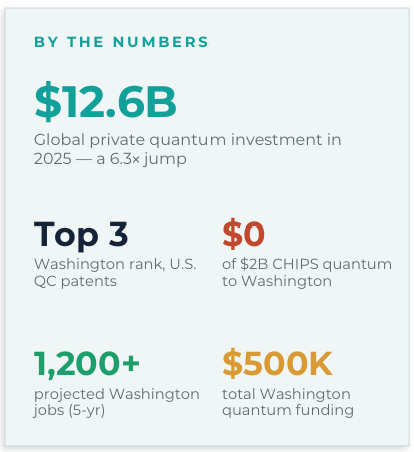
Chart from “Quantum Technology in Washington State.”
Washington state has assembled the country’s deepest bench of quantum technology assets — including two major cloud platforms, a national lab and the first U.S. quantum computer factory — but has captured almost none of the federal money now driving the industry.
That disconnect is the focus of a report released Tuesday morning by the Washington Technology Industry Association, the Northwest Quantum Nexus and the state Department of Commerce.
Since a January 2023 assessment, Washington state’s quantum ecosystem “has grown denser, more visible, and physically larger,” reads the report, authored by Nirav S. Desai, CEO of innovation consultancy Moonbeam Exchange. “Yet the state has fallen behind peers on the coordinated public investment that converts assets into a resilient cluster.”
The report makes five recommendations:
Use the governor’s office to convene a standing group — universities, the Pacific Northwest National Laboratory, companies, investors and the Commerce Department — that decides which federal grants to pursue and assembles joint bids for funding.
Pick one to three specialties to compete in, such as post-quantum cryptography or industry applications, rather than chasing all of quantum.
Build the workforce at all three levels: developers first, then the missing undergraduate and technician programs.
Position the Seattle region and Washington state as a landing pad for Japanese, Korean and Taiwanese quantum companies.
Create a single point of contact for founders, and promote the quantum machine access the state already has but hasn’t advertised.
“This isn’t a resource problem; it’s a coordination problem, and that’s the good news,” said Nick Ellingson, WTIA’s vice president of innovation and entrepreneurship, in a news release.
Quantum computers, which have yet to be proven commercially viable, can hold multiple states at once and could eventually solve problems beyond the reach of conventional machines.
The report points to efforts by states including Illinois, Maryland and Colorado, which have committed $500 million, roughly $200 million and $127 million respectively to quantum campuses and research hubs.
In Washington state, Microsoft and Amazon are among the major tech companies leveraging their research to build quantum platforms and technology. Maryland-based IonQ’s Bothell, Wash., plant, the country’s first dedicated quantum computer factory, employs about 100 people, part of an expansion the report says could generate 1,200 to 2,000 jobs within five years.
Gov. Bob Ferguson vetoed $100,000 for a state quantum strategy in May 2025, citing fiscal pressure, while directing the Commerce Department to build industry partnerships and produce policy recommendations. Tuesday’s report was funded by a grant administered by Commerce.
In April, Ferguson steered $500,000 from the state’s Strategic Reserve Fund to IonQ’s Bothell expansion, Washington’s first direct investment in quantum.
Illinois, by comparison, has committed more than $500 million to the Illinois Quantum and Microelectronics Park, a campus near Chicago anchored by PsiQuantum and IBM.
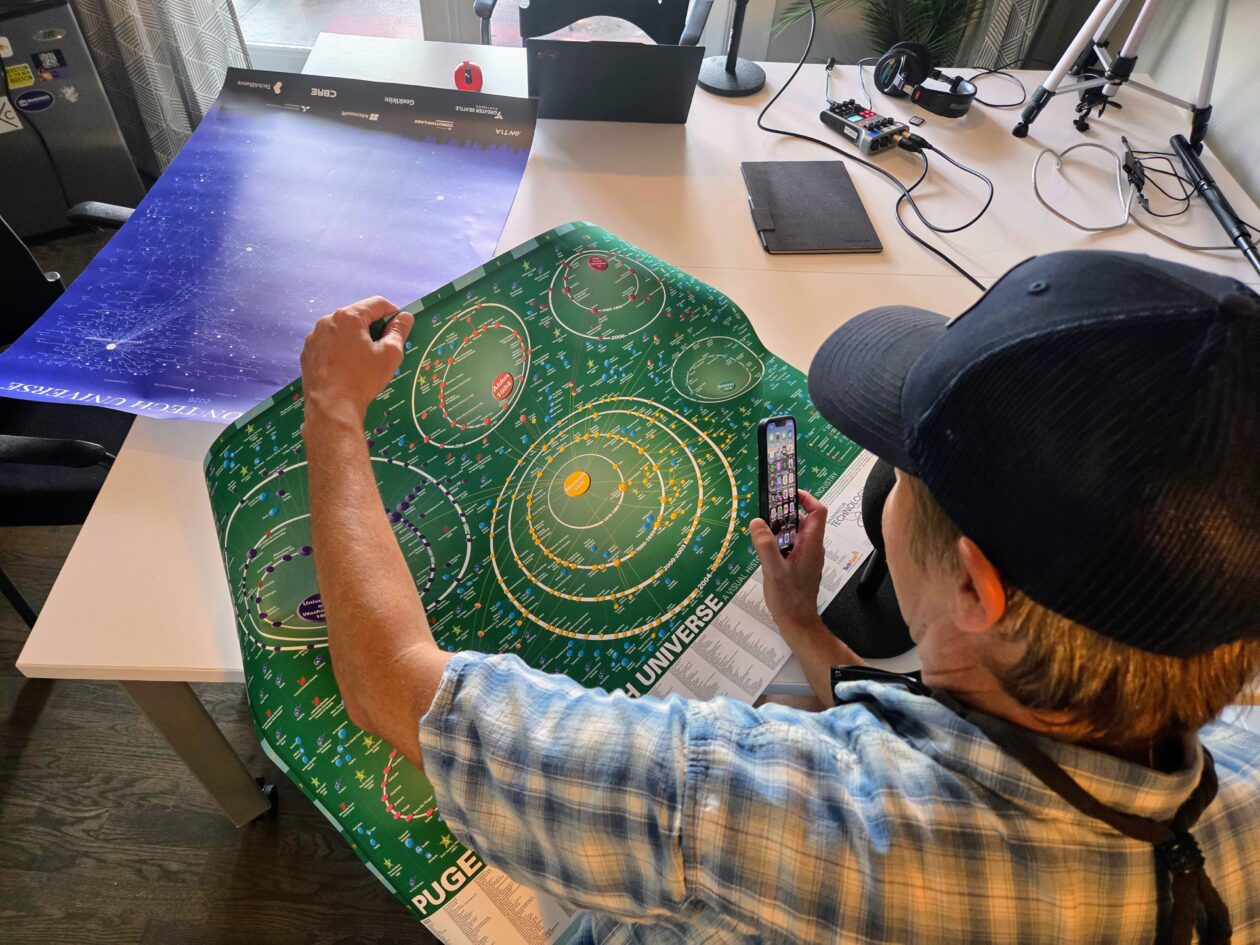
John Cook studies the 2009 Puget Sound Tech Universe map while recording this week’s GeekWire Podcast, with WTIA’s 2026 Washington Tech Universe map on the table behind him. (GeekWire Photo / Todd Bishop)
This week on the GeekWire podcast: SpaceX reports its first quarter as a public company, and Elon Musk says Starlink could deliver a majority of the world’s internet within a decade, leveraging production facilities in Redmond. Musk also explains the company’s data center ambitions, calling terrestrial infrastructure a trivial problem next to reusable rockets.
Plus: we bring two Washington tech universe posters into the studio, 17 years apart. The 2009 original turns up gems including Boeing’s unlikely connection to Classmates.com, the 1990s forerunner to Facebook. It also brings back memories of Teledesic, the Craig McCaw venture backed by Bill Gates that tried to beam internet from space decades before Starlink.
Finally, the GeekWire Trivia Challenge returns with a timely question about Google’s origins.
How interconnected is Washington’s tech industry? Enough that a large share of the state’s companies can trace their lineage to Microsoft, the University of Washington, Amazon, and a handful of other institutions.
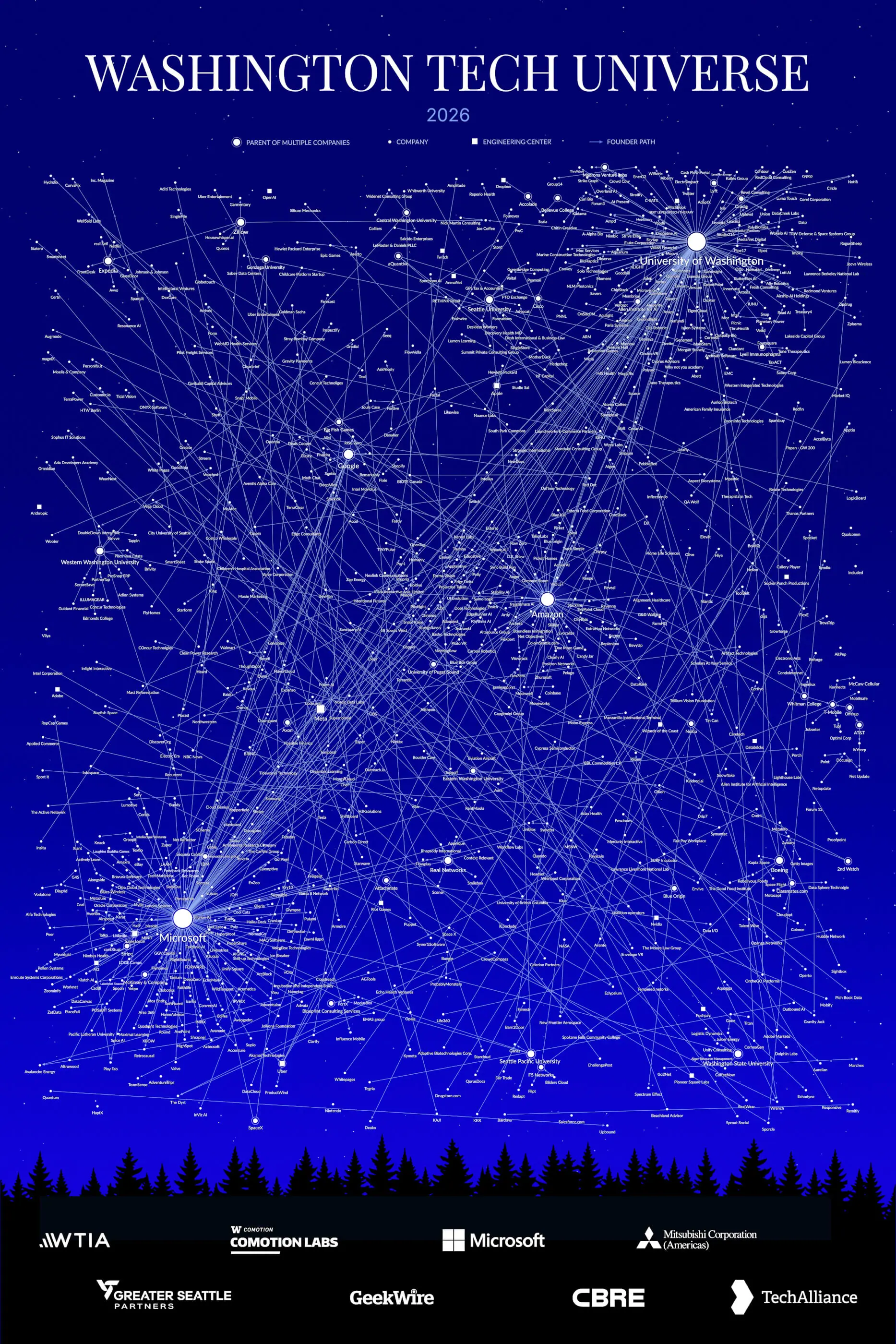
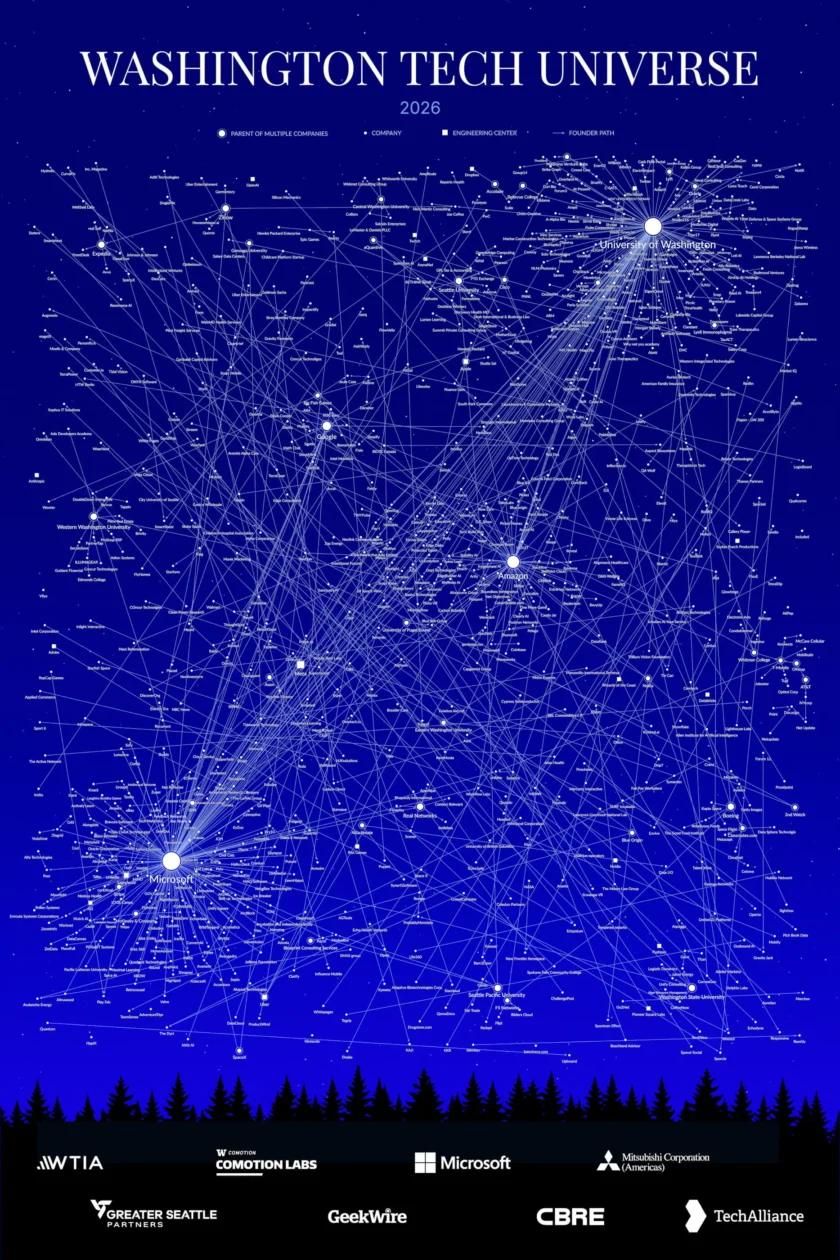
A new visualization from the Washington Technology Industry Association (WTIA), unveiled this week, charts those family trees. But the “Washington Tech Universe” map offers only a partial view: Washington is home to 25,000 tech companies, and just 625 are featured.
“This is not a ranker of all the best companies,” said Nick Ellingson, WTIA’s vice president of innovation and entrepreneurship, during a presentation at Seattle Tech Week. The point, he said, is to show the region’s connectivity and to make the case for investing in the community as a whole.
The “Tech Universe Map” comes 11 years after the trade group published a similar visualization. According to Ellingson, the update came because people kept asking for it, not because of a single event. It’s unrelated to WTIA’s efforts to help Washington establish a public AI narrative.
That said, the 2026 edition is markedly different from the one in 2015: The new map looks at the entire state, aiming to comprehensively chart the connections among different companies, while the prior version was limited to companies in Seattle, with a more narrow focus on acquisitions and similar data.
Microsoft and UW produce the most founders
WTIA’s data shows that today, Washington has four main founder “hubs,” with Microsoft being the largest. About a quarter of the mapped companies — 161 of 625 — have at least one founder who came out of Microsoft. UW is the second with 143 companies, followed by Amazon, which anchors 58 firms. Google rounds out the group with 20 connections, though it’s a pipeline that didn’t exist in WTIA’s 2015 map.
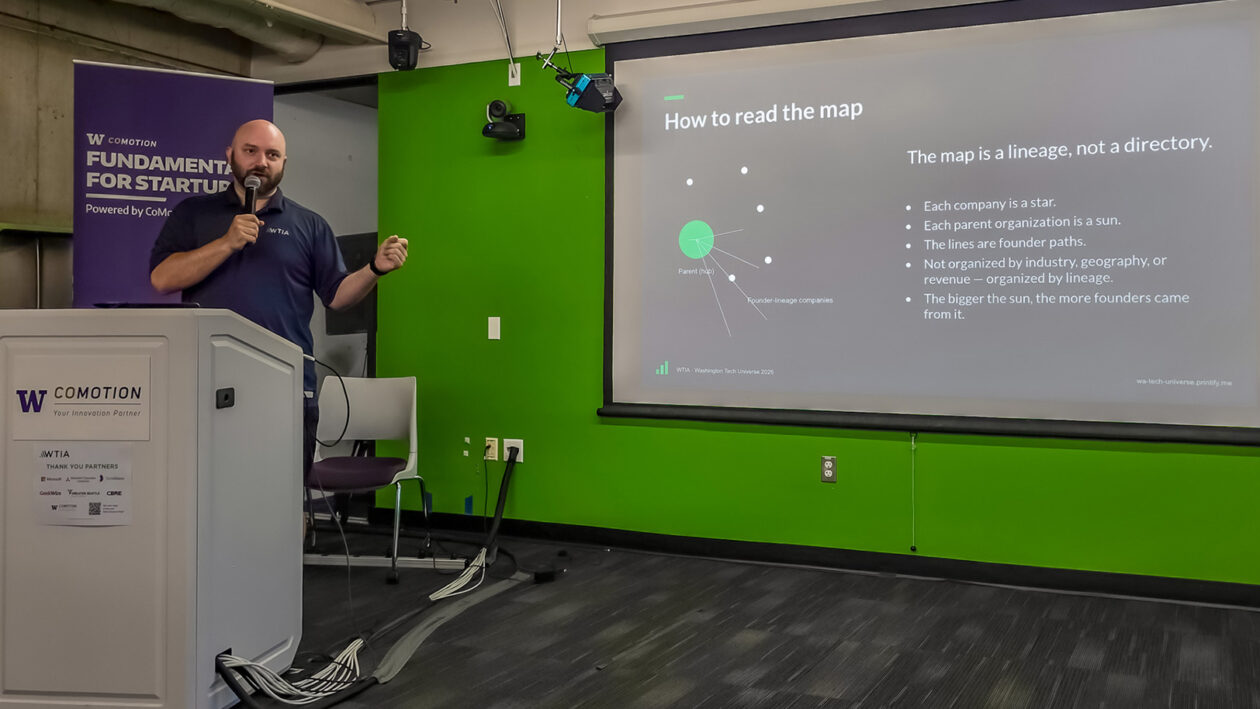
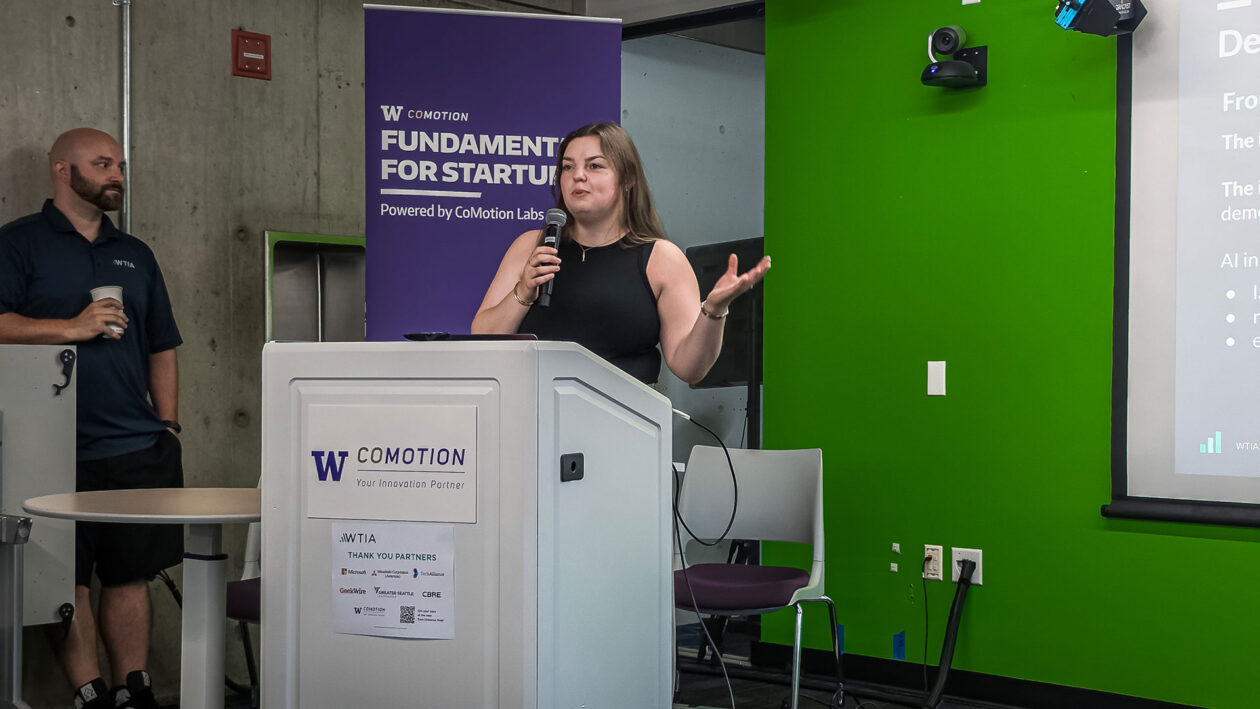
WTIA’s Vice President of Innovation and Entrepreneurship, Nick Ellingson, unveils the 2026 “Tech Universe Map” at the University of Washington’s Comotion Lab on July 27, 2026, explaining how to read the map. (Photo by Ken Yeung, click to enlarge)
UW isn’t the only school producing founders. WTIA’s map traces company lineages to Washington State, Western Washington, Central Washington, Eastern Washington, Whitman College, Seattle University, and Seattle Pacific. Still, UW accounts for 70% of the map’s university connections.
Broken down, the data shows that nearly two out of three companies (64%) grew out of another company listed on WTIA’s map. A third came out of a university, or out of a company that operates in Washington without being headquartered here.
Google is the clearest example of the latter since it’s based in California but has a significant presence here. Moreover, WTIA found that 44% of mapped companies had founders who previously worked at two or more Washington organizations before starting theirs.
Ellingson called the hubs “gravity wells that bend the entire region toward the next generation of founders” in the announcement.
However, he cautioned that this pipeline concentrated around four main sources could be a risk. Some of the hubs he expects to grow next, such as Google, OpenAI, Anthropic, and Nvidia, are headquartered elsewhere and maintain engineering centers here, a presence that is easier to scale back. Microsoft, Amazon, and UW aren’t going anywhere. The next generation of hubs has no such guarantee.
To mitigate this risk, Ellingson called for broad community support for these hubs, saying it would keep the flywheel going.
These companies, he said, “are growing not just the jobs at their companies, but they’re creating the next employers, venture-scale startups, and tech companies that go on to build amazing things, and hire the next generation of talent here and bring more talent to the area, who then go and create their own startups.”
The next hubs are forming around AI
WTIA also recognized AI’s impact on Washington’s tech ecosystem. Although the technology was not a formal selection criterion, it became evident that AI would be a dominant theme among the featured companies. In fact, firms like Read AI, Karat, Yoodli, Outreach, and Pictory appear on the map for the first time. And Ellingson revealed that “many of the startups on the map are AI startups.”
“Twenty-three percent of the AI talent in the United States is here in Seattle,” he said.
That, along with the burgeoning startup ecosystem, is why organizations like the Allen Institute for AI (Ai2) and AI House, are poised to have large constellations of their own. AI House was formerly the AI2 Incubator. It spun out as an independent entity in 2022 and rebranded in June.
WTIA noted that Ai2 is the first research lab on its map to operate as a “founder factory.”
Other AI companies making their presence known on the “Tech Universe Map” include OpenAI and Anthropic. While not Washington-native, both AI model makers have established or expanded their outposts in the state since 2015.
Ellingson predicted that, like Ai2, both would eventually become major hubs.
How companies were selected
UW alumni Jessica Forcucci explains her design process in creating WTIA’s 2026 “Tech Universe Map.” (Photo by Ken Yeung)
To create the “Tech Universe Map,” WTIA started out with a dataset of 3,500 Washington-based tech companies with at least $1 million in funding or revenue according to PitchBook.
The group was filtered further to those that were headquartered or had notable engineering centers in the state, were still active, and had “meaningful” Washington-grown connections through founder or university lineage. The GeekWire 200 was also used in the process.
WTIA enlisted the help of UW graduate Jessica Forcucci and a team of designers to create the visualization. In brief remarks, Forcucci explained her vision for the “Tech Universe Map,” saying the goal was to “demonstrate the interconnectivity” these companies had with each other.
Predicting what the next map will look like
As Washington’s tech ecosystem evolves, Ellingson predicted there will not only be bigger constellations of AI companies, but also quantum, fusion and advanced energy, and space and defense. He believed more tech clusters will blossom statewide beyond King County.
Ellingson said WTIA is seeing real growth in Wenatchee, the Tri-Cities and Spokane. Those regional clusters are small now, he said, but he expects them to be substantial by 2031.
To make the next map happen, Ellingson urged people to open doors for others, make introductions without expecting anything in return, and give first, building community and forming new constellations.

 Login
Login