❌

Reading view

There are new articles available, click to refresh the page.

A16z Frontier Broadens The Pitch For Crypto As Investors Look Across Technologies

Andreessen Horowitz is expanding its crypto team’s investment brief. Chris Dixon’s October 22 announcement renames a16z Crypto as a16z Frontier, with the new fund able to pursue a wider range of emerging technologies while continuing crypto investment.

TL;DR
  • A broader mandate changes the set of businesses considered for funding.
  • Using a blockchain does not determine a company’s customers or revenue model.
  • Commercial demand remains the test for products combining AI and crypto.

The business model becomes more useful than the sector label

The announcement is a change in investment scope. It does not establish how much of future spending will reach any particular technology.

For a founder, the practical question is which problem a prospective investor understands. A payments company using stablecoins may need distribution, banking access and regulatory expertise. A data marketplace may need rights management and reliable buyers. Calling both crypto companies does little to identify the skills that will make either successful.

That difference is already visible in products available today. Circle’s institutional funding documentation deals with reserved balances, settlement and withdrawal routes. These are treasury operations, even though USDC is involved throughout the process.

Similarly, USD.AI distinguishes a governance instrument from the instrument receiving lending income. A project can use tokens at several layers while its underlying commercial task remains financing computing equipment.

The distinction helps explain the variety in BitGo’s move into consumer applications. Infrastructure expertise may support a new product, but it does not eliminate the separate work of attracting users and keeping them engaged.

Combining AI and crypto still needs a paying customer

A broader investment mandate can accommodate companies whose activity does not fit an existing sector neatly. That is useful when a product relies on several technologies at once. It also makes comparison more demanding: a hardware business, a financial intermediary and a software service cannot be evaluated with the same measures.

For a hypothetical AI service purchasing data automatically, blockchain payments might solve a transaction problem. They would not settle whether the purchased data improves the service, whether its use is licensed or whether customers will pay enough to cover the cost.

Those remaining questions determine the business. Faster settlement can improve working capital without creating demand. Automated spending can remove a manual task while also making spending limits and authorization more important.

Payment-fraud screening is one example of the controls that have to accompany easier transfers. And actual payment usage offers more evidence of utility than attaching a new label to a balance sheet.

The rebranding creates room for more kinds of company to enter the investment conversation. Its eventual significance for crypto will depend on the businesses funded, the products they deliver and whether users need the blockchain functions those products contain.

Written by the News Desk and edited by Samuel Rae.

Satellite radar tech startup Kapta Space raises $24M from Bill Gates-backed fund and defense investors

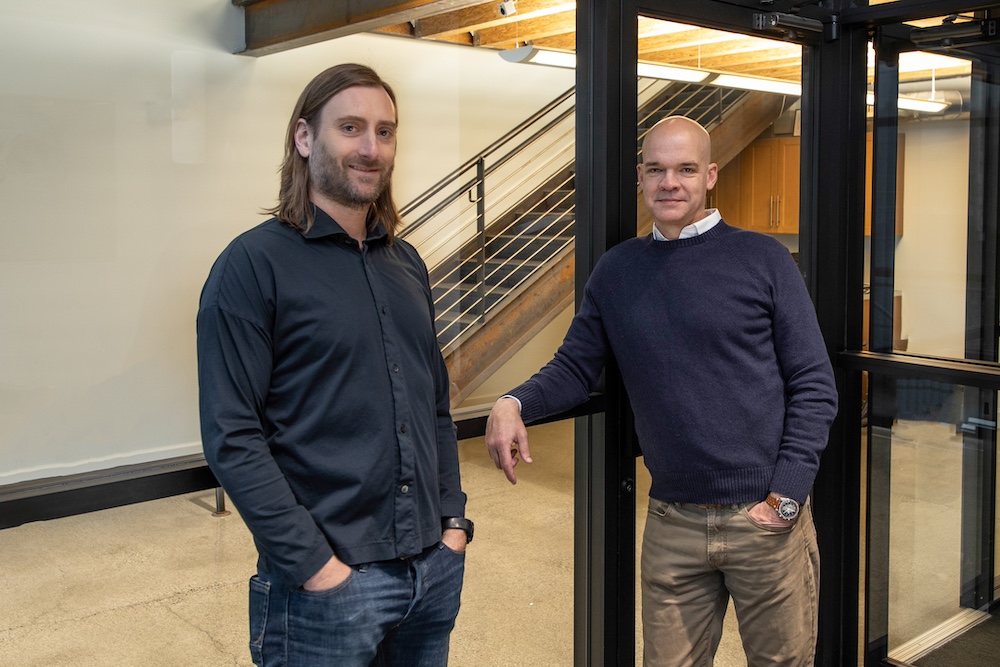
Kapta Space co-founders Adam Bily (left) and Milton Perque. (Kapta Photo)

Kapta Space, a Seattle startup building lower-cost, steerable radar sensors for satellites, has raised $24 million in a Series A funding round to scale production and meet growing demand for defense intelligence contracts.

The investment brings total funding to $30 million, following an initial $5 million seed round led by MetaVC— a metamaterials-focused fund backed by Microsoft co-founder Bill Gates and former Microsoft executive Nathan Myhrvold. It also previously received a $1.8 million grant from the Department of Defense.

The deal highlights the ongoing momentum in the Pacific Northwest’s commercial space ecosystem, where a growing cluster of venture-backed startups is building hardware alongside major satellite operations like SpaceX’s Starlink facility in Redmond and Amazon’s Leo constellation program.

Founded in 2023 by CEO Milton Perque and Adam Bily, Kapta uses metamaterials for its proprietary Metamaterial Electronically Scanned Array (MESA) architecture. The tech provides high-resolution, geospatial imagery and ground-target tracking without the extreme cost, power demands, and manufacturing complexity of traditional systems.

Both founders bring deep local expertise to the hardware: Perque and Bily were previously engineering leaders at radar maker Echodyne. Perque’s background also includes stops at Metacept and Intellectual Ventures, while Bily served as an antenna engineer at Apple and satellite startup Astranis.

The fresh capital will help Kapta expand manufacturing, qualify its hardware for spaceflight, and prepare for initial orbital demonstration missions.

Kapta’s software-defined architecture aims to make persistent satellite tracking feasible at constellation scale, letting spacecraft rapidly steer beams to continuously detect and hold custody of moving targets across air, sea and land.

“The mission calls for persistent awareness, and that requires us to rethink how radar has to work at constellation scale,” said Milton Perque, Founder and CEO of Kapta Space, in a release. “Traditional architectures are cost-prohibitive and were never designed for the scale these missions now demand.”

Washington Harbour Partners, which specializes in defense tech investing, led the round, with Bison Ventures co-leading. Previous backer MetaVC Partners joined alongside MYDA Capital, Entrada Ventures, Aurelia Foundry, and Fitz Gate Ventures.

“Kapta’s MESA architecture changes that equation with a modular, highly manufacturable approach to electronically steerable radar,” said Mina Faltas, Founder and CEO of Washington Harbour Partners. “We believe its combination of performance, cost, and scalability will make Kapta a foundational supplier to the next generation of U.S. and allied space architectures, and we’re thrilled to lead the Series A.”

Rocket fuel: Seattle-area startups raise a record $3.5B as national VC funding cools

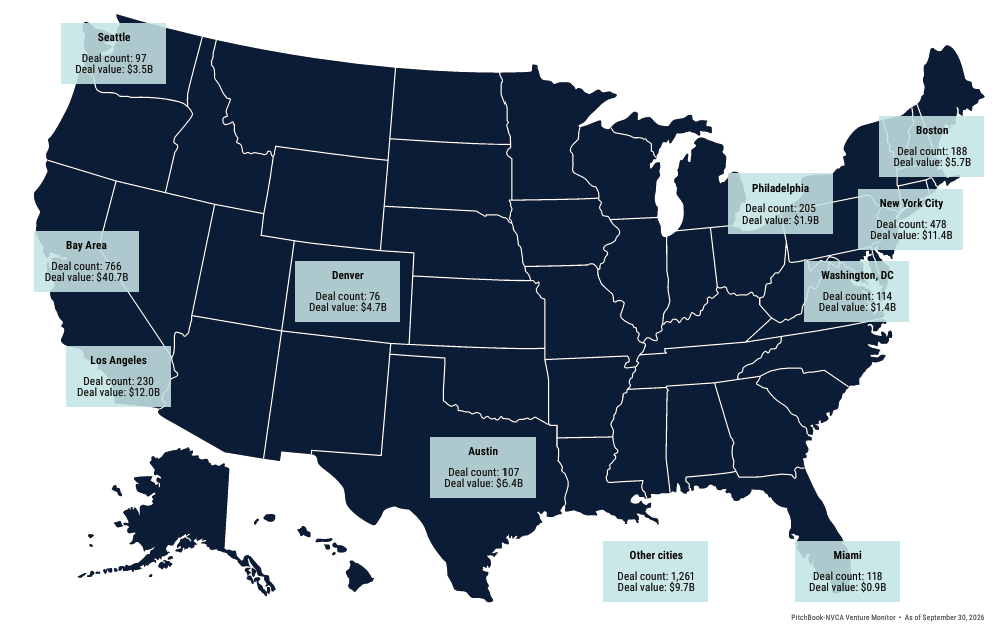
Q3 2026 VC deal activity by U.S. metro area. Note: PitchBook’s map uses broader regional boundaries than the metro-area figures in this story (PitchBook-NVCA Graphic, click to enlarge.)

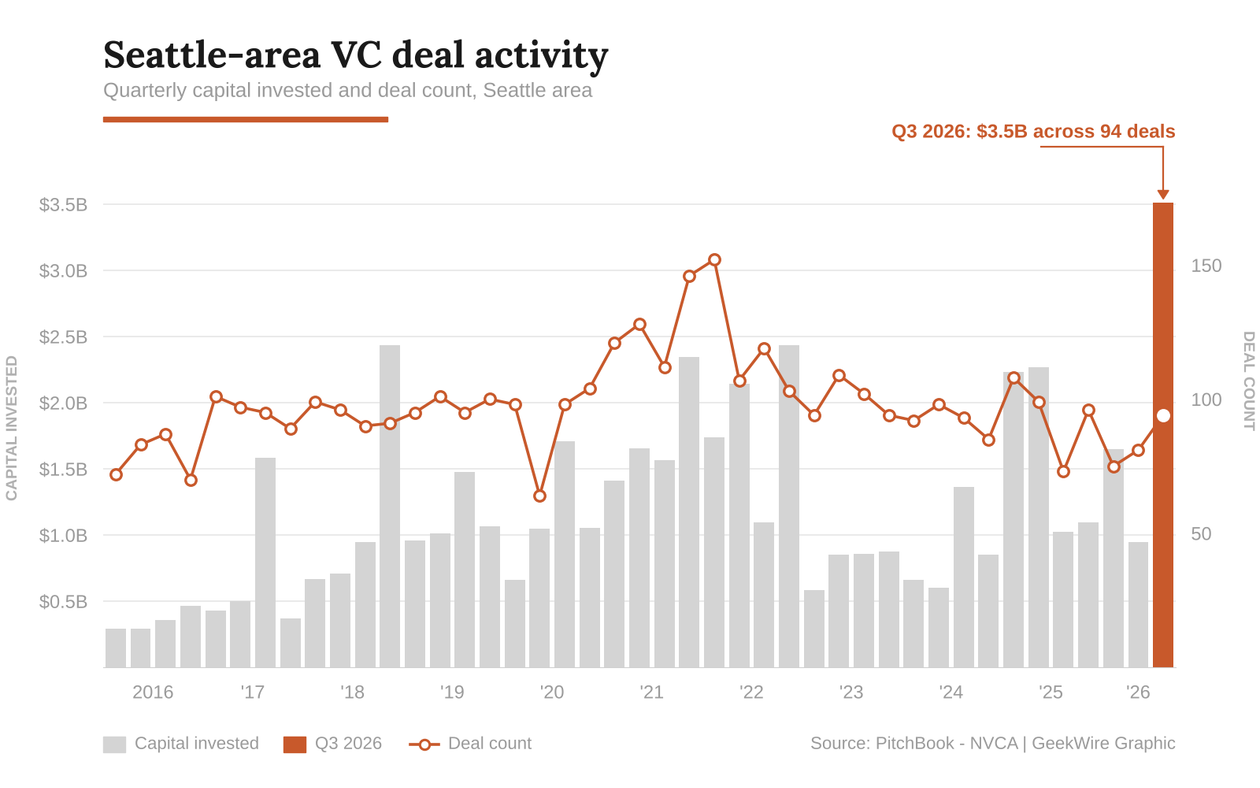
Seattle-area startups raised $3.5 billion in venture capital in the third quarter, the most in any quarter going back at least a decade, led by big rounds for Kent-based rocket maker Stoke Space, Bellevue developer platform Temporal and Everett fusion company Helion.

That’s more than triple the $1 billion raised in the region in the same quarter a year earlier, according to the PitchBook-NVCA Venture Monitor. It’s also more than $1 billion above the previous quarterly high of about $2.4 billion, reached in late 2018 and again in late 2022.

Most of the money went to a handful of companies building physical things: rockets, satellites, spacecraft and fusion power plants. Three space companies in the region raised $1.6 billion combined: Stoke, Redmond-based Starcloud and Seattle’s Hubble Network.

Nationally, the trend went the other way. U.S. venture funding fell 40% from the prior quarter, to $98.4 billion, as the giant rounds for frontier AI labs that drove the first half of the year tapered off.

Seattle ranked seventh among U.S. metro areas for venture dollars in the quarter. The Bay Area led with $40.7 billion, followed by Los Angeles, New York, Austin, Boston and Denver. Denver’s $4.2 billion came largely from a single $3.9 billion round for AI data center developer Crusoe.

By number of deals, Seattle ranked eighth, with 94.

The total includes Helion’s $500 million round, which the company announced in June but PitchBook counts in the third quarter. Even without it, the quarter would still be the region’s biggest on record.

Fast-growing AI startup Nscale doubles Bellevue office footprint to 46K square feet

AI infrastructure startup Nscale is doubling down on its new Seattle-area presence before even opening the doors.

After initially leasing a single floor at The Eight tower in downtown Bellevue earlier this year, the London-based company has expanded by an additional floor, bringing its total footprint in the new development to approximately 46,000 rentable square feet, according to a report from The Broderick Group.

The expansion signals an aggressive ramp-up for Nscale’s primary U.S. engineering hub, slated to open in January 2027. While the initial 24,000-square-foot lease was pegged to accommodate up to 250 employees, the added space gives the fast-growing cloud provider room to scale its local team even further beyond its current 50 Seattle-area workers.

Founded in 2024, Nscale is riding a massive wave of capital and growth.

It raised a $2 billion Series C round at a $14.6 billion valuation earlier this year, backed by Nvidia, Dell, Citadel, Jane Street, and Point72, alongside a $900 million credit line.

The company also earlier this year hired Nidhi Chappell, the former Microsoft corporate vice president who led Azure AI and high-performance computing infrastructure, including the supercomputers that power ChatGPT. As Nscale’s new president of AI infrastructure, based in the Seattle area, Chappell will oversee the company’s global engineering and data center operations.

“I’ve had a front-row seat to some of the biggest moments in AI over the past several years, but one thing has always stood out: the world remembers the breakthroughs, but it’s the people building the infrastructure behind the scenes who make them possible,” Chappell wrote in a LinkedIn post earlier this year announcing the company’s first “onboarding” event in Seattle.

Nscale’s new office is set to open in January, with the second floor slated to open in June, reports The Puget Sound Business Journal.

The company’s growth underscores Bellevue’s growing magnetism for out-of-town AI players. The company joins a dense ecosystem of AI infrastructure and application hubs establishing outposts on the Eastside, including xAI, OpenAI, Databricks, CoreWeave, Armada, and Anduril.

SoFi Co-Founder Mike Cagney Raises $19 Million For New On-Chain Finance Startup

TL;DR: Navra, the latest company led by SoFi and Figure co-founder Mike Cagney, has raised $19 million in Series A funding. The startup is building an interface intended to make on-chain lending, yield products and securities markets easier for traditional investors and institutions to access.

Mike Cagney is building another bridge between conventional finance and blockchains.

Navra, the newest startup led by the SoFi and Figure co-founder, has raised $19 million in an oversubscribed Series A round led by Ribbit.

Baseline and DCM also participated alongside strategic investors including Jump Crypto and Figure Technology Solutions.

The capital will support a platform designed to make blockchain-based financial markets easier to use without requiring customers to interact with the underlying infrastructure in the way experienced DeFi users normally would.

Navra plans to provide access to multiple blockchain venues through a single desktop and mobile interface.

The product is expected to include on-chain yield opportunities and cash rails alongside a self-custody model that avoids conventional seed phrases and private-key management for the end user.

That combination reveals the market Navra is targeting.

The problem for institutional adoption is no longer simply that blockchains lack financial products.

They increasingly contain lending markets, tokenized securities, stablecoins and yield strategies.

The bigger problem is that accessing those markets can still require wallets, bridges, transaction signing and operational processes that feel alien to a conventional investor.

Navra wants to hide much of that complexity.

Cagney has already spent years working on the intersection between blockchain and traditional finance through Figure and Provenance.

His involvement therefore gives Navra a different profile from a typical early-stage DeFi startup.

The company is not trying to convince financial institutions that blockchains can host credit or securities.

It is trying to make the existing on-chain markets easier for those institutions to reach.

That is also why investors such as Ribbit and Jump Crypto are notable participants.

One comes from the fintech world, while the other has deep roots in digital-asset markets.

Navra sits somewhere between the two.

The $19 million round is modest compared with the largest crypto fundraises of previous cycles, but that may fit the current stage of the market.

The industry has moved away from funding blockchains simply because they are blockchains.

Increasingly, the investment case has to explain who will actually use them.

Navra’s answer is traditional finance.

Its job now is making on-chain finance feel traditional enough that those users actually come.

AI founders for hire: Startup hub Foundations launches service to connect businesses with builders

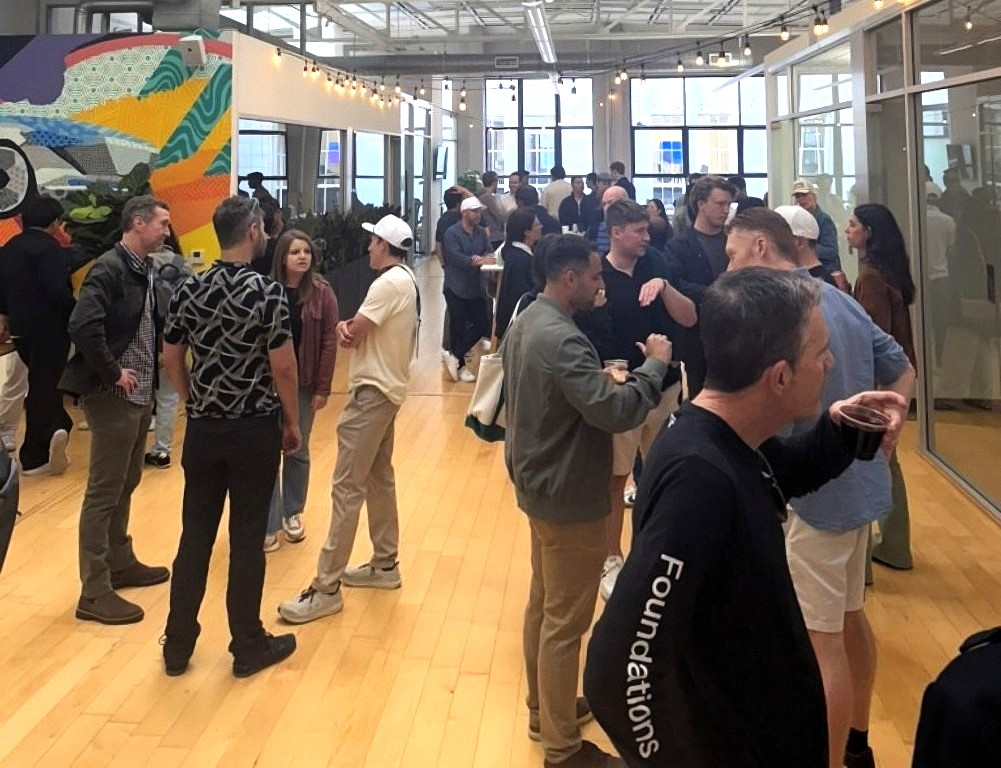
Founders and guests mingle at the opening of Foundations’ San Francisco hub earlier this year. (Foundations Photo)

Foundations, the startup community with hubs in Seattle and San Francisco, launched a service Tuesday that lets businesses contract with its members — many of them technical founders building companies of their own — to plan, develop and implement AI systems and applications.

The service, called Foundations Design and Engineering, is designed in part to give those founders a new way to pay their bills as early-stage investment gets harder to raise. It also reflects how AI is changing tech, making software easier to build and leading some startups to act more like services firms, customizing their work for individual customers.

“I think the world of traditional consulting and startups is just absolutely going to merge,” said Aviel Ginzburg, the Seattle venture capitalist who co-founded Foundations in 2024.

Except, in the case of Foundations Design and Engineering, the consulting won’t have the trappings of the traditional kind, he said. There is no staff of consultants and no billing by the hour. Work is priced by the project.

The pitch on the website: “Not consultants studying AI. Builders using it every day.”

The idea, he said, is to create something that “acts more like a router.” A request from a business might go to a member company already building a product in that area, a founder who knows the customer’s industry, or an early-stage founder looking for paid work.

Ginzburg said the work could have another benefit, giving founders a close look at the problems businesses are trying to solve, which can help them decide what to build.

The initials, FDE, are a play on “forward deployed engineer,” the term for engineers who embed with a customer to get technology working inside its business. Palantir popularized the role, and companies including OpenAI, Anthropic, Microsoft and Amazon have adopted it.

Some of the details have yet to be determined. For example, Foundations is still working out how much of each contract it will keep. Ginzburg said it will vary case by case, from nothing to a double-digit percentage. Also unsettled is whether a business will sign its contract with Foundations or directly with the founder doing the work.

Prices aren’t set. In terms of a starting point, Ginzburg said founders in the community have charged $1,000 to $2,000 to spend a couple of hours with a company’s team and as much as $5,000 for an audit of how a business could use AI, with larger projects varying widely.

Foundations Design and Engineering has its roots in a group of 10 founders who were already doing consulting work and helped put the offering together. Foundations opened the service to the rest of its members Tuesday morning. A veteran Seattle startup founder will run FTE part time at first. (Ginzburg said he wasn’t ready to announce who the person is.)

Foundations counts more than 300 founders in its community, including about 30 in its founder-in-residence program. It is a public benefit corporation, a legal structure for companies that aim to turn a profit while also serving a public purpose.

It doesn’t take equity in the startups that go through the residency program, and Ginzburg said the new service is meant to bring in revenue without pulling the organization away from its mission of making founders successful.

“This is a startup,” he said. “We’ll see how it goes, but it’s going to be fun.”

‘Seattle’s answer to YC Demo Day’: 25 startups pitch investors from across the country at AI House

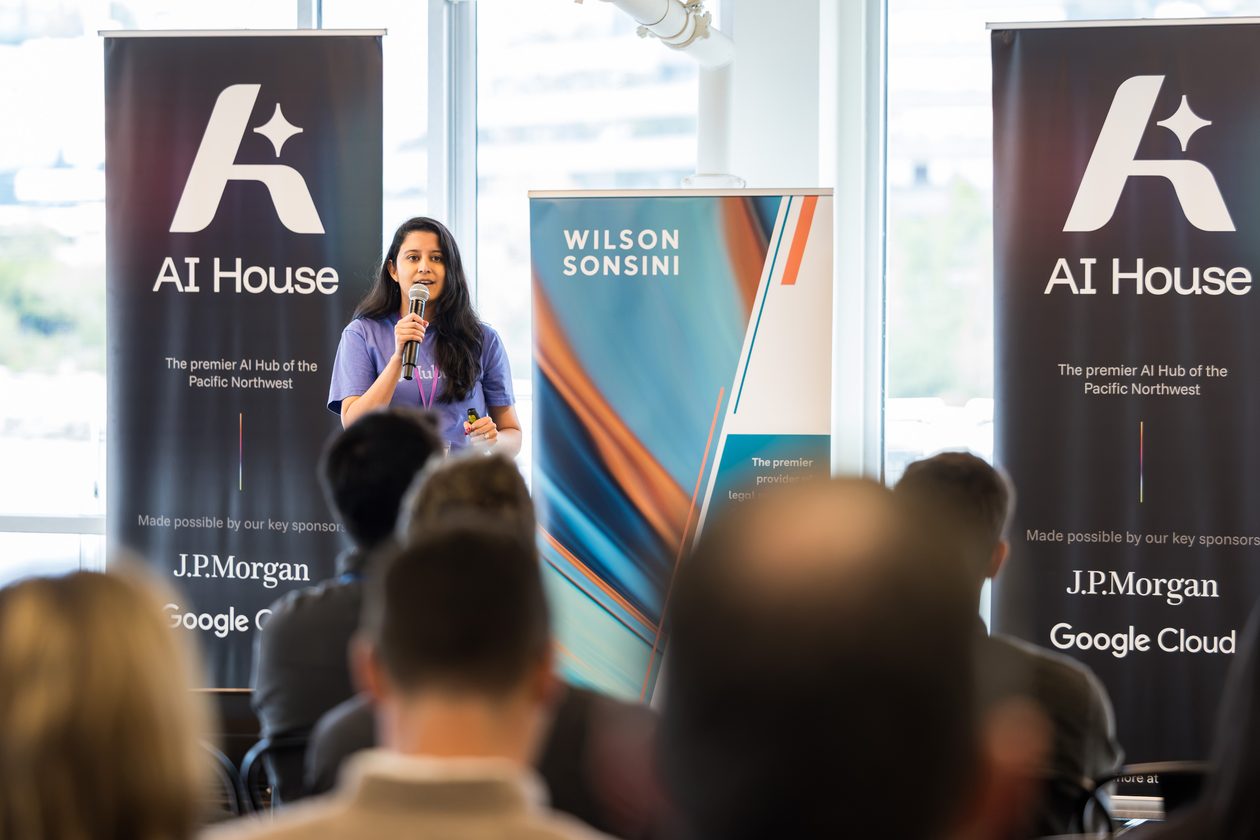
Prabha Dublish, CEO of Hubble, lays out the startup’s vision to become the “Plaid for medical records” at AI House Demo Day on Wednesday. (Photo by Dan DeLong for AI House)

AI House brought investors from as far as Boston, New York, Colorado and the Bay Area to Seattle this week for something the city’s startup scene has rarely tried: a demo day meant to help bring outside money to local founders.

Twenty-five early-stage startups pitched at the event, held Wednesday at the startup incubator and venture capital fund’s offices on Pier 70. Many of them weren’t part of AI House’s own portfolio, and that was by design, said Yifan Zhang, an AI House managing director, who came up with the idea for the event.

“We all complained about not having enough capital here, but no one was doing anything about it,” Zhang said. So AI House tapped its own connections to investors in other parts of the country, she said, and “people flew in from all over for this.”

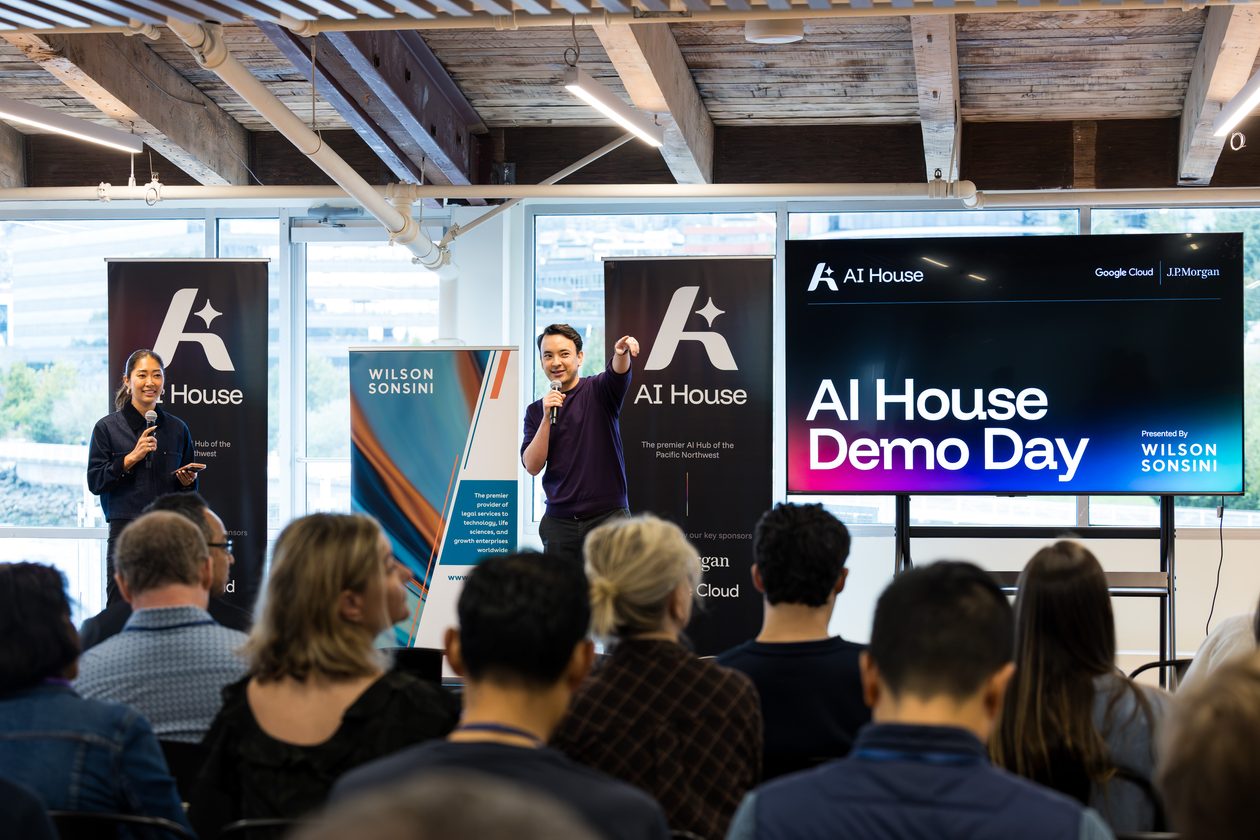
Kicking off the day: Audrey Yun, AI House events and community manager, and Taylor Soper, the organization’s director of community and programming, former GeekWire editor and reporter. (Photo by Dan DeLong for AI House)

Investors in attendance included Mike Vernal, a partner at San Francisco-based Conviction; Emily Melton, founder and managing partner of Threshold Ventures; and Rob Go, co-founder of Boston-based NextView Ventures. Many well-known Seattle-based venture capitalists also attended the event.

Zhang said she wanted the lineup to show multiple sides of Seattle: startups built around real problems and revenue, and technologists doing “crazy ambitious things.”

Theo Ellis, CEO of Seattle mortgage-tech startup Friday Harbor, called it “Seattle’s answer to YC Demo Day,” a reference to Y Combinator’s showcase in the Bay Area.

Many of the city’s startups are “not necessarily in the flashiest spaces,” he said, but they have real customers and are growing fast. For his part, Ellis said, mortgage lending technology is “not exactly nuclear-powered robots landing on Jupiter, but it’s an enormous market with a lot of businesses willing to pay for it.”

Ellis told the crowd during his pitch that Friday Harbor underwrote 0.6% of all U.S. residential mortgage applications in August, and that the company is starting to raise its Series A round.

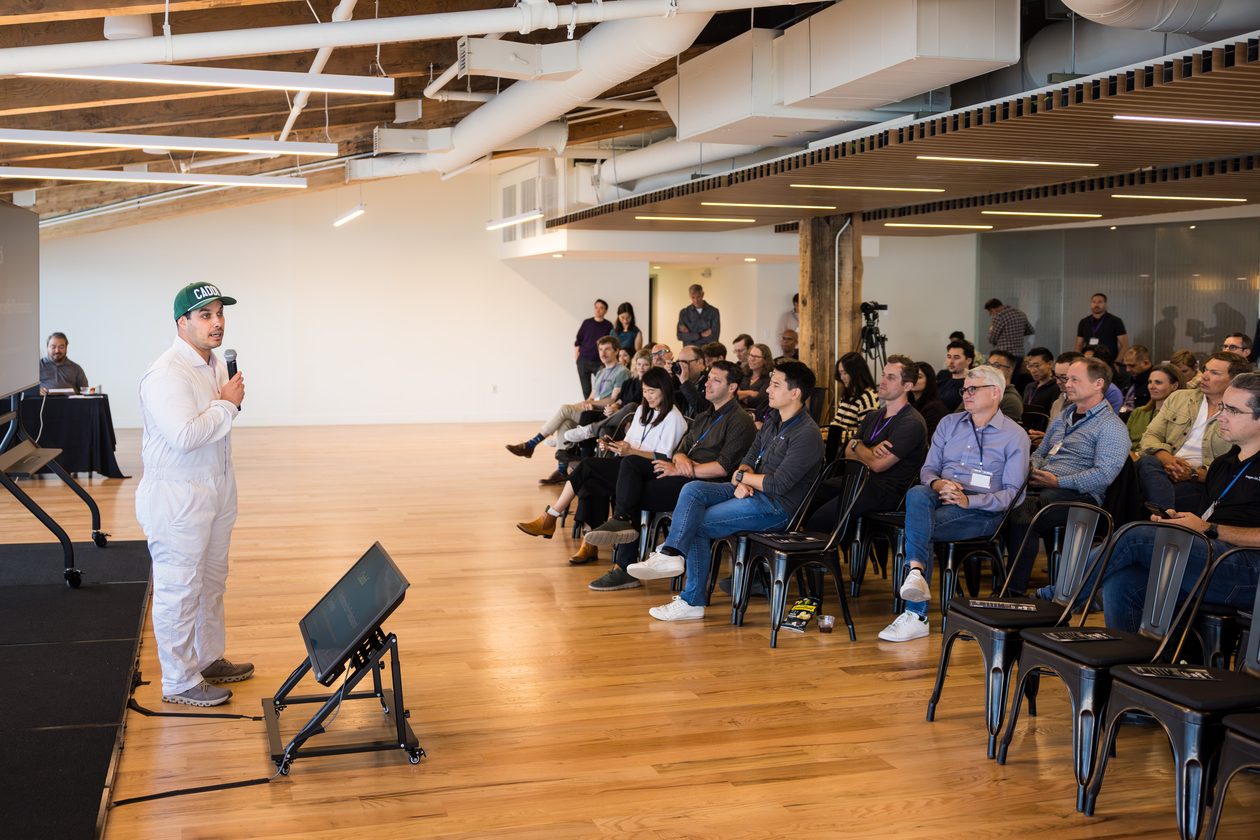
“We’re not a golf company, so relax,” Caddi co-founder and CEO Alejandro Castellano told the crowd at the start of his pitch. The startup builds AI agents to automate back-office work at professional services firms. (Photo by Dan DeLong for AI House)

Many of the companies that pitched have been covered by GeekWire. In addition to Friday Harbor, they included Optimly, Vantari, Jinn Labs, GateIn, Casium, Orbital Robotics, Viata, Ridge AI, Caddi, Lev, Aria (formerly Alpyne Labs) and Synthesize Bio.

Others were new to us, at least in their current incarnations:

  • Moria, co-founded by Chris Mutzel and Jimmy Voorhis, uses AI to produce technical studies for mining companies. Voorhis said one customer expanded a $100,000 contract to $900,000 in two months.
  • Hubble, a Y Combinator Summer 2026 company co-founded by CEO Prabha Dublish and CTO Aaron Leon, is building an API to retrieve patients’ medical records.
  • Atlas, co-founded by CEO Chandra Bhagavatula, a former Ai2 researcher, and Martín Ramírez, is developing AI to run much of a company’s day-to-day operations.
  • Reflection Robotics, led by co-founder and CEO Arsalan Mousavian, a former Nvidia robotics research manager, is building AI models that let factory robots learn precise tasks from a single demonstration.
  • Eidol, an AI House portfolio company based in Los Angeles, makes software that listens to a live singer and keeps pre-recorded vocal tracks in sync with the performance. Founder and CEO Clayton Janes pitched alongside the company’s chief artist officer, Letters to Cleo singer Kay Hanley.
  • Comment.io, co-founded by CEO Jon Gordner, a former Microsoft and Textio product leader, and CTO Max Winderbaum, a longtime Textio engineering leader, is building a tool for people to review and approve work produced by AI agents.
  • Axel, led by founder and CEO Stephen Grabowski, is an AI travel agent that says it finds flight and hotel deals below public prices. Grabowski said it has about $30 million in annualized travel bookings.
  • Suede, founded by Danielle Dantche, a former merchandising director at Seattle retailer Pipe and Row, automates product listings and purchase orders for independent boutiques. Dantche said it has processed $9.9 million in inventory over the past 90 days.
  • Ergoly, co-founded by AJ Gleser and Dan Moore, helps small service firms train and deploy AI workers for each of their clients.
  • Finch, founded by former Brightflow AI CEO Jeffrey Priebe, is building AI to plan and run in-person events that companies use to meet potential customers.

Closing the event, Jacob Colker, AI House co-founder and managing director, made his pitch to the out-of-town investors, building on the themes in his recent GeekWire guest column and a rallying cry he delivered during Seattle Tech Week in July.

The region is full of “space, science, tech, bio, health, startup builders,” he said, with far more good ideas than local investors can fund. “The reality is there’s just not enough capital in the Pacific Northwest.” That’s where the visitors come in, he said, predicting that they’ll find “great investment opportunities and great deals.”

Seattle, Colker said, “is worth your time, your investment, your focus, your energy.”

❌