The style and sound of older video games is unique enough that they’re still copied in relatively modern games like Undertale, Celeste, or Shovel Knight. There’s also a vibrant chiptune community making music on the older hardware directly. Often this involves hardware modding or otherwise finding chips from older gaming systems to replicate that unique retro gaming sound authentically. But disassembling older systems is not always necessary. Take a look at this Game Boy Advance synthesizer which uses the GBA hardware with no modifications at all.
The key to making this work is the GBA’s multiboot feature, which allowed these systems to send executable code over a link cable to other consoles which didn’t have cartridges. This meant that friends could play multiplayer games without each one needing their own cartridge, but it also means that nowadays people can send their own custom software directly to the console’s RAM without much extra effort. To run the synthesizer software, the GBA is connected to a computer, the software is started, and then when the GBA is powered on the snythesizer is automatically loaded into its RAM. The audio output is played over the headphone jack, and various controls are available on the computer and on the console.
In the video linked below, [Andy] is using the GBA with some other musical hardware and the sounds he’s getting from the unmodified console are impressive. It could certainly be a go-to for anyone interested in getting started in this style of music or who doesn’t want to do something like take apart an original Sega Genesis for the audio circuitry.
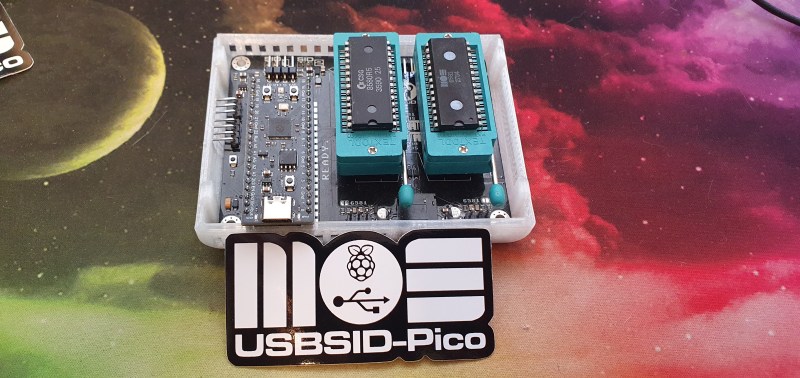
We’ll give you three guesses what the most important bits of silicon in [LouD]’s USBSID-Pico are, and two don’t count. Yes, there’s a Raspberry Pi Pico, and a pair of the unforgettable SID chips from MOS– the sound chip of the C64, the die that launched a thousand chiptunes. Well, unless you build it with a hardware SID replacement, but the goal of this device is to get SIDs hooked up to modern hardware.
To that end, USBSID-Pico can be controlled via USB– obviously– in the form of CDC/WebUSB/WebSerial but also MIDI, and even ASID, which is a specific protocol for streaming SID register data over MIDI. You might be wondering the point, since surely you can get cycle-accurate SID emulation on an RP2040, right? Well, not everyone agrees that cycle-accurate emulation is accurate enough; like the people who swear by the subtle distortions tube amplifiers introduce into the sound, some say the chip’s own inaccuracies give the sound out of the physical device a unique vibe emulators don’t match. That’s a fight for others to litigate; we just appreciate the work that went into getting these old sound chips talking to modern hardware, and getting the project certified as Open Source Hardware.
This combination of old sound and new microcontroller makes the USBSID-Pico a good entry for our ongoing retrocomputing contest, particularly the retro-modern category. Just be aware of PAL and NTSC differences with these old chips, or your beeps and boops might be out of tune. They haven’t made them in decades, but there are more than a few modern replacements for the MOS 6581.
Twin brothers Lucas and Lee Brown co-founded Seattle’s HasOffers in 2009 and rebranded to Tune in 2014. (Instagram / Geeks in the Woods)
Several years after leaving Seattle’s startup scene to build a “tech outpost” in the Alaskan wilderness, serial entrepreneurs and twin brothers Lee and Lucas Brown have set their sights on a new frontier: replacing the traditional newsroom with artificial intelligence.
The duo made their mark in Seattle with Tune, a marketing technology and mobile attribution platform originally founded in 2009 as HasOffers. In 2017, they migrated north to Valdez, Alaska, establishing “Geeks in the Woods” — a remote startup factory and technology outpost designed to incubate new digital ventures away from traditional tech centers.
Now they’re part of the leadership team behind Alaska News, a new platform that relies on AI agents — including a primary AI reporting persona named “Walter” — to ingest public meeting transcripts, filings, and notices to draft thousands of local news stories.
Walter — named in homage to famed television anchor Walter Cronkite — relies on AI products from multiple companies, including Anthropic, OpenAI, Google and xAI, to generate stories. The agent has written over 4,500 stories since its inception earlier this year, according to a profile and Q&A published Thursday by the Anchorage Press.
Walter works alongside human editor Cale Green, who provides oversight in a model the founders frame as a nonpartisan solution to Alaska’s dwindling local news coverage.
The founders maintain that their approach is strictly civic-minded.
“We don’t impose judgment on the things we’re reporting,” co-founder Lee Brown told the Anchorage Press. “We try to provide both sides.”
On its about page, the site argues it can be trusted because it replaces traditional institutional authority with complete operational transparency — explicitly linking every claim to searchable primary sources, clearly labeling AI content and its level of human editing, and operating on a reader-funded model without corporate or algorithmic incentives to push rage bait.
When questioned directly about its boundaries and operational limits, Walter offered a surprisingly clear self-assessment of its place in the newsroom.
“I’m not a person, and I should not be mistaken for one. I do not make phone calls, attend meetings or interview people directly,” Walter told Anchorage Press Executive Editor Nathaniel Herz in a Discord chat. “My lane is record-based reporting: public notices, government filings, meeting materials, transcripts, prior coverage and other documents that can be checked.”
When asked if it possessed a personality, Walter insisted it was purely a utility, though it conceded that “if I have a sense of humor, it’s strictly dry, record-based, and probably unintended.”
On Friday morning, stories on the site written by Walter included a report on a Fairbanks committee considering a rezone for 51 housing units, a federal task order awarded to an Idaho firm for snow removal at the Alcan border port, and a breakdown of state federal notices clearing 46 Alaska Native ancestors for return from museums.
Lucas and Lee Brown during their HasOffers days in Seattle. (GeekWire File Photo)
The Browns are no strangers to unconventional tech setups or building tools off the beaten path.
After bootstrapping HasOffers in its early years, growing Tune into an $80 million business with over 300 employees, and taking on venture funding from firms like Accel Partners, the twins deliberately stepped away from the traditional startup treadmill in late 2018.
They relocated permanently to Valdez — a town of less than 4,000 residents known more for backcountry skiing than software development — where they set up Geeks in the Woods. Framed as an incubator operating far from Seattle in “the quiet space between code and wilderness,” the project builds software and infrastructure for a world where AI agents act as “first-class participants.”
Alaska News is just one piece of that experiment; their Valdez outpost also touches patent discovery, election-integrity research, agent-focused identity infrastructure, and AI-assisted music.
The Browns are part of a five-person founding team behind Alaska News. Alongside editor-in-chief Green, the project’s masthead includes Matt Larkin, a longtime Alaska pollster and political operative, and Grant Robinson, a former television reporter who serves as a spokesperson for Alaska Gov. Mike Dunleavy.
“Lee and I love being entrepreneurs and taking things from 0-to-1, turning crazy ideas into legit business concepts that can grow and scale,” Lucas Brown told GeekWire in 2019.

 Login