❌

Reading view

There are new articles available, click to refresh the page.

Amazon earnings preview: AWS is booked up, and Wall Street wants to know what comes next

Amazon CEO Andy Jassy smiles while seated onstage in front of a red screen showing the Amazon logo.
Andy Jassy says Amazon “could invest a lot more” in AI infrastructure “and it wouldn’t be a bad use of capital.” (GeekWire File Photo / Todd Bishop)

Amazon reports third-quarter earnings Thursday afternoon with more demand for its cloud services than it can serve, driven by AI labs such as Anthropic and OpenAI along with growth in its traditional cloud business.

One big question for Wall Street going into the report is what Amazon might signal about next year’s spending as it tries to keep up with that demand.

CEO Andy Jassy said on an Andreessen Horowitz podcast last week that AWS capacity is largely booked for this year and next, along with “a good chunk of ’28.”

Amazon has said it expects to spend about $220 billion on capital expenditures this year, largely on AI and cloud infrastructure, up from its earlier plan of $200 billion. Even at that level, Jassy said, Amazon is “leaving a meaningful amount of demand on the table.”

Past spending pushed Amazon’s free cash flow to negative $7.6 billion for the 12 months ending in June, as the cost to add data centers, chips and other equipment exceeded the cash its operations brought in. Jassy gave no indication of slowing down, saying the company “could invest a lot more and it wouldn’t be a bad use of capital.”

Core numbers: Analysts expect revenue of about $202 billion, up 12% from a year ago, according to Yahoo Finance. That’s at the top of Amazon’s own forecast of $197 billion to $202 billion.

Analysts expect earnings of $1.96 per share, about the same as a year ago.

Amazon’s sales growth will likely look slower this time, about 12%, down from 20% last quarter. A big reason is timing. Prime Day, the company’s biggest sales event of the year, fell in the second quarter this year, rather than the third quarter as it did last year, so this quarter is up against a tougher comparison.

Amazon estimated in July that the shift would take nearly 4 percentage points off its growth rate this quarter. It hits online store sales hardest: analysts expect them to grow only about 3%, according to Zacks.

AWS: Amazon Web Services, the company’s cloud business, generates the majority of its operating profit. AWS revenue grew 37% to $42.2 billion in the second quarter, its fastest pace since 2021 and the fifth straight quarter of faster growth.

Analysts expect AWS revenue of about $45.4 billion this time, up 37.5%, according to Zacks. Wedbush is more optimistic, projecting growth of about 41%.

AWS had $496 billion in signed contracts it hadn’t yet delivered as of June, more than double the year before. That means its growth depends largely on how quickly Amazon can bring new data centers online.

“Capacity, not demand, is the constraint,” Yorkville Ives analyst Dan Ives wrote of the industry in a note Sunday.

Jassy said on the a16z podcast that running AI models is still “an order of magnitude too expensive” for businesses to use them widely, and that Amazon’s custom chips, including its Trainium AI processors, are a big piece of bringing that cost down. Amazon said in July that its chip business was on pace for more than $25 billion in annual revenue.

Anthropic stake: Amazon’s reported earnings could look very different. That’s because its profit fluctuates significantly depending on the value of its stake in Anthropic.

Last quarter, $53.4 billion in pre-tax gains, mostly on Anthropic, pushed Amazon’s earnings to $5.75 per share, against expectations of $1.82.

Anthropic filed paperwork Monday for a planned IPO on the Nasdaq. Amazon’s stake in the AI company was valued at about $190 billion as of June 30, according to Amazon’s latest quarterly filing. That includes about $92 billion in gains on convertible notes, a form of loan that turns into stock, which haven’t yet been counted in Amazon’s profit. Those notes would convert to Anthropic stock when it goes public.

Anthropic is also one of Amazon’s biggest cloud customers. Its IPO filing shows commitments to spend at least $110 billion on Amazon’s computing capacity into the 2030s, behind the $114.5 billion it committed to Google, as GeekWire reported Tuesday. Anthropic also said in the filing that it has asked its cloud providers for more computing power than they were willing to supply.

Shopping agents: Amazon blocked Meta’s new Muse AI agent from its store last month, escalating a fight over who controls the customer relationship when software does the buying. Amazon said Muse broke its rule requiring agents to identify themselves.

Agents that shop on a customer’s behalf could bypass Amazon’s advertising business, which depends on people browsing its pages. Ad revenue grew 26% to $19.8 billion last quarter, and analysts expect about $20.8 billion this time, up 18%, according to Zacks.

“Investor questions remain on agentic commerce risk, particularly to advertising, but we see limited risk,” Wedbush analyst Ygal Arounian wrote in an Oct. 16 note, citing Amazon’s logistics advantage and its role connecting shoppers with sellers.

Amazon is trying to give shoppers fewer reasons to look elsewhere. It now lists 250 million products sold on other retailers’ sites, about 2.5 times as many as in March, The Information reported Wednesday. On the seller side, Amazon opened its tools to outside AI agents in September, starting with Anthropic’s Claude.

Cloud rivals: Microsoft and Alphabet report quarterly results Wednesday afternoon, a day before Amazon. Microsoft’s report is its first under a new structure that breaks out Azure cloud revenue every quarter.

Check back with GeekWire on Thursday afternoon for coverage.
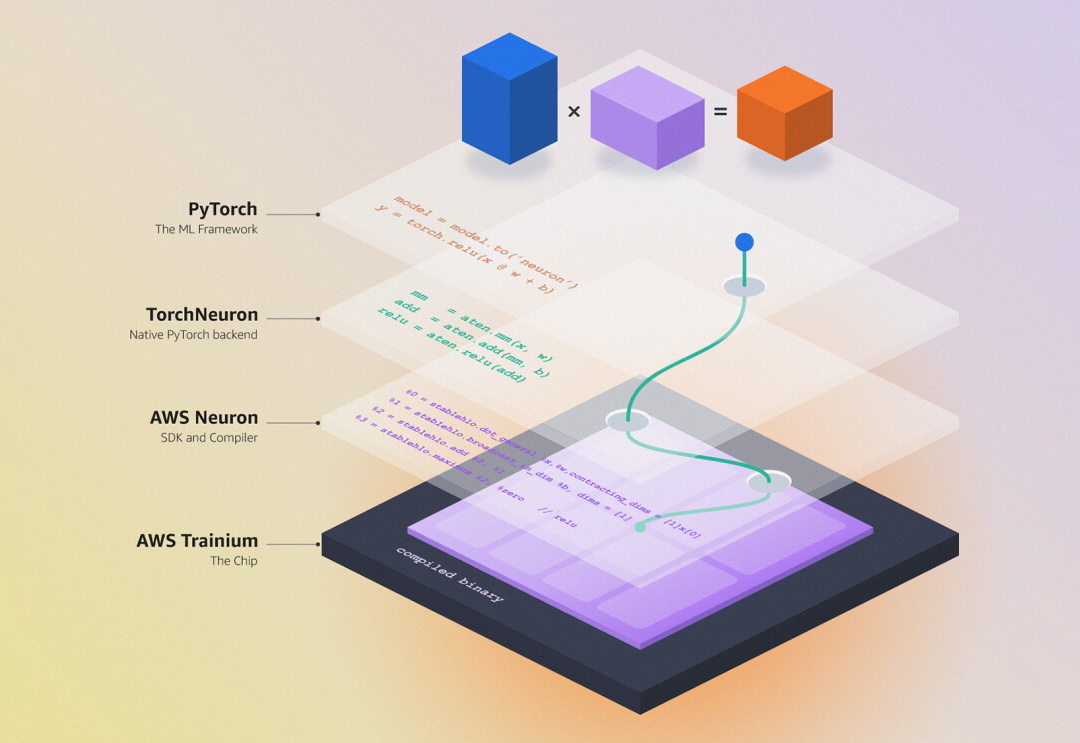
Amazon challenges Nvidia’s software advantage with new tool for its own AI chips

Diagram showing layers labeled PyTorch, TorchNeuron, AWS Neuron and AWS Trainium stacked above a chip
Amazon’s TorchNeuron sits between PyTorch and the company’s Trainium chips, supporting developers’ existing code. (Amazon Image)

A new software tool from Amazon aims to make switching from Nvidia to the company’s own AI chips about as simple as changing a setting.

The software, dubbed TorchNeuron, runs code written in PyTorch, the open-source framework used by many AI developers, on Amazon’s Trainium chips. It has been in private beta since late last year, and Amazon said Monday that it’s opening the software to all developers as a public beta.

Until now, developers who wanted to run PyTorch code on Trainium had to modify it to call programming interfaces specific to Amazon’s chips, said Colin Brace, vice president of technology software at Annapurna Labs, Amazon’s chip-design unit. With TorchNeuron, the same code runs after a basic configuration change.

“If you know PyTorch, then you know Trainium,” Brace said in an interview.

Nvidia dominates the market for AI chips, partly because much of the industry’s AI software was built around its CUDA platform. Adapting that code to other hardware can take months of engineering work. That has made many companies reluctant to switch, even as Amazon, Google and others have developed their own chips.

TorchNeuron is part of a broader push by tech giants to loosen Nvidia’s grip on AI computing, even as they remain among its biggest customers.

  • Google, which has started selling its TPU chips directly to some outside customers, is working on TorchTPU, a similar project to run PyTorch natively on those chips. Google detailed the effort in April, saying the goal is to let developers move existing PyTorch code to TPUs with minimal changes.
  • Microsoft said last week that it plans to run most of its AI services on its homegrown Maia chips rather than Nvidia hardware.
  • Amazon is reportedly in talks to acquire Decart, a startup that makes software to help developers move AI models built for Nvidia chips to alternatives such as Trainium, in a deal that could value it at about $7 billion. Decart already runs its own AI models on Trainium, and Nvidia is an investor in the startup.

Asked about Amazon’s relationship with Nvidia, Brace said the company has “always been about choice,” pointing to another high-profile example: AWS offers Intel processors alongside its own Graviton chips.

Amazon plans to release TorchNeuron as open-source software on Tuesday in conjunction with the PyTorch Conference in San Jose, Calif.

Trainium’s biggest users so far are AI labs with close financial ties to Amazon. Anthropic, in which Amazon has invested billions, uses the chips to train and run its Claude models. OpenAI agreed in February to use 2 gigawatts of Trainium capacity as part of a deal in which Amazon is investing $50 billion in the company.

Brace said Amazon’s goal has always been wide use of the chips, calling TorchNeuron “an accelerant” along those lines.

Amazon’s chip business traces back to its 2015 acquisition of Annapurna Labs, an Israeli chipmaker, for a reported $350 million. The Annapurna team went on to design Trainium as well as Amazon’s Graviton processors.

In his annual shareholder letter in April, Amazon CEO Andy Jassy wrote that the company’s chip business, including Trainium and Graviton, had an annual revenue run rate of more than $20 billion. He estimated that figure would be about $50 billion if the chips were sold to AWS and other customers by a standalone chip business.

“There’s so much demand for our chips that it’s quite possible we’ll sell racks of them to third parties in the future,” he wrote.

More than 30 companies and internal Amazon teams have been using TorchNeuron during the private beta. Deepgram, a San Francisco startup that makes speech AI, says its benchmarks showed Trainium processing about 60% more audio per dollar than its existing GPU setup. The company now runs Trainium in production, Brace said.

Inside Amazon, the Prime Video team used TorchNeuron to build Prime 360, an AI system that reconstructs NBA plays in 3D so viewers can watch replays from angles a traditional camera can’t capture. The feature, which runs on Trainium, will appear on select Prime Video broadcasts this NBA season.

To make sure TorchNeuron works with the huge variety of AI models that developers build, Amazon tests it every night against more than 100,000 models from Hugging Face, the popular online hub for open-source AI, Brace said.

Brace said the timing of the project reflects changes in PyTorch itself. The framework has matured, and its maintainers have been working to make it less dependent on any one kind of hardware.

Amazon has contributed to that effort, removing code that tied PyTorch to specific chips. Newer versions of PyTorch can detect which hardware they’re running on, he said, so in some cases developers don’t need to change their code at all.

Why Amazon might pay billions for Decart, a 3-year-old AI startup that hasn’t disclosed its revenue

Not Werner: Decart’s real-time video model turns AWS Senior Vice President Peter DeSantis into a cartoon of Amazon CTO Werner Vogels, live on stage, at the start of DeSantis’ re:Invent keynote in Las Vegas last December. (AWS Video Screenshot)

A deal for Decart, a startup that makes software to help AI models run faster on different kinds of chips, would give Amazon new ways of getting more AI developers to use its custom chips instead of Nvidia hardware.

The Wall Street Journal reported Sunday that the companies are in talks for an acquisition that could value Decart around $7 billion, citing people familiar with the matter. Amazon and Decart haven’t confirmed the talks. Amazon hasn’t responded to GeekWire’s request for comment.

A deal of that size would rank among Amazon’s largest. The company paid $13.7 billion for Whole Foods in 2017 and $8.45 billion for MGM in 2022, and in April it agreed to buy Globalstar, a satellite company, for $11.57 billion.

It would also be far larger than the deal that started Amazon’s chip business. Amazon bought Israeli chipmaker Annapurna Labs in 2015 for a reported $350 million. That team went on to design Trainium and Amazon’s other custom chips, now linchpins of its cloud business.

Decart hasn’t disclosed its revenue but has been profitable almost from the start, according to the business publication Globes. Its customers include eBay, which is also an investor, according to Bloomberg. CTech reported that Decart’s business remains far smaller than the valuation being discussed.

Nvidia dominates the AI chip market in large part because of CUDA, the software that developers have used for years to build and run AI models. Moving that work to other chips, including Amazon’s Trainium, normally takes extra engineering work.

What Decart does: Decart sells software that makes AI models run faster on chips from Nvidia, Google and Amazon, and makes it easier for developers to switch between them, according to the Journal. It licenses that technology to cloud providers and AI labs.

The company also builds its own AI models, including Lucy, which edits live video in real time, and Oasis, which generates interactive virtual worlds. Brothers Dean and Orian Leitersdorf founded Decart in 2023 with Moshe Shalev. The company is based in San Francisco, with a development center in Tel Aviv.

For Amazon, owning Decart could make Trainium an easier sell. Customers with AI models built for Nvidia chips could run them on Trainium with fewer changes, and Amazon would get the engineers behind the technology.

Decart’s software could also help Amazon get more out of the chips it already has. That was Anthropic’s goal in pursuing the startup, according to Bloomberg.

The company’s video models could fit other Amazon businesses, too. Streamers use its technology on Twitch, which Amazon owns. Its Lucy model can show online shoppers how clothes look on them.

Existing ties to AWS: Decart has already moved its own models to Trainium.

At AWS re:Invent in Las Vegas last December, Decart’s real-time video model turned AWS Senior Vice President Peter DeSantis into a live cartoon of Amazon CTO Werner Vogels on the side screens as he opened his keynote. It was a joke about taking over a morning slot that attendees expected Vogels to fill.

When Decart CEO Dean Leitersdorf took the stage later, the model animated him, too, mimicking his movements. The animations were generated live on Trainium3, Amazon’s newest AI chip.

Leitersdorf said the startup worked with AWS to move its models and infrastructure to Trainium. Amazon said that week that Decart was running real-time video four times faster on Trainium at half the cost of GPUs.

Earlier suitors: Amazon isn’t the first company to pursue Decart. Anthropic was in talks to buy the startup for about $6 billion, Bloomberg reported in August, and Nvidia held acquisition talks before that, according to the tech publication CTech.

Nvidia also invested in Decart’s $300 million funding round in May, which valued the startup at about $4 billion.

Anthropic walked away in September after due diligence, Bloomberg reported, adding that the companies may still work together in other ways. Globes, citing sources close to Decart, reported that the founders had refused Anthropic’s push to move much of the company’s team from Tel Aviv to San Francisco.

Anthropic is one of Amazon’s closest AI partners. Amazon has invested about $18 billion in Anthropic and could invest up to $15 billion more as certain milestones are met. Anthropic uses Amazon’s Trainium chips to train and run its Claude models.

Larger industry moves: Amazon isn’t alone in trying to reduce its reliance on Nvidia. Microsoft on Monday unveiled Maia 300, the third generation of its custom AI chip, and said it plans to make Maia the main hardware for running AI in its own products starting in 2027.

Google has its TPU chips, and OpenAI has developed a chip with Broadcom.

A deal for Decart could come together soon, according to the Journal, unless talks fall apart or another suitor emerges. One open question is whether Decart’s software would keep supporting Nvidia and Google chips under Amazon ownership.

❌