By a show of hands, how many of you clean your power tools? I didn't think so. Those Ryobi tools in the garage are built to handle life's daily wear and tear, tackle DIY projects, and more, but when they get covered in dirt, sawdust, and other grime, a proper cleaning is more important than you think.
Despite all the negative comments and jokes online, Ryobi fans are an enthusiastic and passionate bunch. If you're anything like me, you own a large selection of its brightly colored tools, along with some older blue models. Ryobi releases a little bit of everything, many of which end up discontinued, but those forgotten tools have become collector items, and people are still hunting them down.
Some things just lie on the surface, while others take time to find. In OSINT, finding the right data often means digging deep. Before you reach a conclusion, there must be solid evidence to support it, and data acquisition is always the most time consuming part of this process. The success of your investigation depends on how well you can find information and connect the dots.
OpenPlanter can automate part of this process.
OpenPlanter
Essentially, OpenPlanter is a recursive language model investigation agent. It ingests different kinds of data, which can be corporate registries, campaign finance records, government contracts and more. It then resolves entities across them and surfaces connections through evidence-based analysis. You can also use it to build profiles of individuals based on publicly available information.
OpenPlanter has both a desktop GUI and a terminal interface. The second one is more convenient.
Setting Up
The setup process is quick. We just need to create a Python environment that will host the needed libraries.
kali > git clone https://github.com/ShinMegamiBoson/OpenPlanter.git
kali > cd OpenPlanter
kali > python3 -m venv venv; source venv/bin/activate
kali > pip install -e .
Once it’s done, we need to give it our API keys.
To make web searches, OpenPlanter needs the Exa API. Exa is cheap to use and gives free credits for new accounts, so you don’t have to pay upfront. OpenRouter API is also needed to run the tool. OpenRouter has free AI models, but there is a daily usage limit. Make an account there and get your free API key.
To configure keys, run this command and paste them:
kali > openplanter-agent --configure-keys
At this point, you can use the tool.
Using OpenPlanter with OpenRouter
The daily API usage limit is enough to run a couple of basic tests, like the one below.
OpenPlanter will use Exa API key to find information. Without Exa, it burns tokens faster and gives incomplete results.
Normally, the tool saves the results in a text file in the current directory, but it doesn’t always happen. Be careful and make sure you don’t lose anything.
Here is our first report.
To make things more interesting, we asked it to find a complete list of Tatneft executives. Tatneft is one of the largest oil and gas companies in Russia.
The report was well organized, but all this information is readily available on the internet, due to the size of the Russian company.
When it was asked to find more information on a specific person from the list above, it struggled to find much and ended up with some generic data and a wrong social media account. Well, maybe that person is hard to find, so we gave it a second chance and picked a unique name from the same list: Nail Ulfatovich Maganov.
kali > openplanter-agent --task "Find as much information as you can on Nail Ulfatovich Maganov who works at Tatneft. If possible, find his Vkontakte, phone number, address, email and check if his email has been in data leaks. Save the results in a text file" --provider openrouter --model openrouter/free
The results can be seen below. OpenPlanter did find his LinkedIn account and extracted information from various places.
It also found OpenSanctions records associated with Nail Maganov.
But he is a well known figure in Russia. What about regular employees at a large Russian company? We will use Sibur for this example. Founded in 1995, it’s Russia’s largest petrochemical company.
We tried two individuals. During the first attempt, the tool didn’t find the correct person. After the second attempt with a different employee, it gave the results.
It found Svetlana’s position (Head of HR). This information was in her LinkedIn account. The rest of the information deserves further validation. Keep in mind, Russia has undergone a massive data blackout, systematically dismantling its open data and public statistics infrastructure. No wonder it’s hard to find things there.
Using OpenPlanter with Ollama – Locally
OpenPlanter’s own docs push toward frontier models (GPT-5.2, Claude Opus 4.6, Cerebras Qwen3-235B), because the whole process is quite demanding. Small local models will be noticeably weaker. But we still gave it a try. The first model was Qwen3:0.6B and its first attempt didn’t produce any results. After the second attempt, it found recent vulnerabilities that Windows had.
We also tried it with Qwen3:4b, but it produced absolutely irrelevant data in its response.
We didn’t stop here and tried it again. The results were still irrelevant. Instead of making a report on Mikhail Karisalov (CEO of Sibur) it spoke about something else.
Using OpenPlanter with Ollama – Remote Servers
If you decide to rent a server with good hardware to test other models, don’t waste your time on it. We tried various models, but none of them worked well. OpenPlanter calls a model, the model replies and then it fails. The output can be seen on the screen.
Here is an example with Qwen3.6:27b. Qwen3.6:35b had the same issue.
We also tried Ornith:35B.
These models support thinking and tooling, but they can’t really do much in this case.
Terminal Interface
It’s also important to mention that there are two ways you can use OpenPlanter in the terminal. So far, you’ve seen only one. If you’re more comfortable with a chat interface, you can use the second option.
kali > openplanter-agent --provider openrouter --model openrouter/free
Here you run your prompts and tweak the tool using the available commands.
Summary
After testing the tool in various ways, we came to the conclusion that it works reliably only with OpenRouter. That’s what gave us the best results. The developers also push towards frontier models or OpenRouter. The whole process of investigation relies heavily on the Exa API. Using it with Ollama models hosted externally (VPS) will not work, as it fails silently even if you select a supported AI model.
The tool might confuse people, especially if their names are common and their social media profiles are empty. Everything it finds deserves validation. Occasionally, it may check the results, marking them HIGH, MEDIUM or LOW depending on its confidence. It doesn’t always do it, but this can be fixed if the prompt explicitly asks for it. Most importantly, OpenPlanter can still save you time.
Learn more with our AI for Cybersecurity training. During the training, we’ll show you different ways of using AI in cybersecurity, set up local models and solve tasks with it.
Many aspiring cyberwarriors write to me asking where they should start in artificial intelligence for cybersecurity and the answer is simple, Hackers-Arise! We have dozens of tutorials–and now classes– on how to apply AI to cybersecurity. In addition, we are the sponsor of the upcoming Wittgenstein Award for the best AI cybersecurity agents. This will give our students an inside look at the development of the best of the best in AI cybersecurity as our students will have an opportunity participate and use the models and agents we develop.
Beyond learning AI for cybersecurity, there is another issue. There are many platforms, models, and hardware to choose from. Comparable to Cisco at the advent of internet in the 1990’s, those who hitched their wagon to Cisco found themselves in an advantageous position regarding jobs and promotions. I want to make the case that NVIDIA is the company you should be hitching your wagon to in this new era.
As you know, NVIDIA is the most valuable company in the world! It is rapidly growing an eco-system that will exceed that of Apple and Cisco. They have quietly built an eco-system of AI that will make it very hard to dislodge them from this dominant position. Jensen Huang and NVIDIA are building an almost impenetrable wall around their eco-system assuring it will be here for years to come.
NVIDIA began as a start-up 1993 building graphics processing units (GPU) for PC gamers. Processing pixels for any graphics intensive product is very compute intensive and NVIDIA made those games come alive. Graphics processing is compute intensive as every image is made of millions of tiny polygons that the GPU must compute it’s size, color, and movement. This means crunching a vast amount of data and Jensen Huang and his colleagues developed a graphics card capable of doing all those calculations very fast through massive parallelism. GPU’s have thousands of cores capable of doing these calculations serially and simultaneously. That is the magic of NVIDIA GPU’s and it is what makes NVIDIA GPU’s the preferred chip for AI. Neural networks–the foundation of our LLM’s at this moment– are built almost entirely from matrix multiplications. This means that the same calculation needs to run over and over on different data. The NVIDIA GPU is uniquely designed for this.
Now let’s take a look at the NVIDIA eco-system that Jensen Huang is building in AI.
Major Equity Investments / Strategic Partnerships
Jensen Huang has made numerous investments in companies positioned to benefit from the coming age of AI, including:
Mellonox –in 2019 NVIDIA agrred to buy Mellanox, an Israeli maker of high-speed Infiniband and Ethernet interconnects for $6.9 billion. NVIDIA needed faster interconnects between to communicate to and from it’s super fast GPU’s and other hardware and Mellanox provided that.
ARM— the British chip designer was the next firm in NVIDIA’s cross-hairs. Jensen Huand recognized that needed powerful and efficient CPU’s to manage his systems. ARM designs RISC-based CPU’s that power the mobile world due to their unique combination of speed and efficiency. NVIDIA offered $40 billion to purchase ARM for what Huang called “the world’s premier computing company for the age of AI.” The US FTC sued to block the acquisition and NVIDIA dropped it’s pursuit of owning ARM. Instead, it holds ARM and it’s CPU’s in close partnership integrating their CPU’s in a multitude of products. Interestingly, ARM is now worth about $250 billion, 6x what Huang offered for it just 6 years ago.
OpenAI — NVIDIA and OpenAI announced a letter of intent to deploy at least 10 gigawatts of NVIDIA systems, with NVIDIA intending to invest up to $100 billion in OpenAI progressively as each gigawatt is deployed. Earlier in 2026, OpenAI raised $110 billion at a $730 billion pre-money valuation, with NVIDIA and SoftBank each investing $30 billion and Amazon investing $50 billion. NVIDIA also noted in its 10-K ( a type of disclosure required by US regulators at the SEC) that it’s finalizing an investment and partnership agreement with OpenAI, though there’s no assurance the transaction will be completed.
Anthropic — NVIDIA and Anthropic announced a deep technology partnership to optimize Claude models for NVIDIA architecture and vice versa; Anthropic’s Series H in May 2026 raised $65 billion at a $965 billion post-money valuation, making it one of NVIDIA’s two largest single-company bets alongside OpenAI.
CoreWeave — NVIDIA holds a stake with an original 7% stake (24.2 million shares) worth roughly $2 billion at IPO, plus an additional $2 billion investment in early 2026, on top of a prior $6.3 billion agreement to purchase CoreWeave’s unused computing capacity through 2032.
xAI — A structure of $7.5 billion in equity plus $12.5 billion in debt, largely through a special purpose vehicle for GPU purchases, supporting xAI’s Colossus 2 data center in Memphis.
Hugging Face — A pending acquisition-related investment of $12.9 billion.
Mistral AI — NVIDIA remains an investor alongside lead backer ASML, with Mistral valued at €11.7 billion (about $13.8 billion).
AI Infrastructure Financing
In August of this year (2026), NVIDIA announced a partnership with some of the largest financial firms in the world including Apollo, BlackRock, Brookfield, Goldman Sachs, and KKR. This partnership was designed to facilitate financing of AI infrastructure and, of course, NVIDIA GPU’s.
Venture / Ecosystem Programs
A roughly £2 billion (~$2.6 billion) UK commitment flowing through partner VCs — Accel, Air Street Capital, Balderton, Hoxton Ventures, and Phoenix Court — into startups in London, Oxford, Cambridge, and Manchester.
Similar “VC Alliance” partnerships extended to European firms including Accel, Elaia, Partech, and Sofinnova, offering DGX Cloud Lepton marketplace credits to portfolio companies.
Scale
NVIDIA has committed over $50 billion across AI labs, cloud services, data centers, and optical communications, with private company assets reaching $47.9 billion by July 2026 and about $18 billion in equity commitments still to be executed.
This list isn’t exhaustive — NVIDIA also has long-standing commercial partnerships with cloud providers (AWS, Microsoft Azure, Google Cloud, Oracle), automakers, and chip/hardware partners that function differently from these financial stakes. Let me know if you’d like me to dig into any particular category.
Summary
NVIDIA and Jensen Huang have quietly built an almost impenetrable eco-system of artificial intelligence systems through acquisitions, partnerships, and financing. Similar to the eco-system CISCO built with networking equipment at the advent of the Internet, it will be advantageous to become part of this eco-system as it will likely be dominant for the foreseeable future.
Putting sensors all over the home and connecting them to Home Assistant is fun, I know, but it isn't for everyone — not yet. Thankfully, there are smart home upgrades that don't require any apps. I may have replaced every light switch in my home with a smart one, but my favorite smart home upgrade doesn't connect to my Homey Pro at all, and it's an improvement my entire family likes as much as I do.
You’ve probably seen people committing their env files to GitHub without noticing it. When you’re looking for a job as a coder, that mistake alone is significant enough to get you rejected if it happens during the technical portion. And if it ever happened to you, it’s happened to plenty of others too.
Today we’ll look at TruffleHog. It’s a tool that scans Git repositories and their full history for secrets that got committed by accident. It uses high entropy checks with custom regular expressions to catch strings that look like API keys, tokens, passwords and other sensitive data. You can point it at one repository or use a GitHub or GitLab API to hit a lot of projects in one go.
A developer can delete a key from the latest commit, but it will still live in Git’s past. With those credentials, you access services without making much noise.
Installation
First install git-dumper and TruffleHog. The Python package and the GitHub release are not the same, so pay attention to which one you’re on.
kali > pip3 install git-dumper
kali > pip3 install trufflehog
We’ll use git-dumper when we find an exposed .git directory and then run TruffleHog against that dump. Leaked .git folders are still common.
Dump a Repository
Some servers leave the entire .git directory open. Below you can see a website where it was fully accessible.
Dump it by giving git-dumper the URL and a local folder for the files.
kali > git-dumper http://example.com/.git dump
Other websites block the directory listing but still serve some of the files.
Git-dumper can pull every object, commit and reference it can reach.
kali > git-dumper http://example.com/.git/ dump
Everything will be stored in the dump folder.
Analyzing the Repositories
Once the dump is on disk, run TruffleHog against it. By default it runs entropy-based matching. That can help, but it shouldn’t be the only mode you know. In our case, regex with entropy off gave us more results.
kali > trufflehog --regex --entropy NO dump
In one of the files we found database credentials.
You can also install TruffleHog from the GitHub release and scan the filesystem directly:
kali > curl -sSfL https://raw.githubusercontent.com/trufflesecurity/trufflehog/main/scripts/install.sh | sh -s -- -b /usr/local/bin

kali > trufflehog filesystem /home/kali/Documents/dump
This build is fine for tuning your scans, but it often makes more noise and false positives, so just be aware of it.
Other Ways to Analyze Repositories
Depending on which build you’re using, try these flags to change what you get in the output.
Scan a repo for verified secrets:
kali > trufflehog git https://github.com/trufflesecurity/test_keys --results=verified,unknown
Verified means TruffleHog checked these finding live against the service API (AWS, GitHub and so on). Unknown is both high entropy and regex hits that it couldn’t confirm.
Same scan with JSON output:
kali > trufflehog git https://github.com/trufflesecurity/test_keys --results=verified,unknown --json
Scan a GitHub repo including issues and pull requests:
kali > trufflehog github --repo=https://github.com/trufflesecurity/test_keys --issue-comments --pr-comments
That digs into issues, comments, PR bodies and comments. You can find leaks in discussions too.
Scan a local Git repo:
kali > trufflehog git file://test_keys --results=verified,unknown
Useful when you’ve compromised a dev Linux machine with multiple projects on it. There’s a better chance of finding something locally than pushed to GitHub, although both can happen, as you now know.
Summary
We had an external pentest where several services were accessible but no credentials could be found. Surprisingly, some developers had kept projects they were doing for the company publicly accessible on GitHub. Eventually we found a working pair and got into a database.
TruffleHog can be really helpful here. Sensitive files sometimes get exposed without the publisher even knowing it. We’re humans and we make mistakes. Offensive or defensive, the point is the same.
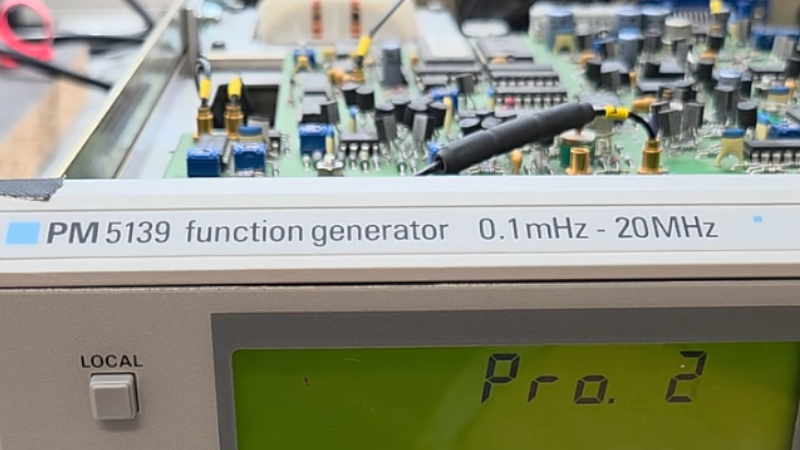
The Philips PM5139 is not famous. It won no great victories on the battlefield, nor was instrumental in changing the political landscape. It was just a useful function generator that you might find on a workbench somewhere, doing its job quietly and relatively accurately. [doctormord] has been doing the work to reverse engineer this humble piece of hardware.
The PM5139 is poorly documented; the only existing service manual out there is for the PM5138A, a less-capable sister model. Hence, there was some value in reverse engineering the device to understand it better. Work started with two EPROM dumps capturing what Philips put in the box all the way back in the early 1990s. From there, the code was examined and tinkered with until [doctormord] felt confident to modify it and improve upon what was already there. This was achieved with the aid of an 8051 emulator that could run the code to make it obvious what was going on. The result was a custom “V2.0” firmware that adds six arbitrary waveforms to the function generator and the ability to play simple music, amongst other tweaks.
Battery-powered tools are now powerful enough to tackle most jobs, with an ever-growing range of options from impact drivers to nail guns and everything in between. These live in your shed or garage when you’re not using them—but this could be a big mistake.
Sometimes you might run the same model twice and get different results. That often happens when you’ve upgraded it with skills. Skills are detailed text documents that lay out the tools the model should use, the approach it should take and how it should analyze the results. Good skills are practical, pulled from actual reports on HackerOne and other bug bounty platforms. A model can still lean on its own knowledge, but that’s just less efficient.
There are plenty of skills out there you might come across, but not everything can be trusted. Some skills can simply be dangerous and infect your system. To make sure they are safe, you can check them with SkillSpector by NVIDIA, so you don’t end up with anything malicious on your system.
Bug Bounty Skills
Both of these repositories do bug bounty hunting end to end, but they go about it in almost opposite ways.
The first is called Bountyforge. It’s actually just one single skill file, but it’s smart enough to split itself into eight different mini agents that all work at the same time. One looks at websites and apps, another at crypto and blockchain, others go after different angles hackers can exploit. It also checks each finding with four different tests to make sure it’s not a false alarm. Then you get a report in whatever format the bug bounty program wants.
You don’t even need Claude Code or any other coding tool for this, you can just run it right inside the regular Claude website in your browser.
The second bug bounty repository is Claude-BugHunter. It takes the opposite approach. The repo has 83 skills and almost half of those were built by studying 681 real bug reports that people actually got paid for on HackerOne. These skills aren’t locked to Claude Code either, you can use OpenCode, Codex or Hermes Agents with them.
Here are a few examples of the results we got with these skills.
API endpoints are often vulnerable and this is worth trying your luck on to see how it goes.
Another approach can be APK reverse engineering. Here we found a hardcoded RSA-2048 signing private key baked into the published APK. With that key, hackers can push a new app to the app store and infect every employee phone, getting access not just to the WiFi network at the workplace but to their personal life too. Quite dangerous.
We found an API endpoint vulnerable to an SQL injection and managed to pull the entire database.
Having skills built on real attacks keeps the model from wandering off into its own weird approaches and missing a lot of good findings.
Active Directory Skills
Claude-AD was made by ADScanPro for testing a company’s internal network. It gives your model a playbook with skills and agents built for an Active Directory assessment. The developers are upfront that it’s not an auto pwn tool. It’s meant to guide you through the assessment. Every finding can get mapped to a compliance control (DORA, NIS2 and ENS).
Claude-AD is very careful about getting caught too. It explains what a security team would actually see on their end if that technique got used. And any time it’s about to do something that would actually change things on the company’s network, it stops and asks for confirmation first.
General Cybersecurity Skills
Antropic-Cybersecurity-Skills is basically a giant reference book. It has 817 skills covering 29 areas of security work, cloud security, malware analysis, all the way down to hardware and firmware. Each skill is its own small file, so your agent will quickly pull out the two or three it actually needs for its task.
Every skill ties back to real security frameworks that companies and auditors already use (NIST CSF, MITRE ATT&CK and so on). So if your model finds a problem using one of these skills, it can also tell you exactly which official standard it violates. You can use it to justify findings to a compliance team.
SCADA Skills
On an industrial network, a clumsy scan can shut down a production line or damage physical equipment, since a lot of this gear is old and wasn’t built to handle unexpected traffic. That’s why the ICS skill by Masriyan is built to never actively touch a live industrial network. Instead, it works off network captures someone already took. It reads the file, recognizes industrial protocols by the ports they normally run on (Modbus, DNP3, Siemens S7, EtherNet/IP, OPC-UA, and more) and counts which devices are talking to each other. It then shows you write commands, these are the ones that change a value on an industrial device. That’s the traffic you want to see first.
The second mode skips network captures and instead searches for exposed industrial equipment using Shodan and Censys. The skill can also help your model reason about how an industrial network is laid out and check findings against MITRE’s ICS specific attack framework and the IEC 62443 security standard.
Science Skills
Although science isn’t really what we want to focus on here, in one of our SCADA articles we mentioned that to carry out a successful attack requires hackers to understand the technical process of the plant. That means understanding how the chemicals are produced and which units are used along the way. We also showed how vinyl acetate is produced and talked about paracetamol production.
1 kg of paracetamol at 100% purity was reported to cost €8,205, while 1 kg at 99% purity cost just €5. So even a single day of sabotage could cause serious financial damage to an enterprise.
Finding a scientist among hackers is quite a challenge, which is why Stuxnet needed a group of people from different backgrounds working toward one objective. But now hackers can just import different skills to make their attacks more devastating. K-Dense published 140 skills with access to different scientific databases and Python tools.
The real concern here isn’t ICS exploits inside the repository, there aren’t any. It’s the access to sensitive scientific data paired with an AI agent that can actually understand that data and change it.
Summary
AI skills can be a gamechanger, especially when they’re based on actual reports hackers got paid for. These skills show your model how to approach things and what tools to use during the test, so it doesn’t wander off hallucinating and inventing its own ways of testing things. That can wreck your bug bounty flow, since you’ll end up overlooking plenty of potential targets.
Simply relying on the AI to find things isn’t enough, hunters that do it keep getting a lot of dupes. You need to test things manually too. For this reason we created our Bug Bounty training to show you how to find bugs and work with the AI more efficiently.
A powerful open-source tool for managing networks and troubleshooting network problems! Streamline and simplify your network administration and troubleshooting with …
If you're a fan of Ryobi's bright, neon-colored tools found at Home Depot, you likely already know the company makes far more than just tools for around the yard and house. One of its best-kept secrets is how the 18V platform can power camping and outdoor gear. I own a ton of Ryobi products for camping, and here are several that are absolutely worth buying.
One of the worst feelings is realizing you're unprepared for a situation, whether that's stuck on the side of the road or during a big weekend project. That's why I always have a selection of dependable tools ready to go for flat tires, stubborn bolts, and other situations. With that in mind, here are five affordable DeWALT tools you'll want in your trunk or in the back of your truck.

 Login
Login