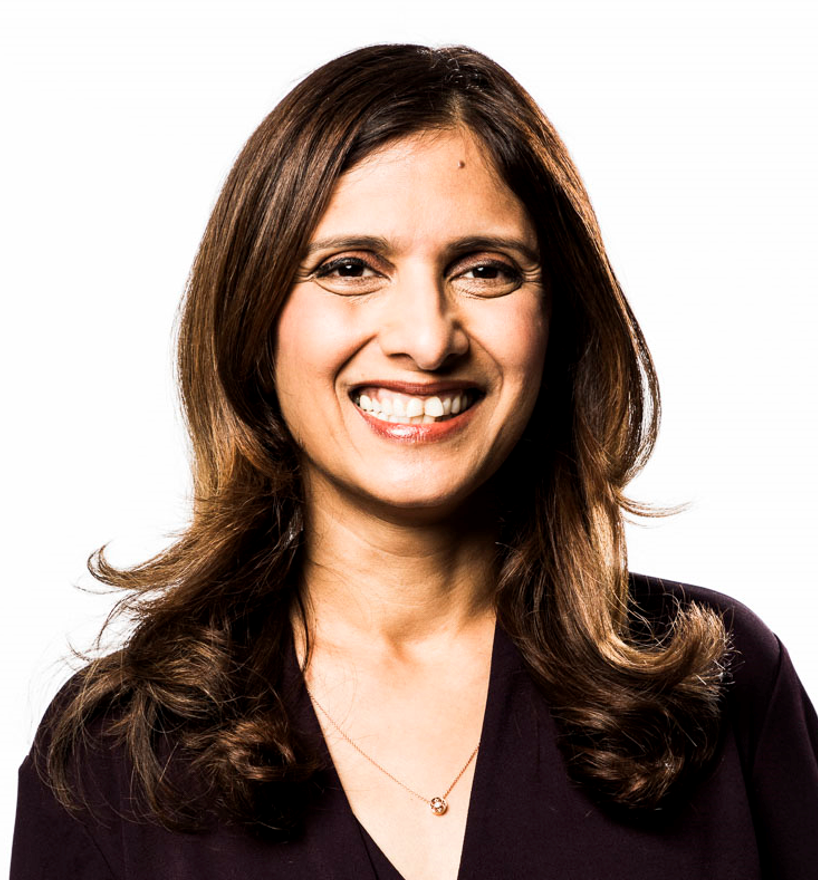
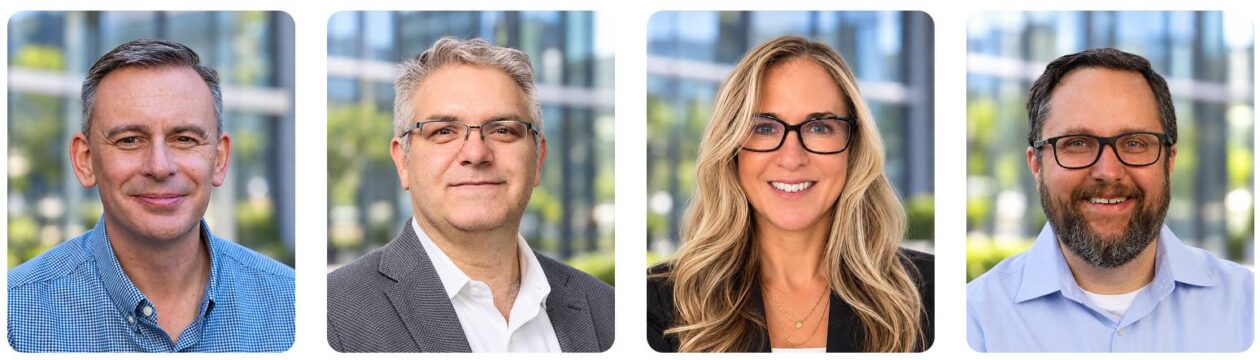
— Xbox Chief Operating Officer Helen Chiang has suddenly left Microsoft after 21 years with the company, just months after landing the role in July. Her past roles include leading Mojang and the Minecraft franchise.
Verge first reported the news on Friday, citing a memo from Xbox CEO Asha Sharma that did not disclose the reason for her departure.
An Xbox spokesperson was likewise mum on details. “We don’t discuss individual personnel matters. We’re grateful for Helen’s years of service and wish her well,” the company said in an email to GeekWire.
Xbox has undergone a massive reorganization that included Chiang’s appointment, roughly 3,200 job cuts through the fiscal year — about 20% of the Xbox workforce — the spinoff of four game studios and a plan to dramatically flatten management.
Philip Su. (LinkedIn Photo)
— Seattle-based tech leader Philip Su has joined Anthropic as a member of technical staff on beneficial deployments. The management role focuses on AI applications in global health, life sciences, economic mobility and education.
Su started his tech career with 12 years at Microsoft and later worked for Facebook. He has launched multiple ventures, including Audere, a global health software nonprofit, and Superphonic, a podcast player. In 2021, he worked at an Amazon fulfillment center to experience the holiday rush.
Su also created and leads an annual course for University of Washington computer science students on how to maximize their personal and professional growth.
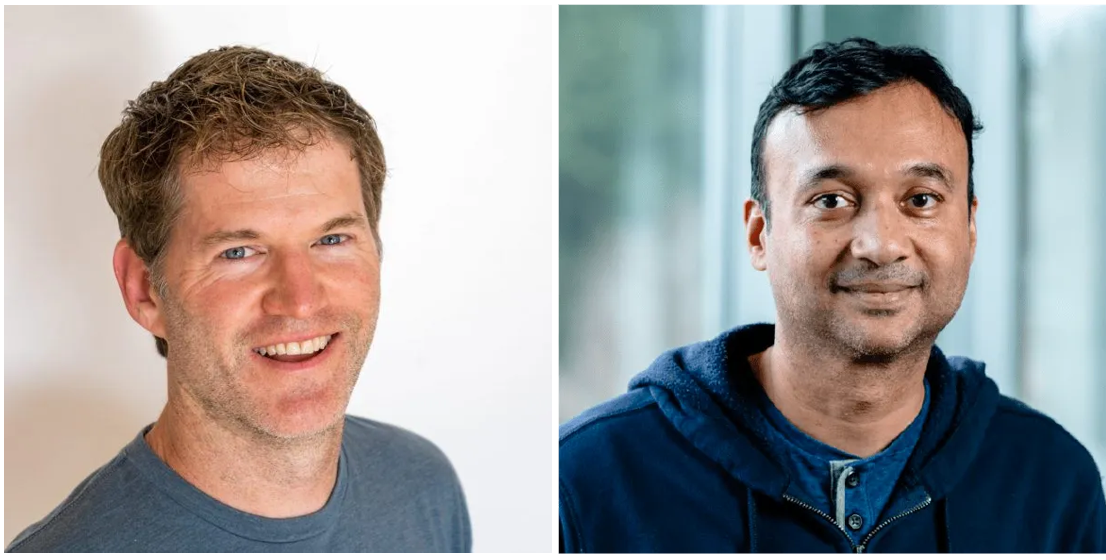
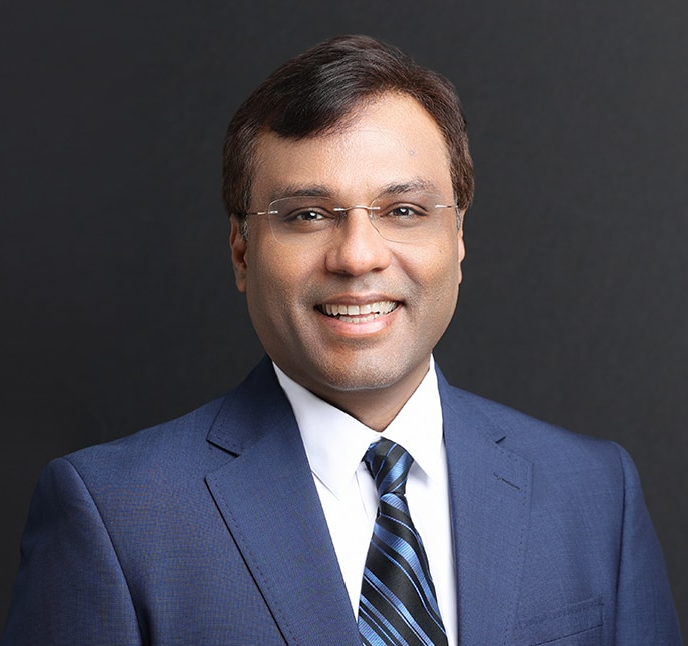
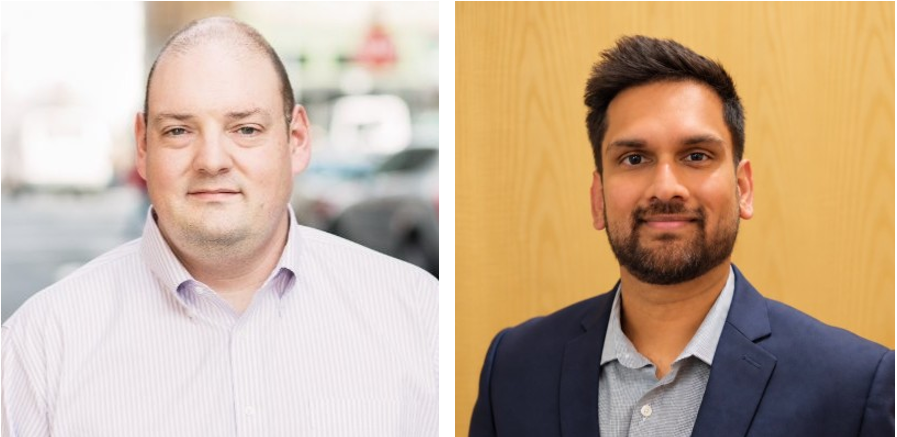
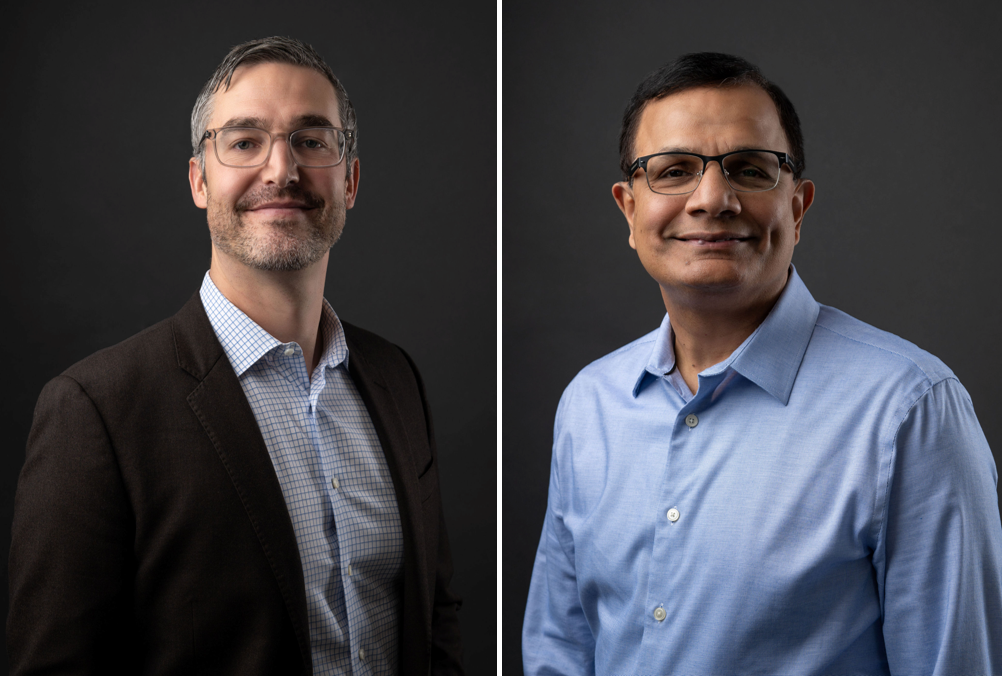
SeekOut President John Tippett, left, and CEO Aravind Bala. (SeekOut Photos)
— More leadership changes are underway at SeekOut, a Bellevue-based recruiting startup launched in 2017. The company announced Monday that co-founder John Tippett is now president, moving from his role as chief client officer.
In April, SeekOut CEO and co-founder Anoop Gupta retired and passed the reins to enterprise software veteran Sean Thompson. In August, co-founder and chief technology officer Aravind Balatook over as CEO. Thompson is now listed as an adviser to the board.
Tippett will lead day-to-day operations and work with Bala “on the company’s direction,” according to a press release. SeekOut said it wants to integrate AI tools into customers’ operations to reduce recruiters’ workload.
SeekOut is No. 68 on the GeekWire 200, a ranked index of the Pacific Northwest’s top startups.
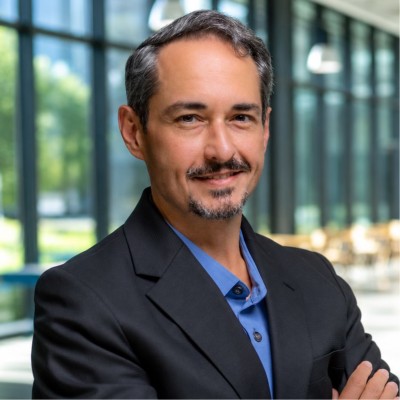
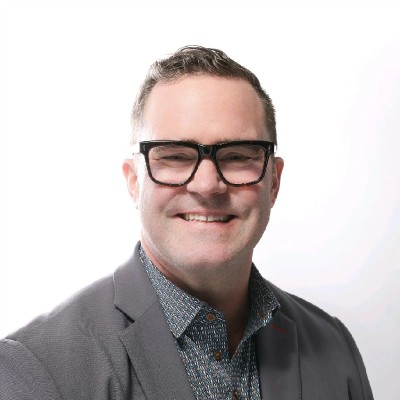
Merritt joins from Penn Medicine, where he was chief operating officer of Penn Signature Services. He has more than 25 years of experience in academic medicine, consulting, strategy, business development and operations.
— Industrial wastewater treatment startup Membrion has named Alexander Demihovsky as director of applications engineering. He joins the Seattle-based company from Xylem. His past employers include Evoqua Water Technologies and Bechtel National.
“Alex helps turn customer needs into viable project plans, mitigate execution risks and develop competitive proposals,” the company said.
— Marine geothermal energy startup Endurance Energy has named Marty Calvert as the director of turbomachinery. Calvert joins the Seattle startup from Blue Origin. He was previously a turbomachinery engineer at NASA for more than 13 years.
Endurance completed its fifth deployment to the ocean floor last month, testing Adélie, a 100-kilowatt geothermal generator named for a penguin.
— Lattice Semiconductor, a Hillsboro, Ore.-based company, has added two directors to its board:
Raejeanne Skillern, former VP and chief marketing officer of Amazon Web Services, who returns to Lattice after serving on the board from 2022 to 2024
John McCool, senior vice president and special adviser to the CEO at Arista Networks
Kymeta, a Redmond, Wash.-based mobile satellite communications company, is working to increase sales with the Department of Defense, the intelligence community and other organizations in national security.
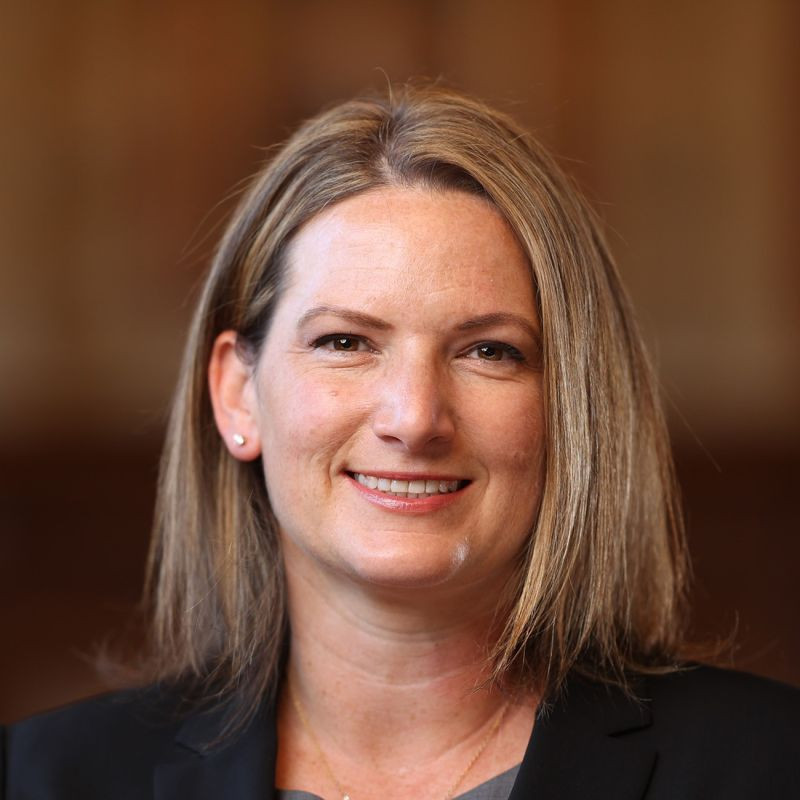
Kimber had a 37-year career with the CIA, departing in 2022 as the agency’s deputy director for operations. She most recently worked as a vice president with Two Six Technologies and has served on Kymeta’s board of directors for two years.
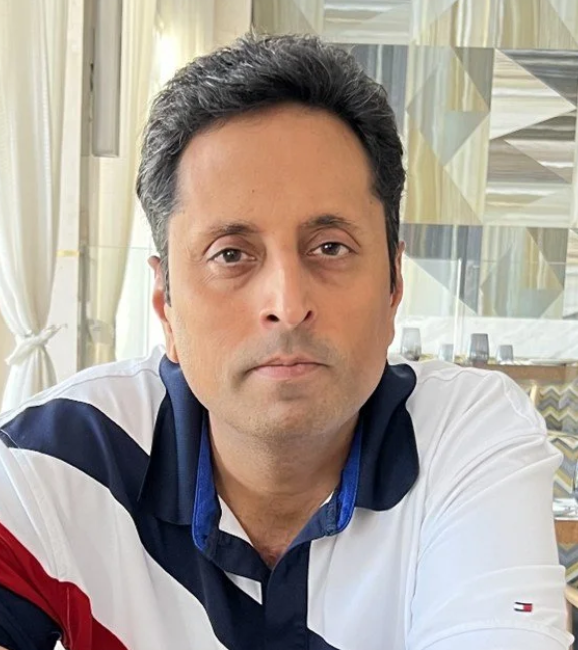
Amaresh Siva. (LinkedIn Photo)
— Alaska Airlines has named Amaresh Siva as its first chief information technology officer. Siva joins from CVS Health and has held technology leadership roles for more than two decades at companies including Lowe’s, Target and GE Money.
“Technology touches nearly every part of how we run our airline and serve our guests, and Amaresh will bring our technology and digital teams together under one leader,” said Ben Minicucci, CEO of Alaska Air Group, in announcing the news.
— Vijaye Raji, founder and former CEO of Bellevue, Wash.-based Statsig and now OpenAI’s CTO of applications, has joined the board of Amplitude, a digital analytics and product intelligence company. OpenAI acquired Statsig last year, and Statsig and Amplitude announced a strategic partnership in May in which Amplitude would build on Statsig’s brand and customers.
“Statsig continues as a platform and brand within Amplitude,” Raji said. “Joining the board is an opportunity for me to help carry that mission forward as Amplitude and Statsig build their next chapter together.”
Here are four departures and arrivals for Microsoft leaders:
Vasu Jakkal. (LinkedIn Photo)
— Vasu Jakkal has left her role as Microsoft corporate vice president of security, compliance, identity, management and privacy after more than six years. She has joined Armadin, a Palo Alto, Calif.-based cybersecurity company, as chief strategy and business officer.
Jakkal is based in the San Francisco Bay Area and previously held executive roles at FireEye and Intel. She praised Armadin’s mission, which she described as building “autonomous security to stay ahead of attackers and build a safer world for all.”
Hans Yang. (LinkedIn Photo)
— Microsoft VP Hans Yang is leaving. The Los Angeles-based leader, most recently focused on AI transformation, product strategy and growth, was formerly a general manager for Microsoft for Startups and Microsoft Learn.
“I think my next hill to climb is helping companies capture real ROI from AI,” Yang said, adding, “If you know a company that is struggling to get started with AI, or has invested but is not yet seeing meaningful value, I would welcome any introductions.”
— Venky Chandrasekharan is returning to Microsoft for the role of general manager of Windows commercial category and investments. He left the company in 2021 after 12 years and worked at Qualcomm and Acuity Brands in the interim.
“Having spent some of my most formative years at Microsoft, there’s definitely a sense of familiarity — but I’m coming back with new experiences, a broader perspective, and a lot of excitement for what’s ahead,” Chandrasekharan said.
— Meg O’Conor Bannecker has left Microsoft after two years leading communications for the company’s Washington state team. Past roles include communications leadership at NanoString Technologies, Bannecker Public Affairs and Pier 70 Ventures.
Patrick Miller. (LinkedIn Photo)
— Patrick Miller has been appointed as global division president of real estate company JLL’s technology sector. Miller joins from Snap, where he served as senior director of global workplace services. He previously oversaw real estate operations for Amazon’s Seattle-area headquarters for more than three years and has worked for Facebook and DTZ.
“I’ve spent my career on the client side … so I know exactly what it feels like to need a partner who shows up, tells you the truth, and solves real problems,” Miller said.
— DigniFi, a Bellevue, Wash.-based fintech company providing repair financing for autos, RVs, ATVs and other motorized vehicles, has namedJefim Piekarz as chief product officer. Piekarz joins from Arch, and his past employers include Skylab74, Welo, Octane and Etsy. Launched in 2012, DigniFi has facilitated more than $575 million in transactions for automotive merchants in the U.S.
— Seattle-based global logistics company Tideworks Technology has named two C-suite leaders:
Mark Traynor, chief product and technology officer, joins from Lynxis. He is an entrepreneur who has worked in port, rail and terminal logistics for more than 20 years.
Guenter Schmidmeir, chief revenue officer, joins from Avlino and has decades of maritime leadership from Germany.
— Adaptiva, a Kirkland, Wash.-based company automating software updates across computers, has named Allison Armstrong VP of product marketing. She joined from Elemica and has worked for Transmit Security, Hopin, Qualtrics, Apptio and others.
— Smarsh, a Portland, Ore.-based company providing communications data and insights, has appointed Alessandro Silva as its first chief growth officer. He joins from ACI Worldwide, and his past employers include Western Union and Carlyle Group. Silva is also a board member for Teach for America.
— Seattle-based Yoodli has named Mike Matheras chief learning advisor. The startup recently expanded from helping people practice speeches, sales pitches and job interviews to providing corporate training across wide-ranging skills. Mather is CLO for the accounting firm KPMG US and was previously a partner at EY, IBM and PwC.
“For most of my career, the hardest part of [learning and development] was the gap between training and the moment someone actually has to perform,” Mather said. “Yoodli closes that gap.”
— DigiStor, a company with offices in Austin, Texas, and Vancouver, Wash., that offers secure data storage products, has appointed Peter Bell to its board of directors. Bell co-founded StorageNetworks and serves as managing partner at Stowe Capital, among other roles.
— Seattle-area tech leader Jake Varghese has been promoted to chief product and technology officer for Dayforce, a Minneapolis company providing HR, payroll and related technology. He previously worked for companies including Microsoft, ServiceNow, Tanium and ConnectWise.
— The Association of Washington Business Institute has appointed Meagan Darrow as executive director. Darrow is also an adjunct professor at Evergreen State College and was most recently executive director of the American Diabetes Association. The AWB Institute is the nonprofit research and education affiliate of the association, a longtime organization advocating on behalf of its 8,000 members.
Dr. Susan Stern, professor emeritus and founding chair of UW Medicine’s Department of Emergency Medicine
Dr. Elizabeth Swisher, professor in the Fred Hutch Clinical Research Division and UW Medicine’s Division of Gynecologic Oncology, as well as deputy director of the Fred Hutch/UW/Seattle Children’s Cancer Consortium
Dr. Leslie Walker, chair and professor of UW Medicine’s Department of Pediatrics and chief academic officer at Seattle Children’s
Dr. Dimitri Christakis, professor in UW Medicine’s Department of Pediatrics, pediatrician at Seattle Children’s and chief health officer with Special Olympics International
Dr. Christopher Longhurst, CEO of Seattle Children’s and clinical professor with UW Medicine’s Department of Pediatrics
— Brinc Drones, the Seattle-based maker of 911 response drones, has named Joe Levy chief revenue officer. Levy joins from Peregrine, a public safety data platform, and early in his career was a drill sergeant and combat engineer for the U.S. Army Reserve.
Levy praised the Brinc team, saying, “They’re passionate about what they do with a vision that will change the public safety landscape. I’m grateful to join them and help scale what they’ve built.”
Brinc announced a $125 million funding round in July, bringing its total raised to more than $280 million. The startup is hiring for numerous roles and is No. 6 on the GeekWire 200, a ranked index of the Pacific Northwest’s top startups.
Jessie Minton. (Fred Hutch Photo)
— Seattle-based Fred Hutch Cancer Center has appointed Jessie Minton vice president and chief digital and information officer, a new position that brings the roles together.
Former Chief Data Officer Jeff Leek stepped down and is now a professor in the Fred Hutch Public Health Sciences Division and CEO of Synthesize Bio, a startup he co-founded in 2023. Last month, Fred Hutch announced Shawn Stapleton as VP and chief AI and innovation officer, another new role.
Minton joins from Washington University in St. Louis where she has been vice chancellor for technology and chief information officer since 2022. She was previously VP and CIO at the University of Oregon.
Fred Hutch praised Minton’s track record “of modernizing complex technology organizations, strengthening cybersecurity, governing large-scale Epic environments and aligning technology strategy with clinical, research and academic priorities.” The new role is effective Dec. 7.
Jason (JJ) James. (LinkedIn Photo)
— Jason (JJ) James has been named chief information officer of Acumatica, the Bellevue, Wash.-based enterprise software giant that was acquired last year by Vista Equity Partners. James has more than 25 years in technology leadership and was previously CIO at companies including Aptos Retail, Net Health and Optima Healthcare Solutions.
“My focus is putting AI to work across Acumatica while keeping security at the core, so we can move fast without compromising the trust our expanding community of customers, partners and developers places in us,” James said in a statement.
Andrew Bennett. (LinkedIn Photo)
— Seattle tech leader Andrew Bennett has joined San Francisco-based Motiveas chief marketing officer. Bennett was with Smartsheet for a decade, leaving as CMO in 2024. He is also a limited partner with the investment firm Stage 2 Capital.
Motive provides software, hardware and AI-powered tools to help businesses manage physical fleets of vehicles and heavy equipment.
— Steven Chen has left LinkedIn, where he served as director and head of corporate legal and sustainability, to become a senior director at Rubrik.
— Seattle-based LevelTen Energy, a startup facilitating the deployment of clean energy projects, has appointed John Barrow as director of a new initiative enabling the purchase and sale of data center projects under development.
Barrow joins from CyrusOne, a global data center developer and operator, and was with CPS Energy for more than 15 years.
“In my career, I’ve had a front-row seat to the data center boom,” Barrow said. Participants are struggling to quickly secure locations and energy, he said, adding that LevelTen “can solve those problems for industry participants at scale.”
— Certivo, a Seattle startup building technology to automate supply chain compliance, has named Jeffrey Bornstein to its board. Bornstein was with GE for nearly three decades and served in roles including vice chairman and chief financial officer.
“He has run the numbers for some of the most complex industrial supply chains in the world while regulators checked every one of them,” said Certivo CEO Kunal Chopra. Certivo is No. 194 on the GeekWire 200.
Convera leadership, from left: Mike Cahill, Jon Southall, Tui Allen and Chris Steinig. (Convera Photo)
— Convera, a Seattle-based fintech company helping businesses transfer money across borders, has added to its leadership team. All four will work out of Convera’s other offices.
Mike Cahill has been appointed EVP and chief operating officer after joining in June as interim chief product and technology officer. Past employers include Early Warning Services, the company behind Zelle, as well as PayPal, Boku and American Express.
Jon Southallhas been named SVP and chief technology officer. He joins from PayPal and has also worked for Boku and Braintree.
Tui Allenhas joined as SVP and chief product officer. She previously worked for employers including Ticketmaster, Shopify and Blackbaud.
Chris Steinig has been named CIO after leading Convera’s technology operations for four years.
— Portable Consultants a Redmond, Wash., enterprise telecommunications and data connectivity provider, has named two leaders.
Carrie Ferrero has joined as VP of product and marketing development. She previously served as VP of sales engineering at Connectbase.
Troy Brockway has been named director of client development, joining from SpikeUp Media.
— Reperio Health, a Portland, Ore., startup bringing preventive health check-ups into the home, has named Brad Nations to its board of directors. Nations is CEO and founder of JB Advisory.
— iQmetrix, a Vancouver, B.C.-based company building point-of-sale and retail management software for cell phone and wireless stores, has appointed Beniamin Longodor as VP of global growth. Longodor, who is based in Austria, was previously with NTS Retail.
Peter Lee, president of Microsoft Science, is trading research labs for racetracks. (GeekWire File Photo / Clare McGrane)
When Peter Lee announced two weeks ago that he was leaving Microsoft, he said only that his next job would fulfill “a dream I’ve had since childhood.”
The dream, it turns out, comes with a pit crew.
The longtime Microsoft Research leader, who is leaving his post as president of Microsoft Science after more than 16 years at the company, plans to join the Mercedes Formula 1 team in a newly created AI advisor role, according to a report by Fortune.
As a career turn, it isn’t as much of a surprise as it might seem. Lee raced karts and Formula Ford as a kid, and he was once a licensed auto body technician, he told GeekWire last year. He had a replica 1955 Porsche 550 Spyder converted to electric and was in the middle of converting a 1968 Ford Mustang GT Fastback last year.
He called cars “a great laboratory” for AI models that decide an agent’s next move.
“The thing I’ve always loved about cars, and why I love to work on cars, is you actually finish something,” he said in that interview. “That never happens in software.”
At Mercedes, he’ll focus on using AI to tackle physics problems for the team’s car, breaking down organizational and data silos, building financial and predictive models, and advising the team on how F1’s regulators might govern AI. He’s expected to join on a one-year contract with an option for a second. His exact title is still being worked out, according to the report.
“I’m completely thrilled, and I’m in disbelief that they would think of me for something like this,” he told Fortune.
His exit is part of a broader wave of senior departures from Microsoft this year, including LinkedIn and Office chief Ryan Roslansky and communications chief Frank Shaw.
— Ravi Vedula, a corporate vice president at Microsoft, is leaving the company after 26 years. Vedula, who is based in the Seattle area, led an organization of more than 1,000 people that runs the data and analytics platform behind Microsoft 365 and Copilot.
“26 years. It’s time,” he wrote on LinkedIn. “Goodbye and thank you, Microsoft. It’s been a privilege. I gave it my all.”
Vedula joined Microsoft in 2000 and was the first engineering manager for Exchange Online.
“I leave with gratitude for the people and experiences that shaped those years,” Vedula told GeekWire.
He said he is leaving room for “another professional chapter if the right opportunity comes along,” but for now plans to focus on travel, ways to contribute and writing, including a possible book based on his experiences receiving a heart transplant in 2017.
Rohit Prasad. (Boston Dynamics Photo)
— AI and robotics company Boston Dynamics announced Rohit Prasad as its new CEO, effective Oct. 7. Prasad, who is based in the Boston area, was Amazon’s senior vice president and head scientist for artificial general intelligence until he left the company at the end of 2025.
He takes over from interim CEO Amanda McMaster, the company’s chief financial officer, after Robert Playter retired in February following more than 30 years at Boston Dynamics. Hyundai Motor Group holds a controlling stake in the company.
Prasad joined Amazon in 2013, during the early days of Alexa, and oversaw the creation of its Nova AI models. Boston Dynamics makes the Spot and Stretch robots and is developing the Atlas humanoid. Prasad is also expected to join the company’s board, subject to approval.
“Boston Dynamics is uniquely positioned to advance Physical AI through its world-class robotics expertise,” Prasad said in the announcement.
Mike Potter. (Qualtrics Photo)
— Qualtrics has appointed Mike Potter chief technology officer of the experience management company. He joins from Petal, an Ontario healthcare company, and has worked in leadership at Qlik, IBM and Cognos.
“I have spent the better part of my career building platforms at scale, the kind of work that requires deep technical conviction, strong collaboration, and a relentless focus on what customers actually need. That is what drew me to Qualtrics,” Potter said.
Qualtrics has dual headquarters in Seattle and Provo, Utah. It recently cut 117 jobs connected to its Seattle operations, largely affecting engineering and product teams. Last year, the company spent $6.75 billion to acquire Press Ganey Forsta.
Shawn Stapleton. (Fred Hutch Photo)
— Shawn Stapleton has been named vice president and chief AI and innovation officer, a newly created role at Fred Hutch Cancer Center. He joins the Seattle nonprofit from MD Anderson Cancer Center, where he led AI lifecycle management for more than three years. Before that, he was the Seattle-based head of data science for Philips.
Stapleton helped scale MD Anderson’s AI initiatives across clinical, research and administrative settings, Fred Hutch said, adding, “His experience at the intersection of strategy, governance and implementation will be instrumental as we continue building the foundation for AI-enabled medicine and discovery.”
Jon Abramovic. (Overland AI Photo)
— Seattle-based defense tech startup Overland AIhas named Jon Abramovic as vice president of international growth. Abramovic has held sales leadership roles in Taiwan, Prague and Beijing. He was most recently director of global defense sales at SIG Sauer and spent eight years at Oshkosh Defense leading business development across Europe and Asia.
“Having spent years operating overseas, I’ve seen firsthand what our allies face against near-peer adversaries and what it takes to stay ahead. Overland AI’s technology represents a generational leap in the ground domain,” Abramovic said.
Overland AI is No. 7 in the GeekWire 200, a ranking of the region’s top privately held tech startups.
— Noosphere Labs, a Seattle-area AI startup first covered by GeekWire in August, has announced its leadership team. The company, launched by former Meta AI research director Kevin Carlberg, is pursuing “human-centered physical intelligence” — AI designed to help people interact with and make sense of the physical world, beyond text and images on screens.
Its team includes:
Tyler Simpson, co-founder and chief operating officer, who left Meta to start Noosphere Labs. He previously was co-founder and CTO of Luum by HealthEquity and spent more than 11 years at Microsoft.
Andrew Ma, engineering leader, has more than 20 years’ experience across Google, Meta, Amazon and Microsoft, most recently leading Google Cloud’s Apache Spark teams.
Joshua Walton, founding design partner, was a director at Meta Reality Labs Research and worked on Microsoft’s HoloLens.
Louis Barinaga, founding hardware partner, spent the bulk of his career at HP and more recently held leadership roles at Meta’s augmented reality program, Valve and Microsoft.
Andrew Smith, founding AI engineer, led Zillow’s first agentic AI system and previously worked for Amazon and Sandia National Laboratories.
Michael Iuzzolino, founding AI engineer, joined from Meta, where he worked on large language models, and previously held roles at Google Brain and Microsoft Research.
Mikhail Shashkov, founding architect, was at Amazon Lab126 for more than seven years and previously at Sandia.
Liz Pearce. (LinkedIn Photo)
— Liz Pearce has been named Earth Finance‘s first chief commercial officer. She joined from Ever.green, where she was chief revenue officer. Past roles include CEO of LiquidPlanner, co-founder and CEO of Fresh Chalk, and vice president of marketing for GoDaddy.
Earth Finance, a Seattle-based startup helping businesses reduce their climate impacts, recently launched a platform called SpatiaFi that enables customers to make location-based capital decisions.
“Earth Finance is already delivering game-changing results for customers,” Pearce said. “I can’t wait to get to work with this team to scale that impact.”
— Charlie Bell, the longtime Amazon Web Services executive who left to run security, compliance and identity at Microsoft, has been appointed to the board of directors at the cybersecurity firm Tenable. The appointment was disclosed in an SEC filing and framed as “reinforcement for Tenable’s AI-driven exposure management push.”
— Two notable Amazon moves:
Fırat Güder, a professor and chief engineer of Güder Research Group at Imperial College London, has joined Amazon as a scholar in the tech giant’s special projects organization. “Here, we are building the next generation of cutting-edge technologies that define the future of humanity. It is an incredible honor to join a small, elite group of innovators and researchers pushing the boundaries of what is possible,” Güder said.
Leonardo de Mourahas been promoted to vice president and distinguished scientist with AWS in Seattle. He joined the company in 2023.
Amelia Marckworth. (LinkedIn Photo)
— Washington Technology Industry Association (WTIA) has named Amelia Marckworth director of programs, innovation and entrepreneurship. She joins from Seattle University, where she has held leadership roles for more than a decade and also served as an adjunct professor of entrepreneurship in the Albers School of Business and Economics.
“Amelia has a proven track record of launching and growing startup programs, coaching founders directly, and being part of WTIA as a committee member and mentor. We’re excited to bring that experience and talent onto our startups team,” Randa Minkarah, WTIA’s executive director and CEO, said in a statement.
Hernan Alvarez. (LinkedIn Photo)
— Hernan Alvarez has taken a role at Seattle-based Hyperparamto lead product and go-to-market at the startup, which is building tools for collecting, storing and analyzing the data that AI systems produce. The company recently launched a product called HypAware to improve oversight of AI agents and catch their errors.
Alvarez joins from Great Expectations, where he was CEO. He earlier worked with Hyperparam founder Kenny Daniel at Algorithmia, a machine learning company co-founded by Daniel and acquired by DataRobot.
Philip Jensen. (Zap Photo)
— Philip Jensen has joined Zap Energy as vice president of fuel programs and operations. Zap, an Everett, Wash.-based fusion startup, announced in April that it was expanding its focus to include nuclear fission. Jensen was previously at First American Nuclear and spent more than seven years at Pacific Northwest National Laboratory.
Zap said Jensen “brings deep expertise in nuclear fuel design, testing, and manufacturing, and a track record of launching new fuel programs and partnerships.”
— Christie Johansen-Pinney has joined Noble Studiosas its Seattle-based vice president of client experience. She has held VP roles at firms including Rooster Punk, DEPT and The Marketing Practice.
— Anders Mortensen, formerly CRO at The Trade Desk, has been appointed to the advisory board of Scowtt, a Seattle startup helping advertisers optimize their ad spending. Mortensen spent more than 13 years at Google, leaving as vice president of U.S. mid-market sales lead generation.
Leadership changes at Bellevue, Wash.-based companies are dominating the news in this week’s Tech Moves, plus some notable items in neighboring Redmond.
— Former Amazon leader Asic Demberel is now chief technology officer for Scala, a Bellevue-based startup offering an AI operating system for contact centers and customer operations. Demberel was with Amazon for 15 years, first working on fraud technology for AWS and leaving the company as general manager and engineering leader for Amazon Pharmacy Kiosks.
“You don’t walk away from 15 years at Amazon for an incremental challenge. It takes an exceptionally complex problem and an opportunity so massive that you simply can’t look away,” Demberel said of his decision to leave.
Scala was founded by Smartsheet CEO Rajeev Singh and former Accolade executive Ardie Sameti. It raised an $8.5 million seed round in February.
New Flyhomes leadership, from left: Tyler Moynihan, Nihit Nirmal and Wendy Tieu. (Flyhomes Photos)
— Flyhomes, a Bellevue-based company providing financial tools for home buying and selling, has named three leadership hires:
Tyler Moynihan has been named vice president of business development. He most recently held a leadership role at Opendoor, following nearly 12 years at Zillow that ended in 2023. While at Zillow, Moynihan helped lead major deals including the purchase of ShowingTime and a partnership with Opendoor.
Nihit Nirmalhas joined as VP of product. Nirmal, who is based in Singapore, launched an AI agent startup to handle corporate conversations and worked in multiple fintech leadership roles.
Wendy Tieu has rejoined Flyhomes as director of partner enablement. Los Angeles-based Tieu left the company in 2024 after seven years, taking leadership roles at MoeGo and Whatnot.
Heinz Marketing leadership, from left: Jenn Steele, COO and president; CEO Matt Heinz; and Maria Geokezas, retiring COO. (LinkedIn Photos)
— Heinz Marketing, a Redmond, Wash.-based B2B marketing and consulting firm, is shaking up its leadership. The company has named Jenn Steele as its chief operating officer and president, while Matt Heinz, who started the business 18 years ago, is moving from president to CEO.
Steele joins Heinz Marketing from Seattle’s SoundGTM, which she co-founded and led. She has held executive roles at numerous Seattle-area companies including CEO of Kissmetrics and top marketing and revenue positions elsewhere.
Maria Geokezas is retiring as COO after nearly 17 years with the firm. The company credits her leadership with shaping the organization and said “the whole team is deeply grateful and will miss her.”
Untamed Intelligence co-founders, from left: Ludovic Fourrage, Paul LeBlanc and Rachel Koblic. (LinkedIn Photos)
“Untamed Intelligence is an innovation studio dedicated to advancing human possibility. We begin by asking what human beings need to flourish and then explore how technology and learning science might help us get there,” the company said on LinkedIn.
Fourrage was previously senior program officer for the Gates Foundation. Before that, he was with Microsoft for more than 13 years, working in certification and learning leadership roles. Fourrage is also the founder of Nucamp Coding Bootcamp, serving as board chairman of the company.
The startup’s other co-founders are CEO Paul LeBlanc and Chief Product Officer Rachel Koblic. LeBlanc was president of Southern New Hampshire University for 21 years until 2024. Koblic has her own learning-focused consultancy and was chief learning officer for Matter and Space.
LogicGate hires, from left: Mike Zinne and Ram Venkat. (LinkedIn Photos)
— LogicGate, a Chicago company offering a no-code governance, risk and compliance platform, has named two Bellevue-based leaders:
Mike Zinnehas joined as chief customer officer, after working at companies including Quiq, Outreach and Zendesk.
Ram Venkat has taken the role of senior vice president of product, joining from Highspot. He also worked at Amazon and T-Mobile.
— The Technology Alliance has appointed Matt Medlin, a longtime CPA with a focus on venture-backed companies, chair of its board of directors. Two current board members have taken new roles, with Helion’s Jessie Thomas becoming vice chair and EY’s Alissa Garner Byersdorfer serving as treasurer.
The UW Climate Risk Lab has named two new members to its leadership council:
Brandon Middaugh, general manager of Microsoft’s sustainable markets and Climate Innovation Fund
Peter Whitney, Amazon Web Services’ business development manager for AI and modern data strategy, for the Americas
Frank Paskiewicz, an aviation regulatory expert who served with the Federal Aviation Administration for 28 years, leaving as deputy director of the Aircraft Certification Service
Sheikh Rabbi, CEO and co-founder of Magnetic Motion, a startup developing drop-in hybrid-electric propulsion systems for climate-friendly aircraft
— Evergreen Goodwill has promoted Derieontay Sparks to chief revenue officer, overseeing operations that support the nonprofit’s tuition-free education and workforce development programs.
— And in case you missed it, two top Microsoft executives shared this week that they’re leaving the Redmond tech giant: Peter Lee, the former head of Microsoft Research, and Ryan Roslansky, Microsoft executive vice president overseeing both LinkedIn and Microsoft Office. See the whole story here.
Peter Lee, left, and Ryan Roslansky both shared news this week that they’re leaving Microsoft. (LinkedIn Photos)
Two top Microsoft executives announced this week that they’re leaving the Redmond, Wash., tech giant:
— Peter Lee, the former head of Microsoft Research and most recently president of Microsoft Science, is resigning after more than 16 years.
“As for what I’ll be doing next, what I can say at this point is that it is a once-in-a-lifetime opportunity to join an elite team, fulfilling a dream I’ve had since childhood. It’s a major detour from what I’ve been doing over the past 2+ decades,” Lee said on LinkedIn.
At the same time, he said he would continue working with healthcare organizations including the Mayo Clinic, Kaiser Permanente Bernard J. Tyson School of Medicine and Seattle Children’s.
Peter Lee, right, in the Moment Motors shop with founder Marc Davis, left, and builder Brandon Beaman, in Austin, Texas. Moment is converting Lee’s 1964 Mustang to electric. (Photo courtesy of Peter Lee)
Before joining Microsoft, Lee spent 22 years at Carnegie Mellon University, where he served as head of its Computer Science Department. He was named one of Time magazine’s 100 most influential people in health and life sciences in 2024.
As a hobby, Lee enjoys converting classic cars into electric vehicles, including a replica 1955 Porsche 550 Spyder and a 1968 Ford Mustang GT Fastback.
— Ryan Roslansky is leaving Microsoft after nearly 18 years with LinkedIn and Microsoft. Last year, he was promoted from CEO of LinkedIn to Microsoft executive vice president overseeing both LinkedIn and Microsoft Office. In April, the company named Daniel Shapero the new LinkedIn CEO.
Roslansky thanked CEO Satya Nadella, noting that when Microsoft acquired LinkedIn a decade ago, “you gave us room to build, and then trusted many of us with a lot more. I’ve learned more from you than I can fit in an email, and I’m grateful for the friendship that came with it.”
Nadella in turn praised Roslansky, saying on the company blog, “I’ve always appreciated his clarity of thinking and I’m deeply grateful for everything Ryan has built, for the leaders and teams he has developed, and for his friendship and counsel.”
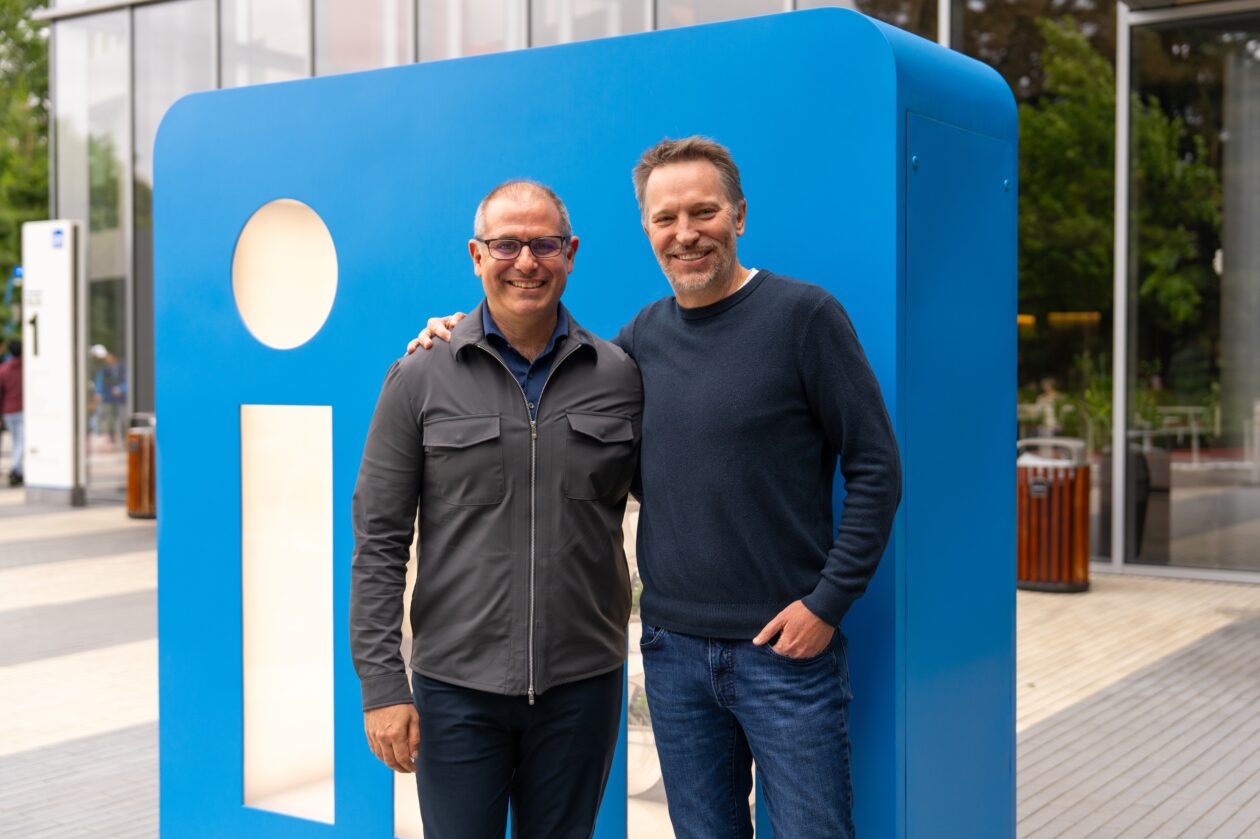
LinkedIn CEO Daniel Shapero, left, and Ryan Roslansky, EVP of LinkedIn and Microsoft Office, at LinkedIn headquarters. (LinkedIn Photo)
Roslansky joined LinkedIn in 2009 as chief product officer and became CEO in 2020. To continue in his role as Microsoft EVP would require relocating his family from the San Francisco Bay Area to the company’s Redmond headquarters.
“But my life and my family’s life are here in the Bay Area,” he said, adding, “The work now goes to leaders who are set up to take it further. I can’t wait to see what they do with it.”
Roslansky will leave the company at the end of the year.
— Niantic SpatialhiredDave Citron as chief product officer. He joined from Microsoft AI, where he was corporate vice president of product on the Superintelligence team and helped build and launch Microsoft’s first frontier foundation models.
San Francisco-based Niantic Spatial, spun out of Pokémon Go maker Niantic, builds spatial AI models and services, including a visual positioning system trained in part on images crowdsourced from Pokémon Go players. The company has an engineering team in Bellevue, Wash.
The Seattle-area executive was previously senior director of product for the Gemini app at Google DeepMind and worked on Google Meet and Google Duo. He began his career at Microsoft in 2005, helping take OneDrive from its first release to more than 200 million monthly users.
“AI is remarkably good at reading and writing, but it still doesn’t understand the physical world well enough to act in it safely,” Citron said in the announcement.
Jane Dietze. (Brown University Photo)
— The Fund for Science and Technology, the Seattle-based foundation responsible for giving away a large portion of the late Microsoft co-founder Paul Allen’s fortune, namedJane Dietze its first chief investment officer. She starts Jan. 4, 2027, after finishing the year at Brown University, where she has held that role since 2018.
Brown says its endowment grew from $3.2 billion to $8 billion over the 10 years through fiscal 2025. Her deputy, Joshua Kennedy, will succeed her. Dietze previously held investment roles at Bowdoin College, Fortress Investment Group and Columbia Capital.
The foundation launched publicly in August 2025 with a mandate to deploy at least $500 million over four years in bioscience, the environment and AI for good. It also funds the Allen Institute and Ai2, the Allen Institute for AI.
The fund started with a $3.1 billion endowment from Allen’s estate and is expected to oversee a large portion of the proceeds from the sale of Allen’s sports teams. Its first CEO, Lynda Stuart, stepped down in May.
Nicholas Stevens. (LinkedIn Photo)
— Nicholas Stevens joined payments giant Stripe as head of product for agentic commerce, working from Seattle, after a decade at Zillow. He was most recently Zillow’s vice president of product for AI and data, leading product strategy for the company’s AI products and data platform.
His LinkedIn profile notes that he drove the partnership that made Zillow one of seven global launch partners for OpenAI’s ChatGPT apps platform. He previously worked in product at Prismatic.
“I believe AI buying & selling on your behalf can be magical,” he wrote.
— Scowtt, a Kirkland, Wash.-based startup that uses AI to predict which sales prospects will become customers, namedBen Trenda chief revenue officer. Trenda is an ad tech veteran who worked at Overture/Yahoo, AOL and Rubicon Project, and co-founded iSocket. Scowtt says it is approaching $10 million in annual recurring revenue.
Emily Levesque. (Photo courtesy AAS)
— The American Astronomical Societynamed University of Washington astronomy professor Emily Levesque the next editor in chief of its journals, including The Astrophysical Journal. She takes charge in August 2027, succeeding Ethan Vishniac.
— ThriftBooks, the online used-book seller founded in Seattle in 2003, namedCarla Anderson Skogland chief financial officer. She had been interim CFO since April. Anderson Skogland, who is based in the Seattle area, was previously CFO of Sono Bello. She spent 11 years at Amazon, and earlier worked at T-Mobile and for more than 15 years at Starbucks.
— Michael Mann is stepping down as executive director of Clean & Prosperous, a climate policy group that backed Washington’s Climate Commitment Act, once a successor is chosen. He took over on an interim basis from the late founder David Giuliani and led the group for five years. Mann, founder of consulting firm Cyan Strategies, previously led the City of Seattle’s Office of Sustainability and Environment.
Lani Ramos. (LinkedIn Photo)
— Lani RamosjoinedYoodli, a Seattle startup that uses AI roleplays for communications training, to build its renewals function. Ramos spent 13 years at Tableau and Salesforce, most recently as director of renewal for North America.
— Former Starbucks CFO Rachel Ruggerijoined the board of San Diego-based Jack in the Box. Ruggeri, a Seattle-area finance leader, spent more than two decades at Starbucks and was its CFO from 2021 to March 2025. She also serves on the board of Stryker.
— Victor Fetter is stepping down at the end of the year as chief technology and business systems officer at Everett, Wash.-based Fortive after nearly seven years. Rich Noonan, Fortive’s chief information security and technology operations officer, will become CIO. Fetter, who is based in Mississippi, plans to expand his board work and angel investing.
— And in case you missed it:
Microsoft moved its communications team under President Brad Smith. Brent Colburn is interim communications leader, and longtime comms chief Frank Shaw will serve as an advisor through the end of the year.
Nate Bek, left, with Ascend founding general partner Kirby Winfield at the firm’s Founders Bash event Thursday night. (GeekWire Photo / John Cook)
— Seattle-based venture capital firm Ascend promoted Nate Bek to principal. Bek joined the firm as an associate in January 2024 and was most recently senior associate and head of research.
Kirby Winfield, Ascend’s founding general partner, credited Bek with helping the firm’s companies launch with national press coverage, researching and communicating its investment theses, and sourcing deals including Neuramill and Endurance Energy.
“Nate has been a force multiplier for Ascend. It’s rare for a micro VC fund to have a resource like him,” Winfield said. “He not only executes and publishes novel market research and thought leadership that strengthens our brand and expands our reach; he’s also hyperconnected in the Seattle ecosystem and has sourced some of our most compelling investments.”
Winfield added, “We’re excited to see him continue to grow as Ascend becomes a nationally recognized pre-seed firm.”
Bek was previously a startups and venture capital reporter at GeekWire. He co-wrote a widely read GeekWire guest column in August making the case that many of Seattle’s most promising startups are building physical products such as rockets, power plants and off-road vehicles.
Brandon Paddock. (LinkedIn Photo)
— Brandon Paddockleft Microsoft to start his own AI software company. Paddock, who is based in Seattle, was a principal software architect in Microsoft’s Office organization and the technical lead for “Agent Mode” in Word, which shipped last fall and became the default Copilot experience in Word early this year. His last day was Sept. 11.
“I am incredibly excited about what I’m building, but not quite ready to talk about it here,” he wrote on LinkedIn.
Paddock first worked at Microsoft from 2005 to 2013, including on search features in Windows 7 and Windows 8. He rejoined in 2016 after serving as CTO of Seattle startup Zealyst. He also built the Twitter client Tweetium as a side project.
Donya Loyd Kemp. (LinkedIn Photo)
— Seattle-based STEM education nonprofit Technology Access Foundation named Donya Loyd Kemp director of TransformED, which works with teachers at partner public schools to put TAF’s project-based STEM learning model into practice.
Kemp comes to TAF from Atlanta, where she was principal of Purpose Built Schools Atlanta and director of project-based learning at Charles R. Drew Charter School. She was most recently a senior consultant at Potential Unleashed Consulting.
In a TAF Q&A, Kemp said she was excited to contribute to work “that recognizes the brilliance of students, particularly students who have historically been underestimated.”
“So excited to have Donya on board. Leveling up for our children and teachers,” TAF co-founder and executive director Trish Millines Dzikowrote on LinkedIn.
Rikki Tremblay. (LinkedIn Photo)
— Zillow Group named Rikki Tremblay vice president and principal accounting officer as Jennifer Rock retires as chief accounting officer, according to a regulatory filing. Rock will stay on in an advisory role through March 1, 2027.
Tremblay has worked at the Seattle-based real estate company since 2014, most recently as vice president of reporting, technical accounting and controls. She previously held audit roles at Deloitte.
— Joy Chikjoined the board of NewCore, a Tel Aviv- and San Francisco-based startup building an identity platform for people and AI agents. NewCore emerged from stealth in June with $66 million in funding.
Chik, who is based in the Seattle area, spent 28 years at Microsoft, most recently as president of identity and network access. She announced her departure in April.
Werner Koepf. (LinkedIn Photo)
— Werner Koepfis now chief technology officer at VanillaSoft, a sales engagement software company. Koepf, a longtime Seattle-area tech leader, was previously chief product and technology officer at AI localization company LILT and senior vice president of engineering at Karat.
He has also held engineering leadership roles at Conversica, Ticketmaster, Expedia and Amazon, where he led the gifting business, including Wish List and registries.
— Christopher Budd joined Salesforce as director of security industry engagement, a new role connecting the company’s security team and research with the broader security industry. He joins Iain Mulholland and other former Microsoft colleagues. Budd, who has contributed many pieces to GeekWire over the years, previously led X-Ops communications at security company Sophos.
Jay Carney. (LinkedIn Photo)
— Jay Carneyjoined venture capital firm SV Angel as general partner and head of public policy and communications. He will connect the firm’s portfolio companies and founders with policymakers in Washington and state capitals. A major focus will be Project Blueprint, SV Angel’s new effort to partner with tech founders and lawmakers to shape AI policy.
Carney, who is based in Washington, D.C., was previously global head of policy and communications at Airbnb, and Amazon’s senior vice president of global corporate affairs from 2015 to 2022. He was White House press secretary to President Obama from 2011 to 2014.
— Seattle-based A Place for MomnamedJason Conley chief technology officer. The company helps families find senior care. Conley will lead its technology strategy, engineering and data organization, including the use of AI across customer experiences and internal operations.
Conley will work remotely from Lexington, Ky. He was previously CTO at VIP Medical Group and Envera Health, and held senior technology roles at BrightSpring Health Services.
— Luis Monterorejoined the Seattle-based Gates Foundation to help shape its AI communications strategy across global health and development. Montero left the foundation about a decade ago for a career in tech.
His roles since then include global head of policy communications at Discord and public affairs positions at Edelman, Google and Microsoft, where he worked on executive communications for President Brad Smith. He is based in New York.
— Vancouver, B.C.-based defense tech startup Juno Industriesexpanded its board, advisory and leadership teams. The company develops AI-native command and control software and sensor systems for the Canadian Armed Forces and allies.
New leaders include head of engineering Dylan Neid, who spent nearly a decade at AbCellera; head of strategy Tania Belisle-Leclerc, former director of policy to Canada’s ministers of foreign affairs and national defense; and head of growth Bryan Riddell, former CEO of Team Rubicon Canada.
Claude Rochette and Alnesh Mohan will join the board once Juno goes public through a reverse merger with Trail Blazer Capital Corp., a shell company listed on the TSX Venture Exchange.
— And in case you missed it:
Microsoft communications chief Frank Shawwill leave the company at the end of the year after overseeing its communications for nearly three decades, first at an outside agency and for the last 17 years as a Microsoft executive.
Amazon namedKevin Mandia, founder of cybersecurity firm Mandiant, to its board of directors.
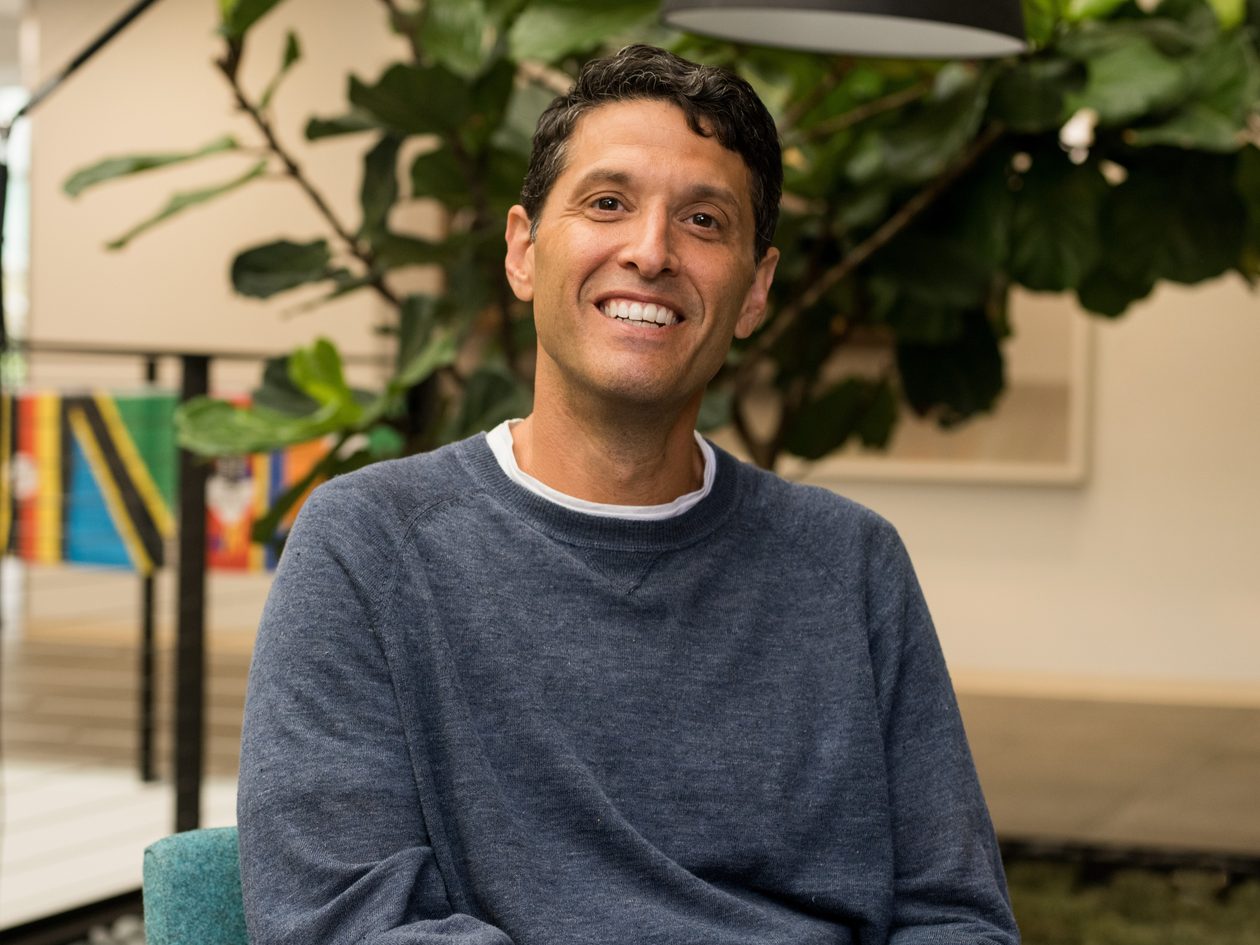
Terry Myerson, Truveta’s co-founder and CEO, will retire at the end of September. (Truveta Photo)
Terry Myerson, the former Microsoft executive who co-founded Truveta during the pandemic, growing it to 500 employees and a valuation of more than $1 billion, is retiring as CEO of the Bellevue, Wash.-based health data company at the end of September.
Truveta co-founders Jay Nanduri, CTO, and Ryan Ahern, the chief medical officer, will take over as interim co-CEOs while the board conducts a search for a permanent CEO. Myerson said in an interview that the board has a responsibility to look for “the absolute best CEO,” but he expressed hope that the search will confirm Nanduri and Ahern as the right leaders for Truveta’s next chapter.
Myerson, 54, will become an advisor to the company and step down from its board. He said he’s leaving because the business is doing well and his co-founders are ready. He also cited changes in his personal life. He and his wife, Katie, are empty nesters, and they want to travel.
“If things were not going well, I would not do this,” he said. “I’d be grinding it out. But things are going really well.”
Truveta pools de-identified patient records from 30 large U.S. health systems into a database that’s updated daily. It sells access to that data, along with analysis and AI tools, to drug makers, medical device companies, researchers and government agencies studying how treatments work in the real world.
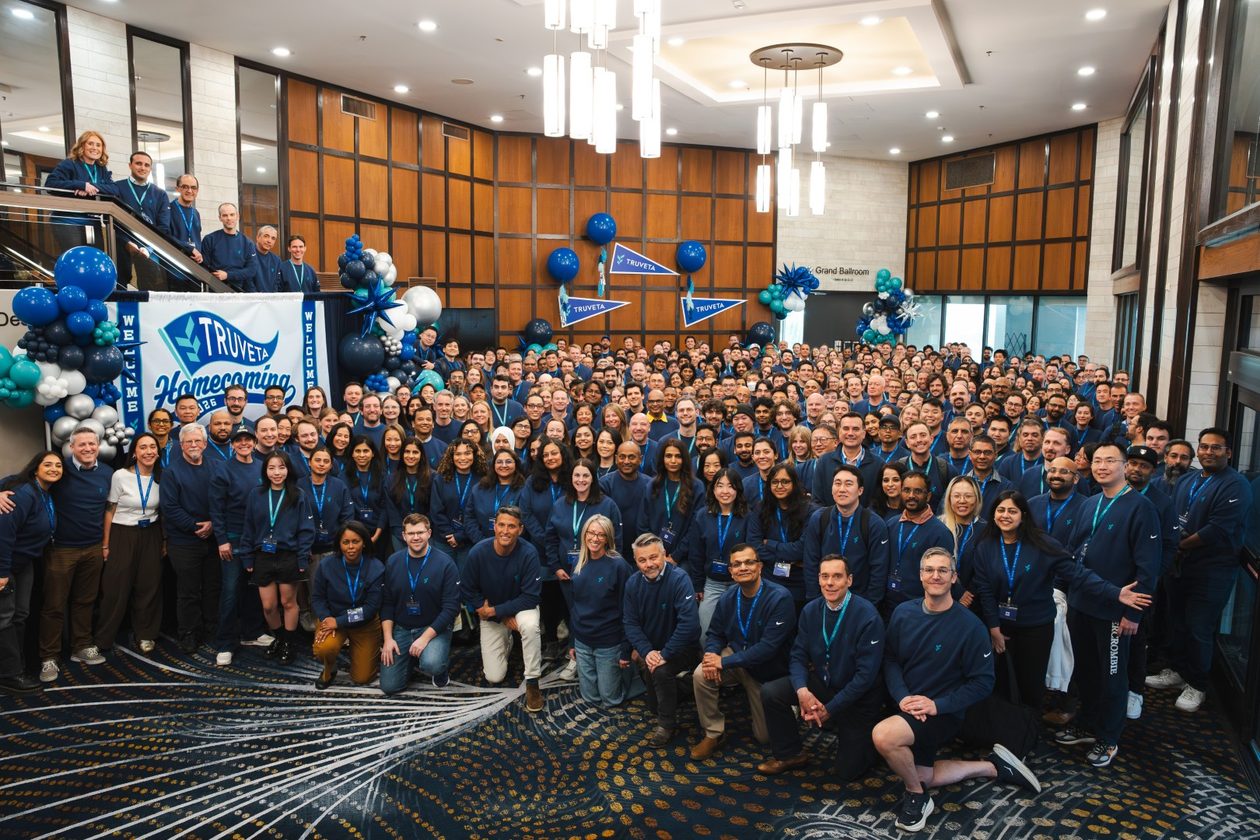
Truveta employees gather at the company’s all-company “Homecoming” meeting in April 2026. (Truveta Photo)
In a LinkedIn post announcing his retirement, Myerson noted that Truveta started “with an idea and no employees, no technology, no customers, and no data.” He wrote that what he’ll remember most are “the hundreds of Truvetans who took a chance on an ambitious idea and turned it into something real.”
Origins in the pandemic: Truveta grew out of a proposal from Providence, the Seattle-area nonprofit health system, for health systems to pool their data for research. Early in the pandemic, then-Providence CEO Rod Hochman called Myerson, who had left Microsoft in 2018 after leading its Windows and Devices Group, and asked him to build it.
GeekWire first reported on the startup in October 2020, and it launched publicly in February 2021 with 14 health systems.
Ahern was treating patients at NewYork-Presbyterian/Weill Cornell Medical Center in New York at the time. “We were giving out hydroxychloroquine, not knowing that it was actually harming patients,” he said. “It was the first time in my career that we were learning a new disease from scratch.”
Ahern was connected to Myerson through Madrona co-founder Jerry Grinstein, a former Delta Air Lines CEO and Ahern’s uncle by marriage. Myerson had joined the Seattle venture firm as a venture partner after leaving Microsoft.
Truveta says its data now covers more than 140 million patients. It published the first peer-reviewed real-world comparison of Ozempic and Mounjaro for weight loss, research that landed the company on the Today Show.
In 2025, Truveta raised $320 million in a round that included Regeneron and Illumina, bringing its total funding to $515 million. The round helped fund the Truveta Genome Project, which is sequencing leftover blood samples from consenting patients and linking the genetic data to de-identified medical records.
State of the business: Myerson declined to share revenue figures. He acknowledged that Truveta isn’t yet profitable but said it doesn’t need to raise more money. An IPO isn’t on the near-term horizon, he said, because Truveta’s revenue isn’t yet large enough for the public markets.
That leaves Nanduri, Ahern and the board with strategic decisions about which path to take over the long term. Myerson said the company has turned down offers, without elaborating.
“One of the problems with a business that’s doing well is you’ve got all those options,” he said.
“We’re blessed with a lot of options,” Ahern added.
Truveta co-founders Ryan Ahern, left, the company’s chief medical officer, and Jay Nanduri, CTO, will be interim co-CEOs. (Truveta Photos)
Dividing the job: Nanduri, a former Microsoft technical fellow, will continue to lead engineering, product and the data systems behind them. Ahern, a physician who remains on the University of Washington faculty part time, will run sales, marketing, customer delivery and the evidence services team that handles regulatory work for customers.
Nanduri described it as supply and demand. “Ryan takes care of demand,” he said. “I make sure that the supply and the ecosystem and everything thrives.”
The company is expanding beyond data into AI tools for research, including Truveta Intelligence, which launched in April and lets researchers ask questions of its clinical data in plain English. Ahern said a key challenge is showing that AI-generated answers can be trusted for high-stakes decisions such as drug safety and label expansion.
Nanduri said each of the companies behind the leading AI models is doing some health-related work, and “they have approached us too.” The board has discussed how Truveta can coexist with them, he said. The company also opened a development center in Hyderabad, India, in July, expanding its engineering organization.
Truveta’s next chapter: The leadership change follows a shift at the board level. In March, Henry Ford Health executive Robin Damschrodersucceeded Hochman as Truveta’s board chair after he retired from Providence and affiliated entities.
The company also added a new senior executive this year, hiring Johnathan Lancaster, an oncologist and former Regeneron executive, as president and chief scientific officer in January.
Asked whether the board changes played a role in his decision, Myerson praised both Hochman and Damschroder, describing her as a disciplined board chair, and said the transitions are all part of the company moving into its second chapter. When it comes to CEO succession, he said, the question is who will commit for the next five to seven years.
“It’s easier for me to say, gosh, Jay and Ryan have earned this,” he said. “Bet on them for the next five to seven years versus betting on me.”
Myerson’s competitive streak, well known from his Microsoft days, hasn’t faded.
Truveta is currently No. 3 on the GeekWire 200, our list of the top Pacific Northwest startups. Myerson once responded to a congratulatory note from GeekWire about the company’s status on the list with a link to a YouTube clip of the famous line from Talladega Nights: “If you ain’t first, you’re last.”
Even as he discussed his departure, Myerson made his case for the top spot, calling Truveta “an amazing Pacific Northwest success story” and noting that more than 200 of its 500 employees are in the Seattle area.
“It’s a Pacific Northwest story that’s having global influence,” he said, “and so I think it should be number one on the list.”
At this stage of his life, he didn’t rule out the possibility of a next professional chapter for himself. But asked about his immediate plans, he said he’s hoping for “a great ski year.”
— Silvia Candianihas been named corporate vice president of Worldwide Telco & Media within the Microsoft Frontier Company, a $2.5 billion initiative launched by the tech giant in July to embed engineers inside customers to build and run AI systems. In her new role, Candiani will lead Microsoft Frontier Company’s work with some of the largest telecommunications operators and media conglomerates.
“The momentum across our industry is extraordinary, and I believe we are only at the beginning of what AI can make possible,” said Candiani, who is based in Milan.
Before joining Microsoft in 2010 as a general manager, Candiani was a marketing director for Vodafone in Italy for more than a decade.
Kevin Frey. (LinkedIn Photo)
— Kevin Frey has been appointed vice president and chief impact officer of Microsoft Elevate, the company’s philanthropic effort providing technology support, donations, sales and AI training for educational organizations and nonprofits. Frey joined from UNICEF, where he was the first CEO of Generation Unlimited, the organization’s skills and employment initiative.
Frey said he was joining Microsoft because it’s “one of the only organizations in the world with the scale, scope and influence to bend the arc of the AI-powered future we are entering.”
“I will be spending my time and energy trying to ensure that the benefits of AI are shared broadly and safely across society — by every teacher, every student and every worker — regardless of their postal code,” he added.
— And while we’re on Microsoft, Anne Linge has been promoted to director of communications for commercial and consumer experiences after nearly 10 years with the company. She previously worked in communications at Weber Shandwick and Waggener Edstrom Worldwide, which has since rebranded as We.
Alexis Bateman. (LinkedIn Photo)
— Alexis Bateman has been promoted to director of global sustainability at Amazon Web Services after more than five years with the company. She was director of the MIT Center for Transportation & Logistics for 14 years before coming to Amazon.
Her work with AWS has given her the chance to help “shape sustainability at enormous scale,” Bateman said. “AI and cloud are transforming technology and society at an unprecedented pace, creating both enormous challenges and incredible opportunities for sustainability.”
Lynn Girotto. (LinkedIn Photo)
— Gradial has appointed Lynn Girottoas chief marketing officer. In June, the Seattle startup announced $65 million in new funding for its agentic AI platform that automates enterprise marketing. The company is No. 127 on the GeekWire 200, a ranked index of the Pacific Northwest’s top startups.
Girotto joins from Qualtrics, where she was CMO for two years. She has previously led marketing teams at companies including Vimeo, Tableau and Getty Images, and was a senior director at Microsoft for nine years earlier in her career.
“The best marketers I know want to build ideas and customer relationships, not manage processes,” Girotto said. “Gradial is the first company I’ve seen that’s built to give them that time back.”
Kam Ghaffarian. (LinkedIn Photo)
— A Seattle-area nonprofit group known as the Fermi Explorer Mission announced that Kam Ghaffarian has joined as co-founder. Earlier this month, the organization shared its plans to send a spacecraft on an 80,000-year trip to the nearest alien star system, Alpha Centauri.
Ghaffarian is a billionaire who helped launch companies including X-energy, Axiom and Intuitive Machines. “By committing to launching a spacecraft to Alpha Centauri by 2029, we are not just pushing the boundaries of current technology; we are inspiring a new generation to look up and dream of interstellar exploration,” Ghaffarian said.
Philip Johnston, co-founder and CEO of the Fermi Explorer Mission, also leads Redmond, Wash.-based Starcloud, a startup aiming to launch up to 88,000 satellites to serve as AI data centers.
Rachel Cougan. (LinkedIn Photo)
— Yoodli, the Seattle-based AI roleplay platform for enterprise training, has named Rachel Couganvice president of human resources. Cougan previously served as a fractional HR leader through her consultancy, Possible HR. Before that, she was VP of people for Logixboard and Hiya, and also served as VP of talent for Textio.
Yoodli, which launched in 2021, has grown to more than 100 employees. The company is No. 17 on the GeekWire 200.
Daniel Finney. (LinkedIn Photo)
— Kestra Medical Technologies has promoted Daniel Finney to vice president of research and development. The Kirkland, Wash.-based company sells cardiac monitoring and therapeutic devices. It raised $202 million in its IPO in March 2025 and was nominated for Deal of the Year at this year’s GeekWire Awards.
Finney has been with Kestra since 2019. CEO Brian Webster praised his role in developing the company’s FDA-approved monitoring device, adding that his “technical depth, product experience, and demonstrated leadership positions him to guide our next phase of innovation.”
Finney succeeds Phillip Foshee, Jr., who recently retired after leading Kestra’s R&D organization for nearly a decade.
— PATH has named Dr. Jeremy Farrar chief of its Asia, Middle East and Europe regional division. Farrar, a globally recognized leader in public health and clinical medicine, will join PATH effective Oct. 1 and be based in Geneva. His past roles include assistant director-general at the World Health Organization and director of the Wellcome Trust.
PATH CEO Nikolaj Gilbert praised the appointment, and noted that Farrar “possesses deep knowledge of the realities that prevent access, the people that make health care possible, and the need for PATH’s mission of ensuring breakthrough innovations reach all who need them.”
Emily Levesque. (AAS Photo)
— American Astronomical Society (AAS) announced that University of Washington scientist Emily Levesque is the next editor in chief of the AAS journals. She will succeed Ethan Vishniac, who is stepping down from the role at the end of summer 2027 after 12 years.
“In the writing and publishing landscape we’re facing today, sharing information has never been easier, but trusting information has never been harder — which makes the AAS journals’ combination of rigorous peer review and accessible science more valuable than ever,” Levesque said.
Levesque has been an assistant astronomy professor at the UW for 11 years. She leads the massive stars research group, which studies the evolution and death of the largest and “most extreme” stars in the universe.
— The Seattle Metropolitan Chamber has added eight members to its board of trustees:
Deniz Anders, Nordstrom’s executive vice president and chief marketing officer
Reuven Carlyle, founder of Earth Finance and former state senator
Carl Gipson, vice president of government and community affairs for Comcast
Trevor Gooby, executive vice president and chief operating officer for the Seattle Mariners
Daniel Huber, BNBuilders’ vice president of operations for the Northwest and Colorado
Frank X. Shaw addresses the media at Microsoft on May 18, 2025, in advance of the Build conference. (GeekWire Photo / Todd Bishop)
It’s the end of an era at Microsoft: Frank X. Shaw, the executive who oversaw the tech giant’s communications for nearly three decades, first at an external agency and for the last 17 years as one of its senior leaders, is leaving at the end of the year.
Shaw, 64, said he’s not retiring, although he doesn’t have another job lined up. He plans to stop working for a while, do some of the things he hasn’t had time for, and then decide what’s next.
“I have had a ringside seat at some of the biggest leadership, technology, and business transformations that have ever taken place,” Shaw said, sharing the news of his departure (under embargo) in a phone call Thursday afternoon. “I just feel incredibly fortunate.”
He said he had been discussing his potential departure for some time with Takeshi Numoto, Microsoft’s chief marketing officer, looking for the right moment.
Microsoft has not announced a successor for his role as chief communications officer. In a LinkedIn post, Shaw said the company will consider internal and external candidates.
A statement from Shaw’s colleagues in corporate communications credited him for his many years shaping Microsoft’s “voice and reputation with intelligence, candor and wit. His leadership and contributions to the company are too extensive to list, as is the number of journalists who have, at one point or another, used his name in vain.”
A former Marine Corps public affairs officer, Shaw has worked with all three of Microsoft’s CEOs. He started on the agency side, at Waggener Edstrom — now known as We. Communications — when Bill Gates was still running the company.
He built his reputation defending and advocating for Microsoft through some of its hardest stretches: the antitrust years, the Windows Vista backlash, the scramble to replace Steve Ballmer as CEO, and the weekend in 2023 when OpenAI’s board fired Sam Altman.
As the company’s top communications executive, he has also told the story of Microsoft’s reinvention under CEO Satya Nadella, from the LinkedIn and Activision Blizzard deals to an AI push that has carried Azure past $100 billion in annual revenue.
Evolving with technology: Shaw has spent much of his career closely watching the tech landscape and moving Microsoft’s voice into new channels as they emerged.
“We’re always thinking about what is the art and science of communications,” Shaw told PRWeek. “How do we reach our audiences most effectively in a changing environment?” He called the arc from print to radio and TV to social media and newsletters a “constant evolution of influence.”
He turned the corporate blog into a place where the company argued its own case, writing “Microsoft by the numbers” himself in 2010 — a stat-by-stat comparison against Apple and Google that TechCrunch dubbed “fantastic passive-aggressive.”
He and his team experimented with different and risky methods of telling the company’s story, holding mass briefings under embargo and publishing documents known as the “Book of News” in advance of its major keynotes and conferences. The prospect of a reporter having to answer to “fxs” was no doubt a factor in ensuring the news (mostly) didn’t leak.
Shaw hired Steve Clayton out of a technical role at Microsoft in London, where he had been blogging about the company unofficially out of frustration with how it was perceived, and made him chief storyteller. In the middle of the AI boom, Clayton and Shaw embraced the analog undercurrents in popular culture and launched Signal, a quarterly Microsoft print magazine for business leaders.
Clayton was VP of communications strategy by the time he left in January to become chief communications officer at Cisco, making Shaw’s planned departure the second high-profile exit from Microsoft’s comms team in a year.
Adapting to AI: In recent years, Shaw made his own team a testing ground for AI, publishing what worked and what didn’t. In a 2023 post he described using Copilot in Teams to pull story ideas out of conversations with spokespeople and anticipate coverage after interviews, and asking the AI to “poke holes in a statement we’re making on a tricky topic.”
He called it his corporal, a reference to Napoleon, who was said to bring one to meetings and ask whether his generals’ war plans made sense to him. A survey of 80 people in Microsoft’s communications and marketing organization found 84% did not want to go back to working without it.
Shaw was also known to use AI as a sounding board when a story frustrated him, offering him an objective take before he called and let a particular reporter have it.
He announced his departure Friday morning in a message to Microsoft’s communications team (reminding them he’s still there for a few months yet) and his public post on LinkedIn.
“Thank you as well to all the reporters, editors, writers, influencers and analysts who have put up with me over this time, enduring my early and late night calls, my off the record ‘no comments,’ my bad story ideas and my extended commentary on headlines and positioning,” he wrote.
“You all have incredibly hard and valuable jobs,” he added, “and while I’ve not agreed with everything said about us 😊 I appreciate you anyway.”

 Login