The U.S. Marine Corps’ Program Manager Light Armored Vehicles held what the service calls a Marine Touchpoint event last month for the Advanced Reconnaissance Vehicle, letting Light Armored Reconnaissance Marines get hands-on time with the new vehicle, including a test drive, months before the program reaches its next major design review. The Advanced Reconnaissance Vehicle, […]
Anchorage Adds Native TRX Staking For Institutional Custody Clients
Anchorage Digital has launched native TRX staking for institutional clients, giving investors a way to earn TRON network rewards directly from a regulated custody environment.
The service allows institutions holding TRX with Anchorage to participate in staking without moving assets out of custody. That detail matters because institutional investors often cannot interact with crypto networks the same way retail users do. They need custody controls, reporting, security processes, and compliance procedures before they can access staking yield.
For TRON, the integration adds another institutional layer to a network already known for high stablecoin transfer activity. For Anchorage, it expands the range of supported staking products inside its custody platform.
The move is not about guaranteed yield. Staking rewards depend on network conditions, validator performance, and other variables. But it does show that institutional staking access continues to broaden beyond Ethereum and Solana.
TL;DR
Anchorage Digital has launched native TRX staking for institutional custody clients.
Institutions can earn TRON staking rewards without moving assets out of Anchorage custody.
Reward rates are variable and should not be treated as guaranteed yield.
Why Custody-Based Staking Matters
Staking is easy to describe but harder to deliver for institutions.
A retail holder can often stake through a wallet or exchange with a few clicks. An institution has to think about custody risk, operational approvals, legal requirements, reporting, governance, tax treatment, and whether assets can be moved safely.
That is why native staking from custody is important.
It lets institutions participate in proof-of-stake networks without giving up the controls they need around asset storage. The assets remain inside a managed custody environment while the client still gains access to network rewards.
That model has become increasingly important as more institutions look beyond simple spot exposure.
Holding a token is one thing. Capturing network economics is another. For proof-of-stake assets, staking is part of the return profile, and custody platforms that support it can make the asset more attractive to professional investors.
TRON’s Institutional Story Is Different
TRON is often discussed through the lens of stablecoins.
The network has become one of the most active rails for USDT transfers, especially because transactions are relatively cheap and widely supported. That gives TRON a practical use case even among users who may not pay close attention to the underlying token.
TRX staking adds a different layer.
It connects institutional holders to the network’s consensus and reward structure rather than just its transfer activity. That can help position TRX as more than a gas or settlement token.
Still, the institutional case for TRON is not the same as the case for Ethereum.
Ethereum has broader DeFi, staking, and institutional infrastructure. Solana has a strong high-throughput and consumer-app narrative. TRON’s strength is settlement volume, stablecoins, and global payments-style usage.
Anchorage adding TRX staking suggests that institutions are interested in that network role enough to require custody-grade access.
Rewards Are Variable
The most important caveat is that staking rewards are not fixed.
TRX staking returns can change depending on network participation, validator dynamics, and broader protocol conditions. Clients also need to consider any custody or service fees, as well as operational requirements around staking and unstaking.
That is why this should not be framed as a guaranteed income product.
The better interpretation is that Anchorage is expanding institutional access to native network participation. The reward opportunity is part of the appeal, but the infrastructure is the main story.
For institutions, the ability to stake from custody reduces friction. It may also help satisfy internal risk controls because assets do not need to move into self-managed wallet setups or less familiar platforms.
That is often the difference between interest and actual allocation.
Staking Access Keeps Expanding
The launch fits a wider trend across crypto.
Institutions increasingly want more than passive exposure. They want yield where it is native to the network, but they want it through controlled, compliant channels. Custodians, fund providers, and staking infrastructure companies are responding by building more professional access points.
TRON joining that list through Anchorage gives the network another institutional support signal.
It does not mean TRX demand will automatically rise. It does not mean staking rewards will be large or stable. It does not mean every institution will want exposure to TRON.
But it does make the asset easier to integrate into professional custody workflows.
That matters because institutional adoption often depends less on headlines and more on plumbing. If assets can be held, reported, staked, and managed inside approved systems, they become easier to use.
For TRON, that is the significance of the Anchorage integration. It gives institutional holders a more direct route into network participation while keeping custody standards intact.
This article is based on Anchorage Digital’s TRX staking announcement.
This article was written by the News Desk and edited by Samuel Rae.
This report is based on information released by GlobeNewswire. at GlobeNewswire
Symbiosis Finance has launched private USDT swaps and transfers involving TRON, adding a privacy layer to one of the most widely used stablecoin networks in crypto.
The key detail is that this appears to be a dApp-level implementation rather than a native TRON protocol change. That distinction matters. TRON itself remains the underlying settlement network, while Symbiosis provides the routing and privacy-focused transfer experience around USDT movement.
The available documentation points to non-custodial MPC routing and Threshold Signature Schemes as part of the system. In practical terms, the feature is designed to reduce the visible link between sender and recipient wallets when users move or swap USDT across chains.
That immediately puts the story inside a larger debate: stablecoins are becoming more useful, but privacy features around dollar tokens can also draw regulatory attention.
Symbiosis Finance has launched private USDT swaps and transfers involving TRON.
The feature is implemented at the dApp layer rather than as a native TRON core update.
The launch highlights the tension between stablecoin privacy, usability, and regulatory scrutiny.
Why Private Stablecoin Transfers Matter
Stablecoins are one of the most practical parts of crypto, but they are not private by default.
On public blockchains, wallet activity can often be traced. Analysts can follow flows, label addresses, identify exchange deposits, and map transaction patterns. That transparency is useful for compliance and security, but it also creates privacy problems for normal users.
A person sending stablecoins may not want every payment linked publicly to a wallet history. A business may not want suppliers, customers, or competitors watching treasury movements. Traders may not want counterparties tracking flows between wallets and exchanges.
That is where privacy-focused transfer tools become attractive.
If users can move USDT without exposing obvious links between sender and recipient, stablecoins become more usable for certain legitimate cases. But the same privacy features can also raise concerns around sanctions evasion, money laundering, and illicit finance.
USDT on TRON is widely used because transactions are cheap and fast, and because exchanges and users around the world already support it. In many markets, TRON-based USDT is one of the most common ways to move dollar value on-chain.
Adding privacy tooling around that flow could be meaningful.
If the feature gains adoption, it may offer users a way to move stablecoins with more discretion. But because TRON is already so important to USDT movement, privacy layers around it may also attract extra scrutiny.
The stablecoin market is already under pressure from regulators who want issuers, exchanges, and service providers to enforce sanctions and compliance rules. Privacy tools complicate that environment.
The question is whether systems like Symbiosis can offer better user privacy without becoming a compliance red flag.
dApp-Level Privacy Is Different From Native Chain Privacy
The implementation detail matters.
If TRON itself had added native private transfers, that would be a major protocol-level shift. A dApp-level implementation is different. It means a third-party protocol is building privacy and routing features on top of existing networks.
That may make the tool more flexible, but it also means users need to understand what they are trusting.
Non-custodial MPC routing and Threshold Signature Schemes can reduce certain risks, but they do not automatically make a system risk-free. Users need to know how funds move, which contracts are involved, what happens if routing fails, and whether the privacy guarantees are strong or limited.
Privacy claims in crypto deserve careful reading.
A tool may hide the link between two wallets from casual observers while still leaving other metadata visible. It may protect one part of the transaction path but not another. It may depend on liquidity, routing behaviour, or user patterns.
That does not make the feature useless. It just means privacy should not be treated as magic.
Stablecoin Privacy Will Keep Getting More Important
The larger issue is that stablecoins are becoming financial infrastructure.
As stablecoin volume grows, more users will want privacy. At the same time, governments will want more visibility and control. That tension is not going away.
Cash has privacy. Bank transfers have compliance. Stablecoins sit somewhere between the two, and different users want different trade-offs.
Centralized stablecoin issuers can freeze funds and respond to law enforcement. Public blockchains make flows visible. Privacy tools try to restore discretion at the transaction layer. Each piece pulls the system in a different direction.
Symbiosis’ TRON-linked USDT feature lands right in the middle of that debate.
For crypto users, it may offer more flexible stablecoin movement. For regulators, it may raise questions about how privacy tools interact with sanctions and compliance obligations. For TRON, it reinforces the network’s role as a major stablecoin rail, even when the innovation comes from a third-party dApp.
The launch is worth watching because it shows where stablecoin infrastructure is heading: faster, more cross-chain, more user-friendly, and increasingly caught between privacy demand and regulatory pressure.
This article is based on Symbiosis Finance documentation and TRON network materials.
This article was written by the News Desk and edited by Samuel Rae.
This report is based on information released by Symbiosis Finance. at Symbiosis Finance
US sanctions have again put stablecoins at the centre of the enforcement debate after addresses linked to Iran were added to the Treasury Department’s sanctions list and $131 million in USDT was reportedly frozen on TRON.
The case is important because it cuts straight through one of crypto’s most uncomfortable tensions. Public blockchains are open and permissionless, but major dollar-backed stablecoins are issued by companies that can freeze tokens when required by law enforcement or sanctions authorities.
That means stablecoins can behave like crypto in one sense and regulated financial instruments in another.
For TRON, the story is especially relevant because the network has become one of the largest venues for USDT transfers globally. Low fees and wide exchange support have made it a major stablecoin rail. But that same usage also means enforcement actions on TRON addresses attract attention quickly.
OFAC added TRON wallet addresses linked to Iran to its sanctions list.
$131 million in USDT was reportedly frozen across designated wallets.
The case shows how stablecoin issuers can enforce sanctions even when assets move on public blockchains.
Stablecoins Are Not As Permissionless As They Look
Stablecoins are often used like crypto cash, but they are not the same as Bitcoin.
A token such as USDT may move on public blockchains, but it is still issued by a centralized company. That issuer manages reserves, redemption, compliance, and in many cases the ability to freeze or blacklist addresses.
That freeze function is controversial, but it is also one reason stablecoins have survived inside the regulated financial system.
Governments expect issuers to respond to sanctions, terrorism-financing concerns, stolen funds, and law-enforcement requests. Stablecoin companies that ignore those expectations risk losing banking relationships, licenses, and access to the broader financial system.
This creates a trade-off.
Users get dollar liquidity that moves quickly across blockchains. They also accept that the token is not fully censorship-resistant. If an issuer freezes an address, the blockchain may keep running, but the frozen tokens cannot move.
The Iranian wallet case makes that trade-off visible.
TRON’s Role In The Stablecoin Market
TRON has become a major stablecoin network because it is cheap, fast, and widely supported by exchanges.
For many users, especially outside the US, TRON-based USDT is a practical payment and transfer tool. It is often used for exchange deposits, peer-to-peer transfers, remittances, and dollar access in regions where banking rails are limited or expensive.
That utility is real.
But the same features that make TRON useful also make it a major surface area for compliance scrutiny. If large amounts of sanctioned funds, exchange flows, or high-risk wallets move through TRON, regulators will pay attention.
The Treasury action shows that public-chain activity can still become part of sanctions enforcement. Wallet addresses are visible, funds can be traced, and issuers can be pressured or required to act.
That does not make TRON unique. Similar issues exist across Ethereum, BNB Chain, Solana, and other networks. But TRON’s dominance in USDT transfers makes it one of the most important networks in this particular debate.
The Enforcement Message Is Clear
The key message from sanctions actions is that stablecoin rails are not outside government reach.
Even when funds sit on decentralized ledgers, the issuer layer can still become an enforcement chokepoint. That is especially true for dollar-backed stablecoins because issuers need banking access and regulatory credibility.
This is why stablecoins sit in a strange middle ground.
They are one of crypto’s most useful products, but they also bring crypto closer to traditional financial controls. They can make payments faster and more global, but they can also carry blacklist and freeze capabilities that are closer to bank compliance than Bitcoin-style neutrality.
For regulators, that is a feature. For some crypto users, it is a flaw.
The bigger question is whether this balance becomes more accepted as stablecoins grow. If stablecoins are to become mainstream payment and settlement tools, governments will expect compliance. If users want uncensorable assets, centralized stablecoins may not be the right instrument.
That distinction matters.
The TRON freeze is not just a story about one sanctions action. It is a reminder of how dollar-backed stablecoins actually work. They can move on-chain, but they remain tied to off-chain issuers and legal obligations.
As stablecoin adoption grows, that enforcement layer will become even more important.
This article is based on the US Treasury Department’s OFAC action and Tether transparency materials.
This article was written by the News Desk and edited by Samuel Rae.
This report is based on information released by US Treasury. at US Treasury
Microsoft may soon test Positron, a rumored Xbox feature that converts physical games into transferable digital licenses while preserving lending, resale, and ordinary disc access.
Tether has again shown how much control stablecoin issuers can exercise when sanctioned wallets enter the picture. Following an updated OFAC action, USDT connected to 131 TRON addresses was frozen, putting stablecoin compliance back at the center of the crypto policy debate.
The addresses were tied to a sanctions update involving crypto-linked funding networks. Chainalysis also published analysis of the action, noting the role of blockchain addresses in the enforcement trail.
For more details, visit the official OFAC platform.
TL;DR
USDT linked to 131 TRON wallets was frozen after an OFAC sanctions update.
The broader identifier list included 134 crypto addresses, including Monero addresses.
The action highlights how centralized stablecoin issuers can enforce blacklists directly at the token level.
Stablecoin Enforcement Is Getting More Direct
The freeze is a reminder that major stablecoins are not neutral bearer assets in the same way as native coins like Bitcoin. Issuers such as Tether can block specific addresses from moving tokens when those wallets appear on sanctions lists or are linked to criminal-finance investigations.
That ability is often controversial inside crypto, but it is also one reason stablecoins have remained usable at scale across regulated exchanges, payment firms, and trading venues. The trade-off is clear: stablecoins offer speed and liquidity, but the issuer still has a compliance lever.
TRON’s Role Comes From Stablecoin Volume
TRON has become one of the most active networks for stablecoin transfers, especially USDT. That makes it a natural place for enforcement actions to show up when sanctions lists include crypto addresses.
The key point is scope. This does not mean TRON itself is sanctioned, nor does it mean every USDT user on the network is affected. The action concerns specific addresses identified in the sanctions process. For market participants, the wider takeaway is that stablecoin rails are increasingly part of traditional financial enforcement, not sitting outside it.
The Trade-Off Behind Stablecoin Scale
USDT’s scale depends partly on its usefulness for fast dollar transfers. But the same scale means enforcement actions have market-wide visibility when an issuer freezes funds. Every blacklist update becomes a reminder that stablecoins sit between crypto infrastructure and the traditional financial system.
That is not necessarily bad for adoption. Institutions and payment firms often want assurance that issuers can respond to sanctions, hacks, and law-enforcement requests. Many crypto users, however, remain uncomfortable with the idea that an address can be blocked by issuer action.
The market is unlikely to resolve that tension soon. Stablecoins are too useful to ignore, and regulators are increasingly clear that issuers will be expected to police sanctioned activity where they can.
For traders, the market impact is usually indirect. Freezes like this do not necessarily move USDT’s peg or TRON’s price, but they do affect how exchanges, payment processors, and institutional desks think about stablecoin risk. Compliance capacity has become part of the product itself.
The cleaner takeaway is to treat this as a specific development inside Tether, not as a blanket prediction for the whole market. It gives readers a concrete data point to watch while keeping the limits of the story clear.
This report is based on information from OFAC’s SDN list materials and analysis from Chainalysis.
This article was written by the News Desk and edited by Samuel Rae.
This is not just another ticker-level move. It points to a deeper shift in how capital, infrastructure, or regulation is moving through crypto. TRON Sets Transaction and Active Address Records Driven by Stablecoin Settlements gives Bitcoinist readers a clean angle on Stablecoins at a point where the market is trying to separate durable signals from short-lived noise.
According to the source material reviewed for this report, the story turns on a few concrete details rather than vague sentiment. That matters because crypto headlines can move quickly, but the pieces that tend to last are the ones backed by filings, official releases, data dashboards, or protocol-level records.
TL;DR
The TRON network set new usage records in June, exceeding 385 million total transactions.
Total active wallet addresses on the network reached 26.9 million.
The growth was driven by high stablecoin settlement volume (OUSD/USDT).
What Changed
The immediate relevance is that this development fits into one of the market’s main themes for the day: institutional positioning, network usage, regulatory pressure, protocol development, or asset-specific rotation. In this case, the key topic is Stablecoins, which is why it deserves a dedicated read rather than being buried inside a broader market recap.
For traders, the useful part is not simply that the headline exists. It is the way the facts line up with the current market backdrop. When official sources, market data, or protocol records show a fresh shift, readers get a better sense of whether the move is just a one-day reaction or part of something more structural.
Why It Stands Out
The core source for this story is tronscan.org with supporting data from tronscan.org. That source trail is important because the final article should not rely on discovery-only media links or second-hand summaries.
The TRON network set new usage records in June, exceeding 385 million total transactions.
Total active wallet addresses on the network reached 26.9 million.
The growth was driven by high stablecoin settlement volume (OUSD/USDT).
The numerical claims in the pack were tied back to specific source material before writing. '385 million' sourced from Tronscan global network transaction charts (June 2026 totals); '26.9 million' sourced from Tronscan active address records (June 2026 totals)
What Comes Next
The caution is just as important as the headline. Do not claim TRX price has hit record highs; the records are for network transactions and addresses.
That means the cleaner read is to treat this as a confirmed development with a defined scope, not as proof of a guaranteed price move or a sweeping market shift. In crypto, the difference matters. A verified data point can strengthen a thesis, but it does not remove execution risk, liquidity risk, regulatory uncertainty, or the possibility that traders fade the initial reaction.
For now, the story gives the market another piece of evidence to weigh. If follow-up filings, dashboard updates, protocol records, or official statements confirm further momentum, the angle can develop into something larger. If not, it still stands as a useful snapshot of where activity is concentrating today.
Crypto markets have had plenty to digest today, and this development adds another layer to the picture. TRON Nile Testnet Deploys Quantum-Resistant Signature Cryptography gives Bitcoinist readers a clean angle on Stablecoins at a point where the market is trying to separate durable signals from short-lived noise.
According to the source material reviewed for this report, the story turns on a few concrete details rather than vague sentiment. That matters because crypto headlines can move quickly, but the pieces that tend to last are the ones backed by filings, official releases, data dashboards, or protocol-level records.
TL;DR
TRON Nile Testnet deployed a post-quantum signature upgrade.
The testnet deployment aims to secure the ledger against theoretical future decryption risks from quantum computing.
The upgrade represents a proactive step in Layer 1 security.
A Fresh Signal For The Market
The immediate relevance is that this development fits into one of the market’s main themes for the day: institutional positioning, network usage, regulatory pressure, protocol development, or asset-specific rotation. In this case, the key topic is Stablecoins, which is why it deserves a dedicated read rather than being buried inside a broader market recap.
For traders, the useful part is not simply that the headline exists. It is the way the facts line up with the current market backdrop. When official sources, market data, or protocol records show a fresh shift, readers get a better sense of whether the move is just a one-day reaction or part of something more structural.
The Numbers That Matter
The core source for this story is nileex.io with supporting data from github.com. That source trail is important because the final article should not rely on discovery-only media links or second-hand summaries.
TRON Nile Testnet deployed a post-quantum signature upgrade.
The testnet deployment aims to secure the ledger against theoretical future decryption risks from quantum computing.
The upgrade represents a proactive step in Layer 1 security.
The numerical claims in the pack were tied back to specific source material before writing. No key numbers mentioned.
The Important Caveat
For readers, the practical question is how much weight to give the update. A single source-backed development can be meaningful, but it should be read alongside liquidity, market structure, and any follow-up confirmation from the relevant issuer, protocol, regulator, or data provider. That is especially true in fast-moving crypto markets, where an official data point can be interpreted aggressively on social feeds before the underlying context has fully settled.
The caution is just as important as the headline. Clarify that it is active on the Nile testnet, not the main TRON mainnet.
That means the cleaner read is to treat this as a confirmed development with a defined scope, not as proof of a guaranteed price move or a sweeping market shift. In crypto, the difference matters. A verified data point can strengthen a thesis, but it does not remove execution risk, liquidity risk, regulatory uncertainty, or the possibility that traders fade the initial reaction.
For now, the story gives the market another piece of evidence to weigh. If follow-up filings, dashboard updates, protocol records, or official statements confirm further momentum, the angle can develop into something larger. If not, it still stands as a useful snapshot of where activity is concentrating today.
Many of us remember back in our school days taking tests and filling out answers on a Scantron sheet, those long rows of A, B, C, D, and E that had to be filled in with a #2 pencil. Ever wonder why it needed a #2 pencil, or what the point of using a Scantron was at all? That question is answered in the latest video from [SimonRetro], where he takes a look at the Scantron and how it works.
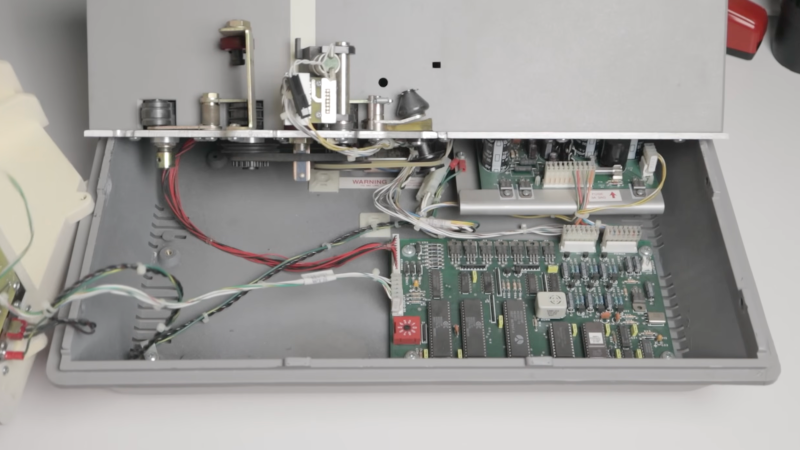
One of the more interesting things about the Scantron is that it’s such a standalone device. No software needed, no keypad to mess with just two rocker switches. The on/off switch is also the way you tell it to forget the last answer sheet and allow you to program in a new test. Upon booting, you feed in a Scantron sheet with some specific boxes filled in, and then it’s programmed and ready to take in and grade all the students’ answers. Opening up the Scantron reveals it’s pretty interesting inside: one control board with early-’90s-era chips. There’s also a lightbulb (no LEDs) shining through the six reading sections of the card, as well as an arrangement of belts and motors to move the card through the machine. The printer is a seven-pin printer used in conjunction with a pair of ink rollers to print out the results on the cards.
[SimonRetro] also went ahead and tried different ways to mark the sheets including pens, Sharpies, colored pencils, and different thicknesses of pencils besides the #2 to see which would and wouldn’t work in the Scantron. Thanks [SimonRetro] for exploring this machine from many of our childhoods and sharing its inner workings. Be sure to check out some of our other reverse engineering articles that explore how classic devices work.
There is a reason this one is worth separating from the usual market noise. Tether Freezes USDT in 131 TRON Wallets Under Updated OFAC Sanctions gives NewsBTC readers a clean angle on Stablecoins at a point where the market is trying to separate durable signals from short-lived noise.
According to the source material reviewed for this report, the story turns on a few concrete details rather than vague sentiment. That matters because crypto headlines can move quickly, but the pieces that tend to last are the ones backed by filings, official releases, data dashboards, or protocol-level records.
TL;DR
Tether froze all USDT held across 131 wallets on the TRON network.
The freeze was implemented in coordination with updated U.S. OFAC designations targeting a crypto-funding network linked to ISIS-K.
The action represents Tether's ongoing efforts to adhere to international compliance and enforcement standards.
The Bigger Picture
The immediate relevance is that this development fits into one of the market’s main themes for the day: institutional positioning, network usage, regulatory pressure, protocol development, or asset-specific rotation. In this case, the key topic is Stablecoins, which is why it deserves a dedicated read rather than being buried inside a broader market recap.
For traders, the useful part is not simply that the headline exists. It is the way the facts line up with the current market backdrop. When official sources, market data, or protocol records show a fresh shift, readers get a better sense of whether the move is just a one-day reaction or part of something more structural.
What The Source Material Shows
The core source for this story is ofac.treasury.gov with supporting data from chainalysis.com. That source trail is important because the final article should not rely on discovery-only media links or second-hand summaries.
Tether froze all USDT held across 131 wallets on the TRON network.
The freeze was implemented in coordination with updated U.S. OFAC designations targeting a crypto-funding network linked to ISIS-K.
The action represents Tether's ongoing efforts to adhere to international compliance and enforcement standards.
The numerical claims in the pack were tied back to specific source material before writing. '131 TRON wallets' sourced from U.S. Treasury OFAC SDN List Update published July 1, 2026; '134 addresses' sourced from U.S. Treasury OFAC SDN List Update total identifier count; '3 Monero addresses' sourced from U.S. Treasury OFAC SDN List Update privacy coins count
Where The Story Goes Next
The caution is just as important as the headline. Do not claim that TRON itself is sanctioned; only these specific address IDs are blocked.
That means the cleaner read is to treat this as a confirmed development with a defined scope, not as proof of a guaranteed price move or a sweeping market shift. In crypto, the difference matters. A verified data point can strengthen a thesis, but it does not remove execution risk, liquidity risk, regulatory uncertainty, or the possibility that traders fade the initial reaction.
For now, the story gives the market another piece of evidence to weigh. If follow-up filings, dashboard updates, protocol records, or official statements confirm further momentum, the angle can develop into something larger. If not, it still stands as a useful snapshot of where activity is concentrating today.

 Login
Login
 The U.S. Marine Corps’ Program Manager Light Armored Vehicles held what the service calls a Marine Touchpoint event last month for the Advanced Reconnaissance Vehicle, letting Light Armored Reconnaissance Marines get hands-on time with the new vehicle, including a test drive, months before the program reaches its next major design review. The Advanced Reconnaissance Vehicle, […]