Reading view

There are new articles available, click to refresh the page.

Opinion: It’s time for Seattle to believe in Seattle

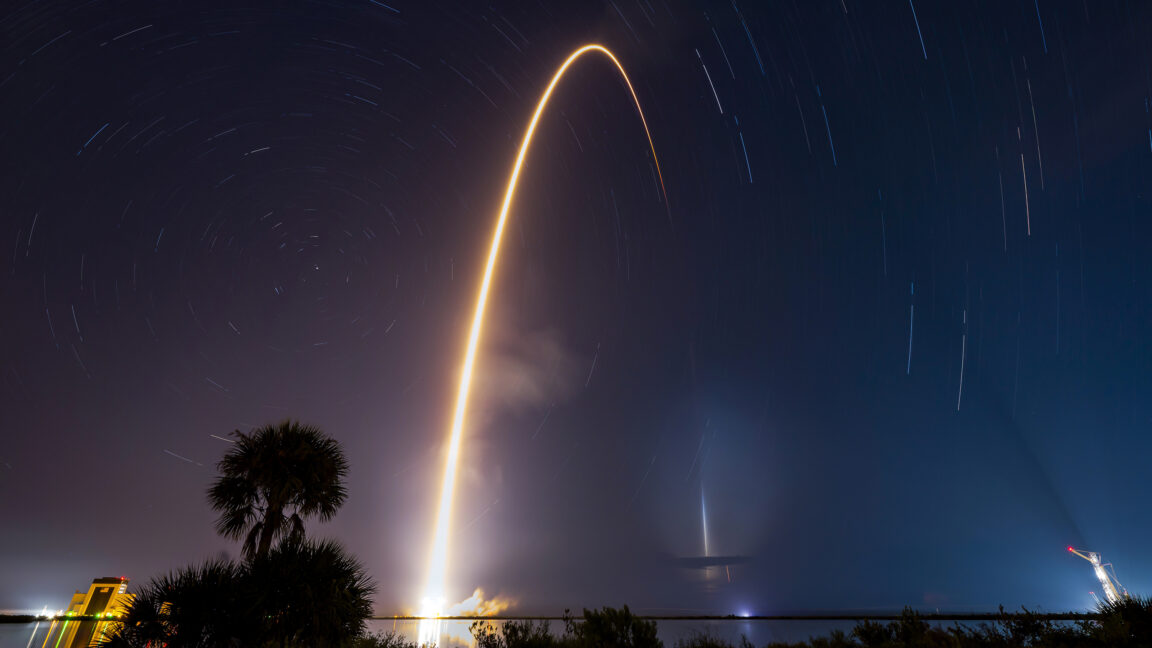
Seattle’s foundation as a hub of technology, science and innovation runs deep. Its confidence should, too. (GeekWire Photo / Kevin Lisota)

[Editor’s Note: Jacob Colker is co-founder and co-managing director of AI House.]

Seattle is one of the most talented, creative and inventive places in the world. But if we want the rest of the country to see us that way, we have to start acting like we believe it ourselves.

First, we need more pride around here.

Let’s talk about what it means to be proud. 

My mother grew up in Tarnów, Poland. She escaped communism and came to the United States in 1978 looking for a better life. She found one, built a family, and has lived in America for nearly 50 years. 

But my mom is still very, very Polish.

Several times a year, I get a message: “Jakub. Did you see this?”

I already know what’s coming. 

Some Polish person did something. A Polish athlete won something. A Polish scientist discovered something. Some guy with a Polish grandmother finished third in a regional Nebraska chess tournament. Doesn’t matter. Poland.

“Jakub. Look at this person.”

Okay, Mom. Who is she?

“POLISH.”

That’s it. That’s the story. 

And I love it, because Mom has this completely indestructible pride in where she comes from. Plenty of us know someone like this: a Greek mom, Vietnamese dad, Indian uncle or Nigerian aunt. Somebody from their corner of the world did something great, and you are going to hear about it.

There is power in that instinct. Not because your people are better, but because you believe your place matters.

Seattle could use more of that.

We are almost pathologically humble. Our response to notable achievements is often a polite nod before everybody gets back to our regularly scheduled Seattle freeze. 

That humility is working against us.

Second, Seattle is awesome and the evidence is everywhere.

I see Seattle’s potential every day working alongside dozens of entrepreneurs building startups. Some of the most ambitious and talented people in the world are already here.

We have many billion-dollar startups across the region and more than 200,000 people working across technology, science, space, health and startups. That is more than enough talent to build yet a dozen more unicorns. 

Nearly 40% of the world flies every day on airplanes built here. Blue Origin and SpaceX build rockets here. Starbucks, Amazon, Costco, REI and Nordstrom reshaped how the world shops. Microsoft helped put computing into our homes. AWS and Azure helped make the cloud the infrastructure of modern life. The University of Washington ranks among the world’s best. Seattle medical breakthroughs have helped save tens of millions of lives. We are pushing forward fusion energy, aerospace and maritime innovation. And let’s not forget: we just won the darn Super Bowl.

And so, so much more. 

So why, despite all the evidence, do we still seem to have a communal case of imposter syndrome?

This is not a city lacking accomplishments.

It is a city with a branding problem.

Third, we have let other people tell our story for far too long. This ends, today. 

Cities have brands whether they intend to or not. Silicon Valley is where ambitious people build companies. Nashville is music. Los Angeles for film and television.

Seattle’s cultural humility mostly assumes our accomplishments speak for themselves.

They don’t.

Reputation gets built one story at a time. You hear one story and it is interesting. You hear 10 and you notice a pattern. You hear 50 and your beliefs begin to change: That’s where important science happens. That’s where talented people live. That’s where I should invest, build or work.

Those beliefs shape real decisions about where people move, where companies get built and where investors put their money.

So to fix Seattle’s branding problem, here’s what we need to do.

Step 1: Let’s tell one clear story — Seattle’s talent pool is ridiculous. 

Seattle is where deep technical talent meets deep domain expertise to build consequential things: AI, aerospace, cloud computing, medicine, fusion, robotics, maritime technology and enterprise software.

We do not need 50 slogans. We do not need another consultant-led branding exercise. We need one simple idea that people outside this region can remember: Seattle’s talent pool is ridiculous.

There is a reason some of the world’s most important companies have built major engineering centers, research hubs and second headquarters here for decades. They come for the talent.

And that talent is why Seattle will not just participate in the future. We will lead in building it.

Step 2: Let’s use the megaphones we already have.

Seattle already has outlets (including this one) telling this story — publications, podcasts and social channels that document the region’s startups, breakthroughs and product launches. 

Every day, startups are raising money, scientists are making breakthroughs, companies are launching products, engineers are building technology and institutions are pushing this region forward.

That is not just tech news. That is the raw material of Seattle’s reputation. So let’s use it.

When you read or hear about a Seattle startup doing something remarkable, share it. When you see a story about a breakthrough at Fred Hutch or the University of Washington, send it to someone outside the region. When a local company raises money, lands a major customer or gets acquired, don’t just scroll past it. Amplify it.

Step 3: Let’s treat every local win as Seattle’s win.

When a local robotics company ships something remarkable, that is Seattle’s story.

When a maritime startup reinvents how ports operate, that is Seattle’s story.

When our AI research labs, or hometown heroes in Amazon and Microsoft, create breakthroughs, that is Seattle’s story. 

When a biotech company lands a major breakthrough, when a game studio creates a global hit, when a clean-energy company reaches a milestone, that is Seattle’s story.

Our companies, universities, hospitals, labs, investors, civic organizations and business leaders should act like an amplification network for one another. Stop treating somebody else’s success as somebody else’s news.

Their win is our collective proof.

Step 4: Let’s put Seattle on the label.

Founders need to say where they are building. “Made with ❤️in Seattle” should be on the bottom of every website. Put Seattle in the press release. Put it in the LinkedIn post. Mention it onstage. Say it in interviews. Tell investors. Tell customers. 

Silicon Valley companies have spent decades attaching their success to their geography. We should do the same. If you build something extraordinary here, make sure the world knows it was built here.

Step 5: Let’s do a better job of selling Seattle.

Every venture capitalist, founder, executive and civic leader in this region should be able to explain in 60 seconds why somebody should build a company here.

Not defend Seattle. Not apologize for Seattle. Sell Seattle. 

Reminder: It’s the talent. 

(And also cream cheese on hot dogs.)

When investors and founders from New York, Boston or San Francisco come to town, show them the region. Introduce them to engineers, researchers and entrepreneurs. Bring them into the community. Let them see what is happening. 

The best branding campaign is somebody getting on a plane home saying, I had no idea all of this was happening in Seattle.

If we’re going to succeed, we need to believe first.

Insert all the Ted Lasso jokes you want, but this stuff matters. 

There is no giant Seattle marketing department coming to save us. There is no national referee who will eventually review the evidence and declare that Seattle deserves more respect.

When somebody here does something extraordinary, act like it. Read the story. Share the post. Send the article to your team. Text it to your friend in New York. Put it in the group chat. Bring it up over dinner. Tell your kids.

Basically, become my Polish mother.

My mom doesn’t give a hoot that Kraków ranks No. 6 on some list or Warsaw is No. 8 on another. She doesn’t need a clickbait listicle to tell her Poland matters. She already believes it does.

We have to build our reputation ourselves. The good news is that we already have everything we need: extraordinary companies, world-class institutions, ambitious people, groundbreaking science and media documenting it all.

What we have been missing is the confidence to start being more loud. Stories become patterns, patterns become reputation, and reputation becomes gravity. 

Gravity is what creates influence and respect.

Pride is not something somebody else gives you. You don’t wait until the rest of the country decides your home is important. YOU decide it is. Then you act like it.

Let’s get to work. 
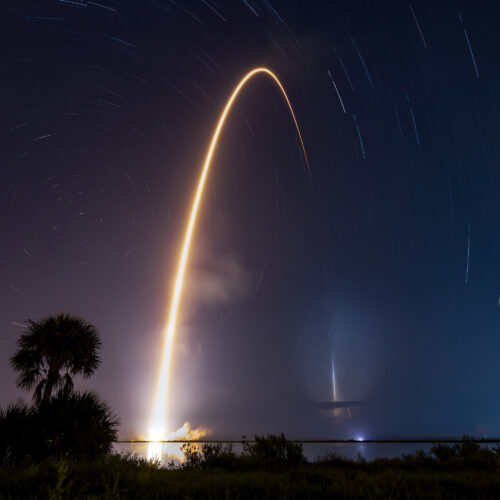
The world's busiest spaceport is about to get a lot quieter, at least for now

SpaceX made Florida's Space Coast home to the world's busiest spaceport for a decade, but that will change this year. The company is significantly cutting the number of launches from Florida until Starship arrives, a senior SpaceX official confirmed Tuesday.

The Falcon 9 rocket has been SpaceX's workhorse, routinely launching batches of satellites for the company's Starlink network, primarily from launch pads at Cape Canaveral Space Force Station and NASA's Kennedy Space Center in Florida. There were 165 Falcon 9 launches last year—about three flights per week—and about 75 percent of them carried Starlink satellites.

This year is different. SpaceX has launched more missions from its West Coast launch pad at Vandenberg Space Force Base in California since January, and this trend will amplify for the rest of the year.

Read full article

Comments

© SpaceX

SpaceX intends to invest up to $100 billion in massive Louisiana spaceport

Louisiana Gov. Jeff Landry said Tuesday that SpaceX will commit $100 billion to develop Starship factories and launch pads in the state's coastal areas. In doing so, the company seeks to replicate the Starbase facility it has built over the last decade in southern Texas on a larger scale.

The announcement capped months of speculation about SpaceX's interest in a sprawling parcel of land along the Gulf coast of Louisiana, which offers room to build multiple launch towers and offers access to the methane propellant that fuels the Starship rocket.

Gwynne Shotwell, the president and chief operating officer of SpaceX, said the "Starbase Louisiana" facility would become a self-sustaining spaceport with propellant production, power generation, deep-water shipping capabilities, vehicle processing facilities, and an airport on site.

Read full article

Comments

© SpaceX

Elon Musk’s Starlink swagger, SpaceX vs. the cloud giants, and Seattle’s tech universe revisited

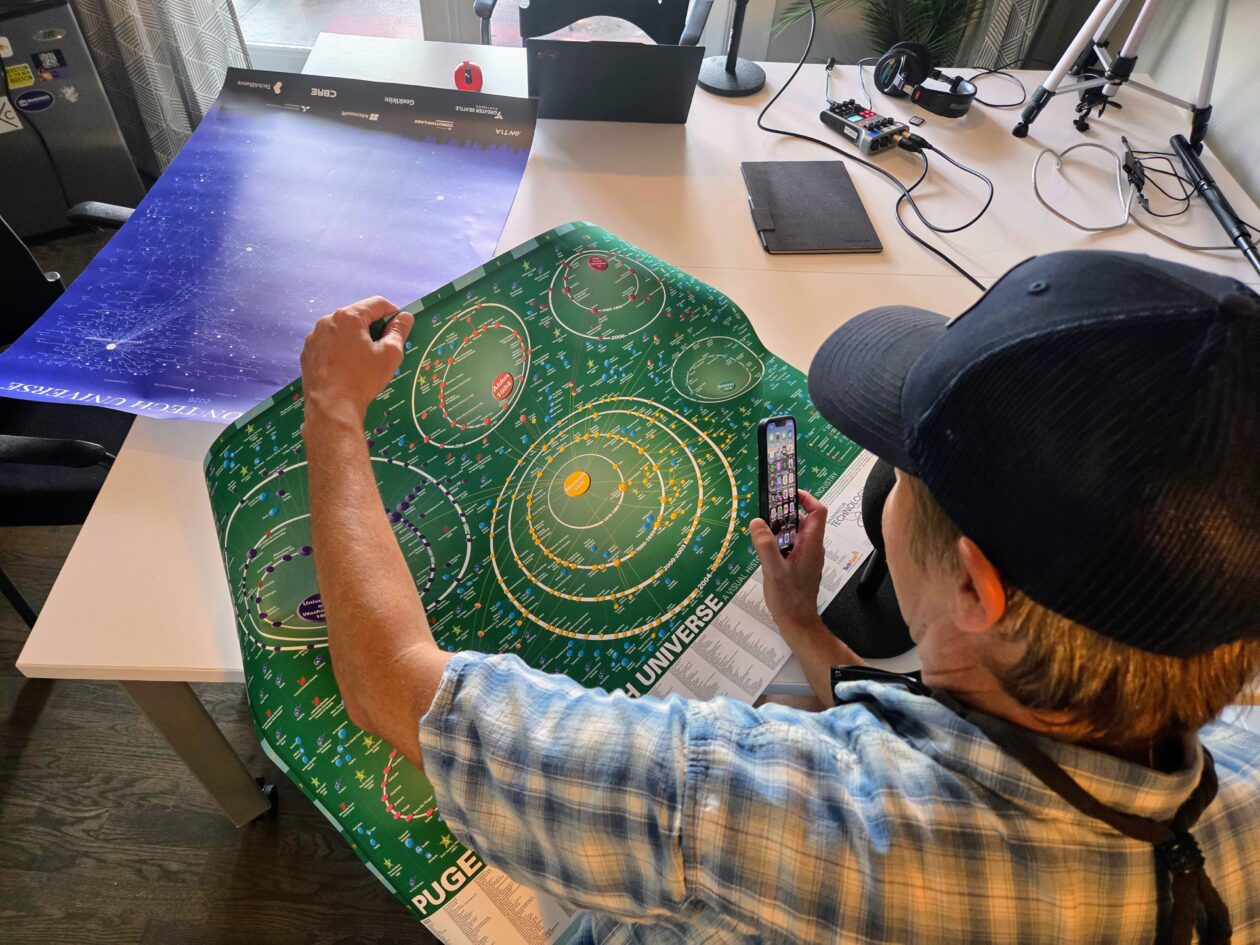
John Cook studies the 2009 Puget Sound Tech Universe map while recording this week’s GeekWire Podcast, with WTIA’s 2026 Washington Tech Universe map on the table behind him. (GeekWire Photo / Todd Bishop)

This week on the GeekWire podcast: SpaceX reports its first quarter as a public company, and Elon Musk says Starlink could deliver a majority of the world’s internet within a decade, leveraging production facilities in Redmond. Musk also explains the company’s data center ambitions, calling terrestrial infrastructure a trivial problem next to reusable rockets. 

Plus: we bring two Washington tech universe posters into the studio, 17 years apart. The 2009 original turns up gems including Boeing’s unlikely connection to Classmates.com, the 1990s forerunner to Facebook. It also brings back memories of Teledesic, the Craig McCaw venture backed by Bill Gates that tried to beam internet from space decades before Starlink.

Finally, the GeekWire Trivia Challenge returns with a timely question about Google’s origins.

Related stories and links

SpaceX’s first earnings call as a public company

Mapping Washington’s tech universe

GeekWire Trivia

Subscribe to GeekWire in Apple Podcasts, Spotify, or wherever you listen.

Audio edited and produced by Curt Milton.

SpaceX earnings: Elon Musk says Starlink could deliver most of the world’s internet within a decade

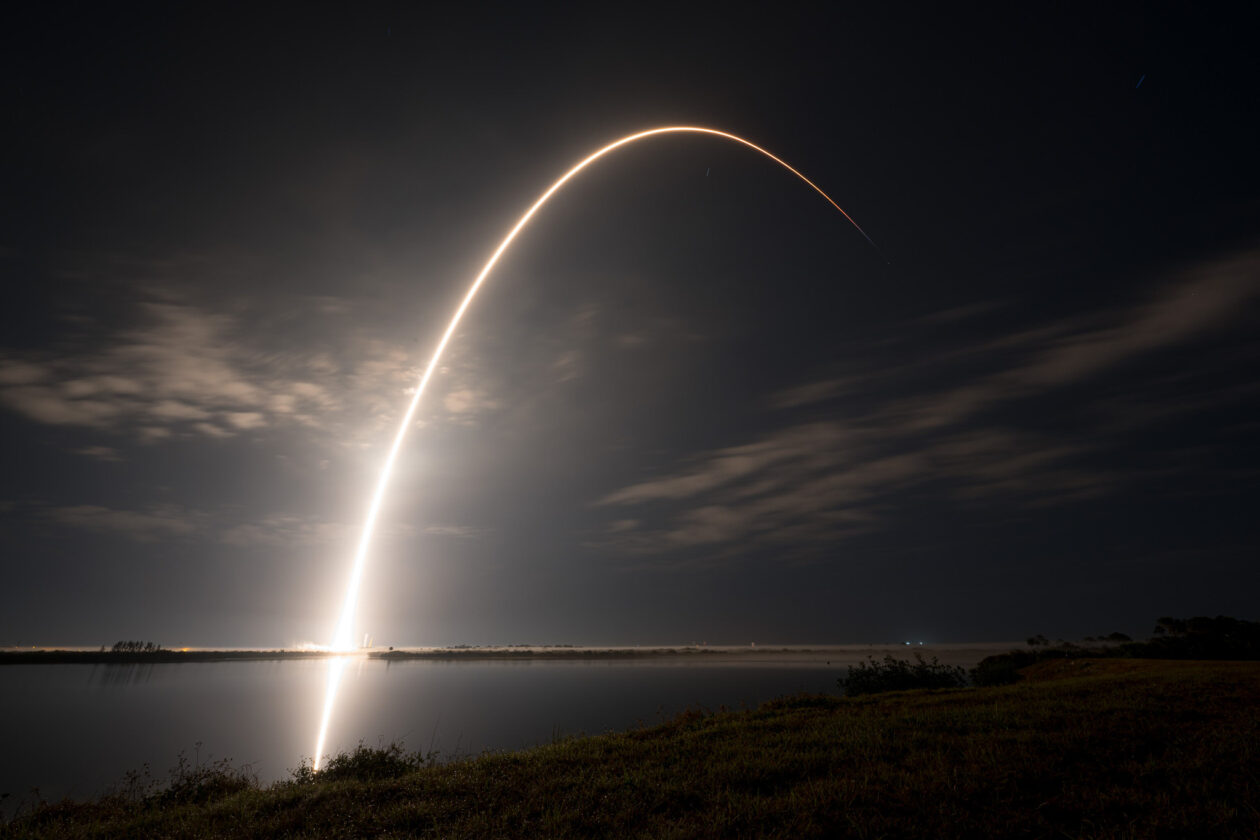
A Falcon 9 rocket arcs into the night sky during a February 2023 launch. Most of SpaceX’s launches carry Starlink satellites built at the company’s factory in Redmond, Wash. (SpaceX Photo, licensed under CC BY-NC 2.0)

The satellites rolling off the line in Redmond, Wash., are paying for Elon Musk’s AI ambitions — and he says the company’s satellite internet business is only getting started.

SpaceX’s Starlink connectivity division posted $1.7 billion in operating income for the second quarter, maintaining its status as the company’s only profitable business, according to numbers released Tuesday afternoon as part of its inaugural earnings report as a public company.

The AI division, built around the Grok model and the X social media and technology platform, lost $1.3 billion while spending $15.8 billion on capital projects. That capital spending amounted to more than three times Starlink’s quarterly revenue of $4.3 billion (up 66%).

Musk, the company’s founder and CEO, used the first SpaceX earnings call to make the case that investors are badly underestimating Starlink.

He said a new generation of satellites could increase Starlink revenue tenfold, and the network could deliver “a majority of the world’s internet” in less than 10 years. Musk said AI and robots will drive demand for bandwidth far beyond anything people generate on their own.

“I think Starlink is the only thing that can actually service that bandwidth,” he said.

Amazon is getting in the race, building its own satellite internet network at a factory in nearby Kirkland, Wash. Its Leo constellation has “close to 400 satellites in orbit, enough to begin initial satellite internet service this year,” CEO Andy Jassy told analysts last week.

Overall, SpaceX topped Wall Street expectations with revenue of $7.8 billion for the quarter, up 92% from $4.1 billion a year earlier. It also narrowed its net loss to $541 million from $1 billion.

SpaceX shares closed at $125.33, up 9.4% on the day, then fell nearly 5% in after-hours trading following the report, apparently on concerns about the company’s capital spending.

SpaceX builds its Starlink satellites at a Seattle-area factory that produced about 70 a week from December 2025 to April 2026, according to the company’s IPO filing. The output has put roughly 9,600 Starlink satellites in orbit, about 75% of all active maneuverable satellites circling the planet.

For the second quarter, SpaceX reported 12 million Starlink subscribers, double the number a year earlier and an increase of 1.7 million from the first quarter. The revenue increase in the Starlink division (officially known as “Connectivity”) was driven by a 108% jump in enterprise and government business, which now accounts for more than 40% of the segment’s sales.

The subscriber total was just under the 12.19 million Wall Street had projected, but the segment’s revenue exceeded expectations by about $460 million, more than any other part of the company.

Starlink now brings in $66 a month per subscriber, down from $85 a year ago as it expands overseas and adds cheaper plans. The good news for SpaceX: the figure stopped falling, holding flat from the first quarter, despite the company’s warning to IPO investors that it would keep sliding.

VC is changing dramatically — what’s a founder to do? 

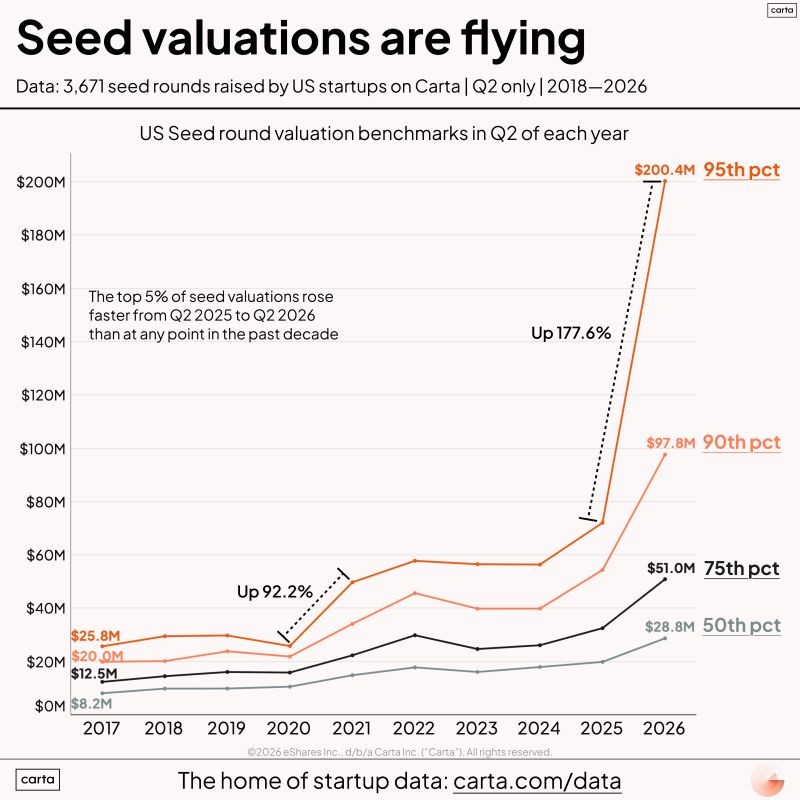
Click to enlarge. The top 5% of U.S. seed-round valuations reached $200.4 million in Q2 2026, up 177% from a year earlier, even as fewer companies were funded. (Chart: Peter Walker / Carta)

Guest Opinion: When I moved to Seattle in 2000 and started in venture capital, I read the book “The Silicon Boys: And Their Valley of Dreams,” which told the story of how venture capital drove the innovation ecosystem.

Entrepreneurs toiled day and night in their garages. Venture capitalists discovered these entrepreneurs, writing “small” checks for ownership and partnering side by side to build blue-chip companies. John Doerr of Kleiner Perkins alone backed Intuit, Netscape, Amazon, and Google. 

More than 25 years later, venture capital is going through a dramatic evolution, chasing once-in-a-lifetime IPOs like SpaceX, Anthropic and OpenAI. There is more venture capital available than ever before, and it is harder than ever for most founders to get funded, especially if you are not working on foundational AI. 

Today’s founders need to think hard about alternative financing and growth strategies, rather than relying on venture capital. But before we get to those solutions and ideas, here are just a few examples of what’s happening in the market.

Anthropic envy: The Wall Street Journal covers the story of Spark Capital’s Yasmin Razavi, a former McKinsey consultant who invested $75 million in Anthropic when much of Silicon Valley passed at a $4 billion valuation in 2023. That stake is now worth about $7 billion — nearly 100x in three years! Silicon Valley is now chasing this pattern. 

More money, fewer winners: In 2025, US venture firms deployed roughly $319 billion, according to the PitchBook-NVCA Venture Monitor. In the first half of 2026 alone, they put in $412.7 billion, more than all of 2025. Capital has never been more abundant. But according to Silicon Valley Bank, 33% of all US venture dollars went to the top 1% of companies by valuation, up from 12% in 2022. 

Seed valuations for the “right company” are at an all-time high. The bar for the next round is not a little higher. It is roughly double what it was a few years ago. 

Peter Walker from Carta tracks seed valuations over time showing that the top 5% of seed deals are up 177% year over year, rising from about $72 million to $200 million. Carta found that 30.6% of companies that raised a seed round in early 2018 reached a Series A within two years. For the 2022 cohort, that number fell to 15.4%. 

The practical takeaway for founders: The median revenue you now need to raise a Series A has roughly tripled, to about $3.5 million in ARR. 

VC for the select few: A company that would have raised easily a few years ago now can’t get funded at all. Reid Christian from CRV argues the way to raise now is to be “Legible to Capital.” Two kinds of startups are getting funded, he says: “stupidly obvious credentialed teams with a semblance of an idea” priced at $50-200M, and later-stage rounds that “don’t require any amount of thinking.” 

If the founders are the right demographic — “young, cracked, or repeat,” the right schools, “nepo, etc.” — capital finds them. Everyone else, he writes, is “just fighting pattern recognition in a lemming industry.” 

So what should a founder do?

Go for it and raise VC: If you are building the next OpenAI, go raise VC. Recruit the best team possible and swing for the fences. Make sure you execute and your growth rates match the high expectations for a 2026 VC-backed company. 

Heather Redman of Flying Fish Partners says companies “are getting pre-seed financed at ‘modest’ valuations and then going and executing like crazy to show dramatic growth … and raising great successive follow-on rounds.” 

Seattle’s Tin Can is a great example of a contrarian bet (landlines for kids) that is showing tremendous growth and follow-on VC funding success. 

Seek other sources of capital: Kirby Winfield of Ascend says, “If you don’t have reasonable confidence in hitting $3M-$5M ARR within 18-24 months of your first commercial contract you probably shouldn’t raise venture in 2026.” 

If that’s not you, that’s fine — it just means priced venture equity may be the wrong instrument. Other sources of capital to consider:

  • Angel funding: Individual angel investors write smaller checks, move faster, and don’t carry the same growth expectations or blocking rights as institutional VCs. A round assembled from angels lets you raise less, give up less ownership, and avoid the signaling trap where a lead investor’s follow-on decision dictates your next round. The tradeoff is more relationships to manage and less firepower behind you for follow-on financing — but you keep control of your own timeline.
  • Venture debt: For companies with revenue and real margins, venture debt extends runway without dilution. It’s a loan taken alongside or shortly after an equity round, repaid over time with interest. The catch: it usually assumes an equity sponsor standing behind you, and it’s debt that must be paid back, so it works best as a bridge to a clear milestone.
  • Revenue-based financing: This approach, which advances capital against your recurring revenue, is one of the fastest-growing categories in startup finance. If you have predictable revenue and real margins, you have more options than a priced equity round. Providers advance a multiple of your monthly recurring revenue and get repaid as a percentage of it. It’s built for exactly the company this market has stranded: too small for a mega-round, too healthy to need one.

Get profitable fast: The cheapest capital you will ever raise is your own revenue. The best founders are not thinking about VC or chasing the next investment milestone. They’re heads-down building their businesses. AI has made this easier than at any point in history. A small team that controls its own burn controls its own destiny. 

Aviel Ginzburg of Foundations and Founders’ Co-op offers this parting advice for founders: “Recognize that venture is just as confused as they are. We aren’t gatekeepers here, we’re getting disrupted.”

❌